

The United States has shut down its government three times in the last 12 months. That is more funding lapses in one year than the country saw across the whole of the 1990s.
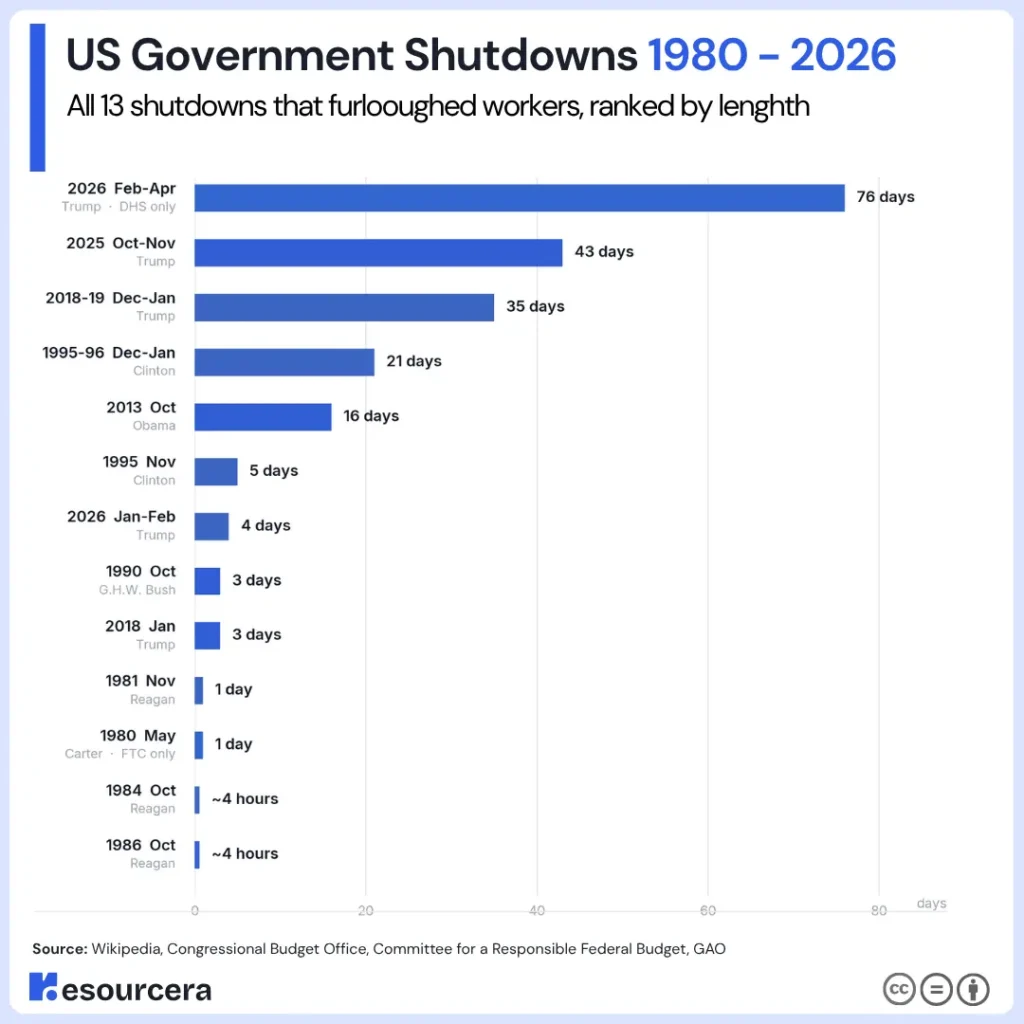
The record for the longest shutdown has also changed hands twice since October 2025. The 43-day shutdown that ended in November 2025 broke the old record. Then a 76-day shutdown of the Department of Homeland Security broke that one.
We have pulled together every important statistic on U.S. government shutdowns from 1980 through 2026, including duration, furlough counts, costs, and which president was in office each time.
Top Key Stats on U.S. Government Shutdowns
- The U.S. government has shut down 13 times since 1980 in ways that furloughed federal workers.
- The longest shutdown on record lasted 76 days. It hit the Department of Homeland Security only, running from February 14 to April 30, 2026.
- The longest governmentwide shutdown lasted 43 days, from October 1 to November 12, 2025.
- Federal workers went through 123 days of funding lapses between October 2025 and April 2026, spread across three separate shutdowns.
- The shortest shutdowns lasted about four hours each, in 1984 and 1986.
- The most federal workers furloughed in a single shutdown was roughly 900,000, during the 2025 shutdown.
- Donald Trump has presided over 5 of the 13 shutdowns, more than any other president. Ronald Reagan is second with three.
- The Congressional Budget Office put the permanent economic loss from the 2025 shutdown at about $11 billion.
- Current federal funding runs out on September 30, 2026, the end of fiscal year 2026.
How Many Times Has the U.S. Government Shut Down?
The U.S. government has shut down 13 times since 1980. That count includes only funding lapses that actually sent federal employees home. Short technical gaps that caused no disruption, like the nine-hour lapse in February 2018 and the 13-hour lapse in March 2024, are not counted.
The first was a one-day closure of the Federal Trade Commission in 1980. The most recent ended on April 30, 2026, when the House passed a Homeland Security funding bill and the president signed it the same day.
| Sr. No. | U.S. Shutdown Dates | Shutdown Duration | Scope | Serving President |
|---|---|---|---|---|
| 1 | 1980 | 1 day | FTC only | Jimmy Carter |
| 2 | 1981 | 1 day | Partial | Ronald Reagan |
| 3 | 1984 | ~4 hours | Partial | Ronald Reagan |
| 4 | 1986 | ~4 hours | Full | Ronald Reagan |
| 5 | 1990 | 3 days | Full | George H. W. Bush |
| 6 | 1995 (Nov) | 5 days | Partial | Bill Clinton |
| 7 | 1995–1996 | 21 days | Partial | Bill Clinton |
| 8 | 2013 | 16 days | Full | Barack Obama |
| 9 | 2018 (Jan) | 3 days | Full | Donald Trump |
| 10 | 2018–2019 | 35 days | Partial | Donald Trump |
| 11 | 2025 | 43 days | Full | Donald Trump |
| 12 | 2026 (Jan–Feb) | 4 days | Partial | Donald Trump |
| 13 | 2026 (Feb–Apr) | 76 days | DHS only | Donald Trump |
Longest and Shortest US Government Shutdowns
This is where most reporting gets muddled, so it is worth splitting the record in two.
The longest funding lapse of any kind is the 76-day Homeland Security shutdown of 2026. It beat the previous record on March 29, 2026. But it only closed one department, and roughly 90% of DHS staff kept working because their jobs were classed as essential.
The longest shutdown that closed the whole government is the 43-day shutdown of 2025. By almost every measure of scale, workers affected, agencies closed, economic damage, that one was bigger.
| Rank | Shutdown | Days | Scope |
|---|---|---|---|
| 1 | Feb–Apr 2026 | 76 | DHS only |
| 2 | Oct–Nov 2025 | 43 | Full government |
| 3 | Dec 2018–Jan 2019 | 35 | Partial |
| 4 | Dec 1995–Jan 1996 | 21 | Partial |
| 5 | Oct 2013 | 16 | Full government |
At the other end, the two shortest shutdowns both happened under Reagan. The October 1984 and October 1986 lapses each lasted around four hours, long enough to trigger furlough paperwork for about 500,000 workers and nothing much else.
U.S. Government Shutdowns by President
Five of the six presidents in office since 1980 have had at least one shutdown. Trump accounts for 5 of the 13, and for 161 of the 208 total shutdown days on record.
| President | Shutdowns | Total Days | Years |
|---|---|---|---|
| Donald Trump | 5 | 161 | 2018, 2018–19, 2025, 2026 (x2) |
| Ronald Reagan | 3 | ~1 | 1981, 1984, 1986 |
| Bill Clinton | 2 | 26 | 1995, 1995–96 |
| Barack Obama | 1 | 16 | 2013 |
| George H. W. Bush | 1 | 3 | 1990 |
| Jimmy Carter | 1 | 1 | 1980 |
George W. Bush, Joe Biden, and George H. W. Bush’s predecessors saw no shutdowns during their terms. Reagan’s three add up to roughly one day in total, since two of them were four-hour lapses.
What Is the Impact of a U.S. Government Shutdown?
Add up the furlough counts from every shutdown since 1980 and you get roughly 5.1 million. That is a count of furlough events, not unique people. Many of the same workers were furloughed in 2013, 2018, 2025, and 2026.
The same applies to cost. Summing the published cost estimates from 1980 through 2019 gives about $7.7 billion, but those figures were calculated in different ways and in different dollars. Some measure back pay. Others measure lost economic output. They are not really addable.
The cleaner numbers come from the Congressional Budget Office, which uses a consistent method:
- The 2018–19 shutdown cut GDP by $11 billion, of which $3 billion was never recovered.
- The 2025 shutdown caused a permanent loss of $7 billion to $14 billion, with $11 billion the most cited midpoint. It also cut annualized fourth-quarter GDP growth by 1 to 2 percentage points.
- The 2013 shutdown shaved at least 0.6% off annualized fourth-quarter GDP growth, according to Standard & Poor’s.
Most of the damage reverses once funding returns. Workers get back pay, agencies catch up on delayed purchases, and GDP rebounds the following quarter. What does not come back is the work that never got done. Lost hours cannot be re-lived.
The 2026 DHS shutdown showed a different kind of damage. Over 1,110 TSA officers quit during those 76 days, out of a workforce of about 50,000. Callout rates at some airports hit 55%. Houston’s George Bush Intercontinental ran security wait times near four hours with only two of eight checkpoints open. Staff you lose during a shutdown do not come back when it ends.
Beyond the economy, shutdowns close national parks and federally run museums, stall regulatory approvals, delay immigration hearings, and pause research. Essential services keep running. The military, air traffic control, federal law enforcement, and border security all stay on duty, though often without pay until the lapse ends.
U.S. Government Shutdown Statistics by Year
Here is every shutdown since 1980, with the cause, the duration, how many workers were sent home, and what it cost. Figures are drawn from GAO, CBO, CRS, and OMB reporting where available.
1980
The first official federal shutdown happened after the Federal Trade Commission’s funding lapsed. It was triggered by a new reading of the Antideficiency Act from Attorney General Benjamin Civiletti, which said agencies had to stop work during funding gaps. Before that opinion, agencies simply kept going.
- Duration: 1 day
- Agencies Affected: FTC
- Employees Furloughed: 1,600
- Estimated Cost: $700,000
- President: Jimmy Carter
- Senate Majority: Democratic (58–41–1)
- House Majority: Democratic (277–157–1)
1981
President Ronald Reagan vetoed a continuing resolution because he wanted deeper cuts to domestic spending. This was the first shutdown to hit most of the executive branch rather than a single agency.
- Duration: 1 day
- Agencies Affected: All except the Legislative Branch
- Employees Furloughed: 241,000
- Estimated Cost: $80–90 million
- President: Ronald Reagan
- Senate Majority: Republican (53–46–1)
- House Majority: Democratic (242–192–1)
1984
A four-hour lapse caused by last-minute fights over a water projects package and a civil rights measure. Congress dropped both and added funding for the Nicaraguan Contras to get the bill through. About half a million workers were technically furloughed.
- Duration: ~4 hours
- Agencies Affected: Some
- Employees Furloughed: 500,000
- Estimated Cost: $65 million
- President: Ronald Reagan
- Senate Majority: Republican (55–45)
- House Majority: Democratic (269–165–1)
1986
Another four-hour lapse, this one used to push Congress toward agreeing on a full-year omnibus spending bill. It ended the same afternoon once the bill passed.
- Duration: ~4 hours
- Agencies Affected: All
- Employees Furloughed: 500,000
- Estimated Cost: $62.2 million
- President: Ronald Reagan
- Senate Majority: Republican (53–47)
- House Majority: Democratic (253–181–1)
1990
This three-day shutdown came out of President George H. W. Bush’s decision to break his “no new taxes” pledge and work with Democrats on deficit reduction. Conservative Republicans revolted. The lapse fell over Columbus Day weekend, which kept the damage small.
- Duration: 3 days
- Agencies Affected: All
- Employees Furloughed: 2,800
- Estimated Cost: $2.57 million
- President: George H. W. Bush
- Senate Majority: Democratic (55–45)
- House Majority: Democratic (267–167–1)
1995 (Nov)
The first of two shutdowns in the Clinton era standoff. It came from a fight between President Clinton and the Republican-controlled Congress over proposed cuts to Medicare, education, and environmental programs.
- Duration: 5 days
- Agencies Affected: Some
- Employees Furloughed: 800,000
- Estimated Cost: $400 million
- President: Bill Clinton
- Senate Majority: Republican (53–47)
- House Majority: Republican (232–202–1)
1995–1996
The second round of the same fight, and a record at the time at 21 days. Fewer departments closed, so the furlough count was lower than in November. It ended with a balanced budget deal in January 1996. The political fallout badly damaged Speaker Newt Gingrich and helped Clinton win re-election.
- Duration: 21 days
- Agencies Affected: Some
- Employees Furloughed: 284,000
- Estimated Cost: Not published
- President: Bill Clinton
- Senate Majority: Republican (53–47)
- House Majority: Republican (232–202–1)
2013
Triggered by House Republicans trying to defund or delay the Affordable Care Act. The standoff ran 16 days and closed the entire federal government. Around 800,000 workers were furloughed and another 1.3 million worked with no known payment date.
- Duration: 16 days
- Agencies Affected: All
- Employees Furloughed: 800,000
- Estimated Cost: $2.5 billion in pay and benefits for hours not worked (OMB)
- President: Barack Obama
- Senate Majority: Democratic (53–45–2)
- House Majority: Republican (234–201)
2018 (Jan)
A short shutdown centered on immigration, specifically DACA recipients. Democrats filibustered a funding extension to force negotiations. It ended after three days when they agreed to reopen the government in exchange for fresh talks.
- Duration: 3 days
- Agencies Affected: All
- Employees Furloughed: 692,900
- Estimated Cost: Not published
- President: Donald Trump
- Senate Majority: Republican (51–47–2)
- House Majority: Republican (241–194)
2018–2019
At 35 days, this held the record for nearly seven years. It was driven by President Trump’s demand for $5.7 billion in border wall funding. Around 380,000 workers were furloughed and another 420,000 worked unpaid. Air traffic controller absences caused flight delays that a White House source later called a catalyst for ending it.
- Duration: 35 days
- Agencies Affected: Some
- Employees Furloughed: 380,000
- Estimated Cost: ~$5 billion to the government; $11 billion in lost GDP, $3 billion never recovered (CBO)
- President: Donald Trump
- Senate Majority: Republican (51–47–2 → 53–45–2)
- House Majority: Republican → Democratic (235–199)
2025
The longest governmentwide shutdown in U.S. history, running 43 days from October 1 to November 12, 2025. Senate Democrats blocked the House-passed continuing resolution because it did not extend enhanced Affordable Care Act subsidies set to expire on December 31. The same bill failed 14 times before a deal came together.
SNAP nearly ran dry. USDA warned that about 42 million Americans could lose food assistance in November, and told states to hold off issuing benefits. Air travel buckled as controller absences mounted, with more than 16,700 delays and 2,282 cancellations over a single weekend. The FAA ordered flight reductions at 40 airports.
- Duration: 43 days
- Agencies Affected: All
- Employees Furloughed: ~900,000 (about 750,000 per day)
- Estimated Cost: $7–14 billion permanently lost, ~$11 billion midpoint (CBO)
- President: Donald Trump
- Senate Majority: Republican (53–45–2)
- House Majority: Republican (219–213)
2026 (Jan–Feb)
The November 2025 deal only funded the government through January 30, 2026. Congress got close to a full-year package, then CBP agents killed Alex Pretti on January 24 and Senate Democrats pulled support for the Homeland Security bill.
A compromise passed the Senate 71–29 on January 30, funding five departments for the year plus a two-week stopgap for DHS. The House could not vote in time under its 72-hour rule, so about half the government shut down anyway for four days. It reopened on February 3.
- Duration: 4 days
- Agencies Affected: About half, including State, Treasury, Defense, Transportation, HUD, HHS, Labor, Education, and DHS
- Employees Furloughed: Total not published. FAA furloughed ~10,500 and the State Department ~8,000 of its 27,000 direct hires.
- Estimated Cost: Not published
- President: Donald Trump
- Senate Majority: Republican (53–45–2)
- House Majority: Republican (218–214)
2026 (Feb–Apr)
The two-week DHS stopgap ran out on February 14 with no deal on immigration enforcement reforms. What followed became the longest funding lapse in U.S. history at 76 days.
Democrats wanted enforcement conditions attached to DHS funding, including judicial warrants before entering private property, body cameras and visible ID for agents, and limits on operations near schools and hospitals. Republicans called the list excessive. Both sides blocked the other’s reopening bills repeatedly. Senate Democrats blocked seven Republican stopgaps. Republicans blocked all five Democratic proposals.
The odd part is that this shutdown barely touched immigration enforcement. ICE and Border Patrol kept getting paid from the One Big Beautiful Bill Act, so the agencies at the center of the fight were the least affected. TSA took the hit instead.
It ended on April 30 when the House passed the Senate bill on a voice vote. The final measure funded most of DHS but left out ICE and Border Security Operations, which Congress funded separately through a reconciliation bill signed on June 10, 2026.
- Duration: 76 days
- Agencies Affected: Department of Homeland Security only
- Employees Furloughed: ~22,900 of 271,927. The other ~249,000 kept working, most without immediate pay.
- Estimated Cost: Not published
- President: Donald Trump
- Senate Majority: Republican (53–45–2)
- House Majority: Republican (218–214)
Is the U.S. Government Shut Down Right Now?
No. The federal government is fully funded as of July 2026. The last shutdown ended on April 30, 2026, when the Homeland Security appropriations bill was signed.
The next deadline is September 30, 2026, the last day of fiscal year 2026. If Congress has not passed the 12 fiscal year 2027 appropriations bills or a continuing resolution by then, agencies start shutting down on October 1.
Progress so far has been slow. As of early July, the House had passed 2 of the 12 required bills and the Senate had passed none. A stopgap is the likely outcome. Congress has not passed all 12 bills on time since fiscal year 1997.
Sources: Wikipedia, Congressional Budget Office, Committee for a Responsible Federal Budget, GAO
When Does a U.S. Government Shutdown Happen?
A government shutdown happens when Congress and the President fail to pass legislation funding federal agencies. Without legal authority to spend, agencies must stop or scale back operations.
The U.S. follows a budget process set in 1974 that took effect in 1976. The President sends a budget proposal to Congress. Congress prepares a budget resolution setting the overall spending plan. Then Congress must pass 12 appropriation bills giving departments legal permission to spend.
The federal financial year starts on October 1. All 12 bills, or a temporary continuing resolution, must be enacted by then. If not, spending authority runs out.
The Antideficiency Act says agencies cannot spend money without approval. Before the 1980s, funding gaps did not usually cause shutdowns. Agencies kept working on the assumption that funding would arrive. In 1980, Attorney General Benjamin Civiletti ruled that this was illegal. A follow-up opinion in 1981 created the “life and property exception” that decides who keeps working during a lapse.
One detail worth knowing: a shutdown does not have to be all or nothing. If Congress has passed some of the 12 bills, only the unfunded departments close. That is how a shutdown can hit one department for 76 days while the rest of the government runs normally.

