

People search for information very differently today than they did in the past, largely because artificial intelligence has transformed how search engines work. The journey began in 1990 with Archie, the first search engine built to search internet files. Soon after, Yahoo! and Google changed online search completely, setting the foundation for how people find information today.
Google now dominates the global search engine market with a 89.82% share, while competitors such as Bing, Yandex, Yahoo!, and DuckDuckGo trail far behind. Google’s lead grows even stronger in specific countries. India records the highest Google market share at 97.18%, while the United States stands at about 85.05%.
In this article, we explore search engine market share in depth. We also break down performance by device, country, and region, and examine the rise of AI-powered search engines and how they compete in today’s search landscape.
Key Search Engines by Market Share in 2026 (Editor’s Pick)
- Google leads the search engine market globally, with a 89.82% market share across all devices.
- Bing ranks second with 4.31% share worldwide.
- There is an 85.73 percentage-point gap between Google and Bing globally.
- Although it’s the leader, Google’s global market share in the search engine industry has decreased by 2.54% from 2022 to 2026.
- Around 4 in 10 Millennials say they are likely to use an AI-powered search engine.
Global Search Engine Market Share (Across All Devices)
As of 2026, Google dominates the global search engine industry with 89.82% market share. Microsoft Bing and Russia’s Yandex follow, with 4.31% and 1.84% respectively.
Yahoo! and DuckDuckGo rank 4th and 5th in the list, with 1.45% and 0.89%, respectively.
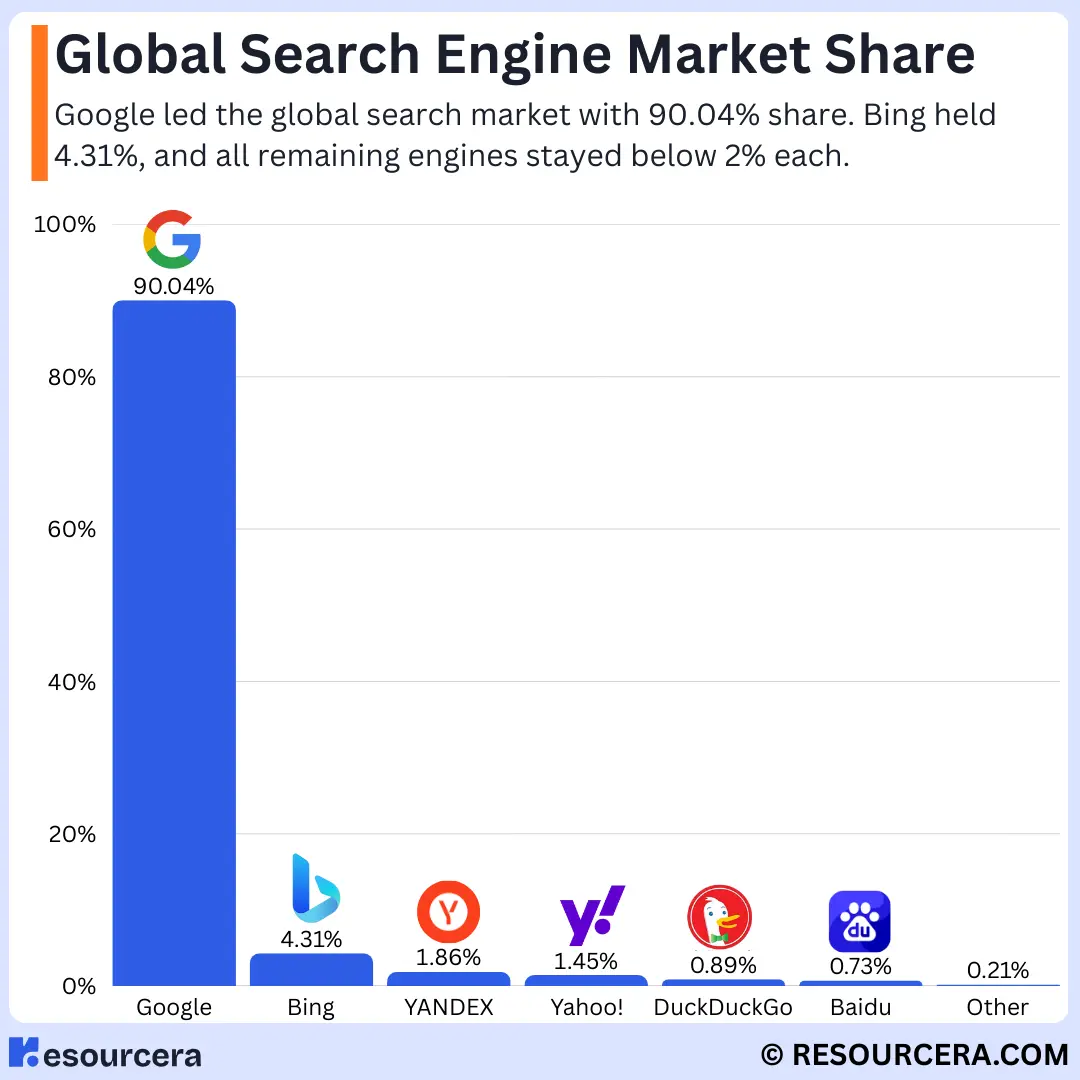
The table below shows the global market share of all popular search engines in 2026:
| Search Engines | October 2025 | October 2024 | Y-o-Y % change |
|---|---|---|---|
| 89.82% | 89.34% | + 0.78% | |
| bing | 4.31% | 4.16% | + 3.61% |
| YANDEX | 1.86% | 2.78% | – 33.09% |
| Yahoo! | 1.45% | 1.33% | + 9.02% |
| DuckDuckGo | 0.89% | 0.69% | + 28.99% |
| Baidu | 0.73% | 0.82% | – 10.98% |
| Naver | 0.21% | 0.35% | – 40.00% |
| CocCoc | 0.11% | 0.15% | – 26.67% |
| Haosou | 0.08% | 0.09% | – 11.11% |
| Ecosia | 0.15% | 0.11% | + 36.36% |
| Seznam | 0.04% | 0.03% | + 33.33% |
| Sogou | 0.02% | 0.03% | – 33.33% |
| Qwant | 0.03% | 0.02% | +50.00% |
| AOL | 0.02% | 0.02% | 0.00% |
| Shenma | 0.01% | 0.02% | – 50.00% |
| Petal Search | 0.01% | 0.01% | 0.00% |
| Other | 0.04% | 0.04% | 0.00% |
Search Engine Market Share Worldwide For Desktops
With 82.38% market share, Google dominates the global desktop search engine market, reflecting its continued leadership driven by strong algorithm relevance, widespread Chrome usage, and deep integration across digital platforms.
Google is followed by Microsoft Bing and Yahoo!, with 10.29% and 2.65% market share, respectively. This distribution shows that while Google dominates, Bing and Yahoo! continue to hold steady positions in the global search landscape. They remain popular alternatives for users worldwide.
The table below shows a deep analysis of the desktop search engine market share globally:
| Search Engines | Market Share on Desktop |
|---|---|
| 82.38% | |
| Bing | 10.29% |
| Yahoo! | 2.65% |
| YANDEX | 2.44% |
| DuckDuckGo | 0.95% |
| Baidu | 0.43% |
Search Engine Market Share Worldwide For Tablets
Google leads the global tablet search engine market with an 89.82% share, highlighting its strong dominance and users’ preference for its seamless browsing experience on larger screens.
Bing and YANDEX follow after Google, with 7.75% and 2.02% market share, respectively, and maintain smaller but stable user bases in this segment.
The table below displays the search engine market share on tablets globally:
| Search Engines | Market Share on Tablet |
|---|---|
| 89.82% | |
| Bing | 7.75% |
| YANDEX | 2.02% |
| DuckDuckGo | 0.81% |
| Yahoo! | 0.73% |
| Baidu | 0.4% |
Search Engine Market Share Worldwide For Smartphones
With a 94.35% share, Google leads the mobile search engine market globally, while YANDEX and Baidu follow next, with 2.03% and 0.83% market share, respectively. This dominance reflects Google’s strong integration across Android devices and mobile ecosystems, leaving limited room for competitors to capture niche audiences.
Bing has the smallest market share in the global mobile search, at 0.61%. It has a bigger market share on desktops and tablets, whereas its mobile penetration remains limited due to stronger competition from Google.
Here is detailed information about the global mobile search engine market share:
| Search Engines | Market Share on Mobile |
|---|---|
| 94.35% | |
| YANDEX | 2.03% |
| Baidu | 0.83% |
| DuckDuckGo | 0.79% |
| Yahoo! | 0.71% |
| Bing | 0.61% |
Source: Statcounter (January 2026)
Search Engine Market Share by Year
Google’s market share has stayed almost the same over the last five years. It fell slightly from 92.58% in 2022 to 89.82% in 2026. Over this period, Google’s market share declined at an average rate of roughly 0.64% points per year.
Bing has remained the second most-popular search engine globally. It has shown a steady upward trajectory for 5 consecutive years with an average growth rate of 0.29%.
The table below showcases the market share of each search engine by year:
| Search Engines | 2026 | 2024 | 2023 | 2022 | 2021 |
|---|---|---|---|---|---|
| 89.82% | 89.73% | 91.62% | 92.58% | 91.94% | |
| Bing | 4.31% | 3.98% | 3.37% | 3.03% | 2.86% |
| YANDEX | 1.86% | 2.55% | 1.65% | 1% | 1.1% |
| Yahoo! | 1.45% | 1.29% | 1.12% | 1.24% | 1.5% |
| Baidu | 0.73% | 0.81% | 0.96% | 0.73% | 1.37% |
Search Engine Market Share by Country
Google clearly holds a near-monopoly in most of the countries listed, but the level of dominance changes sharply by region. India stands out as Google’s strongest market, where it controls over 97% of all searches. This shows that alternative search engines have almost no meaningful presence in the Indian market.
In contrast, the United States, Canada, and Germany show slightly stronger competition, even though Google still leads. In these countries, Bing and DuckDuckGo together cross 10–13% combined share, indicating a healthier level of competition compared to India.
Japan shows a very different pattern from Western markets. While Google still leads, Bing and Yahoo together hold over 23% of the market, making Japan one of the most competitive search markets among the listed countries.
South Korea and China are clear exceptions to Google’s global dominance. In South Korea, Google’s share drops to nearly 52%, far lower than in Western markets. In China, Google’s presence is almost negligible at just 2.08%, while Bing holds a much stronger position, showing how local regulations and domestic platforms shape search behavior more than global trends.
Overall, the data shows that Google dominates globally, but local policies, user habits, and regional ecosystems still play a major role in limiting or strengthening its control in specific countries.

Here is the table to display the search engine market across the top countries:
| Country | Bing | Yahoo! | DuckDuckGo | |
|---|---|---|---|---|
| India | 97.18% | 1.42% | 0.56% | 0.7% |
| United Kingdom | 92.47% | 4.75% | 1.5% | 0.69% |
| Italy | 91.58% | 4.41% | 2.12% | 0.76% |
| France | 88.55% | 5.5% | 1.95% | 0.78% |
| Canada | 87.49% | 8.2% | 2.3% | 1.48% |
| USA | 85.07% | 8.81% | 3.13% | 2.37% |
| Germany | 83.63% | 7.93% | 2.37% | 1.83% |
| Japan | 74.78% | 13.76% | 9.62% | 0.69% |
| South Korea | 52.44% | 5.85% | N/A | N/A |
| China | 2.08% | 16% | N/A | N/A |
Search Engine Market Share by Region
In North America, Google dominates the region’s search engine market, with an 85.66% share. It is followed by Bing, Yahoo!, and DuckDuckGo, with 8.66%, 2.93%, and 2.14% market share, respectively. YANDEX and Ecosia rank fifth and sixth, with a market share of 0.32% and 0.12%, respectively.
In South America, Google and Bing rank first and second, with 92.67% and 5.22% market share, respectively. Yahoo! and DuckDuckGo follow next, with 1.58% and 0.25% share, respectively.
Google dominates the African search engine market, with a 96.56% market share. It is followed by Bing and Yahoo!, with 2.73% and 0.25% market share, respectively.
In Asia, Google and YANDEX dominate its search engine market, with 91.03% and 2.92% share, respectively. Bing and Baidu also have 2.17% and 1.46% market share, respectively.
In Europe and Oceania regions, Google holds the lead position in the search engine market, with 88.95% and 91% market share, respectively.
Here is the complete breakdown of search engine market share across different regions:
| Regions | Bing | Yahoo! | DuckDuckGo | YANDEX | Ecosia | |
|---|---|---|---|---|---|---|
| North America | 85.66% | 8.66% | 2.93% | 2.14% | 0.32% | 0.12% |
| South America | 92.67% | 5.22% | 1.58% | 0.25% | 0.22% | 0.04% |
| Africa | 96.56% | 2.73% | 0.25% | 0.14% | 0.19% | – |
| Asia | 91.03% | 2.17% | 0.97% | – | 2.92% | – |
| Europe | 88.95% | 4.87% | 1.35% | 0.91% | 3.07% | 0.46% |
| Oceania | 91% | 6.29% | 1.33% | 0.95% | 0.17% | 0.17% |
Source: Statcounter
Search Engine Market Share in the United States (Across All Devices)
In 2026, Google dominates the United States search engine market with an 85.07% share, a decrease of 2.32% from 87.39% in 2024. It is followed by Microsoft Bing, with 8.78% market share, reflecting the dominance of Google’s reliability and ecosystem integration.
Yahoo! and DuckDuckGo are growing steadily, ranking third and fourth in the list, with 3.13% and 2.37% market share, respectively.
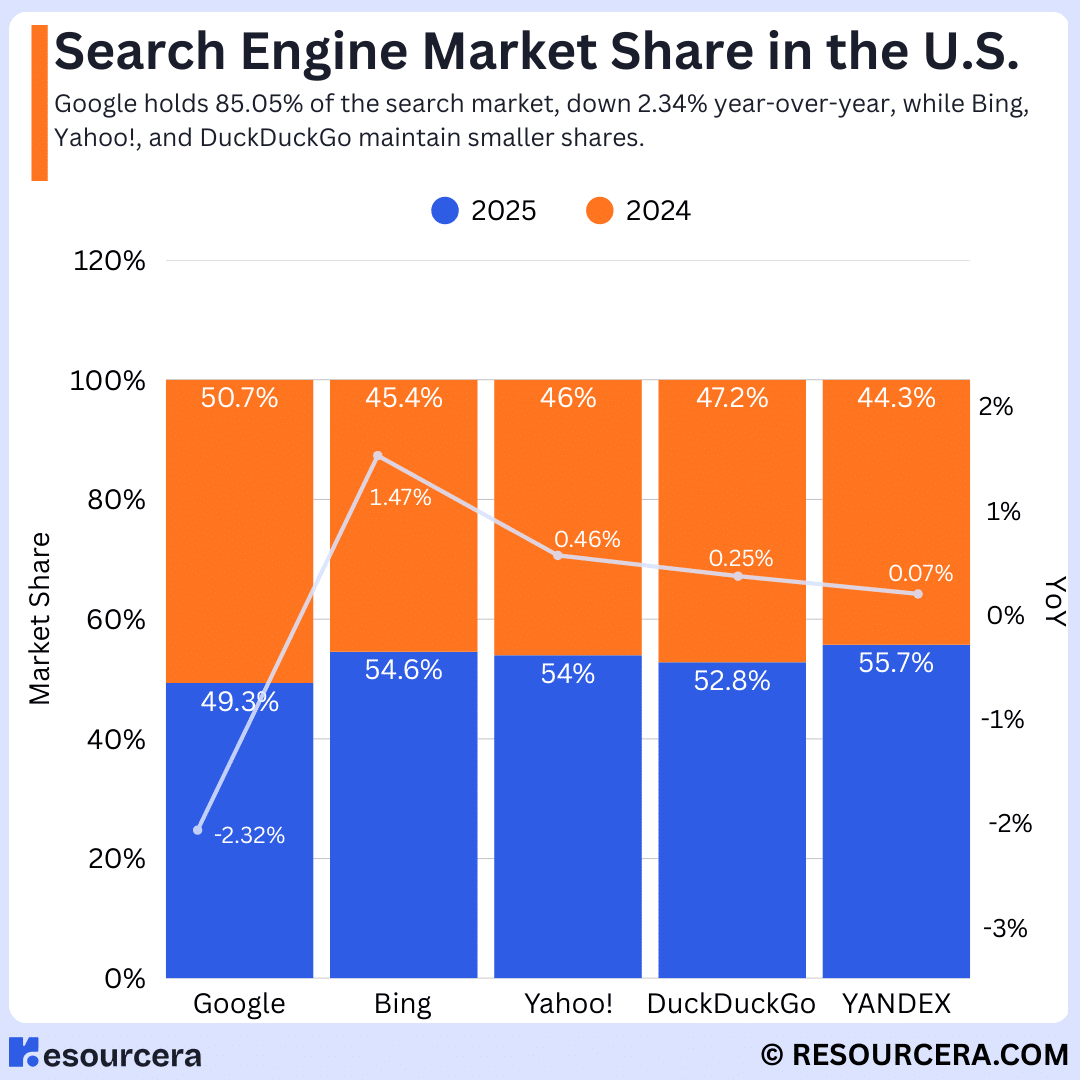
The table below shows the market share of search engines in the United States:
| Search Engines | 2026 Market Share | 2024 Market Share | 2-Year Change |
|---|---|---|---|
| 85.07% | 87.39% | – 2.32% | |
| Bing | 8.78% | 7.31% | + 1.47% |
| Yahoo! | 3.13% | 2.67% | + 0.46% |
| DuckDuckGo | 2.37% | 2.12% | + 0.25% |
| YANDEX | 0.34% | 0.27% | + 0.07% |
The above table shows that, except for Google, all other search engines have shown positive growth from 2024 to 2026. This reflects the integration of AI in their search functionalities, which has helped them improve their market share and reach a wider audience.
Search Engine Market Share in The United States For Desktop
Google dominates the United States’ desktop search engine market with a 76.34% share, while Bing and Yahoo! follow with 16.75% and 3.94%, respectively. Google’s market share has remained unchanged since 2024.
DuckDuckGo and YANDEX rank fourth and fifth in the US desktop search engine market share list, with 2.28% and 0.29% share, respectively.
The table below showcases the US desktop search engine market share in 2026:
| Search Engines | Market Share on Desktop in the US |
|---|---|
| 76.34% | |
| Bing | 16.75% |
| Yahoo! | 3.94% |
| DuckDuckGo | 2.28% |
| YANDEX | 0.29% |
| AOL | 0.21% |
Search Engine Market Share in The United States For Tablets
With a 78.43% market share, Google dominates the United States tablet search engine market. However, Google saw a drop from 85.63% in January 2025 to 78.43% in January 2026, due to the rise of its alternatives, including Bing, DuckDuckGo, and Yahoo!.
Bing and DuckDuckGo follow next in the list, with 17.61% and 2.34% market share. Bing witnessed a rise in market share from 10.73% in January 2025 to 17.61% in January 2026.
Here is the detailed information for the tablet search engine market share in the United States in 2026:
| Search Engines | Market Share on Tablet in the US |
|---|---|
| 78.43% | |
| Bing | 17.61% |
| DuckDuckGo | 2.34% |
| Yahoo! | 1.17% |
| YANDEX | 0.36% |
| Ecosia | 0.02% |
Search Engine Market Share in The United States For Smartphones
Google leads the mobile search engine market in the US with a 92.99% share. However, over the last 12 months, Google saw a drop in its market share from 96.06% in November 2024 to 92.99% in January 2026.
Yahoo! and DuckDuckGo follow next, with 2.53% and 2.45% market share, respectively.
The table below shows the US mobile search engine market share in 2026:
| Search Engines | Market Share on Mobile in the US |
|---|---|
| 92.99% | |
| Yahoo! | 2.53% |
| DuckDuckGo | 2.45% |
| Bing | 1.41% |
| YANDEX | 0.38% |
| Ecosia | 0.14% |
Source: Statcounter
Search Engine User Statistics
- More than 5 billion people worldwide use Google, reflecting its dominance in its global reach and the central role it plays in how people search, learn, and access information every day.
- Google processes over 5 trillion searches per year, totalling about 16.4 billion searches daily, more than 11.4 million searches per minute, and over 189,815 searches per second.
- Search engines account for 68% of total website traffic. They remain the most influential channel for discovery, making strong SEO performance essential for brands seeking consistent visibility and growth.
- About 71% of B2B customers rely on search engines to do product research. This statistics highlights how important search visibility has become in B2B buying cycles.
Sources: Think With Google, Exploding Topics
Search Engine Usage Statistics
- Users spend around 76 seconds per session on Google. This highlights its strong ability to deliver quick, relevant answers, keeping users’ search interactions fast and efficient.
- Most users search online about 3 to 4 times a day, reflecting how frequently people depend on search engines for everyday information. With the introduction of AI search engines, online search has become an integral part of daily decision-making.
- Around 80% of American consumers search for local businesses online every week. Whereas, roughly 32% do the same daily or multiple times a day.
- More than 58% of US consumers look up local business information via voice search. While over 46% of them use it every day, and another 28% do so at least once a week.
- Roughly 75% of users never proceed beyond the first page of Google results. The top-ranked results alone capture around 28.75% of all clicks.
Sources: Backlinko, SOCi, Score
Google vs. Bing Comparison (Two of World’s Largest Search Engines)
Google and Bing have been ranking first and second in the global search engine market share over the past few years across all devices. In 2026, Google leads with 89.82% market share, followed by Bing with 4.31%.
When it comes to tablets and mobile phones, the ranking is similar. Google dominates the global tablet search engine market with an 87.83% market share, and Bing ranks second with 7.75%.
Whereas, in the global mobile phone search engine market share list, Google and YANDEX rank first and second, with 94.35% and 2.03% market share, respectively. In this list, Bing ranks sixth with a 0.61% market share.
The table below shows the comparison between Google and Bing by search engine market share:
| Category | Bing | |
|---|---|---|
| Global Market Share | 89.82% | 4.31% |
| US Market Share | 85.07% | 8.78% |
| Mobile Market Share | 94.35% | 0.61% |
| Desktop Market Share | 82.38% | 10.29% |
| Tablet Market Share | 87.83% | 7.75% |
| Projection for 2027 | 89.5%-90.5% | 4.3%-4.6% |
Source: Statcounter
(Note: Projection for 2027 is based on historical Statcounter trend data from 2021–2026.)
Search Engine Marketing Statistics
In 2026, search engines have a 14.6% close rate, outperforming traditional marketing channels by a significant margin. This gives a clear idea that search-driven traffic continues to be marketers’ top source of qualified leads and conversions in digital marketing.
Roughly half of users find a new company or product through online search. It highlights how important search optimization is for brands that aim to attract first-time consumers.
Source: Hubspot
AI-Powered Search Engine Statistics
- About 25% of Google searches now display an AI Overview. This figure is projected to increase as Google integrates this feature more widely. With the introduction of AI into searches, there is a shift in how users consume information online.
- Roughly 40% of Millennials say that they will use an AI-powered search engine, the highest among all age groups. Gen Z and Gen X users follow next, with 32% and 29%, respectively, saying they would do the same.
Here is the table to show AI-powered search engine adoption among age groups in the USA:
| Age Group | Yes | Don’t know/No opinion | No |
|---|---|---|---|
| All adults | 28% | 18% | 54% |
| Generation Z | 32% | 14% | 54% |
| Millennials | 40% | 17% | 44% |
| Generation X | 29% | 19% | 52% |
| Baby Boomers | 16% | 20% | 64% |
- 32% of American adults trust an AI-powered search engine to provide factual results. 27% of them trust it to provide unbiased results.
- About 68% of US adults use an AI-powered search engine to explore or learn about a new topic, while 62% use it to directly inquire about a topic.
- Google reports that AI Overviews now reach more than 2 billion monthly users.

