Businesses are investing in SEO more aggressively than ever, and the numbers explain why. Nearly 75% of users never go past the first page of Google, which handles about 16.5 billion searches every day. With the first five results capturing almost 70% of all clicks, visibility has become a top priority for brands across the world. As a result, the global SEO market is valued at $74.9 billion in 2025 and is expected to grow to $127.3 billion by 2030.
At the center of this growth is a big shift in how search works. Google still dominates with a 90.04% market share, but AI-driven search is rewriting the rules. AI Overviews now show up in 47% of Google searches, cutting CTR to the #1 organic result by 34.5%, while AI platforms like ChatGPT and Perplexity drove 1.13 billion referral visits in June 2025 alone.
This article breaks down the most important SEO statistics of the year across global search trends, AI search, mobile, local, content, backlinks, international SEO, video, image optimization, and more to help you understand where search is heading and how to stay ahead.
Key SEO Statistics for 2025
- The global SEO market has reached a valuation of $74.9 billion in 2025.
- 75% of people never scroll past the first page of search results.
- The first five organic results in the SERPs account for nearly 70% of all clicks.
- 84% of marketers now use AI to align content with search intent, making AI one of the most adopted tools in modern SEO.
- 47% of Google searches trigger an AI Overview, reshaping click-through patterns across the SERPs.
- 8 in 10 U.S. consumers search for a local business online at least once a week.
- 76% of “near me” searchers visit a business within a day.
- 80% of top-ranking websites are mobile-optimized
Global SEO Market Statistics
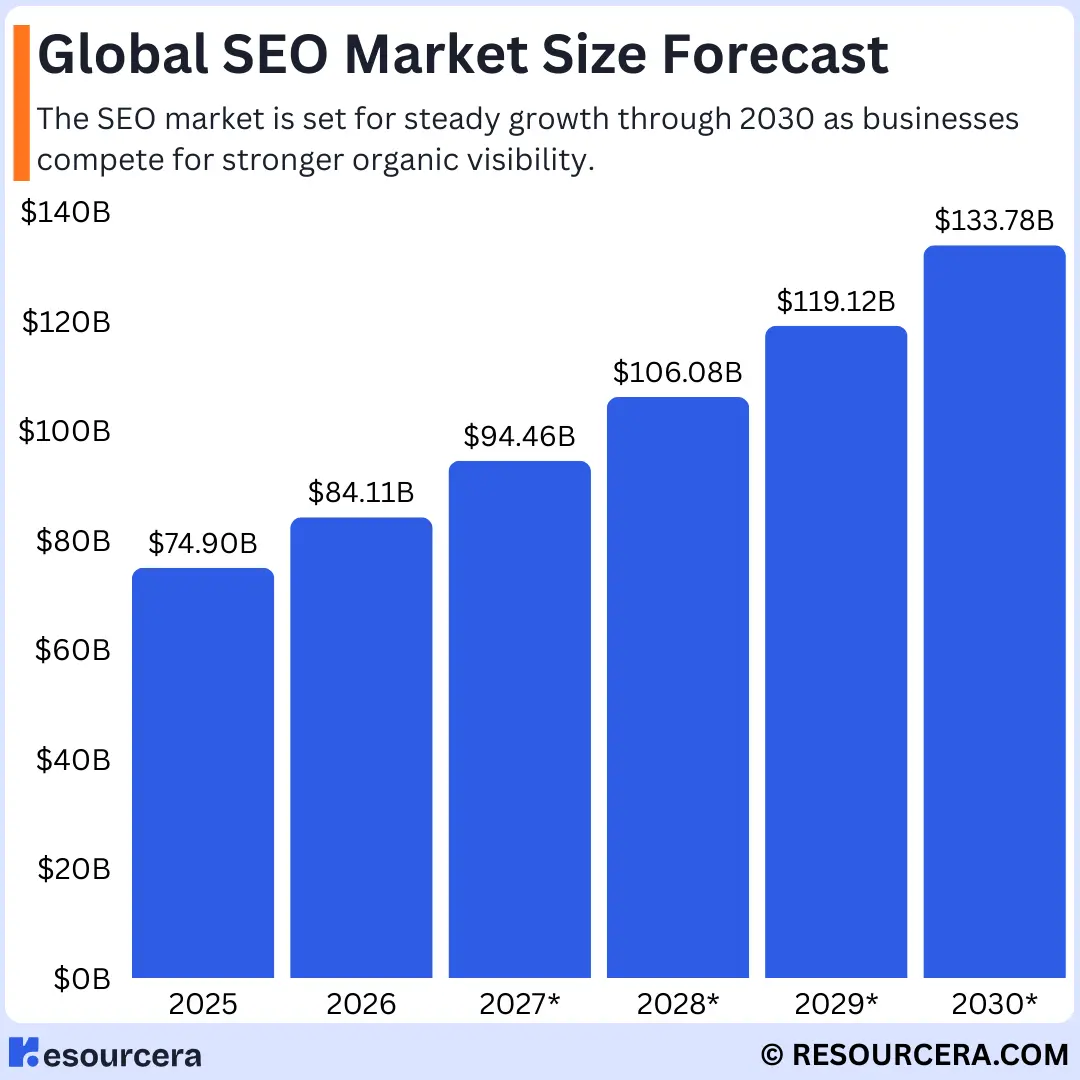
- The global search engine optimization (SEO) services market is valued at $74.9 billion in 2025 and is expected to reach $127.3 billion by 2030, growing at a steady 12.3% CAGR.
| Year | Market Size |
|---|---|
| 2025 | $74.90 billion |
| 2026* | $84.11 billion |
| 2027* | $94.46 billion |
| 2028* | $106.08 billion |
| 2029* | $119.12 billion |
| 2030* | $133.78 billion |
- On-Page SEO holds the largest share at 42.3% in 2025, while Voice & Visual Search SEO is expected to grow the fastest at 20.8% CAGR through 2030.
- Small and Medium Enterprises (SMEs) make up 59% of the market, while demand from large enterprises is growing at a 16.5% CAGR.
- By service model, Retainer or Subscription agreements generated 62.5% of total revenue in 2024, but Outcome-Based contracts are growing quickly at 19% CAGR, showing clients’ preference for measurable results.
- North America contributes 34.2% of total SEO revenue globally. Looking at the future, APAC is projected to grow the fastest at 13.9% CAGR between 2025 and 2030.
Source: Mordor Intelligence
SEO Software Market Statistics
- The global SEO software market is valued at $74.6 billion, and is projected to reach $154.6 billion by 2030, growing at a strong 13.5% CAGR between 2025 and 2030.
- North America remains the largest revenue-generating region in 2024, reflecting high adoption of SEO technology among enterprises.
- Moreover, the U.S. SEO software market is projected to grow at a 9.5% CAGR from 2024 to 2030.
- The Asia Pacific SEO software market is projected to grow at a CAGR of 15.9% from 2024 to 2030, making it the fastest-growing region globally, while Europe is expected to expand at a CAGR of 12.6% during the same period.
Source: Grand View Research
Search Engine Usage Statistics
- With 75% of people never scrolling past the first page of search results, it’s clear that ranking on page one isn’t just beneficial; it’s the difference between being discovered and being invisible.
- Google remains the leader in the global search engine market with a 90.04% market share in 2025. Bing holds the second spot with 4.31%, followed by Yandex at 1.86% and Yahoo! with 1.45%.
- Privacy-focused DuckDuckGo accounts for 0.89%, while China’s Baidu holds a 0.73% share globally, reflecting the enduring global preference for Google despite the presence of regional and niche competitors.
AI SEO Statistics
- 900 million active users use AI tools worldwide, AI overviews appear in 47% of Google searches, and 58% of informational queries trigger them as the top result. Moreover, 88.1% of queries that trigger AI Overviews are informational in nature.
- Around 80% of consumers now rely on AI-generated answers for roughly 40% of their online searches. And 95% of keywords that show an AI Overview have either no ads or a very low CPC, suggesting Google is deploying AI Overviews mostly on less commercial queries.
- When Google’s AI Overviews appear, the CTR for the #1 organic result drops by about 34.5%, according to Ahrefs.
- Semrush data shows that 13.14% of all queries triggered an AI Overview in March 2025, up from 6.49% in January 2025.
- Meanwhile, a large-scale study (covering ~12,000 queries across 7 countries) found that users trust Generative AI search less than traditional search, but reference links and citations significantly increase trust.
- AI platforms generated 1.13 billion referral visits in June 2025, a 357% increase from June 2024. During the same period, in AI search traffic, ChatGPT accounted for around 50% of all AI-sourced visits.
Sources: MarketingWeek, Botify, arXiv, Exposure Ninja, Search Engine Land, Semrush.
Statistics on AI Use Cases in SEO
- According to recent data, 84% of marketers use AI to align their web content with user search intent, ensuring that what they publish matches exactly what audiences are looking for. Around 62% of organisations leverage AI for data analysis, helping them make faster, smarter decisions.
- 60% of companies use AI to create tailored customer experiences, while 56% rely on it to design and optimise marketing campaigns.
- When it comes to content creation, 42% of businesses use AI to produce long-form website copy, and 35% use it to develop SEO-driven content strategies. Meanwhile, about 26% of U.S. marketers are already using AI specifically to optimise their content for search engines.
Sources: Statista, Capgemini, Forbes
AI Search & Visibility Statistics
- AI search traffic is experiencing explosive growth, rising 527% year-over-year between January and May 2024 and the same period in 2025. Traffic from large language model platforms like ChatGPT, Perplexity, and Copilot increased from around 17,000 to 107,000 sessions, with some sites now reporting over 1% of total sessions coming from AI platforms.
- Google AI Overviews, which summarize content directly on results pages, now reach 2 billion monthly users worldwide. Nearly nine in ten queries that trigger these Overviews have informational intent, while commercial, transactional, and navigational queries account for only 8.69%, 1.76%, and 1.43% respectively.
- Interestingly, 95% of keywords that trigger AI Overviews show no ads or have very low CPC, and over 68% of these terms receive 100 or fewer monthly searches.
- In addition, almost 80% of these keywords fall into the low difficulty range of 0%-40%, making them easier to rank for but also highly exposed to AI-driven visibility shifts.
Sources: Search Engine Land, Google, Semrush
AI SEO Concerns Statistics
- As users increasingly find answers directly on the search engine results page (SERP), websites are seeing 15 to 64% declines in traffic, with around 60% of Google searches now classified as “zero-click” searches as of 2025.
- About one in four business owners worry that AI could negatively affect their website traffic, highlighting early apprehensions about visibility in search results.
- 85% of SEO professionals believe that generative AI could eventually take over SEO roles, showing how seriously the industry is considering automation.
Sources: Bain, Sparktoro, Forbes, BruceClay
SEO Keywords Statistics
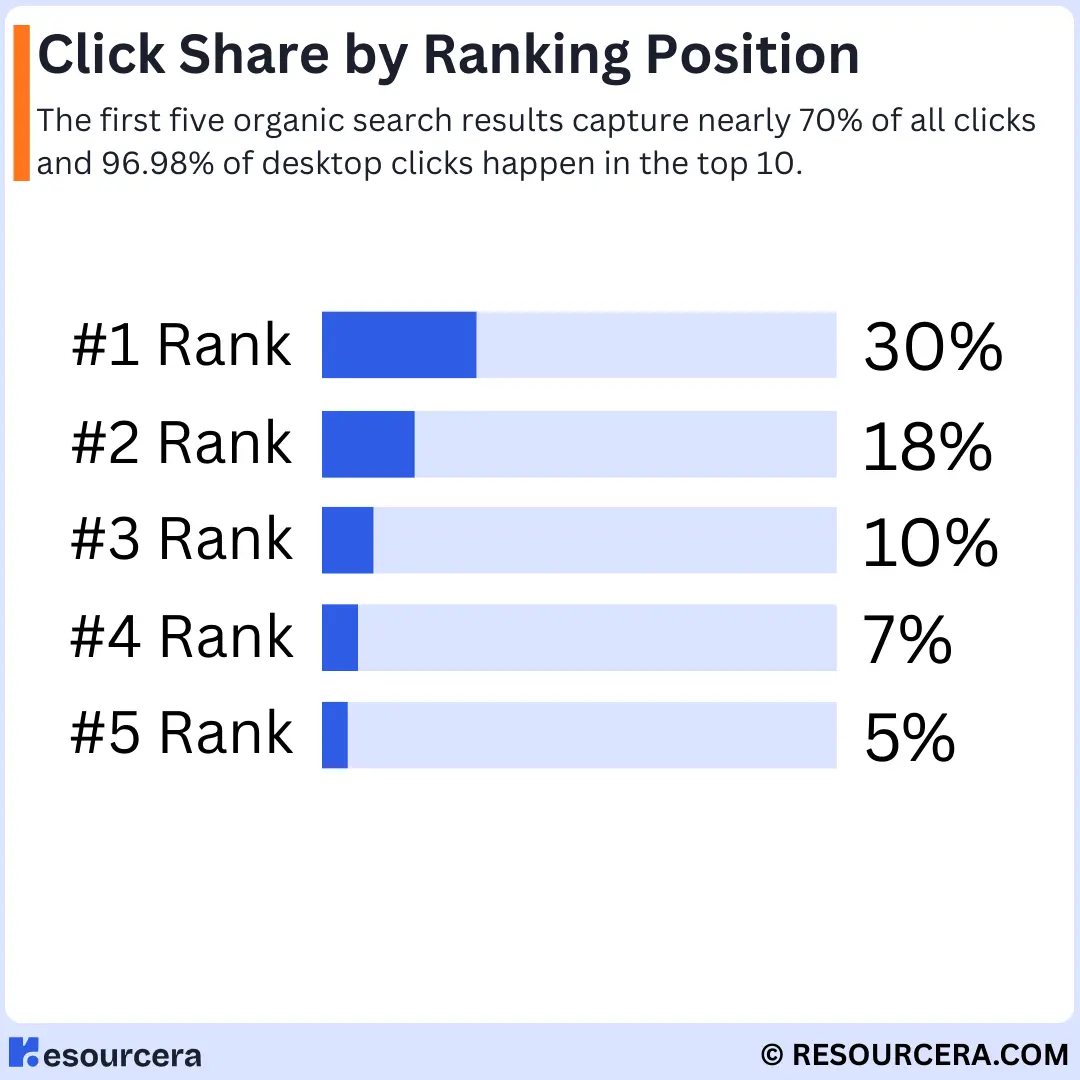
- Most clicks in search results are concentrated at the top. The first five organic results in the SERPs account for nearly 70% of all clicks, showing the importance of ranking high.
- About 88% of all searches in the US contain three words or fewer, while only a small portion of high-volume keywords, roughly 29% of keywords with over 10,000 monthly searches, include three or more words.
- Long-tail keywords dominate search traffic, making up about 70% of all searches. These queries are often longer and more specific, reflecting users’ desire for precise information.
- Also, longer search queries tend to get more clicks. Searches containing 10 to 15 words receive 1.76 times more clicks than single-word queries, showing that detailed queries can drive higher engagement.
- Two of the most popular SEO tools, Semrush and Ahrefs have a database of 27.5 billion and 28.7 billion keywords respectively.
- In recent years, “near me” queries have increased by 500%, and local search queries now drive 1.5 billion location visits each month, highlighting the importance of optimizing for local SEO.
- 60% of pages in Google’s top 10 results are over three years old, showing that authority and longevity still matter.
Sources: UpInc, Statista, Ahrefs, SearchAtlas, Backlinko, SEO.com, Essey Marketing
SEO Content Statistics
- On average, blog posts are nearly 1,400 words long, though only 3% of blogs regularly publish articles exceeding 2,000 words, showing that longer, in-depth content is still relatively rare.
- Articles with over 2,500 words tend to earn the most links, while very long reads of 3,000+ words generate three times more traffic than average-length posts of 900 to 1,200 words.
Sources: Orbit Media, SmallBizTrends
Link Building and Backlink Statistics
- Link building remains one of the most significant challenges in SEO. In fact, 41% of large companies say it’s the most difficult part of their strategy, and nearly two-thirds of all web pages have no backlinks at all.
- Content quality also plays a major role. Long-form content earns 77.2% more backlinks than shorter articles, making it one of the most effective ways to attract links naturally and strengthen SEO performance.
- On the flip side, 94% of all blog posts have zero external backlinks, showing just how competitive link acquisition truly is.
- “Why” posts, “What” posts, and infographics earn 25.8% more backlinks than videos and “how-to” guides, suggesting that explanatory and data-driven formats tend to attract more citations and references across the web.
- While the average cost of a backlink is around $360, links from high-authority websites can be significantly pricier. Research from Siege Media shows that a single premium backlink can cost up to $1,500, and some businesses invest as much as $20,000 per month in backlink campaigns to stay competitive.
- About 52% of link builders say that link building is the hardest part of any SEO campaign, highlighting just how resource-intensive and complex earning high-quality backlinks can be.
- Approximately 94% of link builders say that the quality of the links they build matters more than the sheer number they generate.
- At the same time, nearly 80% of SEO professionals consider link building an essential pillar of their overall optimization strategy.
Sources: Conductor, Ahrefs, Backlinko, Siege Media, Authority Hacker, X.
Internal Linking Statistics
- URLs with 40 to 44 internal links received about four times more clicks than those with only a handful, but once a page crosses roughly 45 to 50 internal links, traffic actually begins to decline.
- Naked URL anchors account for less than 1% of all links, yet they proved surprisingly effective, with pages using them receiving almost 50% more traffic than those that didn’t.
- In comparison, over 6% of internal links used empty anchor text, usually from image links, and this showed no measurable negative impact on click-throughs.
- 42% of marketers spend roughly equal time building both external and internal links, recognizing the value of each for SEO performance.
- When it comes to adding internal links to blog posts, 51% of marketers recommend including two to three links, while 36% believe that up to five internal links is ideal.
- Additionally, pages that include URL anchors in their internal links see nearly 50% more traffic than pages without them, highlighting the effectiveness of strategically placed internal links.
Sources: DataBox, Zyppy, DataBox
Image SEO Statistics
- Images continue to play a crucial role in search and content performance. Currently, 36% of websites feature oversized images, which can impact page speed and user experience.
- In the U.S., images appear on 35% of Google search results pages, and about 32.9% of queries return image results, though images account for only around 3% of all Google search clicks.
- Studies show that updating and republishing old blog posts with fresh content and images can be highly effective, sometimes boosting organic traffic by 106%.
- Visual search is also gaining popularity among younger users, with 62% of Millennials and Gen Z preferring the ability to search by image over any other emerging technology.
- Posts with images get 650% more engagement than those without, and using visual content can increase readership by 12%.
Sources: SE Ranking, Supple
Video SEO Statistics
- Videos are 50 times more likely to rank in Google search results than regular text. In fact, blog posts with videos get 157% more search traffic and attract three times more backlinks than text-only posts.
- Success on Google often overlaps with YouTube, as 88% of videos that rank on Google also rank on YouTube.
- Brands are leveraging video for growth, with 51% promoting videos to increase website traffic and 90% using them to boost brand awareness.
- Video has now surpassed blogs and infographics to become the most popular content format.
- On YouTube, the average first-page video is nearly 15 minutes long, and 68.2% of these top results are HD, showing the importance of quality and viewer experience.
- Video content also drives stronger engagement, delivering a 41% higher click-through rate than text-only pages. For businesses that haven’t yet adopted it, 68% plan to include video in 2025.
Sources: BrightEdge, Vidico, Status Labs, AISEO
Mobile SEO Statistics
- Globally, mobile users make up 59% of all internet traffic each month, while in North America, they account for 45%. 80% of top-ranking websites are now mobile-optimized, showing that responsive design is essential for SEO success.
- Mobile has become central to how people discover and interact with brands. 51% of phone users find new products or brands while searching on their devices, and around 55% of all internet traffic now comes from mobile.
- Ranking first on mobile drives 27.7% of clicks, compared to 19 to 20% on desktop, highlighting the importance of mobile-first optimization.
- By the end of 2025, it’s expected that 75% of the world will access the internet via phones, and 79% of users are more likely to return to a site that is easy to navigate on mobile, emphasizing the critical role of mobile-friendly design.
- The first organic listing on mobile captures only 6.74% of clicks, compared to 8.17% on desktop. Overall, organic click-through rates on mobile are roughly 50% lower than on desktop
Sources: Google, Backlinko, CNBC, Statista, StatusLabs, SparkToro, SEOClarity
Local SEO Statistics
- Local search has become a critical part of consumer behavior, with 8 in 10 Americans looking for local businesses online at least once a week and one-third checking multiple times per day.
- Today, 4 in 5 consumers rely on search engines for local information, and Google Search (72%), along with Google Maps (51%), remain the most widely used platforms.
- Younger users shift even more toward social platforms, with Instagram (67%) and TikTok (62%) leading their local search habits.
- Additionally, 94% of high-performing brands now invest in a dedicated local marketing strategy, far higher than the 60% of average-performing brands that do the same.
- And as local search continues to evolve, 86% of local marketers report that their clients are increasingly aware of how new search developments can influence their visibility and rankings.
Sources: BrightLocal, SOCi, Google, BrightLocal.
Some Statistics About Google’s Role in Local SEO
- Google’s ecosystem plays an outsized role, with 42% of users clicking inside the Google Maps Pack and 60% of mobile users contacting a business directly from search results. In fact, customers are 2.7× more likely to trust a business with a complete Google Business Profile, and such businesses are 50% more likely to be chosen by potential customers.
- People frequently look up practical details too: 40% check opening hours several times a month, while 39% search to see if a business is dog-friendly, child-friendly, or accessible.
Sources: Backlinko, Google, BrightLocal.
International SEO Statistics
- Even though English is everywhere online, it actually reaches only about 19% of the global internet population, while nearly 49.4% of websites are still written solely in English.
- Translated sites get 327% more visibility in Google AI Overviews compared to untranslated ones.
- Around 75% of internet users don’t speak English as their first language, meaning a big global SEO opportunity.
- In a survey by SurferSEO across 8,700+ users in 29 countries, 76% said they prefer buying products when information is in their native language.
- When companies go multilingual, magic happens: they can expand their reach by 75% more users who don’t speak English, improving trust, engagement, and visibility.
- And it’s not just about traffic. Businesses report up to a 70% boost in conversion rates when they localize for other languages.
Sources: Weglot, Bright Plugins, AsiaLocalize, Search Engine Journal
E-commerce SEO Statistics
- A paper in TIJER found that SEO significantly enhances brand visibility and influences consumer purchase decisions in e-commerce.
- According to Reboot Online, e-commerce brands rank for an average of 1,783 organic keywords, which drive around 9,625 visits/month.
- That organic traffic (if bought via ads) would cost approximately $15,504/month in paid search.
- The same report finds that 52% of e-commerce sites use digital PR to build backlinks, and the average Ahrefs Domain Rating of such links is 46.
- In terms of business impact, SEO-driven conversion rates in e-commerce range between 2.99% to 4.4%, depending on industry and product category.
- Returning visitors from organic search have a 23% higher average order value than first-time visitors.
Sources: RebootOnline, ProfileTree, TIJER
Impact-Site-Verification: 06608eb5-7678-484b-9432-ecfcba9469dc