

Discord made an estimated $950 million in 2025, up 8.1% from the year before.
In 2024, revenue jumped 52.9% to $879 million, the fastest growth since 2021. One year later, the pace dropped to single digits.
Discord is private and has never published a financial statement. Published estimates for the same year run from $561 million to $1 billion, so the number you start with decides everything built on top of it.
This report rebuilds the figures year by year. You will find Discord’s full revenue history from 2016, how much each of its six revenue streams brings in, what a single Nitro subscriber is worth, revenue per user, valuation, funding, the IPO filing, and where revenue lands by 2030.
Discord Revenue (2026): Key Highlights
- Discord made around $950 million in revenue in 2025.
- Revenue jumped 52.9% in 2024, rising from $575 million to $879 million.
- Discord should cross $1 billion in revenue for the first time in 2026.
- Revenue is now 190 times bigger than in 2016, when Discord made just $5 million.
- Nitro brought in about $280 million in 2025 from 7.3 million subscribers, which is 29.5% of all revenue.
- Discord makes $3.80 per user each year, and fewer than 3 in every 100 users pay for anything.
Discord Revenue Over the Years (2016 to 2030)
Discord’s revenue curve has three distinct phases. From 2016 to 2021, it tripled or doubled almost every year off a tiny base.
From 2021 to 2023, growth decayed steadily as Nitro saturated its core audience. From 2024 onward, advertising and digital goods took over as the growth engine.
The compound annual growth rate from 2016 to 2025 works out to 79.2%. Narrow that to the last five years, from 2020 to 2025, and it falls to 47.7%. Narrow it again to the last two years and it drops to 28.5%.
The business is still growing, but the rate is compressing every time you shorten the window.
Discord Revenue by Year
Discord has grown revenue 190 times over since 2016, from $5 million to an estimated $950 million in 2025. The pace has slowed sharply along the way, from an average of 128.3% a year between 2016 and 2021 down to 32.3% a year between 2021 and 2025.
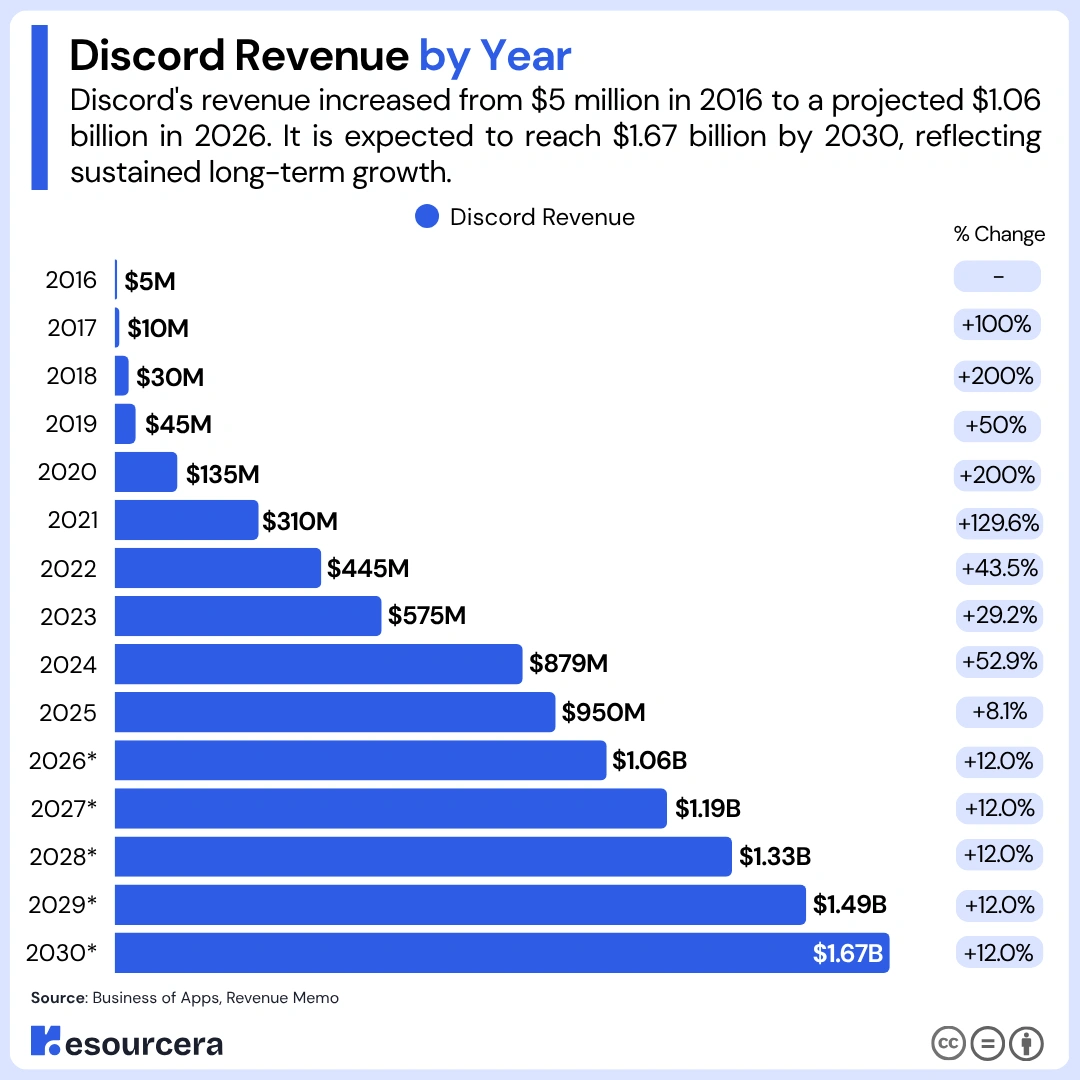
The table below covers every year from 2016 through 2025, followed by projections through 2030 under two scenarios.
| Year | Discord Revenue | % Change |
|---|---|---|
| 2016 | $5 million | – |
| 2017 | $10 million | +100.0% |
| 2018 | $30 million | +200.0% |
| 2019 | $45 million | +50.0% |
| 2020 | $135 million | +200.0% |
| 2021 | $310 million | +129.6% |
| 2022 | $445 million | +43.5% |
| 2023 | $575 million | +29.2% |
| 2024 | $879 million | +52.9% |
| 2025 | $950 million | +8.1% |
| 2026* | $1.06 billion | +12.0% |
| 2027* | $1.19 billion | +12.0% |
| 2028* | $1.33 billion | +12.0% |
| 2029* | $1.49 billion | +12.0% |
| 2030* | $1.67 billion | +12.0% |
Source: Business of Apps, Revenue Memo, Sacra
How Much Revenue Does Discord Make in 2026?
Discord generated an estimated $950 million in 2025, up from $879 million in 2024.
On current trends, 2026 revenue should land between $1.06 billion and $1.16 billion, which would be the first time the company clears the billion-dollar mark.
The 2024 jump was driven by advertising arriving as a genuine revenue line for the first time, which lifted the business by roughly $65 million in the back half of the year alone.
Once that one-time step-up was absorbed, growth settled back toward the low double digits.
Our 2026 projection is based on a $950 million base rather than the $750 million to $800 million figure circulating elsewhere, which is anchored to a 2025 estimate we consider too low.
Source: Revenue Memo, Sacra, Value Add VC
How Does Discord Make Money? (Discord Revenue Streams)
Discord makes money from six streams, and every one of them is paid for by users rather than advertisers buying access to user data.
Subscriptions and community upgrades still carry the business, but their share is falling as advertising and digital goods scale.
The core product is free and always has been. Roughly 97% of monthly active users never pay Discord anything. The entire business rests on converting a small, highly engaged minority into paying customers, then finding more ways for that same minority to spend.
Nitro was the whole business as recently as 2021. Today it accounts for under a third of revenue. The other five streams have grown from $137 million combined in 2021 to roughly $670 million in 2025, an increase of 4.9 times.
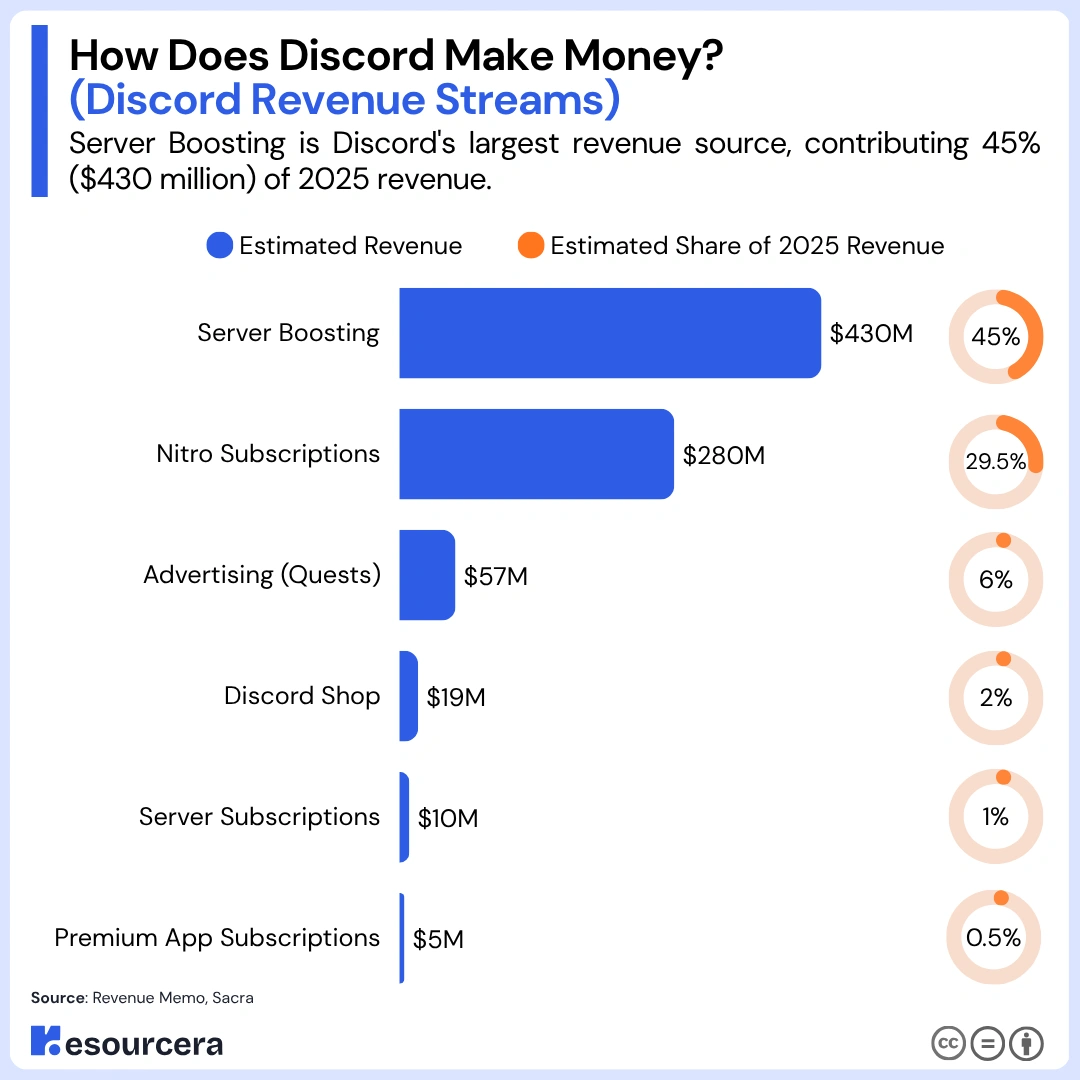
The table below breaks down all six streams by estimated share of 2025 revenue.
| Revenue Stream | Estimated Share of 2025 Revenue | Estimated Revenue |
|---|---|---|
| Server Boosting | 45% | $430M |
| Nitro Subscriptions | 29.5% | $280 million |
| Advertising (Quests) | 6% | $57M |
| Discord Shop | 2% | $19M |
| Server Subscriptions | 1% | $10M |
| Premium App Subscriptions | 0.5% | $5M |
Only Nitro and advertising have figures firm enough to state precisely. Nitro is calculated from subscriber count and pricing.
Advertising is anchored to the $65 million lift recorded between August and December 2024.
The remaining four are ranges derived from qualitative descriptions, with Server Boosting sitting as the residual once every other stream is accounted for.
Nitro Subscriptions
Nitro brought in roughly $280 million in 2025 from 7.3 million subscribers, which works out to 29.5% of total revenue.
At $280 million across 7.3 million subscribers, the average Nitro user is worth $38.36 a year, or $3.20 a month. Full-price Nitro costs $9.99 a month. Nitro Basic costs $2.99 a month, or $29.99 on an annual plan, which is $2.50 a month.
A blended $3.20 a month sits almost exactly between Nitro Basic monthly and Nitro Basic annual.
That tells us the subscriber base skews heavily toward the cheaper tier and toward annual billing, not toward the flagship plan.
The theoretical ceiling shows how much room is being left on the table. If all 7.3 million subscribers paid full monthly Nitro, the stream would generate $875 million a year, which is close to Discord’s entire revenue. Actual Nitro revenue is 32% of that ceiling.
| Scenario | Annual Nitro Revenue | Per Subscriber Per Year |
|---|---|---|
| All on Nitro, monthly | $875 million | $119.88 |
| All on Nitro, annual | $730 million | $99.99 |
| Actual estimated 2025 | $280 million | $38.36 |
| All on Nitro Basic, monthly | $262 million | $35.88 |
| All on Nitro Basic, annual | $219 million | $29.99 |
Now the 54% claim makes sense. Nitro generated an estimated $173 million in 2021 against total revenue of $310 million, which is 55.8%. That figure is real; it is just five years old. Nitro’s share has fallen every year since.
| Year | Nitro Revenue | Total Revenue | Nitro Share |
|---|---|---|---|
| 2021 | $173 million | $310 million | 55.8% |
| 2023 | $207 million | $575 million | 36.0% |
| 2025 | $280 million | $950 million | 29.5% |
Between 2021 and 2025, Nitro grew at a 12.8% compound annual rate while total revenue grew at 32.3%. Nitro is not shrinking. It is being outgrown by everything else, which is exactly what a maturing subscription product inside a diversifying business looks like.
Source: Revenue Memo, Sacra, Value Add VC
Server Boosting
Server Boosting is the largest single revenue stream at an estimated 45% to 55% of the total, worth somewhere between $430 million and $520 million in 2025.
It works as a microtransaction rather than a subscription, letting members pay monthly to unlock perks for a community they belong to.
Boosts cost $3.49 a month for Nitro subscribers and $4.99 a month for everyone else.
Every full Nitro subscription includes two boosts at no extra cost, which makes the two products tightly linked. Servers need multiple boosts to reach each reward tier, so members frequently coordinate to fund a community together.
The structural advantage here is that boosting scales with community activity rather than raw user count. A server with 500 highly engaged members can generate more boost revenue than one with 50,000 passive ones.
Source: Revenue Memo, Sacra
Discord Shop and Digital Goods
The Discord Shop contributes an estimated 2% to 5% of revenue, or $19 million to $48 million a year.
It launched in late 2023 as a marketplace for avatar decorations, animated profile effects, and limited-time seasonal cosmetics.
Nothing in the Shop does anything functional. Every item is pure self-expression, which is precisely why the margins are good. Nitro subscribers get discounted pricing and early access to certain drops, which pulls Shop buyers toward Nitro and Nitro subscribers toward the Shop.
The catalog has expanded through more frequent seasonal drops and brand collaborations, including anime-themed cosmetics launched across 2024 and 2025.
Source: Revenue Memo, Sacra
Server Subscriptions
Server Subscriptions contribute an estimated 1% to 3% of revenue, or $10 million to $29 million a year. The feature lets server owners charge members directly for exclusive channels, roles, and content without routing them to an outside platform.
Creators set their own pricing, with tiers running from $2.99 a month up to $199.99 a month. Discord takes 10%, and the creator keeps 90% before payment processing fees.
That split is deliberately generous compared to most creator platforms, and it is meant to keep community builders from leaving.
The restrictions explain why the revenue is still small. The feature is limited to the United States, requires creators to be 18 or older, and pays out through Stripe. Until those limits lift, the addressable base is a fraction of Discord’s community owners.
The economics favor Discord regardless. Infrastructure costs are minimal, the billing system already exists, and the stream grows automatically as communities and creator adoption grow.
Source: Revenue Memo
Premium App Subscriptions
Premium App Subscriptions are the smallest stream at an estimated 0.5% to 2% of revenue, worth $5 million to $19 million a year. The program lets third party developers charge for advanced features inside the bots, apps, and activities they build on Discord.
Discord takes 15% on the first $1 million a developer earns annually, then 30% on everything above that. The structure mirrors the major app stores but is meaningfully cheaper for small and mid sized developers, which is the point.
Midjourney is the clearest proof the model works. The image generation tool ran entirely through Discord in its early years and still maintains a large presence there, even after launching its own standalone product. That single case demonstrated that a real business could be built inside Discord rather than merely alongside it.
Margins on this stream are high because Discord owns the billing infrastructure and takes a cut of every transaction without carrying product development costs.
Source: Revenue Memo
Advertising (Sponsored Quests)
Advertising contributes an estimated 6% to 8% of revenue, or $57 million to $76 million a year, and it is the fastest-growing stream in the business.
Quests launched in 2024 as opt-in video ads that reward users with in-game loot or cosmetics for watching and streaming gameplay.
The format expanded quickly. Sponsored Quests launched on desktop and console, Video Quests reached mobile in mid 2025, and Arena Quests were added in October 2025.
The median ad completion rate across the stack is 96%, which is far above what conventional video advertising achieves.
That completion rate is the whole argument. Because users choose to start a Quest in exchange for something they want, the ad is not an interruption. Advertisers get finished views instead of skipped impressions, and Discord protects the clean experience that made the platform work.
The impact on revenue is measurable. Advertising helped lift annual recurring revenue from an estimated $660 million in August 2024 to $725 million by the end of that year, a $65 million gain in roughly four months. That single stream is the main reason 2024 revenue grew 52.9% after two years of decelerating growth.
Source: Revenue Memo, Sacra
Discord Revenue Share and Pricing
Discord keeps 100% of what users pay for its own products and takes a cut of between 10% and 30% on anything sold by creators and developers. The full pricing and revenue share structure is below.
| Product | Product Price | Discord’s Cut |
|---|---|---|
| Nitro Basic | $2.99 per month or $29.99 per year | 100% |
| Nitro | $9.99 per month or $99.99 per year | 100% |
| Server Boost (with Nitro) | $3.49 per month | 100% |
| Server Boost (without Nitro) | $4.99 per month | 100% |
| Discord Shop items | Varies by item | 100% |
| Server Subscriptions | $2.99 to $199.99 per month, set by creator | 10% |
| Premium Apps, first $1 million per year | Set by developer | 15% |
| Premium Apps, above $1 million per year | Set by developer | 30% |
Annual Nitro plans cost $99.99 against $119.88 for twelve monthly payments, a 16.6% discount. Nitro Basic annual costs $29.99 against $35.88 monthly, a 16.4% discount.
Those discounts are close to identical, which suggests annual conversion is a deliberate priority across both tiers.
The boost pricing gap matters more than it looks. A non subscriber pays $4.99 per boost while a Nitro subscriber pays $3.49 and already has two boosts included. Buying Nitro Basic and a boost costs less than buying two boosts alone, which pushes heavy boosters toward a subscription.
Source: Revenue Memo
Discord Revenue Per User (ARPU)
Discord earns $3.80 per monthly active user per year, or about 32 cents a month. That is one of the lowest figures for any social platform at this scale, and it is entirely by design.
The number has climbed steadily. ARPU was 67 cents in 2018, passed $1 in 2020, crossed $2 in 2021, and reached $3.82 in 2024 before flattening in 2025 as user growth caught up with revenue growth. From 2020 to 2025, ARPU grew at a 23% compound annual rate.
One thing worth flagging. The ARPU figures most commonly quoted elsewhere, roughly $1.30 for 2021 and $2.54 for 2023, do not match the revenue and user data they are supposed to come from.
Divide 2021 revenue by 2021 users, and you get $2.21, not $1.30. Divide 2023 revenue by 2023 users, and you get $2.88, not $2.54. Those quoted numbers line up almost exactly with 2020 and 2022 instead, which points to a one- to two-year labeling error that has been copied across multiple sites.
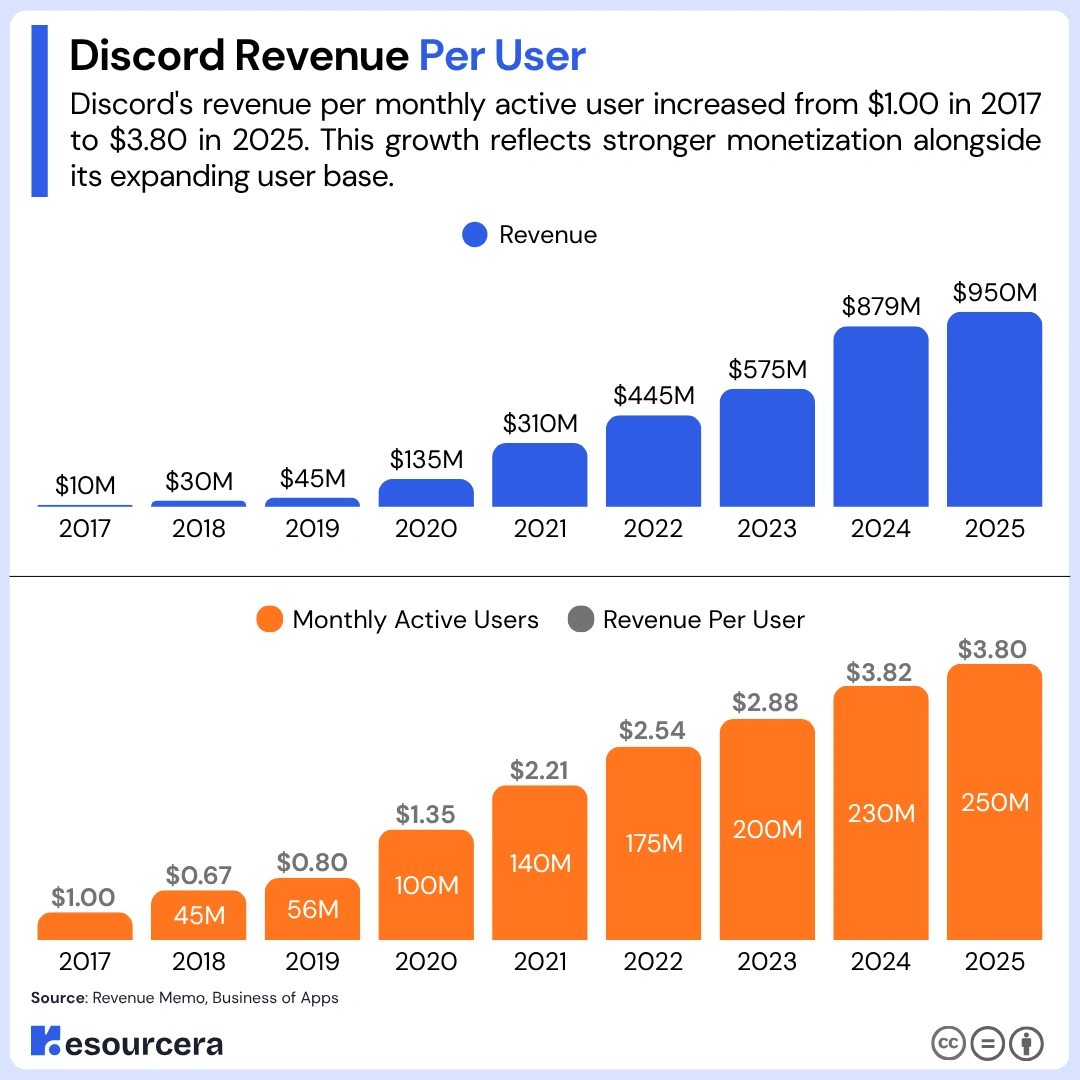
Here is the full series, calculated directly from revenue and monthly active users for every year.
| Year | Revenue | Monthly Active Users | Revenue Per User |
|---|---|---|---|
| 2017 | $10 million | 10 million | $1.00 |
| 2018 | $30 million | 45 million | $0.67 |
| 2019 | $45 million | 56 million | $0.80 |
| 2020 | $135 million | 100 million | $1.35 |
| 2021 | $310 million | 140 million | $2.21 |
| 2022 | $445 million | 175 million | $2.54 |
| 2023 | $575 million | 200 million | $2.88 |
| 2024 | $879 million | 230 million | $3.82 |
| 2025 | $950 million | 250 million | $3.80 |
Only 7.3 million of Discord’s 250 million monthly active users pay for Nitro, a conversion rate of 2.9%. Measured against 750 million registered accounts, the paying rate drops to 0.97%.
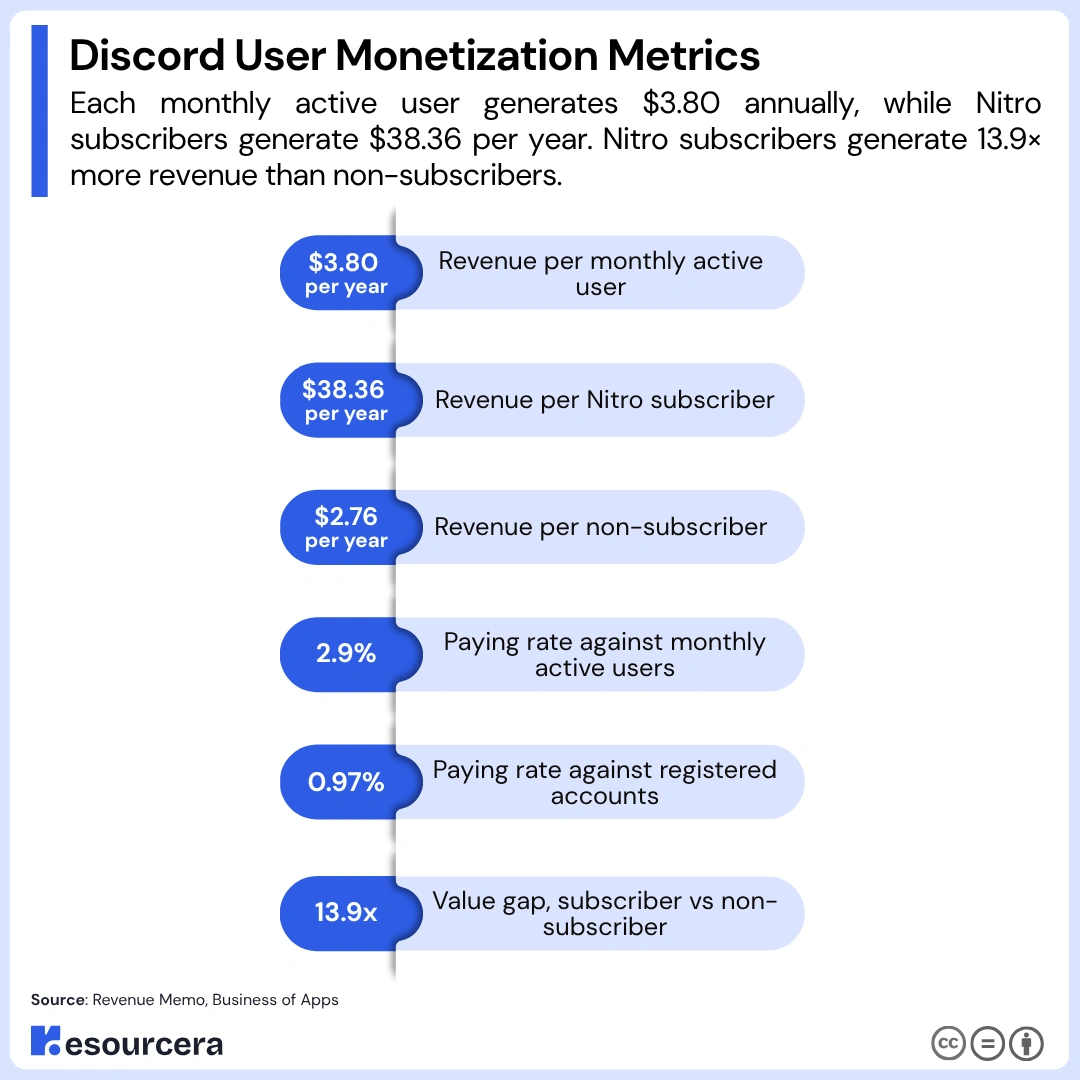
Those paying users are worth $38.36 a year each. Everyone else is worth $2.76 a year, earned through boosts, Shop purchases, and advertising rather than subscriptions. A Nitro subscriber is therefore worth 13.9 times more to Discord than a non-subscriber.
| Metric | Value |
|---|---|
| Revenue per monthly active user | $3.80 per year |
| Revenue per Nitro subscriber | $38.36 per year |
| Revenue per non-subscriber | $2.76 per year |
| Paying rate against monthly active users | 2.9% |
| Paying rate against registered accounts | 0.97% |
| Value gap, subscriber vs non-subscriber | 13.9x |
Source: Revenue Memo, Business of Apps, Value Add VC
Discord Users vs. Revenue Growth
Discord’s revenue is growing considerably faster than its user base, which is the clearest signal the business is maturing properly.
Between 2017 and 2025, Discord monthly active users grew at a 49.6% compound annual rate while revenue grew at 76.7%.
That 27 percentage point gap is what separates a platform that is monetizing from one that is just accumulating users. Every year the gap holds, each user becomes worth more than the year before.
Registered accounts tell a different story. Discord has 750 million registered accounts against 250 million monthly actives, meaning only 33.3% of people who ever signed up still use the platform monthly. That ratio has actually improved over time, from 22.4% in 2019 to 35.7% in 2023, before slipping slightly as registration growth outpaced activation.
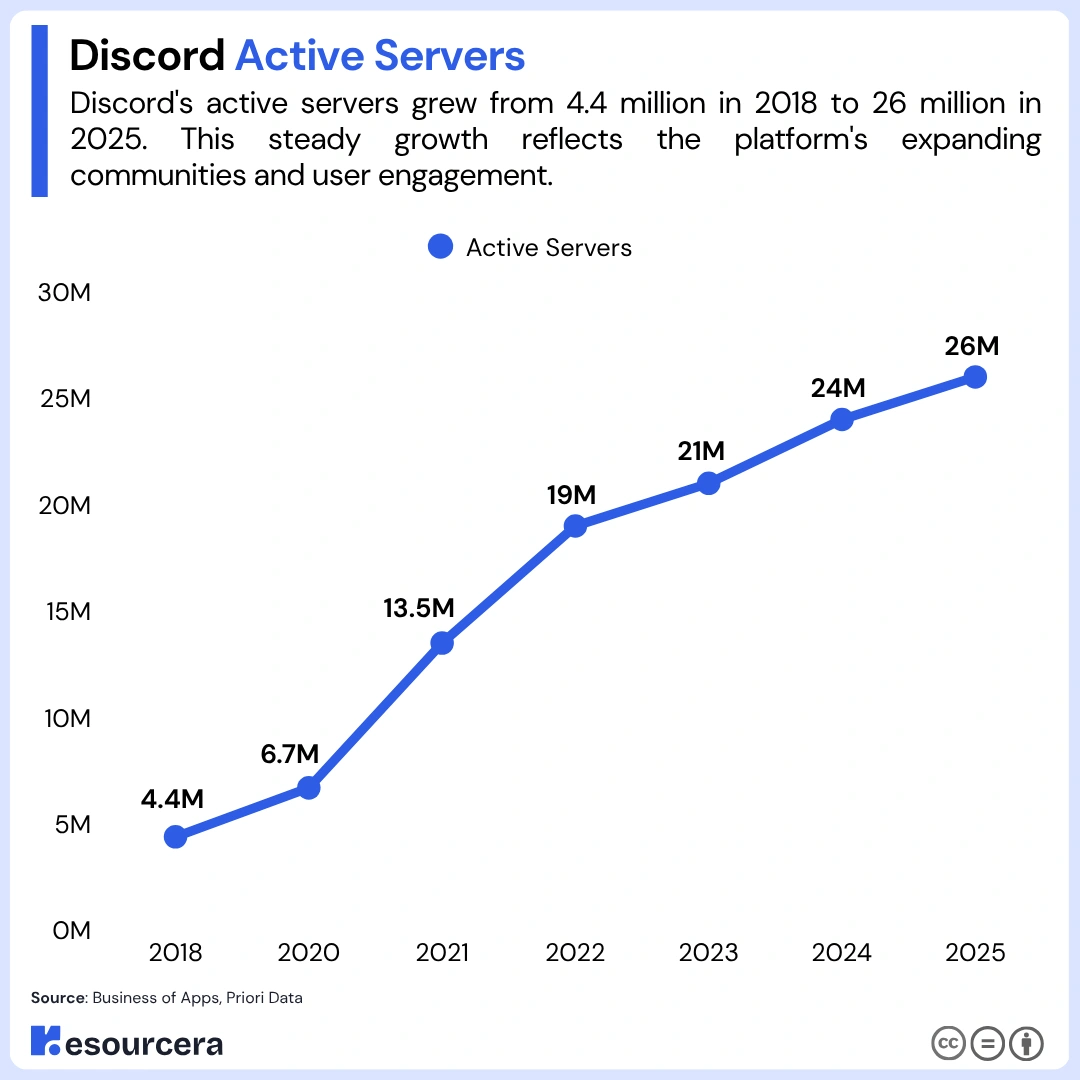
Server growth adds a third dimension. Active servers rose from 4.4 million in 2018 to 26 million in 2025, a near six fold increase. Since boosting revenue scales with server activity rather than user count, server growth is arguably a better predictor of Discord’s revenue than user growth.
| Year | Active Servers |
|---|---|
| 2018 | 4.4 million |
| 2020 | 6.7 million |
| 2021 | 13.5 million |
| 2022 | 19 million |
| 2023 | 21 million |
| 2024 | 24 million |
| 2025 | 26 million |
One more shift matters for the revenue outlook. Roughly 55% of Discord users now identify as non-gamers, up from a base that was almost entirely gaming when the platform launched.
That expansion widens the addressable market but complicates advertising, since the Quests format depends on game publishers as buyers.
Source: Business of Apps, Priori Data, Value Add VC
Discord Mobile Revenue and App Store Fees
Discord generated close to $31 million in mobile revenue in the fourth quarter of 2023, which annualizes to roughly $124 million.
At that scale, Apple and Google’s 30% commission costs Discord somewhere near $37 million a year.
Mobile accounted for about 21.6% of total revenue in 2023, and that share has grown as Video Quests reached mobile in mid 2025 and the subscriber base shifted toward phones. The more mobile grows, the more of every dollar leaves before Discord sees it.
The company’s response is differential pricing. Subscriptions cost slightly more when purchased through a mobile app than through the web, which passes part of the platform commission back to the user. It protects margin but adds friction on the device where most new signups happen.
Payment costs do not stop at app store fees. Web purchases carry processing fees through Stripe, and the full cost of running a payments operation includes fraud prevention, chargeback handling, and billing support.
| Mobile Revenue Metric | Figure |
|---|---|
| Q4 2023 mobile revenue | $31 million |
| Annualized mobile revenue | $124 million |
| Mobile share of 2023 revenue | 21.6% |
| Estimated annual app store commission | $37 million |
| App store commission rate | 30% |
Source: Revenue Memo
Is Discord Profitable?
Discord reported positive adjusted EBITDA for five consecutive quarters as of April 2025, meaning the business is profitable at the operating level. It has never confirmed profitability on a full accounting basis, and the S-1 filing will be the first time anyone outside the company sees the real cost structure.
Getting there took two rounds of cuts. Discord reduced headcount by 4% in August 2023, then by a further 17% in January 2024, which affected around 170 employees. The company had announced a target of reaching profitability during 2024, and the cuts were the mechanism.
Hiring has since resumed, particularly in engineering and trust and safety, as the advertising and developer platform businesses scaled. Headcount now sits close to 1,000 people, concentrated in the San Francisco Bay Area where compensation costs are among the highest in the industry.
The cost base is unusual for a company this size because 97% of users pay nothing while still consuming real bandwidth and moderation resources.
The 2021 acquisition of moderation startup Sentropy shows how seriously the trust and safety cost is taken. On a semi private platform where most content is invisible to outsiders, moderation cannot be crowdsourced, so it has to be bought and built.
Source: Sacra, Revenue Memo, Motley Fool
Discord Valuation
Discord was valued at $15.2 billion in its August 2021 funding round and traded at roughly $8.5 billion on secondary markets in July 2026, a decline of 44%. Revenue tripled over that same period.
That combination is the whole story of the 2021 private market correction in one company. In 2021, investors paid 49 times revenue for Discord. At the 2026 secondary price against 2025 revenue, the multiple is 8.9 times. The multiple compressed by 82% while the underlying business got three times larger.
Discord is not unusual here. Companies that raised at 2021 multiples almost universally repriced downward on secondary markets before going public.
| Year | Valuation |
|---|---|
| 2017 | $1.6 billion |
| 2018 | $2 billion |
| 2019 | $3.5 billion |
| 2020 | $7 billion |
| 2021 | $15.2 billion |
| 2026 (secondary market) | $8.5 billion |
The valuation climbed 9.5 times between 2017 and 2021, with the largest single jump coming in 2021 when it more than doubled off the previous year.
Source: Revenue Memo, Value Add VC, Business of Apps
Discord Funding
Discord has raised approximately $995 million to $1 billion in private funding across 16 rounds since 2012. The single largest was a $500 million round in September 2021, which accounted for roughly half of everything raised to that point.
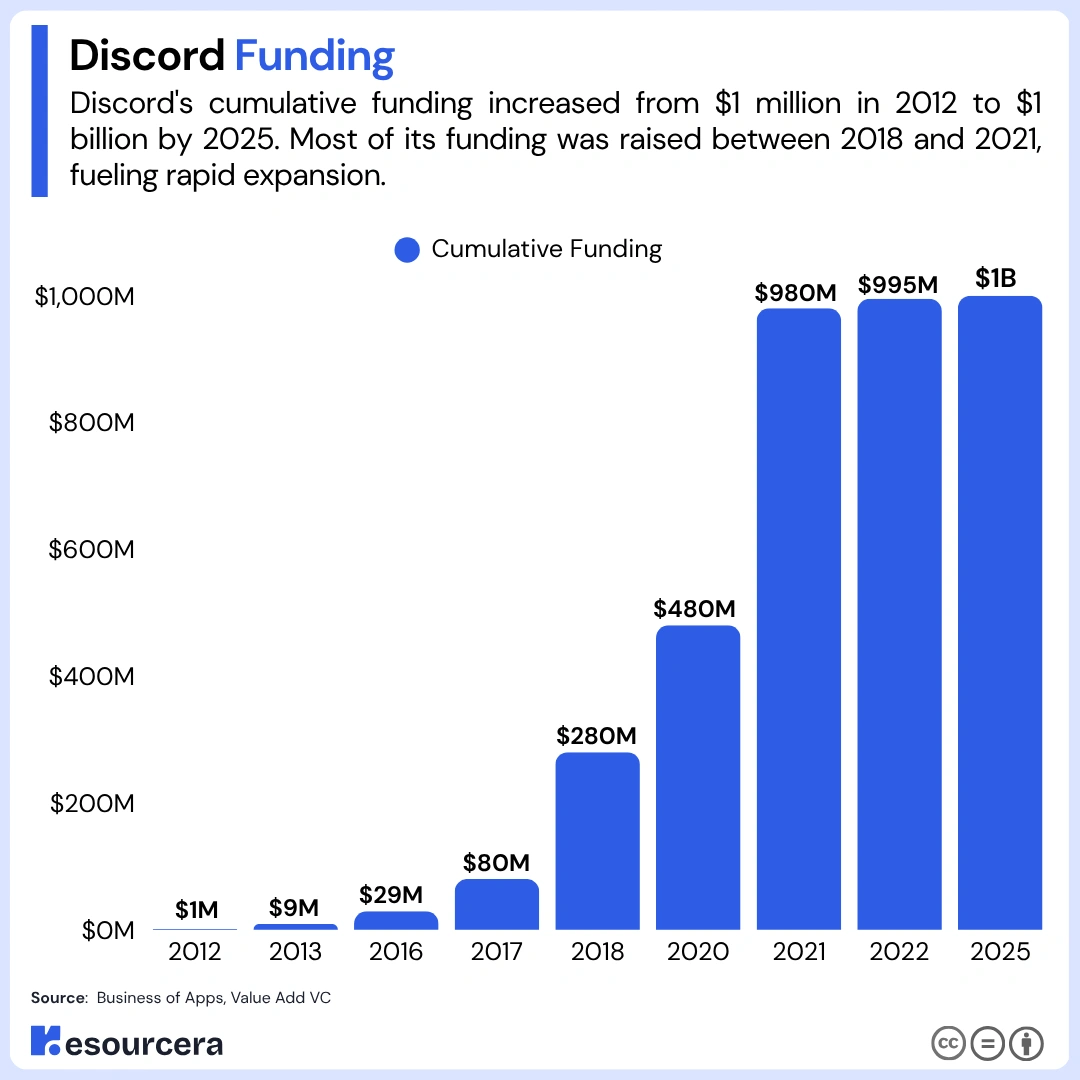
The company has raised almost exactly as much money as it now generates in a year. Total funding of about $1 billion against 2025 revenue of $950 million puts the ratio near one to one, which is a reasonable position for a company heading into an IPO.
| Year | Cumulative Funding |
|---|---|
| 2012 | $1 million |
| 2013 | $9 million |
| 2016 | $29 million |
| 2017 | $80 million |
| 2018 | $280 million |
| 2020 | $480 million |
| 2021 | $980 million |
| 2022 | $995 million |
| 2025 | $1 billion |
The funding pattern tracks the product story closely. Early rounds through 2016 were small and built the core voice product for gamers. The 2018 round funded the games storefront experiment, which was later shelved.
The 2020 rounds captured the pandemic surge as usage moved beyond gaming. The 2021 rounds came at the peak and carried the highest valuation.
Backers include Greenoaks Capital, Index Ventures, Greylock Partners, Dragoneer Investment Group, Benchmark, Tencent, Fidelity, and Franklin Templeton.
The presence of Fidelity and Franklin Templeton matters for an IPO, since crossover investors of that type are set up to hold through a listing rather than sell into it.
(Source: Business of Apps, Value Add VC, Priori Data)
Discord IPO and What It Means for Revenue
Discord filed a confidential S-1 with the SEC on January 6, 2026, with Goldman Sachs and JPMorgan as lead underwriters. As of July 2026, no listing date had been set, and no pricing had been confirmed.
A confidential filing keeps the financials private while the SEC reviews them, and the document typically becomes public around 15 days before a roadshow begins.
The valuation the market assigns will come down to which revenue figure it accepts and what multiple it applies.
At our projected 2026 revenue of $1.06 billion to $1.16 billion, a 12 times forward multiple implies $12.7 billion to $13.9 billion, and a 15 times multiple implies $15.9 billion to $17.4 billion.
| Benchmark | Amount | Context |
|---|---|---|
| Peak private valuation | $15.2 billion | August 2021 funding round |
| Microsoft acquisition offer | $12 billion | Rejected in 2021 |
| Secondary market price | $8.5 billion | Forge, July 2026 |
| Implied at 12x our 2026 estimate | $12.7B to $13.9B | Based on $1.06B to $1.16B revenue |
| Implied at 15x our 2026 estimate | $15.9B to $17.4B | Premium consumer subscription multiple |
Those implied ranges sit well above the $9 billion to $12 billion figures quoted elsewhere, and the reason is the revenue base.
Estimates built on $750 million to $800 million of 2026 revenue produce lower valuations than estimates built on $1.06 billion to $1.16 billion. The gap between those two revenue assumptions is worth roughly $4 billion in implied market value.
The S-1 will settle it. Whatever the audited numbers say, they will replace every estimate in this report and every competing one.
Source: Value Add VC, Revenue Memo
Why Discord Said No to Microsoft’s $12 Billion
Microsoft offered approximately $12 billion to acquire Discord in 2021, and Discord walked away. At the time, Discord was generating $310 million a year, which means Microsoft was offering 38.7 times revenue.
Five years on, the answer is not settled. Revenue has grown 3.1 times since the offer, from $310 million to an estimated $950 million. But the secondary market values the company at $8.5 billion, which is 29% below what Microsoft was willing to pay.
The break-even point is straightforward. Discord needs to price its IPO above $12 billion for the rejection to look correct in pure financial terms.
Against our 2026 revenue projection, that requires a forward multiple of roughly 10.8 times, which is achievable but not guaranteed.
The reasoning behind the decision was strategic rather than financial. Selling to Microsoft would have made Discord a feature inside Teams or Xbox. Staying independent was a bet that it could become a platform in its own right, with developers, creators, and an advertising business built on top of it.
That bet has partly paid off. Discord now runs six revenue streams instead of one, has an app ecosystem with real businesses inside it, and reached operating profitability. What it has not yet done is convince the market to value that at more than Microsoft offered.
Leadership has changed since. Co-founder Jason Citron stepped down as chief executive in April 2025 and was replaced by Humam Sakhnini, a former Activision Blizzard vice chairman, with Citron remaining on the board. The executive who turned Microsoft down will not be the one taking the company public.
Source: Value Add VC, Revenue Memo
Final Thoughts
Discord closes 2025 as a $950 million business where almost nobody pays. Fewer than 3% of users spend money, and the average user is worth $3.80 a year.
What changed underneath is the mix. Nitro carried 55.8% of revenue in 2021 and carries 29.5% today. It did not shrink. Everything around it grew faster.
That shift decides the next five years. On current growth, Discord crosses $1 billion in 2026 and reaches $1.67 billion by 2030. If advertising scales the way it did through 2024, the number is $2.57 billion instead. The $900 million gap between those two outcomes comes down to one thing, which is how large Quests becomes.
Our read is that the conservative path is the likelier one. Growth already fell to 8.1% in 2025 and the subscription base is saturated.
Discord will pass $1 billion comfortably. Getting to $2 billion requires advertising to become the largest stream in the company, and the current numbers do not show that happening yet.

