

The global AI in education market is valued at $10.4 billion in 2026, it is expected to grow to $32.27 billion by 2030, with a CAGR of 31.2%.
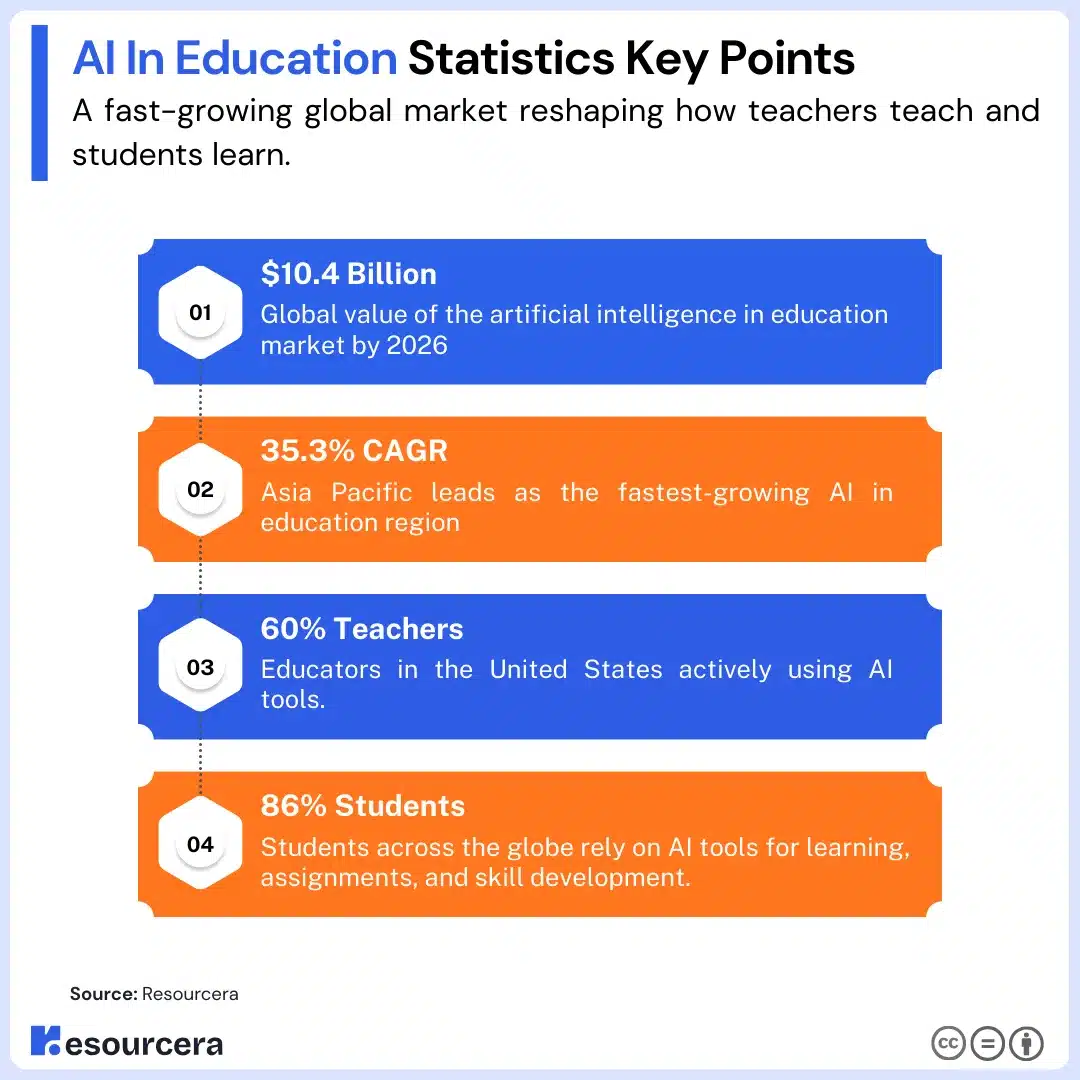
Artificial intelligence is now part of everyday academic workflows with adoption reaching 60% of U.S. teachers and 86% of students worldwide.
This report brings together market size data, regional adoption trends, usage patterns, and educator concerns to present a clear, data-backed view of how AI is actually being implemented in education globally.
AI In Education Statistics Key Points (2026)
- The artificial intelligence in education market is valued at $10.4 billion globally as of 2026, with North American market accounting for the largest share at 36%.
- 60% of teachers in the U.S. use AI tools.
- 86% of students globally are using AI in their studies.
- 2 in 3 teens in the U.S. are aware of ChatGPT.
- Teaching jobs in universities and higher education are expected to grow by 24% between 2025 and 2030, with almost no risk of being replaced by AI.
Artificial Intelligence In Education Market Size (2026 to 2030)
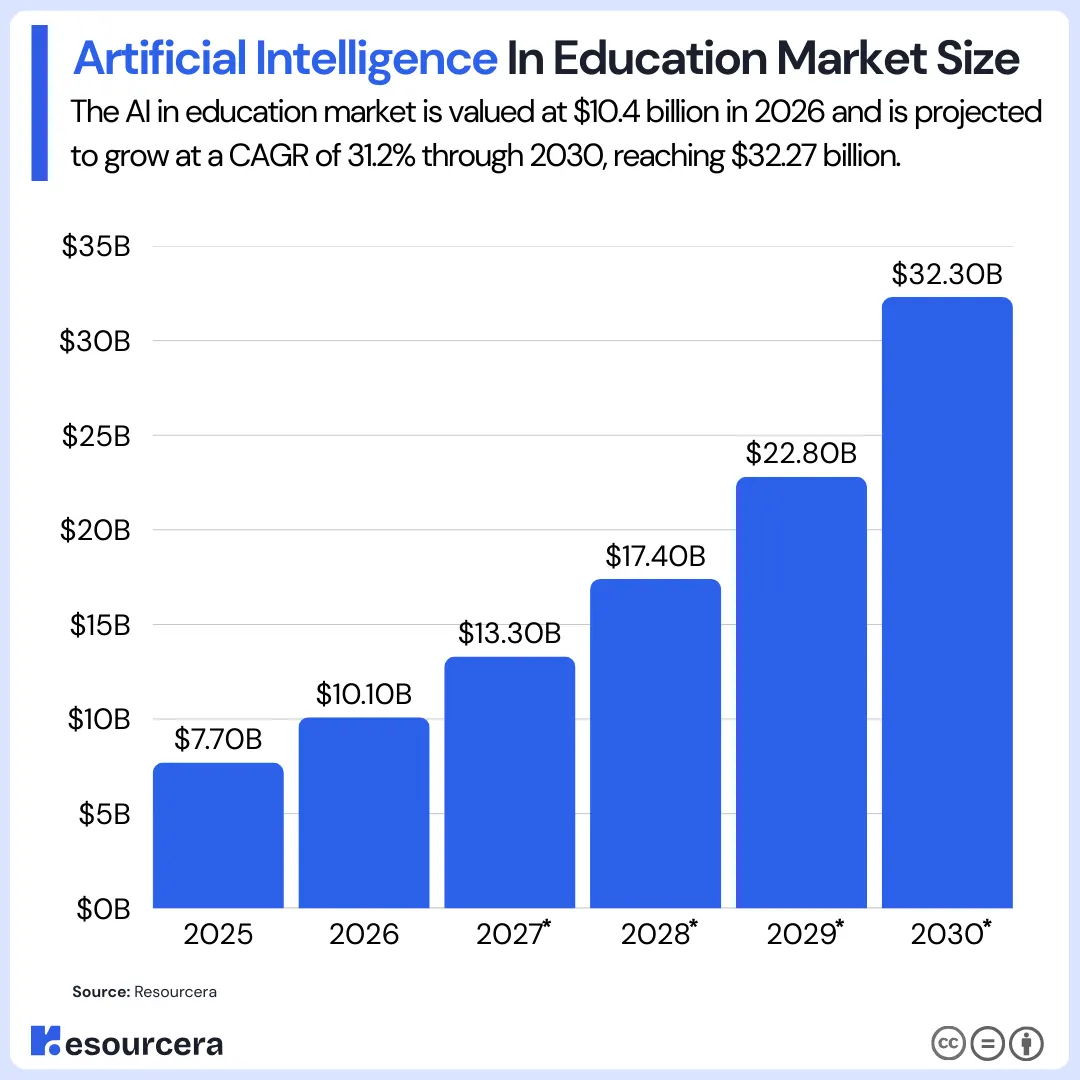
The AI in education market is valued at $10.4 billion in 2026 and is projected to grow at a CAGR of 31.2% through 2030, reaching $32.27 billion.
| Year | Market Size of AI in Education |
|---|---|
| 2025 | $7.7 billion |
| 2026 | $10.4 billion |
| 2027 | $13.3 billion |
| 2028 | $17.4 billion |
| 2029 | $22.8 billion |
| 2030 | $32.3 billion |
Region Wise Market Size of AI in Education
| Region | 2026 Revenue (Estimated) | 2030 Revenue | CAGR (2026–2030) |
|---|---|---|---|
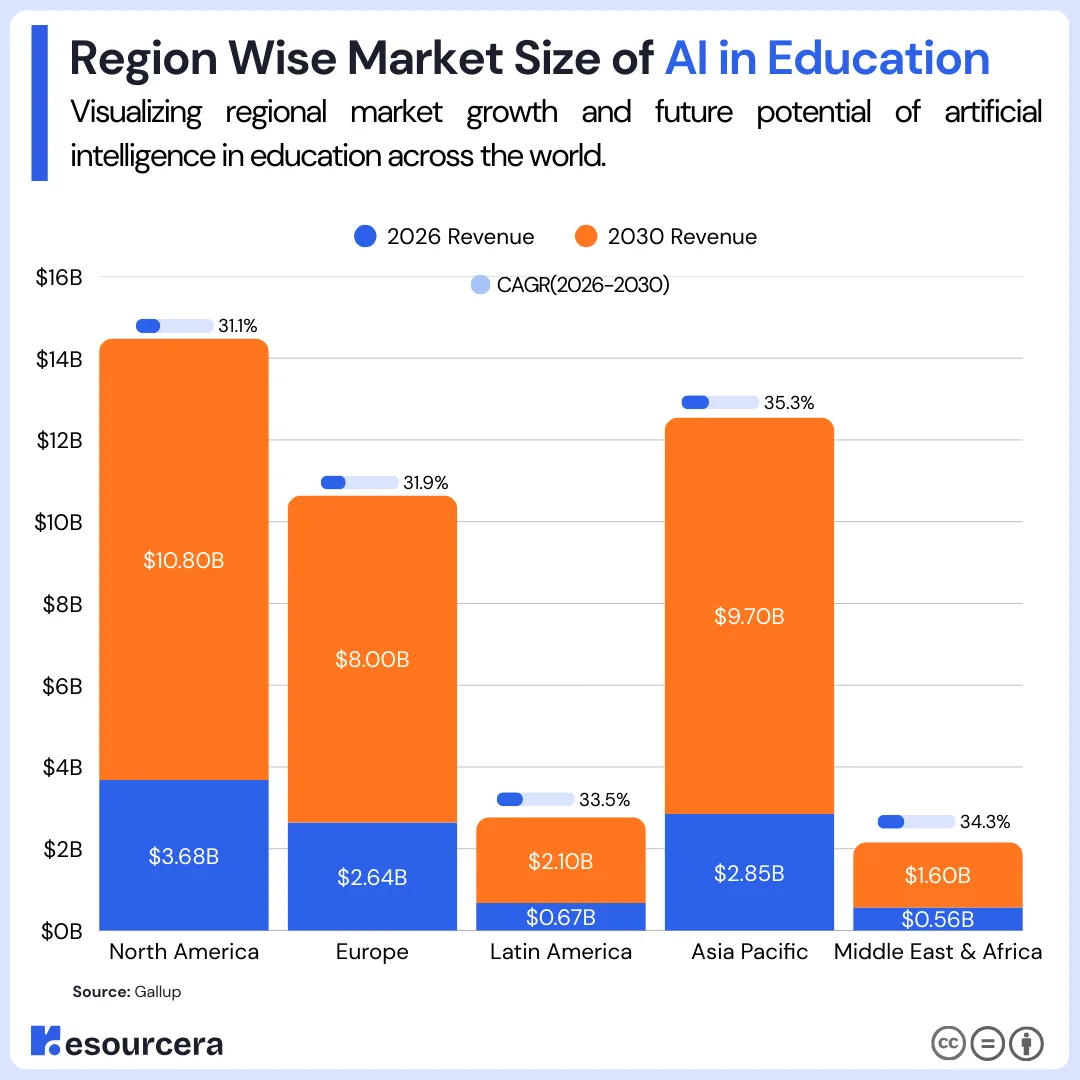
| North America | $3.68 billion | $10.8 billion | 31.1% |
| Europe | $2.64 billion | $8.0 billion | 31.9% |
| Latin America | $0.67 billion | $2.1 billion | 33.5% |
| Asia Pacific | $2.85 billion | $9.7 billion | 35.3% |
| Middle East & Africa | $0.56 billion | $1.6 billion | 34.3% |
1. North American AI
The AI in education market in North America is valued at $3.68 billion in 2026. From here, it is expected to grow at a compound annual growth rate of 31.1%, reaching $10.8 billion by 2030.
North America leads the global AI in the education market not just in size but also in absolute growth. From 2026 to 2030, the region is projected to add $8.0 billion in revenue, which is the highest dollar-value gain among all regions.
By 2030, North America alone will account for more than one-third of the total revenue across the five key regions, solidifying its position as the most mature and commercially dominant market for AI applications in education.
2. Europe
The AI in the education market in Europe is currently valued at $2.64 billion, it is expected to grow at a compound annual growth rate of 31.9%, reaching $8.0 billion by 2030.
Even though Europe ranks behind North America in total revenue, it has a better CAGR and is expected to nearly quadruple its 2026 market size by 2030.
Check Resourcera’s Take On Gen AI Usage In UK’s Schooling Systems
3. Latin America
The AI in the education market size in Latin America is $0.67 billion in 2026. It will grow at a compound annual growth rate of 33.5% to reach $2.1 billion by 2030.
Latin America stands out for its growth efficiency, generating approximately $48 million in additional revenue for every 1% of CAGR.
Though smaller in absolute size, the region’s CAGR indicates aggressive digital transformation. This surge represents a catch-up phase as countries across Latin America ramp up their investments in AI-based learning tools to bridge longstanding educational gaps and scale access in remote areas.
4. Asia Pacific
The AI in the education market size in Asia Pacific region is $2.85 billion in 2026. From there, it is expected to grow at a compound annual growth rate of 35.3%, reaching $9.7 billion by 2030.
Asia Pacific is the fastest-growing region in terms of CAGR. Despite a smaller starting point in 2026 compared to North America, the region is expected to reach $9.7 billion by 2030, which is very close to the leader.
The massive scalability and tech-readiness of countries like China, India, Japan, and South Korea, where AI is being integrated at all levels of education is the reason for this growth.
5. Middle East and Africa
The AI in education market in the Middle East & Africa is valued at $0.56 billion in 2026. From there, it is expected to grow at a compound annual growth rate of 34.3%, reaching $1.6 billion by 2030.
The region’s AI in education market is projected to grow fourfold between 2026 and 2030, signaling a significant pivot toward smart learning solutions.
60% of School Teachers In The United States Integrate Artificial Intelligence In Daily Teachings
A survey of 2,232 teachers across the United States found that 60% used AI tools with usage being higher among high school teachers (66%) and early-career teachers (69%).
The data also highlights that teachers in suburban schools are leading the way, with 65% reporting AI use, compared to 58% in urban schools and 57% in rural or town-based settings.
Teachers who use AI tools at least once a week said they save about 5.9 hours per week, mostly by cutting down on routine tasks.
Source: Gallup.
Most Common Ways Teachers Are Using AI Tools
37% of teachers in the U.S. say they use AI tools for lesson prep at least once a month. Other frequent uses include creating worksheets (33%), modifying materials to fit student needs (28%), handling administrative tasks (28%), and developing assessments (25%).
On the other hand, fewer teachers rely on AI for grading (16%), one-on-one instruction (14%), or analyzing student data (12%), making these the least common applications.
Most Used AI Tools By K-12 Teachers
The most widely used tool among primary teachers is virtual learning platforms, around 80% say they use tools like Google Classroom at least once a week.
Adaptive learning systems such as Khan Academy, IXL, and i-Ready come next, with 61% of teachers using them weekly to support personalized learning.
Chatbots are also finding their way into classrooms. About 53% of K–12 teachers say they use AI chatbots like ChatGPT or Google Bard with students every week.
| AI Tool/Product | Used at Least Once a Week |
|---|---|
| Virtual learning platforms | 80% |
| Adaptive learning systems | 61% |
| Chatbots | 53% |
| Automated teaching feedback tools | 20% |
| Virtual assistants | 18% |
| Lesson plan/instructional material generators | 17% |
| Assessment generators | 10% |
| Intelligent tutoring systems | 9% |
| Automated grading tools | 8% |
Source: American School District Panel.
86% Of Students Are Using AI In Their Studies
86% of students globally are using artificial intelligence in their studies, with 54% using it weekly. ChatGPT is the most used tool, with 66% of students relying on it, and over two-thirds using AI for information searches.
Despite high usage, half of the students don’t feel AI-ready. 58% say they lack the knowledge and skills, and 48% don’t feel prepared for an AI-driven workplace.
This trend is consistent across multiple surveys. A Chegg survey of 11,706 undergraduate students across 15 countries reported that 80% have used generative AI to support their university work. In the UK, a separate survey by HEPI and Kortext, involving 1,041 full-time undergraduates, revealed that 92% of students were using AI tools, which is a sharp increase from 66% the year before.
Source: The Digital Education Council.
Common Use Cases Of AI For Students
37% of students use AI to brainstorm and start their assignments. 33% use it to summarize content, and another 33% to find answers faster.
32% rely on AI for initial feedback on their work, while 30% use it to study in a way that suits them. 28% say AI helps improve their writing.
Here is a full table showing the most common use cases of AI among students
| AI Use Case | Share of Students |
|---|---|
| To help me get started and brainstorm on my assignments | 37% |
| To summarize information for me | 33% |
| To get the answers or information I need more quickly | 33% |
| To get initial feedback on my work | 32% |
| To help me learn or study in the way that works best for me | 30% |
| To improve my writing skills | 28% |
| To make my presentations and projects more visually appealing | 25% |
| To develop the skills I need for my future | 22% |
| To do my assignments for me | 22% |
| To enhance my creativity | 21% |
| To free up my time to focus on learning and connection | 21% |
| To help me better take care of myself and my wellbeing | 19% |
Source: Microsoft.
19% of American Teens Use ChatGPT for Schoolwork
2 in 3 teens in the U.S. are aware of ChatGPT, with 23% saying they’ve heard a lot about it and 44% having heard a little. However, 32% still haven’t heard of it at all.
Among those familiar with ChatGPT, 19% have used it for school-related tasks. The usage levels tend to increase with grade level with 24% of 11th and 12th graders saying that they have used it for schoolwork, compared to 17% of students in 9th and 10th grades, and just 12% in 7th and 8th grades.
When it comes to what’s considered appropriate use, American teens have mixed opinions. 69% believe it’s fine to use ChatGPT for researching topics, another 39% think using it for solving math problems is acceptable, and 20% feel it’s acceptable using the chatbot to write essays.
Source: Pew Research.
Concern Raised By Students While Using AI Tools Academic Purposes
The most common concern among students while using AI tools is the risk of being accused of plagiarism or cheating, cited by 33% of respondents. Closely following this, 30% of students worry about becoming overly dependent on AI tools, while 28% are concerned about misinformation or incorrect interpretation of AI-generated content.
Learning quality is another key issue. About 24% fear that AI could reduce the most meaningful or enjoyable parts of learning, while an equal share raise ethical concerns related to autonomy and responsibility in AI-driven decisions. Job displacement due to automation also remains a concern for 22% of students, reflecting anxiety about long-term career impact.
| Concern | Share of Students |
|---|---|
| Risk of being accused of plagiarism or cheating | 33% |
| Becoming overly dependent on AI tools | 30% |
| Misinformation or incorrect AI-generated content | 28% |
| Loss of meaningful or enjoyable learning experiences | 24% |
| Ethical concerns (autonomy, responsibility) | 24% |
| Job loss due to future automation | 22% |
| AI generating inappropriate or harmful content | 20% |
| Privacy and data security concerns | 19% |
| Lack of clear school guidance on AI use | 16% |
| Impact on mental health and wellbeing | 15% |
| Unequal access to AI tools | 14% |
| Reinforcement of bias or stereotypes | 12% |
| Insufficient training to use AI effectively | 12% |
98% of Teachers Want Ethical AI Training For Students
98% of teachers support at least some form of education for students on the ethical use of AI. Among them, 61% say comprehensive education is necessary, while 33% recommend some education. Only 4% feel minimal education is sufficient, and just 1% each believe there is no need for education or are unsure.
Source: Forbes.
Concerns Raised by Teachers About the Use of AI Among Students
34% are worried about an increase in plagiarism and cheating due to AI use. About 27% are concerned that students may become too dependent on AI tools, and 26% fear the spread of misinformation from AI-generated content.
Privacy and security issues related to student and staff data concern around 24% of teachers. Roughly 23% feel they lack proper training to use AI effectively in education. These concerns show that most educators are focused on immediate classroom challenges rather than long-term ethical issues.
| Concern | Share of Teachers |
|---|---|
| Increase in plagiarism and cheating | 33% |
| Overdependence on AI tools | 30% |
| Misinformation from AI-generated content | 29% |
| Privacy and security concerns | 28% |
| Lack of training for educators/admins to understand and use AI effectively | 27% |
| Ethical concerns (loss of autonomy, responsibility for AI decisions) | 23% |
| Harmful/inappropriate AI-generated content | 22% |
| No clear AI policies or regulations | 22% |
| Students not guided on proper AI tool usage | 20% |
| Job loss due to AI automation | 19% |
| No proof that AI tools improve learning outcomes | 18% |
| Lack of IT infrastructure or expertise to use AI tools | 17% |
| Loss of meaningful/enjoyable parts of teaching | 16% |
| Impact on student mental health and wellbeing | 15% |
| Not all students having equal access to AI tools | 14% |
| AI reinforcing public bias and stereotypes | 13% |
Source: Microsoft.
Should Teachers Be Afraid Of Losing Their Job To AI?
Generative AI has limited ability to take over teaching-related tasks such as mentoring and coaching. Current data from the World Economic Forum shows that less than 30% of these skills can be handled by AI, putting teaching among the least automatable professions.
Looking ahead, teaching jobs in universities and higher education are expected to grow by 24% between 2025 and 2030, with almost no risk of being replaced by AI. This points to a strong and stable job outlook for educators.
Teaching also ranks 16th among the most in-demand skills that employers are looking for today. So it’s clear that while AI can help with certain classroom tasks, the human side of teaching remains hard to replace.
Source: WEF.
78% of Education Leaders Plan to Hire AI-Skilled Teachers
Educational leaders are actively preparing teachers for an AI-driven future. Around 71% of them say their institutions are considering adding roles that focus on AI, showing a shift toward integrating these skills into education. Nearly 75% are confident that AI agents will be used to support and expand teaching capacity within the next 12 to 18 months.
Looking ahead, 47% of education leaders believe that helping teachers build AI-related skills is the most important workforce strategy. In fact, 78% of them are thinking about hiring for roles that specifically require AI skills. 66% of leaders even say that they wouldn’t hire at all if someone lacks AI literacy skills.
This points to a strong push toward making AI knowledge a core part of teaching in the near future.
Source: Microsoft.

