

Hiring has always been a time-consuming job. Posting vacancies, going through hundreds of resumes, scheduling interviews, and following up with candidates. It’s a lot of work, and there’s a lot of room for mistakes.
That’s where AI comes in. Companies are now using AI tools to handle many of these tasks.
The global AI recruitment market is already worth over $661 million, and it’s on track to cross $1.28 billion by 2035.
87% of companies now use AI somewhere in their hiring process, and 99% of Fortune 500 companies rely on it in some form.
But candidates aren’t fully sold yet. 71% of Americans don’t want AI making the final hiring call, which means how companies use these tools still matters.
In this post, we break down the most important AI recruitment statistics you need to know to stay ahead in talent acquisition in 2026.
Top Picks of AI Recruitment Statistics (2026)
- The AI recruitment market size is valued at $703.42 million in 2026, expected to rise to $1.22 billion by 2030.
- Today, over 87% of the companies use AI in their recruitment process.
- By 2026, 80% of organizations are expected to use AI for end-to-end recruitment
- 92% of companies plan to increase their AI investments in the next three years
- 75% of recruiters say AI speeds up hiring through faster resume screening
- North America leads the AI recruitment market at $280 million in 2023, and it is expected to reach $475 million by 2030.
AI Recruitment Adoption & Usage Statisticsin 2026
Today, 87% of organizations actively use AI in their HR processes, while another 38% are preparing to integrate it in the future. Only a small fraction, about 17%, have no plans to explore it at all.
On the global stage, the shift is just as clear: half of all workers already rely on some form of AI at work, and the current adoption rate of AI in HRM stands at 21%. These numbers highlight not just a trend but a change that is steadily redefining how people are recruited, managed, and supported in modern organizations.
92% of companies plan to increase their AI investments in the next three years, yet only 1% consider their AI deployment fully mature. Nearly half of C-suite executives (47%) believe their organizations are implementing AI too slowly.
On the workforce side, 65% of employees are optimistic about AI-powered co-workers. By 2026, 80% of organizations are expected to integrate AI into HR functions, with adoption growing 35% annually. At the same time, 70% of employees will interact with AI tools daily, and AI-driven workforce transformation is projected to save companies $1.2 trillion globally.
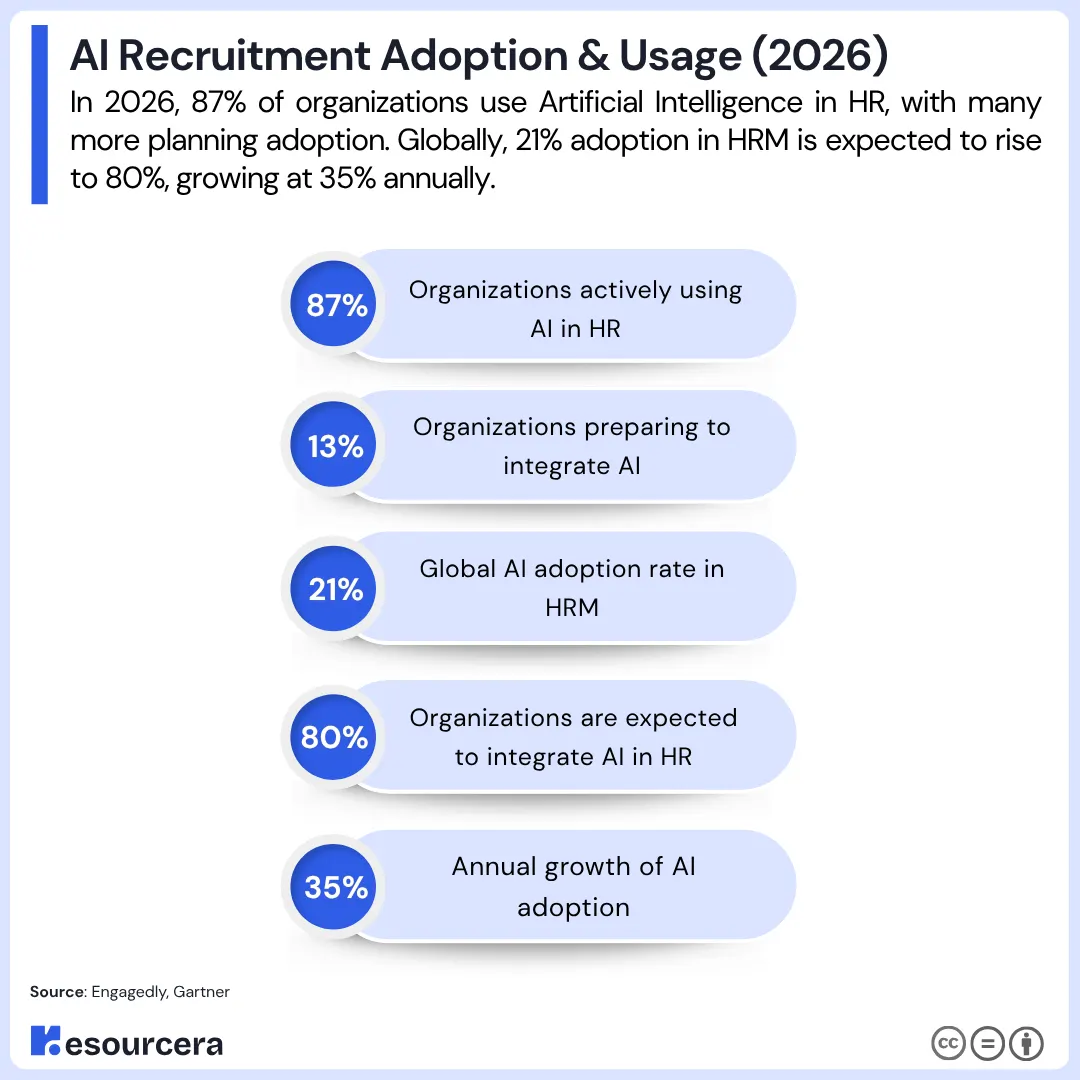
Let’s look at these statistics in a table:
| Metric | AI Usage |
|---|---|
| Organizations actively using AI in HR | 87% |
| Organizations preparing to integrate AI | 13% |
| Global AI adoption rate in HRM | 21% |
| Organizations are expected to integrate AI in HR | 80% |
| Annual growth of AI adoption | 35% |
Sources: Engagedly, Gartner
AI Usage In Employee Payroll and Benefits
AI-powered payroll systems already reduce processing time by 70% and are expected to cut payroll errors by 90% by the end of 2026.
In compensation, AI-driven models improve pay equity by 30%, while salary benchmarking tools enhance competitiveness by 25% in 2026. 60% of employees will expect such benchmarking, and compensation tools are projected to reduce pay gaps by 30%.
In benefits, AI-based personalization increases employee satisfaction by 40%, and predictive analytics improve benefits utilization by 22%.
AI also automates 90% of benefits administration tasks, with 70% of organizations expected to personalize benefits using AI by 2026.
Sources: Gartner 2, McKinsey, Indian Muneem
AI Usage Statistics In Performance Management
In 2026, 90% of HR decisions will be supported by AI-driven analytics, reducing hiring costs by 25% and saving companies an estimated $500 billion globally through workforce optimization.
Around 72% of HR professionals believe AI improves workforce planning, with AI-powered analytics able to predict workforce trends with up to 90% accuracy.
AI can also forecast skills gaps three years in advance, and 80% of organizations are expected to adopt this capability by 2026. HR dashboards powered by AI enhance decision-making by 60%, and attrition models save companies millions in rehiring costs.
AI in Hiring Statistics
Currently, 44% of organizations use AI for recruitment and talent acquisition, with 58% relying on it for video interview analysis. AI-powered tools are cutting costs by up to 30% and reducing time-to-hire by an average of 50%.
Recruiters confirm these gains, with 75% saying AI helps speed up the process through faster resume screening. AI-driven interview analytics boost hiring accuracy by 40%, while predictive analytics improve talent matching by 67% and workforce diversity by 35%.
By the end of 2026, 60% of organizations are expected to use AI for end-to-end recruitment processes. These tools are projected to reduce recruitment bias by 50%, automate 40% of repetitive tasks, and align with the preferences of 75% of job seekers who will favor AI-driven recruitment for faster feedback.
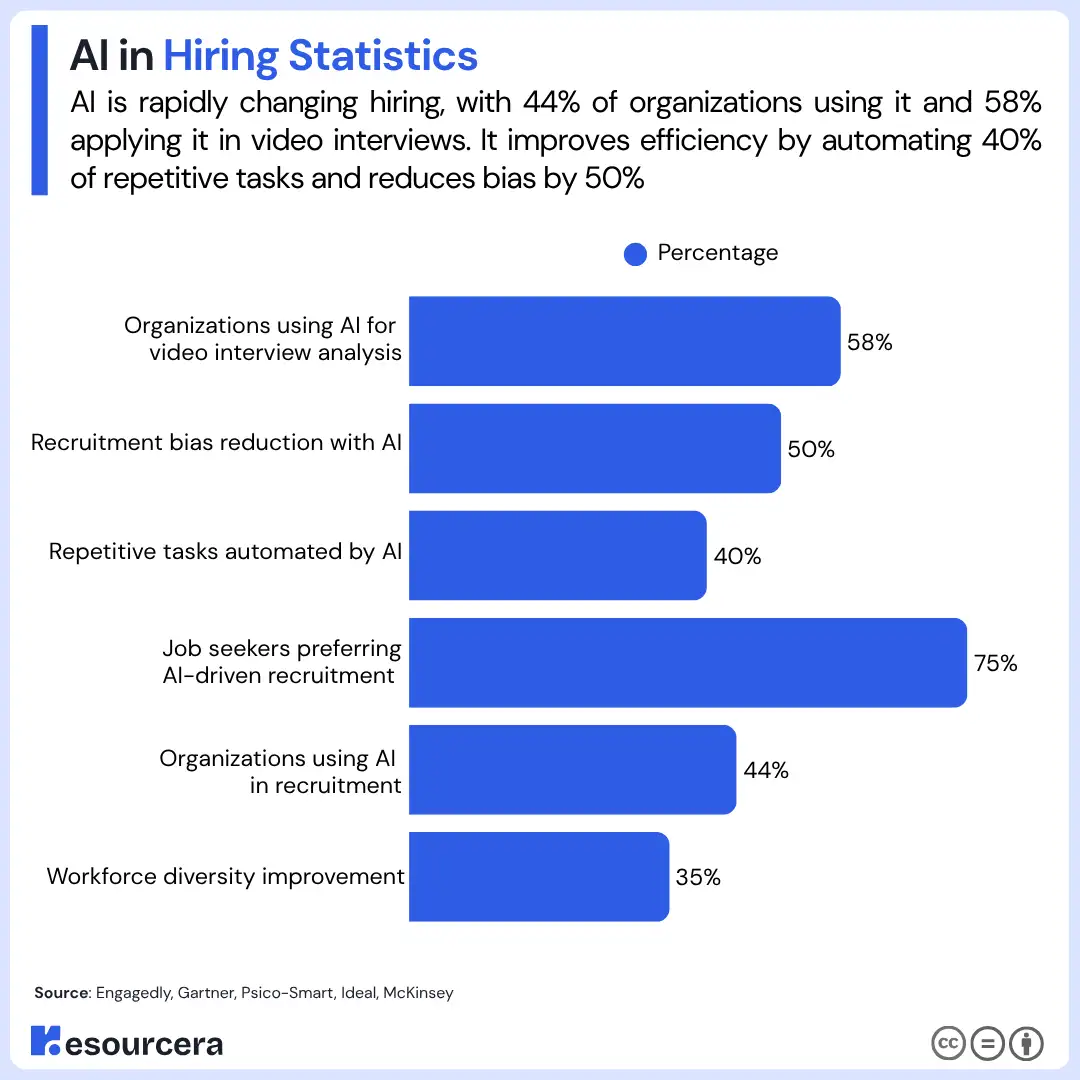
Here’s a table with the latest statistics on how organizations are using AI to streamline recruitment and talent acquisition:
| Trend | Percentage |
|---|---|
| Organizations using AI for video interview analysis | 58% |
| Recruitment bias reduction with AI | 50% |
| Repetitive tasks automated by AI | 40% |
| Job seekers preferring AI-driven recruitment | 75% |
| Organizations using AI in recruitment | 44% |
| Workforce diversity improvement | 35% |
Sources: Engagedly, Gartner, Psico-Smart, Ideal, McKinsey
Global AI Recruitment Market Size
The global AI recruitment market is valued at $703.42 million in 2026. It is expected to reach $1.22 billion by the end of 2033, with an expected CAGR of 7.2%.
From 2020 to 2023, the market grew by over $280 million in just three years. One of the most impressive jumps happened between 2022 and 2023 alone, where the market increased by more than $120 million in a single year. Overall, the industry has grown by over 64.45%, which is a remarkable achievement in a relatively short period of time.
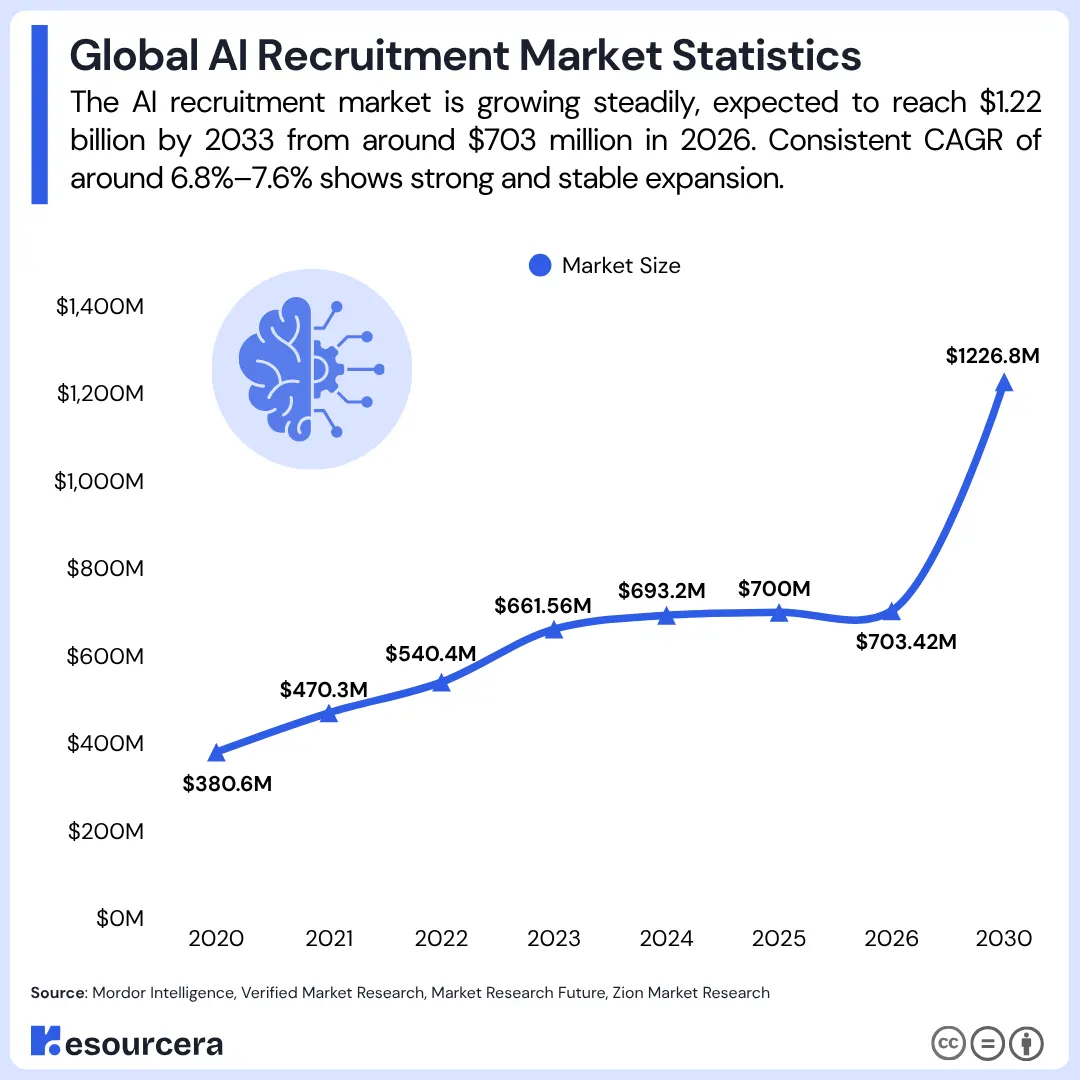
To truly understand how far this industry has come, it helps to look at the numbers year by year:
| Year | Market Size |
|---|---|
| 2020 | $380.6 million |
| 2021 | $470.3 million |
| 2022 | $540.4 million |
| 2023 | $661.56 million |
| 2024 | $693.2 million |
| 2025 | $700 million |
| 2026 | $703.42 million |
| 2030* | $1,226.8 million |
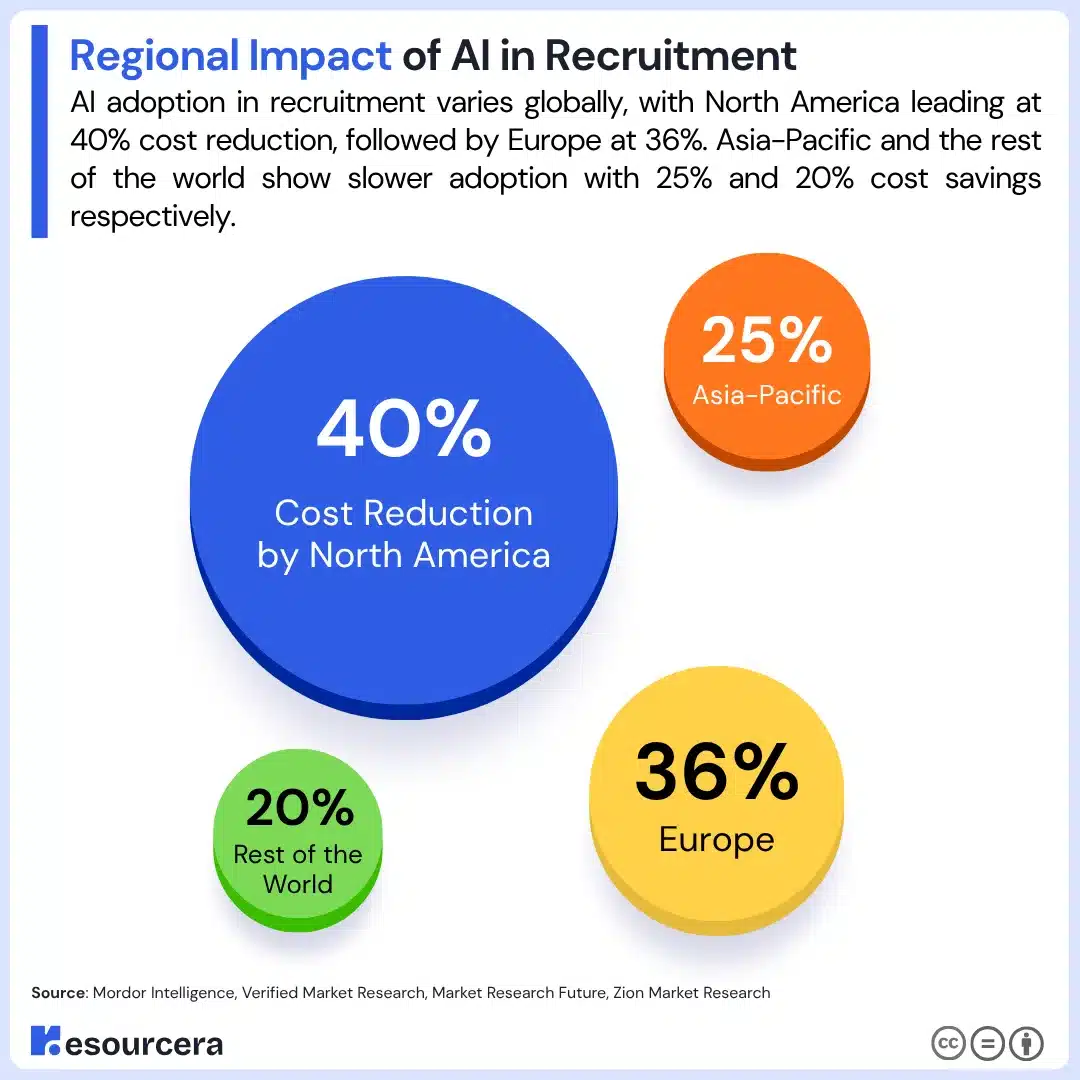
Not every part of the world is adopting AI in recruitment at the same pace. Here is how different regions compare when it comes to cutting costs in HR processes through the use of AI:
| Region | Cost Reduction |
|---|---|
| North America | 40% |
| Europe | 36% |
| Asia-Pacific | 25% |
| Rest of the World | 20% |
North America is clearly the front-runner. Companies in this region managed to cut their HR-related costs by 40% in 2022 by using AI tools in their recruitment processes. This strong adoption also translated into real money. North America generated $206.4 million in revenue for the global AI recruitment industry in 2022. By 2030, that contribution is expected to rise to $323.2 million.
Europe is not far behind, achieving a 36% cost reduction in the same year, making it the second most advanced region in AI-driven recruitment.
Asia-Pacific comes in third with a 25% cost reduction, while the rest of the world follows at 20%. As AI technology becomes more accessible globally, these numbers are likely to improve across all regions in the coming years.
The AI recruitment tools segment was valued at approximately US $1 billion in 2023 and is projected to triple to US $3 billion by 2032, with a robust 12.5% CAGR.
From multiple studies, it is evident that GAI recruitment market growth rates generally fall between 6% to 8%, indicating consistent but not explosive expansion.
Sources: Mordor Intelligence, Verified Market Research, Market Research Future, Zion Market Research
AI Recruitment Market Size by Region
In 2023, North America led the AI recruitment market with a value of $280 million, projected to reach $475 million by 2030.
Europe followed with a $150 million market in 2023, expected to hit $230 million by 2030, supported by GDPR compliance, transparency mandates, and compliance-driven hiring solutions.
The Asia-Pacific region stood at $120 million in 2023 and is projected to double to $250 million by 2030.
Here is the breakdown of AI recruitment market share by region:
| Region | 2023 | 2030 Projection |
|---|---|---|
| North America | $280 million | $475 million |
| Europe | $150 million | $230 million |
| Asia-Pacific | $120 million | $250 million |
Source: WeCP
Job Seeker Perspective on AI in Recruitment
66% of U.S. adults say they would not apply for a job where AI is used to make hiring decisions, while 79% of candidates want to be informed if AI is used in the recruitment process.
70% of job seekers believe AI can improve response time and enhance their experience, and 75% of candidates reported preferring AI-driven recruitment tools if it meant faster feedback and a more personalized experience.
Also, 44% of job seekers report experiencing discrimination during the recruitment process and believe AI tools could help reduce such bias.
On the other hand, 67% of job seekers feel “uncomfortable” when employers use AI to review resumes and make decisions, and almost 90% want companies to be forthright about using AI in hiring.
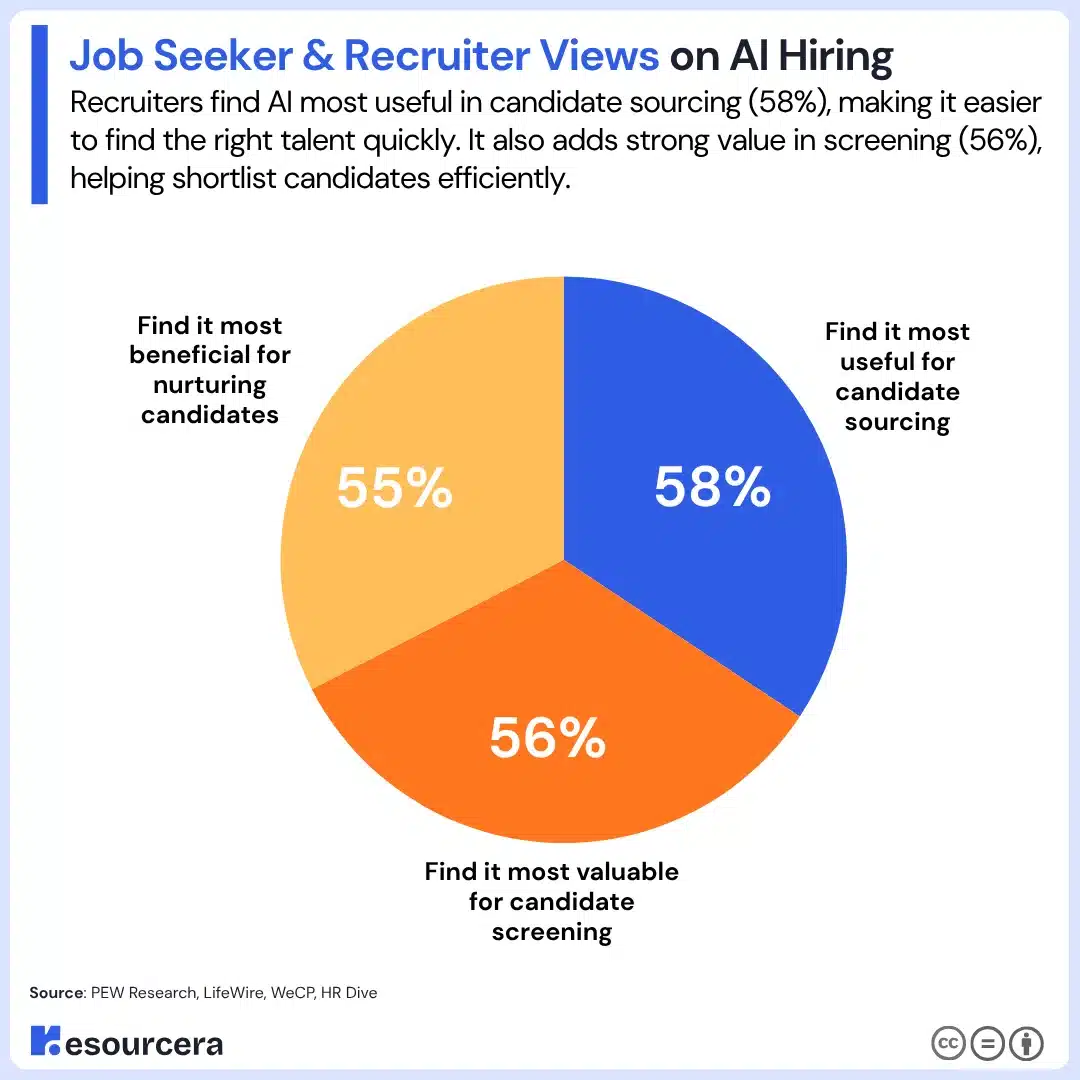
It is also worth understanding exactly where in the hiring process AI is making the biggest difference. Among recruiters who actively use AI:
| How Recruiters Feel about AI | % of recruiters |
|---|---|
| Find it most useful for candidate sourcing | 58% |
| Find it most valuable for candidate screening | 56% |
| Find it most beneficial for nurturing candidates | 55% |
Sources: PEW Research, LifeWire, WeCP, HR Dive
The Real Impact of AI on Hiring
One of the most compelling findings in AI recruitment is the quality of candidates it selects. Research shows that candidates chosen by AI are 14% more likely to pass their interviews
compared to those selected through traditional human-led processes.
These AI-picked candidates also have an 18% higher chance of accepting a job offer when one is extended to them.
When hiring decision-makers were asked about the primary benefit of using AI in recruitment, the answer was overwhelmingly clear, 67% said it saves time.
This is further supported by the fact that 86.1% of recruiters confirm that AI makes the hiring process faster.
Another important impact of AI in recruitment is its ability to make the process fairer. 43% of hiring decision-makers highlighted that AI helps remove human bias from the recruitment process.
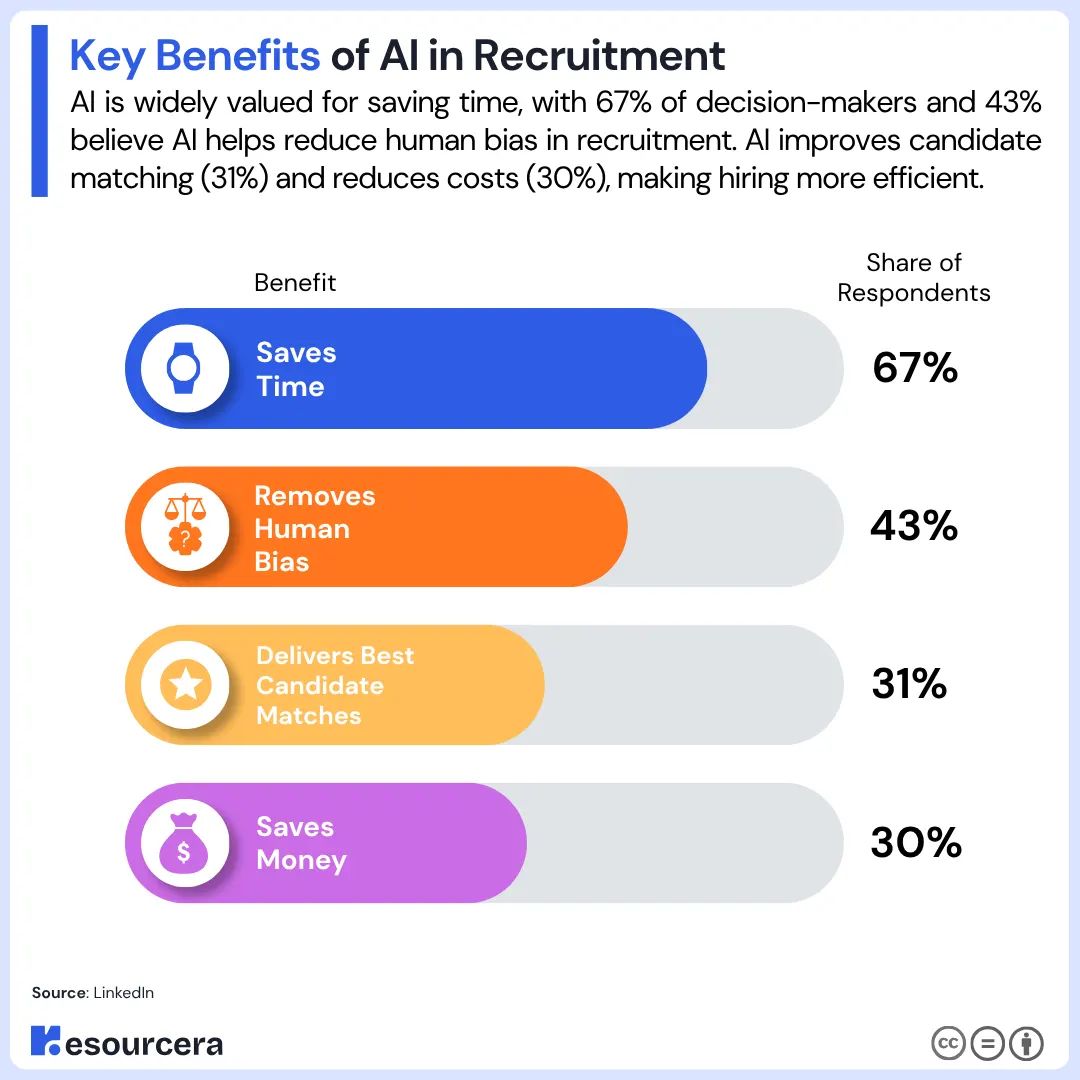
Here is a breakdown of the benefits that recruiters and hiring professionals associate with AI in recruitment:
| Benefit | Share of Respondents |
|---|---|
| Saves Time | 67% |
| Removes Human Bias | 43% |
| Delivers Best Candidate Matches | 31% |
| Saves Money | 30% |
Beyond time-saving and bias reduction, 31% of respondents said AI helps deliver the best candidate matches, while 30% pointed to cost savings as a key advantage.
AI Hiring Trends in 2026
73% of talent acquisition professionals agree that AI will fundamentally change how companies hire.
37% are already experimenting with or integrating generative AI into their hiring processes, and those using it report saving an average of 20% of their weekly workload.
89% say measuring the quality of hire will become more important, but only 25% feel highly confident in their organization’s current ability to evaluate it. Still, 61% believe AI can help improve this metric.
Around 93% of Talent Acquisition pros believe skills-based hiring is essential, and companies emphasizing skills in search are 12% more likely to make quality hires. Additionally, among those using generative AI, 35% redirected saved time to candidate screening and 26% focused on assessing skills.
Perhaps the most fascinating aspect of the future of AI in recruitment is how professionals within the industry themselves view its potential.
Here is a breakdown of which parts of the hiring process recruiters believe AI will eventually replace:
| Part of the Hiring Process | Share of Respondents |
|---|---|
| Screening Candidates | 65% |
| Searching for Candidates on Different Platforms | 56% |
| Creating Job Descriptions | 46% |
| Conducting Initial Interviews | 37% |
| The Whole Hiring Process | 31% |
Source: LinkedIn
Future Trends Of AI In Recruitment
58% of organizations believe AI will boost employee productivity in the next five years, while 55% expect it to enhance the overall employee experience.
More than half (53%) see AI improving performance management, 45% anticipate gains in employee development, and 31% expect improvements in talent management.
Currently, 35.5% of small and medium businesses are already allocating part of their budget toward recruiting tools that use artificial intelligence or machine learning.
Looking ahead, enterprises are expected to allocate the highest budgets toward AI-powered recruitment tools, according to Statista’s research.
This makes sense given the scale at which large organisations hire and the significant return on investment that AI can deliver at that level.
Meanwhile, 24% of mid-market companies are also planning to invest in AI-driven recruitment solutions, showing that the middle segment of the market is not sitting on the sidelines either.
By 2026, AI is forecast to augment 90% of HR functions and transform HR into a strategic function in 80% of organizations.
On the employee side, 70% are expected to believe AI improves their work-life balance. Altogether, AI-driven HR tools are projected to save organizations $1.5 trillion globally by 2026.
Taken together, these investment trends point to one clear conclusion. AI in recruitment is not a passing trend. It is becoming a core part of how businesses plan and operate their hiring strategies.
Sources: McKinsey, Deloitte, PWC
Will AI Replace Recruiters Entirely?
This is the question that naturally follows. And the answer, based on current sentiment, is largely no.
Only 31% of recruiters believe that AI will ultimately take over the entire hiring process. This means the majority of recruitment professionals still see a meaningful human role in hiring, even as AI takes on more and more of the workload.
On the other end of the spectrum, 15% of recruiters firmly believe that AI will never replace the human element of recruitment. They argue that hiring is fundamentally about human connection, judgment, and cultural fit qualities that a machine cannot fully replicate.
The most widely shared view among over 85% of HR professionals is that AI will replace several aspects of the recruitment process, but not all of it. This balanced perspective suggests that the future of recruitment will be one of collaboration between humans and AI, rather than a complete handover to machines.

