

With approximately 2 billion monthly active users, TikTok ranks as the fifth most popular social media platform on the planet. That massive scale brought intense scrutiny from governments worldwide.
As of 2026, countries have responded in three distinct ways: full consumer bans that block the app for everyone, government-device restrictions that apply only to officials, and partial or event-triggered blocks tied to specific incidents or political moments.
In total, 35 countries and institutions have placed some form of restriction on TikTok as of 2026. These include 8 full consumer bans, 16 government-device restrictions, 5 partial or conflict-triggered blocks, and age-based bans across 10 countries.
This guide covers every category of countries that banned TikTok, when, why, and which bans have since been reversed.
TikTok Banned Countries 2026: Key Takeaways
- TikTok has approximately 2 billion monthly active users globally, making it the fifth most-used social platform.
- Seven countries currently maintain active full consumer bans: India, Afghanistan, Iran, Somalia (announced but inconsistently enforced), Kyrgyzstan, Gabon, and North Korea.
- China does not permit the international version of TikTok users there to access Douyin, its domestically regulated counterpart.
- India had around 200 million active monthly users when it imposed its ban in June 2020.
- Nepal’s ban was lifted in August 2024, and Albania’s was ruled unconstitutional in March 2026.
- Russia formally restricted TikTok in 2022, yet an estimated 56 million users still reach the platform through VPNs.
- Australia became the first country in the world to ban social media apps for users under 16, effective December 2025.
TikTok Banned Countries List
The table below covers every country and institution that has taken formal action against TikTok, across all restriction types.
| Country / Entity | Restriction Type | Year | Status (2026) |
|---|---|---|---|
| India | Full consumer ban | 2020 | Active , permanent |
| Afghanistan | Full consumer ban | 2022 | Active |
| Iran | Full consumer ban | Ongoing | Active , part of broader censorship |
| Somalia | Full consumer ban (unenforced) | 2023 | Announced; not consistently enforced |
| Kyrgyzstan | Full consumer ban | 2023 | Active , lifting proposed Feb 2026 |
| Gabon | Full consumer ban | 2026 | Active |
| North Korea | Full consumer ban | Ongoing | Active , total internet censorship |
| China | International TikTok blocked; Douyin only | Ongoing | Active |
| United States | Government devices (federal + 34+ states) | 2023 | Active |
| United Kingdom | Government devices | 2023 | Active |
| Canada | Government devices | 2023 | Active |
| Australia | Government devices (68+ agencies) | 2023 | Active |
| European Union | EU institutional devices | 2023 | Active |
| France | All civil servant devices | 2023 | Active |
| Belgium | Federal government devices | 2023 | Active |
| Denmark | Ministry of Defence devices | 2023 | Active |
| Norway | Government minister and advisor devices | 2023 | Active |
| Latvia | Ministry of Foreign Affairs devices | 2023 | Active |
| Estonia | All state-issued devices | 2023 | Active |
| New Zealand | Parliamentary devices | 2023 | Active |
| Taiwan | All public sector devices | 2022 | Active |
| Ireland | All public sector devices | 2023 | Active |
| Netherlands | Government official devices | 2022 | Active |
| NATO | All official NATO devices | 2023 | Active |
| Russia | Partial , access severely restricted | 2022 | Active; 56M users via VPN |
| Senegal | Partial , blocked amid political unrest | 2023 | Awaiting regulatory agreement |
| Bangladesh | Partial , protest/event-triggered blocks | 2018, 2024 | Intermittent |
| Azerbaijan | Partial , conflict-triggered restrictions | 2020, 2023 | Intermittent |
| Armenia | Partial , functionality loss during conflict | 2020 | Unconfirmed government action |
| Australia | Under-16 social media ban | 2025 | Active |
| France | Under-16 social media ban (in progress) | 2026 | Implementing |
| Denmark | Under-16 social media ban (in progress) | 2026 | Implementing |
| Germany | Under-16 social media ban (in progress) | 2026 | Implementing |
| Spain | Under-16 social media ban (in progress) | 2026 | Implementing |
| Greece | Under-16 social media ban (in progress) | 2026 | Implementing |
| Indonesia | Under-16 social media ban (in progress) | 2026 | Implementing |
| Slovenia | Under-16 social media ban (in progress) | 2026 | Implementing |
| Malaysia | Under-16 social media ban (in progress) | 2026 | Implementing |
| United Kingdom | Under-16 social media ban (in progress) | 2026 | Implementing |
Source: Wikipedia, Business of Apps, PBS NewsHour
Countries Where TikTok Is Fully Banned (Active 2026)
The countries below block TikTok at the network level for all residents. The app is unavailable through national app stores and inaccessible on local ISP connections.
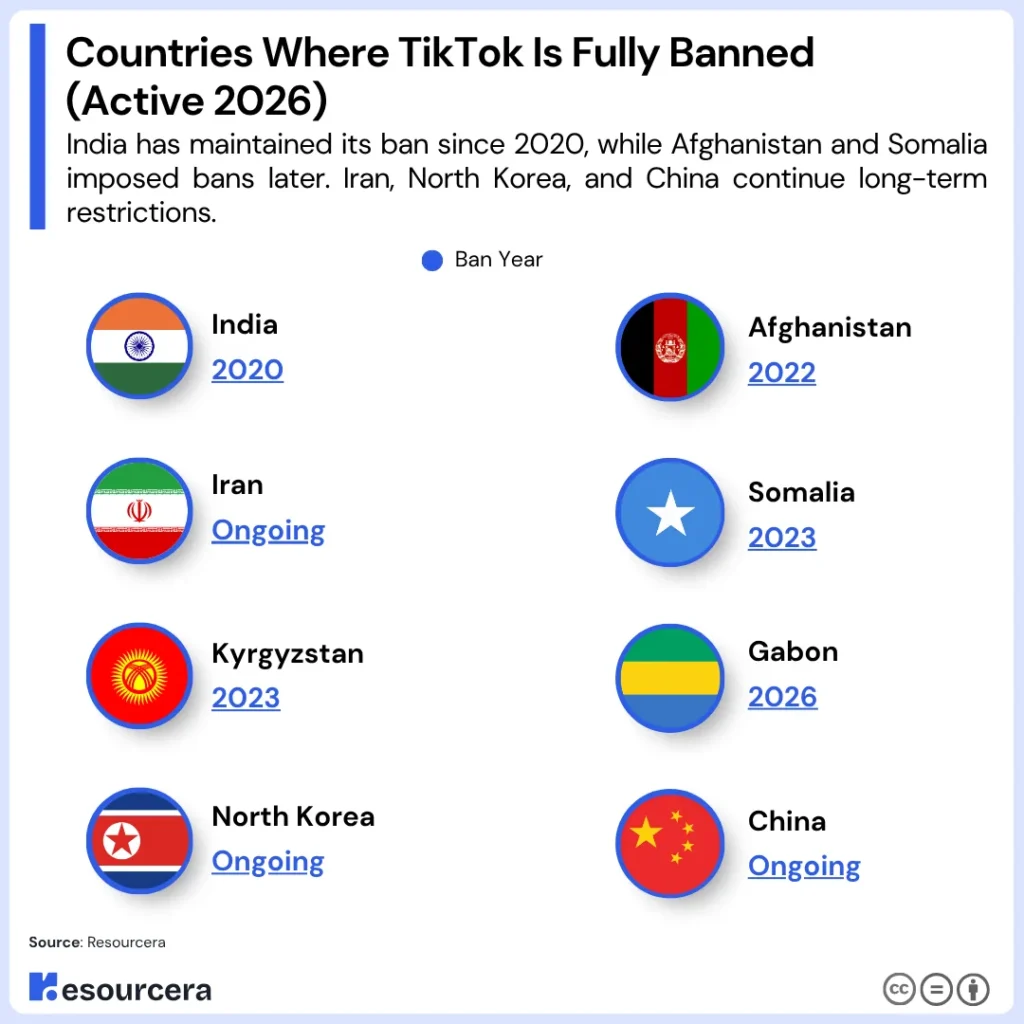
These countries include:
| Country | Ban Year | Primary Reason | Notes |
|---|---|---|---|
| India | 2020 | National security, data sovereignty, India-China border conflict | Permanent; no reversal announced |
| Afghanistan | 2022 | Content deemed incompatible with Islamic law | Taliban-imposed |
| Iran | Ongoing | Part of Iran’s broader internet censorship framework | Not a standalone TikTok-specific ban |
| Somalia | 2023 | Violent extremism, explicit content | Announced but not consistently enforced at network level |
| Kyrgyzstan | 2023 | Child mental health, content moderation failures | Government proposed lifting ban in Feb 2026 |
| Gabon | 2026 | Broad social media restriction amid civil unrest | Applied to multiple platforms |
| North Korea | Ongoing | Total internet censorship regime | No external platforms accessible |
| China | Ongoing | International TikTok blocked; domestic Douyin used instead | Douyin operates under government content controls |
China
China occupies a unique position on this list. The international version of TikTok does not work on mainland Chinese networks. Instead, ByteDance operates Douyin, a separate, government-compliant version of the app for domestic users. This means TikTok’s own parent company’s home country is one of the most restrictive environments for the platform.
Somalia:
Somalia’s communications ministry formally announced the ban in August 2023, but multiple sources indicate that enforcement at the network level has been inconsistent. Users in Somalia have continued to access TikTok in practice. The ban exists in policy, but not uniformly in effect.
India:
On June 29, 2020, India’s Ministry of Electronics and Information Technology banned TikTok along with 58 other Chinese-developed apps, citing threats to national sovereignty, defence, and public order.
At the time of the ban, India was TikTok’s largest overseas market. While active monthly users stood at roughly 200 million, cumulative downloads had reached approximately 611 million, accounting for around 30% of TikTok’s total global downloads to that point.
ByteDance shuttered its Indian operations and abandoned a planned $1 billion investment in the country. YouTube Shorts and Instagram Reels moved into the gap and absorbed most of the displaced creator community. India has since become YouTube’s largest global market, with nearly 500 million monthly users.
In late August 2025, speculation about a potential lifting of the ban emerged after TikTok’s website briefly became accessible to some Indian users, and ByteDance posted India-based job listings on LinkedIn. No official reversal has been announced as of May 2026.
Countries Where TikTok Is Restricted on Government Devices
No consumer-level ban applies in these countries. TikTok is freely accessible to the public, but is prohibited on officially issued government phones and devices due to cybersecurity concerns.
| Country | Restriction Scope | Affected Population |
|---|---|---|
| United States | Federal agencies + 34+ state government bodies | Federal employees, state government workers |
| United Kingdom | All civil servants and ministers | Full public sector |
| Canada | Federal government employees | All federal workers |
| Australia | 68+ federal agencies | Federal government devices only |
| European Union | EU Parliament, Commission, EU Council | ~32,000 EU Commission staff |
| France | All civil servant work phones | ~2.5 million civil servants |
| Belgium | Federal government devices | Federal employees |
| Denmark | Ministry of Defence devices | Defence Ministry staff |
| Norway | Government ministers and advisors | Ministers, political advisors, secretaries |
| Latvia | Ministry of Foreign Affairs devices | Foreign Affairs staff |
| Estonia | All state-issued devices | Public officials |
| New Zealand | Parliamentary devices | Lawmakers and parliamentary staff |
| Taiwan | All public sector devices | Entire public sector workforce |
| Ireland | All public sector devices | Official public sector bodies |
| Netherlands | Government official devices | Government officials |
| NATO | All official NATO devices | NATO personnel across member countries |
A government-device restriction targets institutional data risk, it has no impact on personal phones, tourists, or private citizens. TikTok remains fully accessible to the general public in every country on this list.
Is TikTok Banned in the USA (2026)?
TikTok is not banned in the United States. The platform operates under a restructured ownership model that satisfies federal legal requirements.
Congress passed PAFACAA in 2024, giving ByteDance a deadline to divest its US operations or face a full ban. On January 18, 2025, TikTok briefly went dark in the United States for several hours as the deadline arrived.
President Trump signed an executive order on his first day in office extending the deadline, eventually resolving the standoff through a formal ownership restructure.
On January 22, 2026, TikTok USDS Joint Venture LLC was officially established. Oracle, Silver Lake, and MGX each acquired 15% stakes as managing investors. Affiliates of existing ByteDance investors hold a combined 30.1%. ByteDance itself retained 19.9%, deliberately structured to stay below the 20% threshold specified in federal law.
TikTok rebounded quickly following the transition, returning to 90+ million daily active users in the US by February 2026. The US accounts for roughly 10% of TikTok’s global users but generates approximately 38–41% of its global advertising revenue.
TikTok Restrictions in Europe (2026)
No major European country has a full consumer-level TikTok ban as of 2026. Restrictions across the continent are limited to government and institutional devices, though regulatory pressure through GDPR has produced significant financial consequences.
| Metric | Data |
|---|---|
| Status | No consumer bans active |
| Restriction Type | Government device bans + GDPR compliance requirements |
| EU Monthly Active Users | 169 million |
| Albania Status | Ban lifted Feb 3, 2026; ruled unconstitutional March 11, 2026 |
| Notable Regulatory Action | France fined TikTok €60 million in 2025 for GDPR violations |
In March 2025, Albania became the first European country to impose a nationwide consumer-level ban on TikTok, triggered by the fatal stabbing of a 14-year-old student in Tirana in November 2024.
The Prime Minister cited a survey of 65,000 parents, 90% of whom reportedly supported the ban. However, Albania’s Constitutional Court ruled on March 11, 2026, that the ban violated freedom of expression and freedom of the press, and the ban had already been lifted on February 3, 2026.
In France, GDPR enforcement took a different form: TikTok was fined €60 million in 2025 for illegally tracking cookies without adequate parental consent. Germany mandates age verification for users under 16, and the UK continues to investigate TikTok’s data practices and algorithmic operations under its independent post-Brexit regulatory framework.
Bans That Have Been Lifted or Reversed
Several countries that appeared on earlier TikTok ban lists no longer have restrictions in place. These cases are worth tracking because they show the fluid nature of government enforcement.
| Country | Ban Imposed | Ban Lifted | Reason for Lifting |
|---|---|---|---|
| Nepal | November 2023 | August 2024 | Agreement with TikTok on criminal misuse identification |
| Albania | March 2025 | February 3, 2026 | Ruled unconstitutional by Constitutional Court (March 11, 2026) |
| Pakistan | Multiple (Oct 2020 – Nov 2021) | November 2021 (final) | TikTok’s assurances on content moderation |
| Jordan | December 17, 2022 | December 23, 2022 | Six-day temporary ban; lifted after platform engagement |
| Indonesia | July 3, 2018 | July 11, 2018 | Eight-day ban; lifted after TikTok pledged content moderation |
Nepal’s case is particularly instructive: the government banned TikTok over “social harmony” concerns in November 2023, then lifted it less than nine months later after TikTok agreed to help authorities identify criminal misuse of the platform.
Pakistan went through four separate cycles of banning and lifting TikTok between October 2020 and November 2021, each time over content moderation disputes. As of 2026, TikTok is fully accessible in Pakistan.
Partial, Conflict-Triggered, and Disputed Restrictions
Some countries have imposed temporary or situational blocks on TikTok that don’t fit neatly into either the full ban or the government-device-restriction categories.
Russia:
TikTok access became severely limited following Russia’s invasion of Ukraine in 2022. The app was formally restricted, but enforcement has been uneven. An estimated 56 million Russian users continue to reach TikTok through VPNs and alternative apps.
Senegal:
In August 2023, Senegal blocked TikTok following the arrest of opposition leader Ousmane Sonko amid political unrest. The government later indicated it would lift the restriction only after signing a comprehensive regulatory agreement with the platform.
Bangladesh:
Bangladesh has a long and complicated history with TikTok. An initial block came in November 2018 as part of a broader crackdown on pornography and gambling sites. The ban was cleared after TikTok agreed to remove flagged content. Most recently, in August 2024, TikTok and YouTube were both blocked during the quota reform protest movement, a temporary measure tied to a specific political moment.
Azerbaijan and Armenia:
In September 2020, Azerbaijan restricted access to TikTok and several other platforms during the Nagorno-Karabakh conflict, citing the spread of unverified information. Armenia experienced a loss of TikTok functionality around the same period, though it was never confirmed whether this was a deliberate government-ordered action or an infrastructure consequence of the conflict. Azerbaijan imposed a second round of TikTok restrictions in September 2023 during renewed clashes in the region.
Kyrgyzstan:
While listed in the active full ban table, the Kyrgyzstan government proposed lifting its ban in February 2026 to support the country’s growing economy. The status of that proposal remains unresolved as of publication.
TikTok Ban Impact: Global Statistics (2026)
The numbers below capture the measurable scale of how bans, restructures, and restrictions have affected users, creators, and the advertising economy.
- India’s ban instantly cut off approximately 200 million active monthly users and 611 million cumulative downloads from the platform overnight.
- Russia formally restricted TikTok, yet an estimated 56 million Russian users still access the platform through VPNs and clone applications.
- Indonesia is TikTok’s largest single country market with approximately 180.1 million users, followed by the United States at 136 million and Brazil at 91.7 million.
- US net advertising revenue for TikTok in 2025 was approximately $11.01 billion.
- TikTok Shop generated $15.82 billion in US sales in 2025, representing 108% year-on-year growth. Over 71.4 million Americans made purchases through the feature that year.
- In countries where TikTok is banned or under sanctions, TikTok creator fund is disabled entirely. Creators in those markets have lost an estimated 60% of their platform income and typically migrate to YouTube Shorts or Instagram Reels.
- The average TikTok user globally opens the app more than 15 times per day and spends approximately 58 minutes on the platform daily.
Why TikTok Is Banned in Certain Countries
The stated reasons differ by government, but five concerns appear consistently across nearly every action on this list.
- Data Privacy: TikTok collects location data, device identifiers, browsing history, and biometric information. Governments worry that ByteDance’s obligations under Chinese national security laws could force the company to hand this data to Chinese authorities , regardless of where the data is stored.
- National Security: Under PAFACAA, the US Congress formally designated TikTok a “foreign adversary-controlled application.” The underlying concern is that a foreign government could access user data or use the platform’s reach to influence public opinion. India cited near-identical language in its 2020 ban order.
- Algorithm Opacity: Multiple governments, including those in the EU and South Korea, have raised concerns about the fact that TikTok’s recommendation algorithm is not transparent. If the algorithm can be adjusted by an external actor, it could theoretically be used to suppress certain content, amplify others, or influence political narratives , without users or regulators being aware.
- Content Moderation: Governments in politically unstable or conservative-leaning environments flagged TikTok for the rapid spread of violent, explicit, and politically destabilizing content. Afghanistan, Somalia, Nepal, and Kyrgyzstan all cited content moderation failures as their primary justification.
- Youth Safety: Albania’s ban in 2025, triggered by a school stabbing in Tirana, brought child safety to the center of the global conversation. Australia’s under-16 social media ban in December 2025 accelerated this trend into a broader legislative movement. Youth safety now sits alongside national security as a co-equal driver of platform regulation.
In most cases, governments act when two or more of these concerns converge simultaneously.
Can You Access TikTok in Countries Where It’s Banned?
Technically yes, but it is not legal in most cases. In full-ban countries like India, Iran, and Afghanistan, VPNs can bypass restrictions. Russia’s 56 million users still access TikTok this way despite a formal ban.
In full-ban countries (India, Iran, Afghanistan): TikTok is blocked at the ISP level, meaning the app cannot be accessed through local networks without a VPN. Russia’s estimated 56 million remaining TikTok users primarily rely on this method.
Using a VPN to bypass a full ban is technically possible but illegal or legally ambiguous in most of these countries. In India, no legal method of access exists, and the government has confirmed the ban is permanent with no reinstatement planned.
In government-device-restriction countries (UK, France, Canada, Australia, etc.): There is no restriction whatsoever on personal devices. Tourists, private citizens, and employees using personal phones face zero limitations. The ban applies exclusively to officially issued government hardware.
For creators in banned markets: Many displaced creators have migrated to YouTube Shorts and Instagram Reels, which expanded significantly to absorb TikTok’s former user base. India is now YouTube’s largest global market as a direct consequence of the 2020 ban.
Wrap Up
Seven countries maintain active full consumer bans, with China representing a unique structural case through its Douyin-only policy. Over 15 governments restrict the app on official devices without touching public access.
And several countries like Nepal, Albania, Pakistan, Jordan, and Indonesia demonstrate that bans can be reversed when political conditions or regulatory agreements shift.
Data privacy, national security, algorithm transparency, and child safety are the four pillars driving every major decision in this space. For creators and businesses operating globally, the consistent message from all three of these trends is the same.

