


WhatsApp is one of the most widely used apps in the world, with over 3.3 billion active users. Despite this massive scale, the platform has remained free for users and does not rely on traditional advertising for most of its revenue.
Instead, WhatsApp primarily earns money through its business ecosystem. The company launched WhatsApp Business in 2018, allowing businesses to communicate with customers, send updates, and offer support directly through the app. Today, this side of the platform has grown significantly, with over 764.38 million people using the WhatsApp Business app every month.
While the core messaging experience remains ad-free, WhatsApp also has a large monetization opportunity through its content surfaces. The Updates tab, which includes Status and Channels , and is visited by more than 1.5 billion users every day, making it one of the platform’s most heavily used sections.
To tap into this engagement, WhatsApp has started introducing ads within the Updates tab, allowing businesses to promote products and Channels without interrupting private chats. This move signals a new phase in WhatsApp’s monetization strategy, built around its massive global user base.
WhatsApp Revenue Over The Years
Its estimated that WhatsApp registered a revenue of $2,440 million in 2025 and is projected to reach $3,260 million in 2026. The revenue is driven primarily by the rapid growth of its business API and ads now being shown in the status and channel.
The revenue of WhatsApp has grown steadily over the years, increasing from $443 million in 2018 to $2.44 billion in 2025, representing an increase of more than 450.8% in seven years.
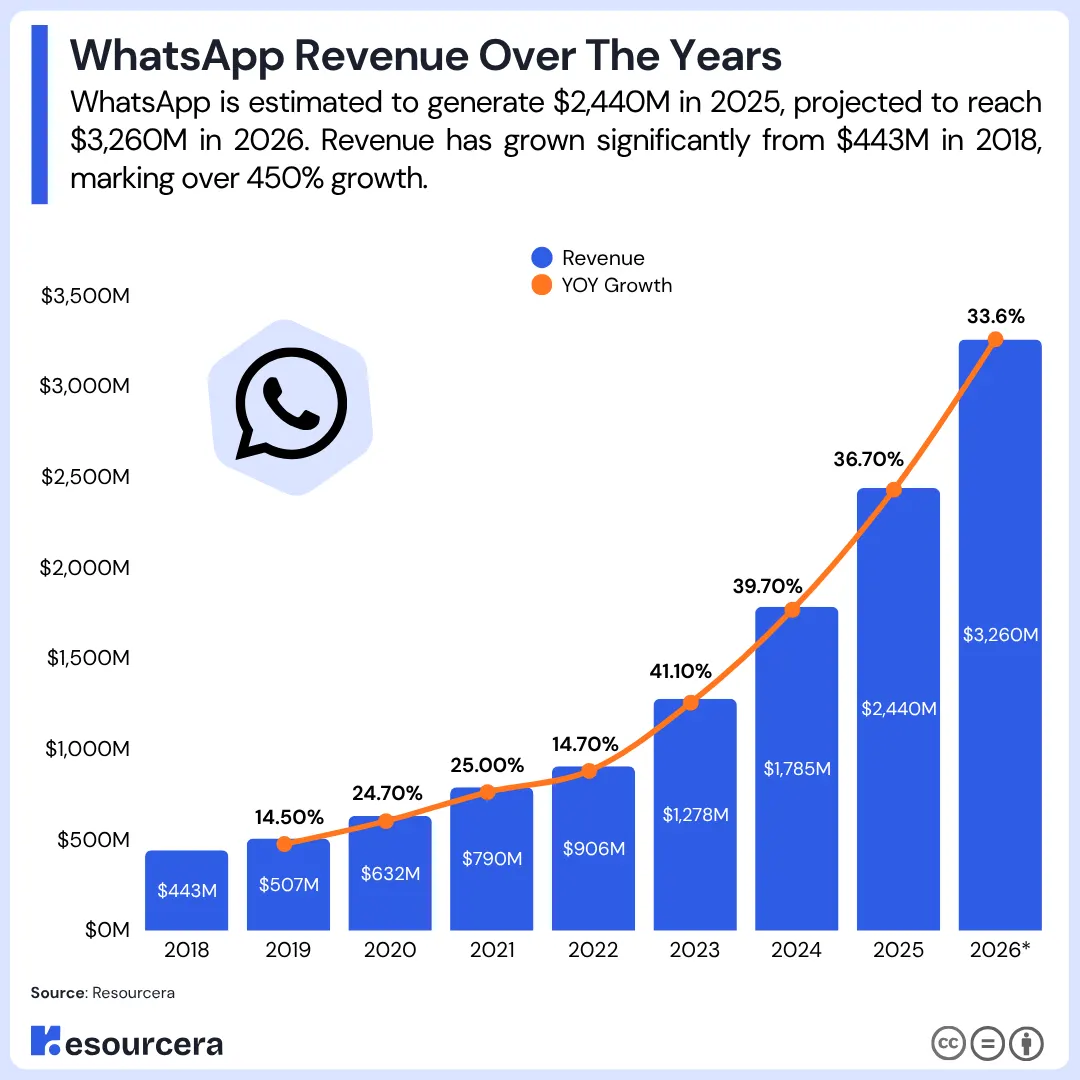
The table below shows WhatsApp’s revenue over the years.
| Year | Revenue | YOY Growth |
|---|---|---|
| 2018 | $443 million | – |
| 2019 | $507 million | 14.50% |
| 2020 | $632 million | 24.70% |
| 2021 | $790 million | 25.00% |
| 2022 | $906 million | 14.70% |
| 2023 | $1,278 million | 41.10% |
| 2024 | $1,785 million | 39.70% |
| 2025 | $2,440 million | 36.70% |
| 2026* | $3,260 million | 33.6% |
WhatsApp Revenue By Region
Asia is the largest contributor to WhatsApp’s revenue, accounting for nearly half of the total. This is driven mainly by countries like India, Indonesia, and Pakistan where WhatsApp is the predominant online messaging app.
Europe is the second-largest revenue source. High Smartphone penetration and widespread business adoption of WhatsApp in countries like Germany, Spain, and the UK contribute to the revenue.
North America and Oceania lag behind, showing that WhatsApp’s monetization is still highly dependent on regions that have high active user engagement.
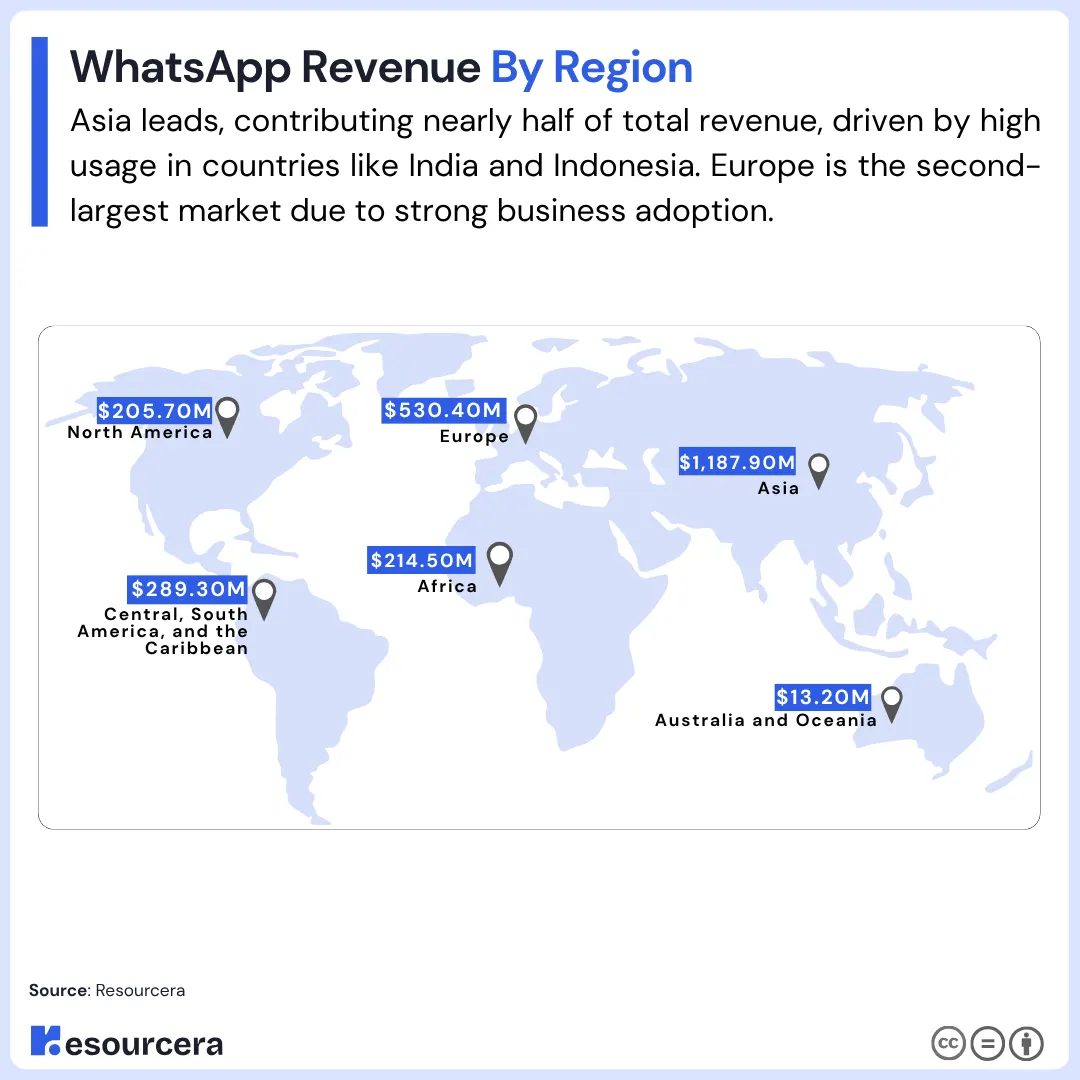
Below is the estimated breakdown of WhatsApp revenue across different regions for 2025.
| Region | Revenue |
|---|---|
| Asia | $1,187.90 million |
| Europe | $530.40 million |
| Central, South America, and the Caribbean | $289.30 million |
| Africa | $214.50 million |
| North America | $205.70 million |
| Australia and Oceania | $13.20 million |
How WhatsApp Makes Money?
WhatsApp mainly makes money through business-focused tools rather than charging regular users. The platform earns money from Click to WhatsApp Ads, WhatsApp Business API, WhatsApp Payments, and WhatsApp Channels.
The following is the detailed breakdown of WhatsApp’s different revenue sources.
Click to WhatsApp Ads
Click to WhatsApp Ads are growing fast, contributing to Meta’s nearly $10 billion annual business messaging revenue, and in India alone, more than 60% of WhatsApp users message a business app account every week.
These are the Ads on Facebook and Instagram that open a WhatsApp chat when someone taps on “Message on WhatsApp”.
Click to WhatsApp Ads allows businesses to talk directly with customers, making it easier to answer doubts, share product information, and complete sales quickly.
WhatsApp Business API
WhatsApp Business API has turned out to be a major source of revenue. It earned around $1.7 billion in 2024.
The WhatsApp Business API is free to access, but businesses have to pay Meta for each conversation. The price depends on the country and the type of message, such as marketing, utility updates, and authentication messages.
WhatsApp Payments
WhatsApp Payments is the in-app feature that enables users to send and receive money directly in their chats. It can be used for both personal and business payments in countries like India and Brazil.
WhatsApp Channels
WhatsApp Channels is the feature that allows businesses, creators, and organizations to share updates with a large audience through one-way broadcast.
Users can choose to follow channels to receive updates in the form of text, videos, images, and more.
Real Madrid, FC Barcelona, and Netflix are some of the most followed channels on WhatsApp.
WhatsApp’s Contribution to Meta’s Revenue
Whatsapp with its $2.44 billion in revenue made up 1.21% of Meta’s overall revenue in 2025.
The click-to-WhatsApp ads appear on Facebook and Instagram and initiate chat on WhatsApp when users click on them. The revenue generated from these ads is counted as part of Meta’s total advertising revenue.
Although WhatsApp currently contributes a small fraction of Meta’s total revenue, its fast-growing business platform and expanding global adoption make it one of the important revenue drivers for Meta’s future.
Future Trends in WhatsApp’s Revenue Growth
WhatsApp’s revenue is expected to grow steadily as it expands its business messaging services, introduces new commerce features, and monetizes ads.
Business messaging via the WhatsApp Business API, combined with click-to-WhatsApp Ads on Facebook and Instagram, is expected to remain the primary driver of revenue.
With the expansion of WhatsApp Pay and in-chat commerce, WhatsApp is positioning itself as a key platform for digital transactions and small to medium business sales.
Overall, WhatsApp is projected to contribute an increasingly significant portion of Meta’s total Ad and business revenue in the coming years.

