We’re already into the third month of Q1 2026 and Generative AI is reshaping how education works in schools globally. In the United Kingdom, 65% of primary and secondary teachers use GenAI for schoolwork.
More than 3 in 4 teens in the U.K. also use GenAI tools to support homework, creative tasks, and even classroom learning. And yet, the institutions around them aren’t keeping up. Most schools still lack formal AI policies. Many teachers don’t feel equipped to guide students, and over half of non-users say they simply don’t know how GenAI fits their role. In other words: AI is moving faster than the system built to contain it.
Top Generative AI in UK Education Statistics (2026)
- Teacher adoption of GenAI rose from 17% to 42% in just 7 months (Apr–Nov 2023).
- 74% of UK online youth aged 16–24 have used GenAI tools.
- 61% of students use GenAI for homework; 40% for general home learning.
- Only 8% of teachers believe GenAI is not relevant to their role.
- 65% of school leaders have no plan for GenAI integration.
- 76% of teachers feel unprepared to advise students on safe AI use.
AI Adoption In UK Education Statistics
GenAI is seeing rapid uptake in UK schools, especially among younger teachers, men, and secondary educators. Adoption is more prevalent in independent schools and among college educators. Students are even further ahead, with most teens already experimenting with AI tools for schoolwork and creative tasks.
Among Teachers
- 65% of primary and secondary teachers use GenAI for schoolwork as of March 2026, up from 42% in 2026.
- Men, younger teachers, and secondary school staff are more likely to use GenAI:
- 18% of male teachers vs. 9% of female teachers.
- 15% of teachers aged 18 to 34 vs. 9% of those aged 45 to 54.
- 14% of secondary vs. 9% of primary school teachers.
- 23% of college educators had used GenAI.
- Independent school teachers were twice as likely as state school teachers to use GenAI (17% vs 9%).
Among Students
- 79% of online 16 to 24 year olds in the UK use a GenAI tool as of March 2026.
- 82% of online teenagers (13 to 17) and 40% of online children (7 to 12) had used GenAI tools like ChatGPT, Snapchat My AI, Midjourney, or DALL-E.
- 14% of secondary pupils self-reported using AI for schoolwork; other surveys suggest up to 67% of secondary pupils and around 50% of university students use GenAI to support studies.
Among Parents
- 37% of parents of secondary school pupils were unsure if their child used AI for schoolwork.
How GenAI Is Used By Teachers In The U.K.
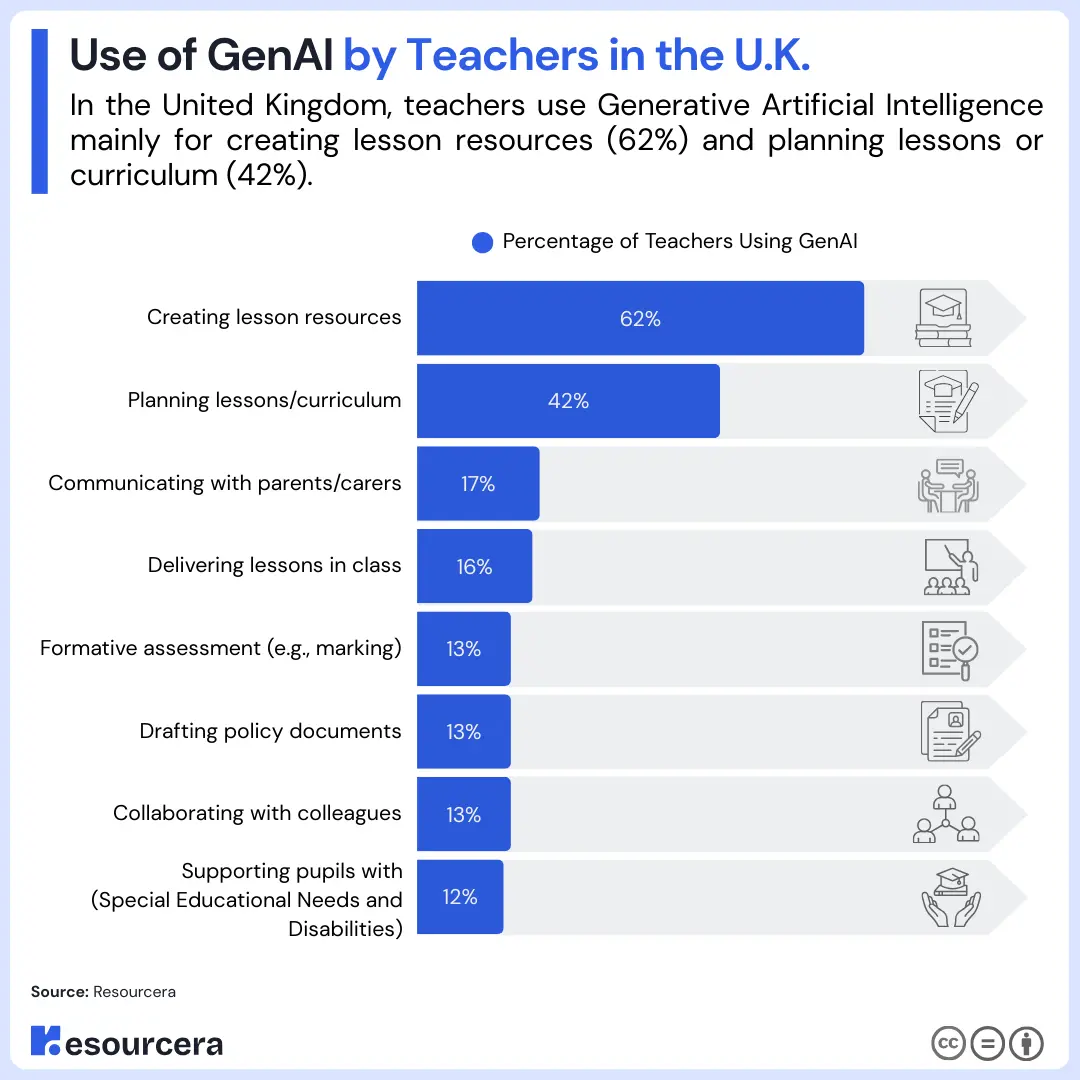
| Use Case | Percentage of Teachers Using GenAI |
|---|---|
| Creating lesson resources | 62% |
| Planning lessons/curriculum | 42% |
| Communicating with parents/carers | 17% |
| Delivering lessons in class | 16% |
| Formative assessment (e.g., marking) | 13% |
| Drafting policy documents | 13% |
| Collaborating with colleagues | 13% |
| Supporting pupils with (Special Educational Needs and Disabilities) | 12% |
For a global perspective, see our insights on AI usage in education worldwide.
Gen AI Use Cases By Educational Stage
- Secondary educators use GenAI for assessments (18% formative, 16% summative) more than primary (6% and 3%, respectively).
- School leaders use GenAI for admin: 31% for parental comms, 30% for policy drafting (vs. 15% and 10% for non-leaders).
How GenAI Is Used By Students In The U.K.
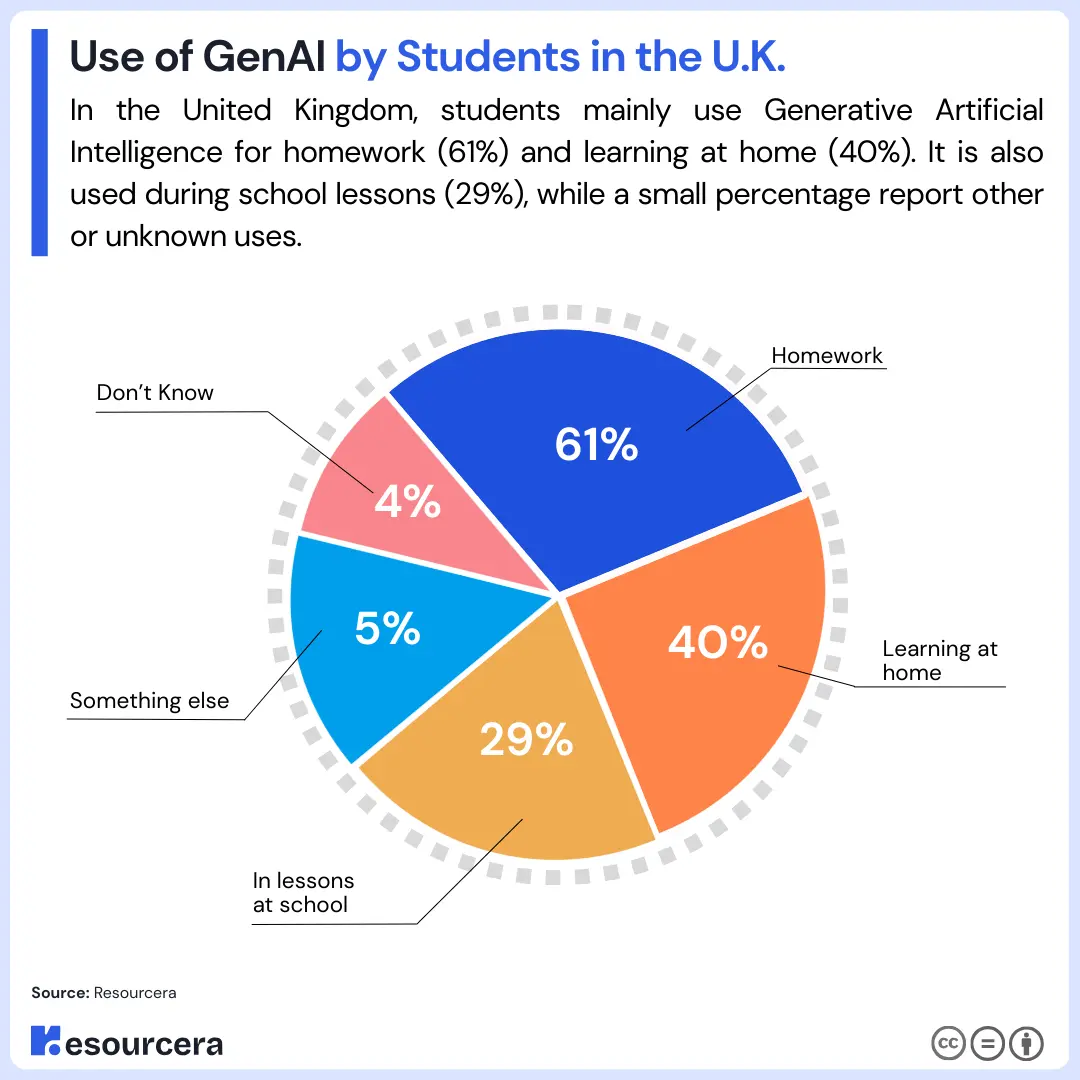
| Context of Use | Percentage |
|---|---|
| Homework | 61% |
| Learning at home | 40% |
| In lessons at school | 29% |
| Something else | 5% |
| Don’t know | 4% |
Gen AI’s Reported Benefits For UK Teachers and Students
Teacher Benefits
Teachers are experiencing significant time savings thanks to GenAI, especially when it comes to routine tasks such as creating lesson resources and writing reports. This reduction in workload allows them to focus more on teaching and student engagement.
Another major benefit is the fresh influx of ideas, GenAI often inspires more creative and engaging classroom activities that might not have been considered otherwise.
Additionally, technology makes it easier to personalize learning. Differentiating assignments becomes more manageable, particularly for students with special educational needs and disabilities (SEND) or those learning English as an additional language (EAL).
Student Benefits
GenAI tools enhance students’ creativity and help them produce higher-quality work, even if they don’t naturally excel in areas like art or design.
GenAI also improves accessibility, especially for English as an Additional Language and Special Educational Needs and Disabilities learners who might struggle with conventional formats.
There is also emerging evidence that GenAI may support students who have difficulty getting started on tasks, something particularly helpful for learners with ADHD.
Generative AI Challenges Experienced By UK School Faculties
Beyond general faculty issues, teachers face distinct GenAI challenges in their roles.
Challenges Faced By Teachers
- 58% of non-users cite lack of knowledge of how GenAI can be used in their role.
- 23% of non-users worry about risks like malpractice, data privacy, and ethics.
- 19% lack school technology, and 9% work where GenAI is restricted.
- Only 8% of teachers believe GenAI isn’t relevant to their role.
School-Level Issues Of Gen AI
- 59% of school leaders have no plans to address the GenAI issue; only 1% have already made changes.
- GenAI deployment often depends on a few tech advocates within schools.
- Less than 10% of schools globally have formal guidance on AI.
Academic Integrity While Implementing Gen AI
- 76% of teachers are not confident advising pupils on safe/appropriate AI use.
- AI text detectors are unreliable for detecting AI-generated work.
- Some schools are considering traditional assessments (oral exams, in-person tests) to combat AI-enabled malpractice.
Conclusion
GenAI use in UK education is rising sharply, offering real benefits in workload reduction and tailored learning. Barriers remain around knowledge, infrastructure, and academic integrity. Schools, policymakers, and EdTech companies need to work together to maximize positive impacts and address growing concerns.