


In 2026, the global AI in ecommerce market is worth $11.21 billion and is on track to reach $74.93 billion by 2035, growing at a 23.59% CAGR.
In 2025, over 21% of retail shopping was done online, and shoppers now expect instant support, personalized recommendations, and a checkout that takes seconds.
Businesses still running on manual workflows are losing those shoppers to rivals that let AI handle search, service, pricing, and personalization at scale.
That pressure is why 96% of online retailers already use AI in some form, and why nearly every major platform now treats it as core infrastructure rather than a side project.
Yet adoption is wide but shallow, and most companies have barely scratched the surface of what the technology can do.
This report breaks down the market size, adoption rates, leading use cases, real sales impact, and where agentic AI takes ecommerce next.
AI in Ecommerce (2026): Key Statistics
- The global AI ecommerce market is worth $11.21 billion as of 2026 and is projected to reach $74.93 billion by 2035, with a CAGR of 23.59%.
- 96% of online retailers use AI in their ecommerce operations, either fully (59%) or experimentally (37%).
- The US AI in the ecommerce market is valued at $3.06 billion in 2026, the single largest national share of the global total.
- 89% of retail and consumer goods companies are using or piloting AI, and 97% plan to increase AI spending.
- Organizations that build AI into their business strategy earn an average of 10% to 12% more revenue.
- Retail chatbots increase sales by up to 67%, while strong AI personalization can lift revenue by up to 40%.
- Shoppers who use AI chat convert at 12.3%, nearly four times the 3.1% rate of those who do not.
- AI resolves 93% of customer questions without any human help.
- AI cuts inventory levels by 20% to 30% and logistics costs by 5% to 20%.
- 71% of merchants say AI merchandising tools have had limited to no effect on their business so far.
- Less than 1% of online retailers use advanced AI agents today, a share projected to reach about a third by 2028.
How Big Is the AI in the Ecommerce Market?
The global AI in the ecommerce market stands at $11.21 billion in 2026, up 24.4% from $9.01 billion in 2025.
It is projected to reach roughly $74.93 billion by 2035, which marks a 23.59% compound annual growth rate over the decade.
At that pace, the market is set to grow about 6.7 times its 2026 size and add nearly $63.72 billion in value over ten years.
The jump from 2025 to 2026 alone is 24.4%, slightly above the long-run average, because more businesses are crossing from pilots into full deployment at the same time.
Compounding in the low-to-mid 20% range every year is fast for any technology category, and faster than most retail planning cycles are built to absorb, which is part of why so many retailers feel behind even as they invest.
(Source: Precedence Research)
AI in the Ecommerce Market Size Over the Years
The AI in the ecommerce market is expected to grow by around 20% to 25% each year during the forecast period.
In 2025, the AI market size in ecommerce stood at $9.01 billion. This makes it 24.4% increase in 2026, when the market is valued at $11.21 billion.
The annual growth rate eases slightly over time as the base gets bigger, a normal pattern for a fast-scaling market.
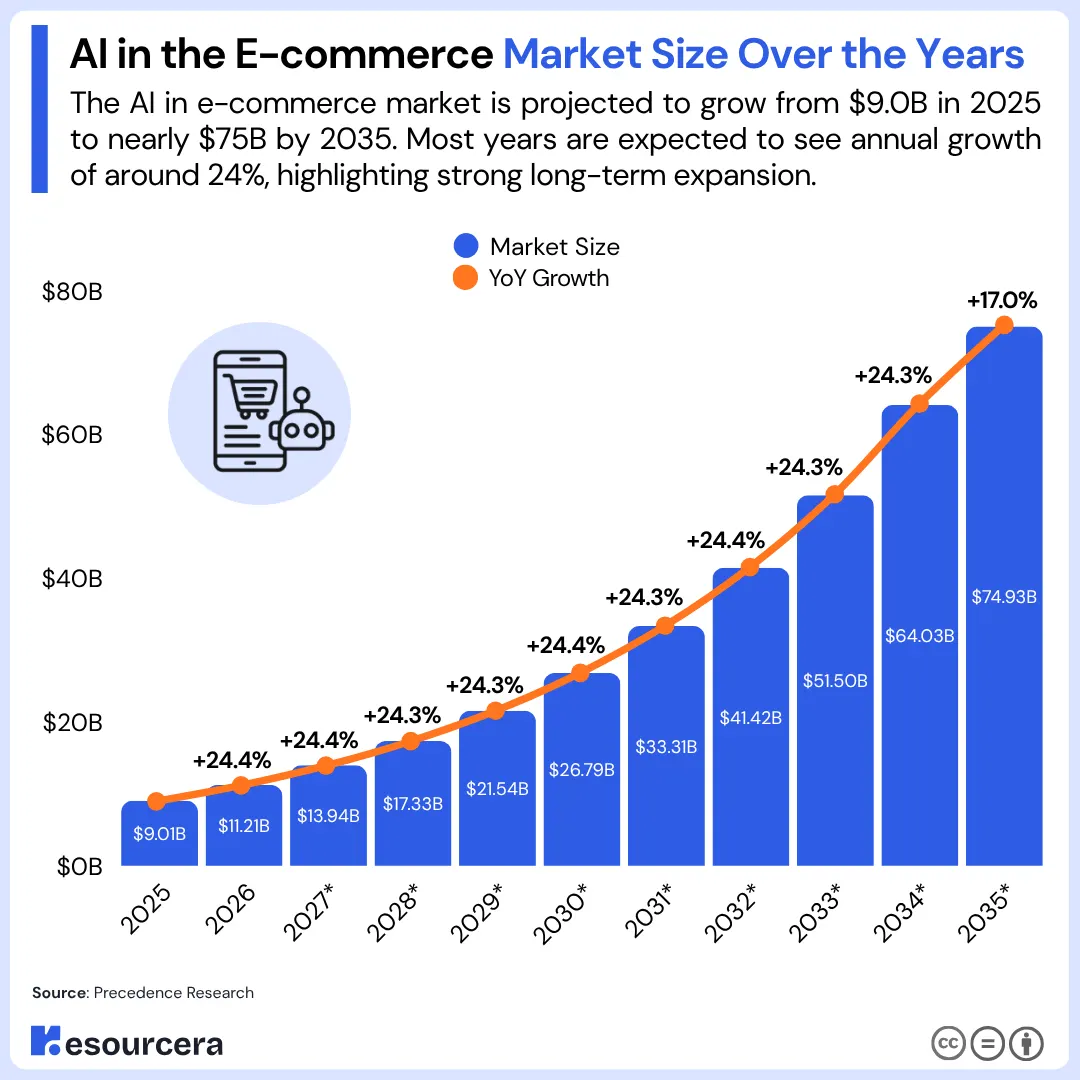
The table below shows the AI in the ecommerce market size by year, including past figures and projections through 2035:
| Year | Market Size | YoY Growth |
|---|---|---|
| 2025 | $9.01 billion | – |
| 2026 | $11.21 billion | +24.4% |
| 2027* | $13.94 billion | +24.4% |
| 2028* | $17.33 billion | +24.3% |
| 2029* | $21.54 billion | +24.3% |
| 2030* | $26.79 billion | +24.4% |
| 2031* | $33.31 billion | +24.3% |
| 2032* | $41.42 billion | +24.4% |
| 2033* | $51.50 billion | +24.3% |
| 2034* | $64.03 billion | +24.3% |
| 2035* | $74.93 billion | +17.0% |
(Source: Precedence Research)
AI in Ecommerce Market Size by Region
North America leads the global AI in ecommerce market with a 39% share in 2026, worth around $4.37 billion of the $11.21 billion global total.
Europe ranks as the fastest-growing region with 28% market share, while Asia Pacific holds 22% of the market.
The US carries most of that demand as the home base for the major technology companies and a market where retailers from Amazon to Netflix build AI directly into how they recommend and serve.
Asia Pacific is closing in fastest, powered by China’s dominance in live-streaming commerce and rapid digital adoption across India and Southeast Asia, while European growth leans on stronger demand forecasting and faster delivery backed by government AI programs.
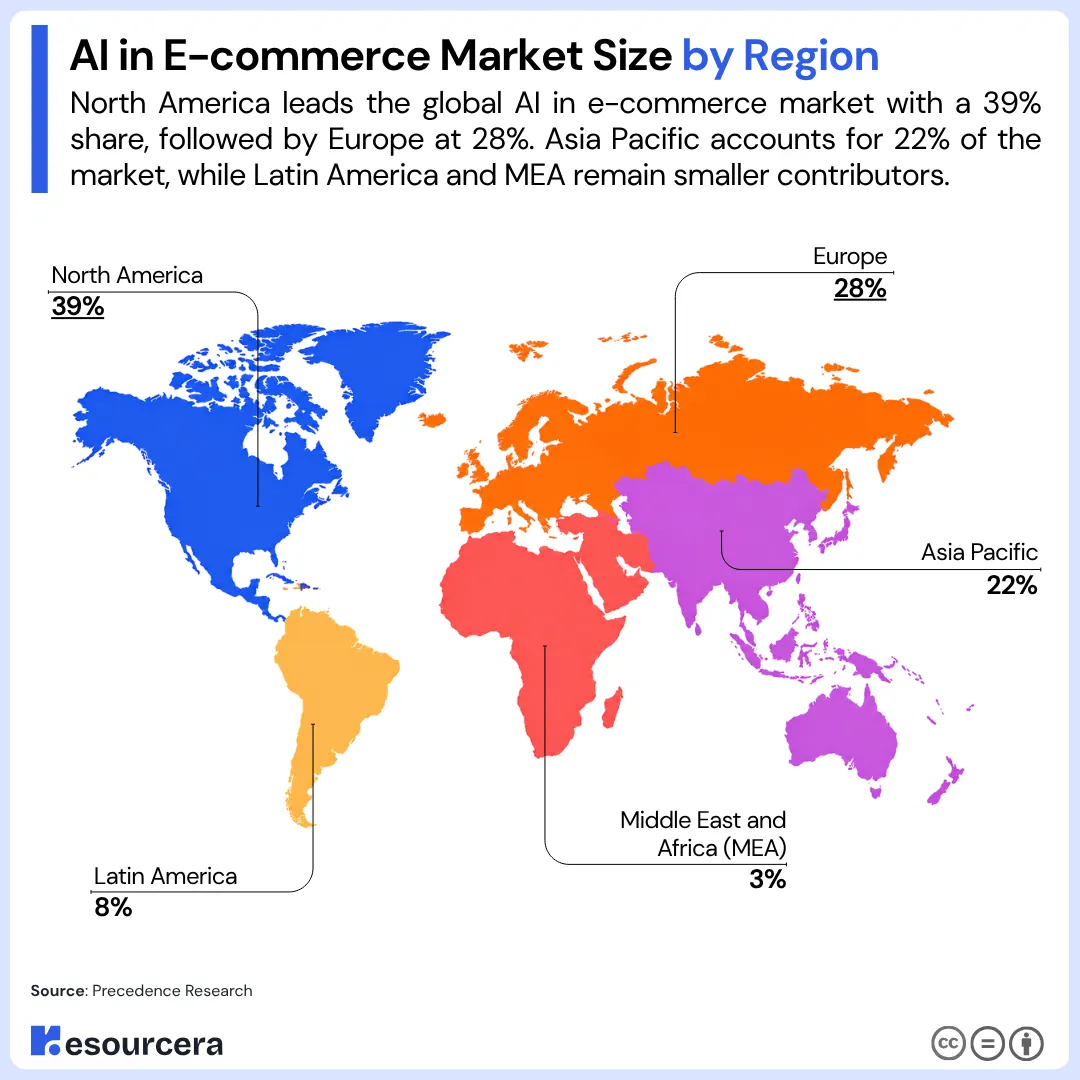
The table below represents the standing of each region in the global AI in ecommerce market as of 2026:
| Region | Market Share 2026 |
|---|---|
| North America | 39% |
| Europe | 28% |
| Asia Pacific | 22% |
| Latin America | 8% |
| Middle East and Africa (MEA) | 3% |
(Source: Precedence Research)
US AI in Ecommerce Market Size
The US AI in the ecommerce market reaches $3.06 billion in 2026, up from $2.46 billion in 2025. It is projected to climb to $20.92 billion by 2035, growing at a 23.87% CAGR.
The US holds its lead because its biggest retailers treat AI as a standard layer of the shopping experience rather than an add-on. That pulls the wider market along and keeps adoption costs falling for smaller sellers, which in turn widens the gap between the US and other single markets.
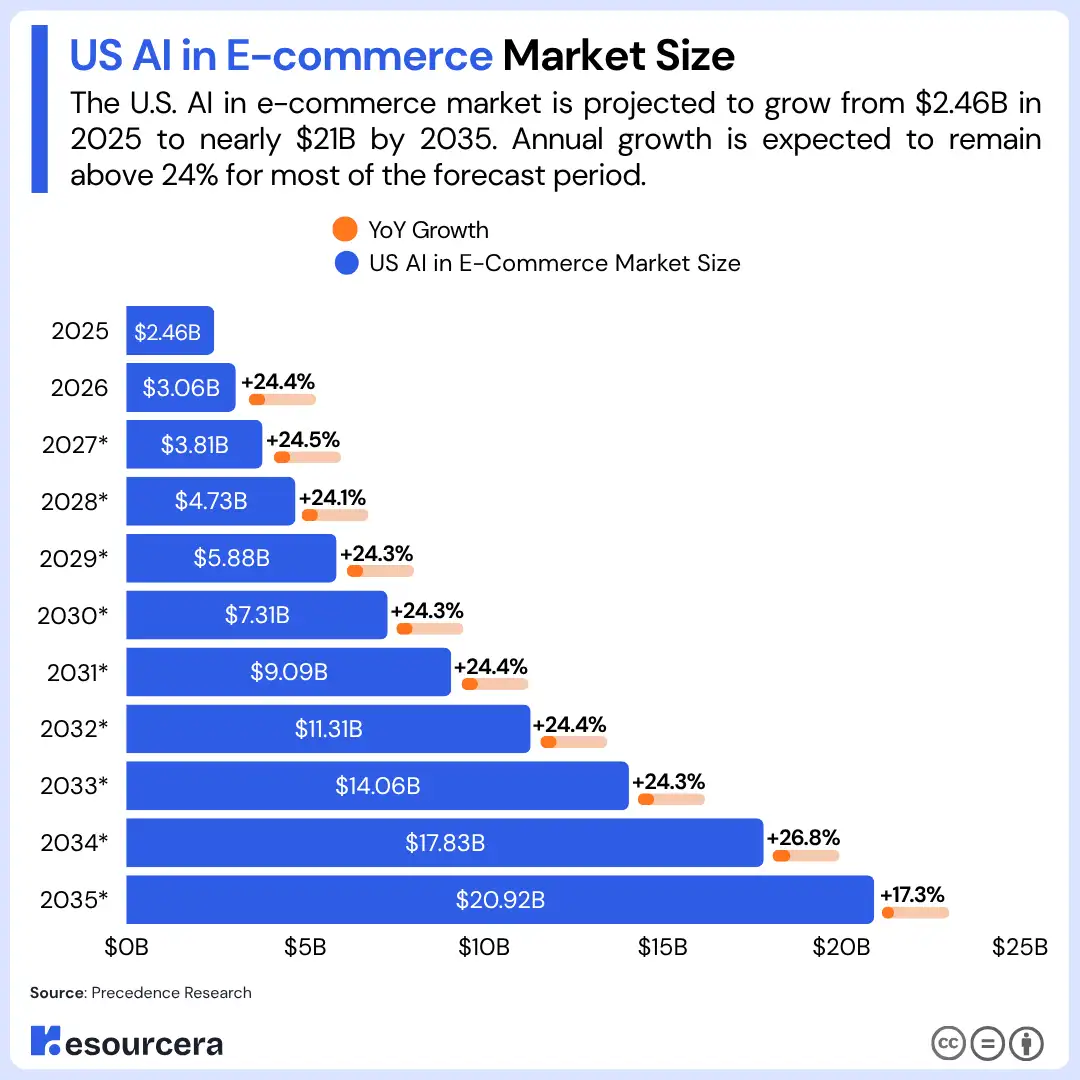
The table below shows the US AI in the ecommerce market size by year, with past figures and projections through 2035:
| Year | US AI in ECommerce Market Size | YoY Growth |
|---|---|---|
| 2025 | $2.46 billion | – |
| 2026 | $3.06 billion | +24.4% |
| 2027* | $3.81 billion | +24.5% |
| 2028* | $4.73 billion | +24.1% |
| 2029* | $5.88 billion | +24.3% |
| 2030* | $7.31 billion | +24.3% |
| 2031* | $9.09 billion | +24.4% |
| 2032* | $11.31 billion | +24.4% |
| 2033* | $14.06 billion | +24.3% |
| 2034* | $17.83 billion | +26.8% |
| 2035* | $20.92 billion | +17.3% |
(Source: US Ecommerce Sales)
AI in the Ecommerce Market by Segment
Cloud-based deployment, software, and retail are the leading segments of the AI in the ecommerce market.
As of 2023, cloud held a dominant 75.6% share, software led the component split at 65%, and retail topped end-user demand at 45%.
Cloud leads by a wide margin because it removes the cost and complexity of building AI infrastructure in-house, which puts advanced tools within reach of small sellers and startups, not just large chains.
The software segment leads because the products driving the market, recommendation engines, forecasting models, and chatbots, are software-first. Retail tops end-user demand because online stores sit on the richest behavioral data and face the sharpest competition, so they adopt AI faster than fashion, electronics, or grocery, which fill out the rest of the segment.
The table below represents the leading segments of AI in the ecommerce market:
| Segment | Leading Category | Share (2023) |
|---|---|---|
| Deployment | Cloud-based | 75.6% |
| Component | Software | 65% |
| End-user | Retail | 45% |
(Source: Market.us)
AI Adoption in Ecommerce
96% use AI in their ecommerce operations, either fully or experimentally, and 89% of retail and consumer goods companies report they are actively using or piloting AI.
Retailers who have rolled out AI report strong outcomes, with 87% seeing a boost in annual revenue and 94% noting lower operational costs from automation and smarter decisions.
Online retail also runs well ahead of the wider economy, where 78% of all businesses use AI in at least one function, up from 72% earlier in 2024 and 55% in 2023.
Shopping is data-rich and intensely competitive, which is why ecommerce moved from early experiment to default infrastructure faster than almost any other sector.
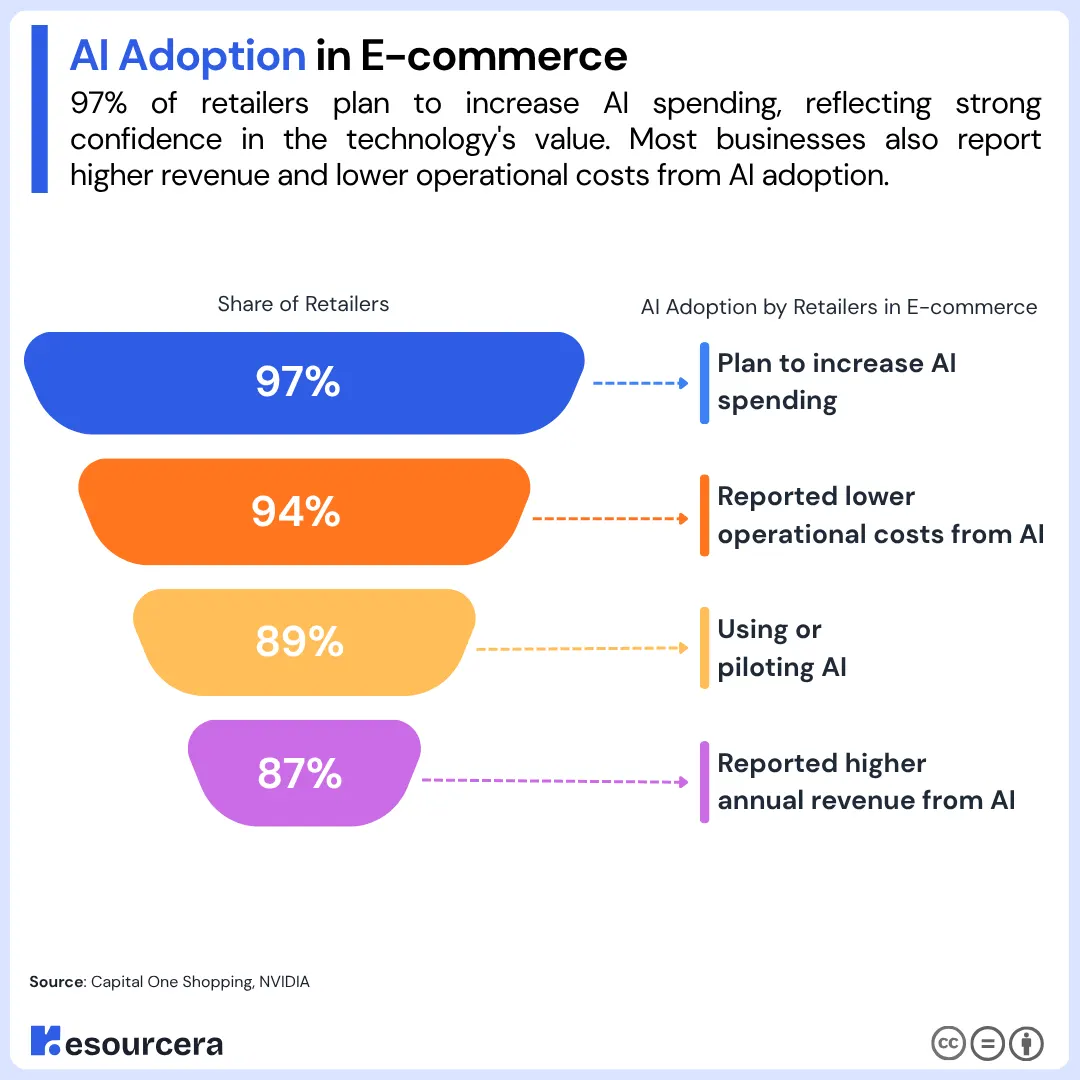
The table below shows AI adoption and reported outcomes among ecommerce retailers:
| AI Adoption by Retailers in Ecommerce | Share of Retailers |
|---|---|
| Using or piloting AI | 89% |
| Reported higher annual revenue from AI | 87% |
| Reported lower operational costs from AI | 94% |
| Plan to increase AI spending | 97% |
(Source: Capital One Shopping, NVIDIA)
How Many Ecommerce Businesses Use AI?
59% of online retailers have fully implemented AI, while another 37% are experimenting with it. Only 3% are still evaluating it, and just 1% have no plans to adopt AI at all.
Business-to-business sellers are close behind on total adoption, with 81% having fully or experimentally implemented AI, but the depth is very different. B2C retailers are more than twice as likely to have fully rolled AI out, at 59% versus 25%, while B2B wholesalers are mostly still experimenting.
That gap reflects how consumer retail, with its constant flow of shopper data and direct competition, has more immediate use cases than wholesale, where buying cycles run longer and lean on relationships.
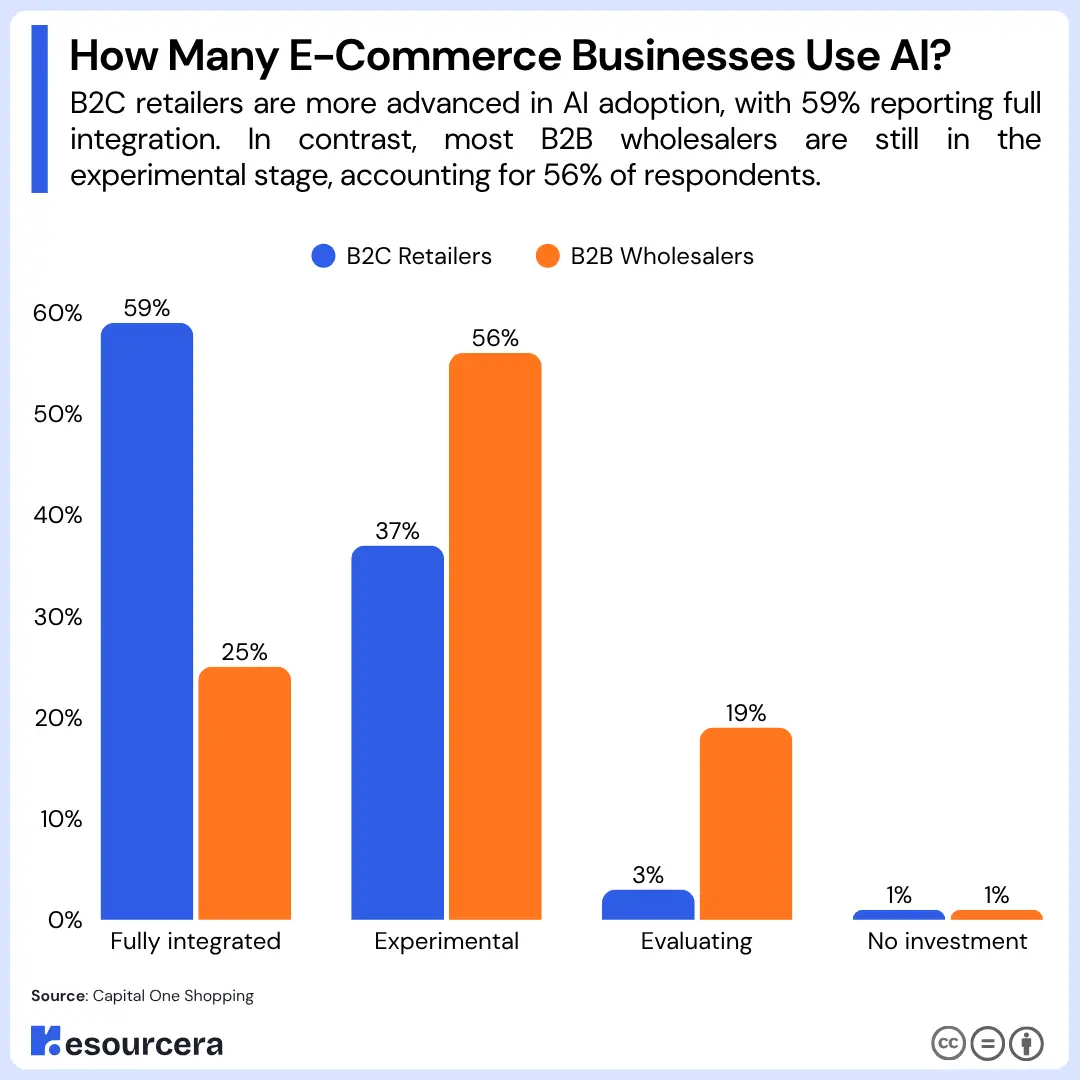
The table below compares AI investment levels between B2C retailers and B2B wholesalers:
| How Retailers have Invested in AI | B2C Retailers | B2B Wholesalers |
|---|---|---|
| Fully integrated | 59% | 25% |
| Experimental | 37% | 56% |
| Evaluating | 3% | 19% |
| No investment | 1% | 1% |
(Source: Capital One Shopping)
AI Adoption by Retailer Size
Larger and faster-growing businesses adopt AI more aggressively than smaller ones. 75% of small and medium-sized businesses are at least experimenting with AI tools, but among SMBs in growth mode, 83% already use it.
The returns are what keep them investing. Among SMBs that use AI, 87% say it helps them scale their operations, and 78% of growth-stage SMBs plan to raise their AI spending in the year ahead, compared with just 55% of declining SMBs.
That split suggests the adoption gap and the growth gap are starting to feed each other. Many smaller leaders also underestimate how common AI already is, since about 80% of AI users assume most of their peers use it too, while only a third of non-users believe the same.
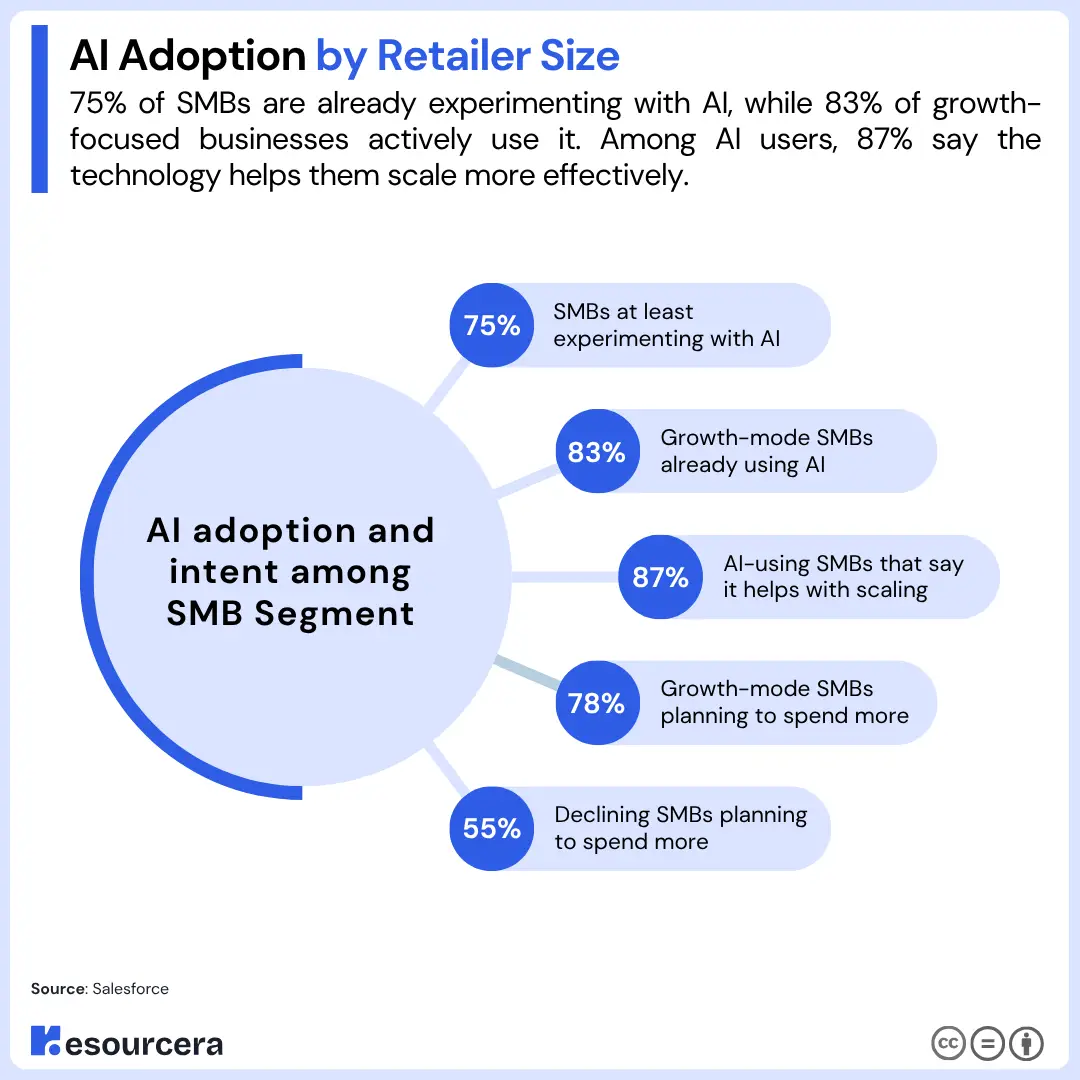
The table below shows AI adoption and intent among small and medium-sized businesses:
| SMB Segment | Share Using AI / Intent |
|---|---|
| SMBs at least experimenting with AI | 75% |
| Growth-mode SMBs already using AI | 83% |
| AI-using SMBs that say it helps with scaling | 87% |
| Growth-mode SMBs planning to spend more | 78% |
| Declining SMBs planning to spend more | 55% |
(Source: Salesforce)
Retailer AI Spending and Investment Plans
Spending momentum is strong, with 97% of retailers planning to increase their AI budgets in the next fiscal year. More than 60% intend to grow their AI infrastructure investment within the next 18 months.
Retailers are already spending at scale, not just promising to. They put $19.7 billion into AI technology in 2023, which made up 12.8% of all global AI spending that year, an outsized share for a single sector.
The appetite reaches the top of the corporate ladder, too, as 90.9% of Fortune 1000 companies are increasing their AI investment, and across the broader market, nearly half of all US startup funding in 2024 went to AI startups.
That level of commitment signals that AI budgets in retail are now treated as fixed operating costs rather than discretionary pilots, which is usually the point at which a technology stops being optional.
The table below represents key AI spending and investment signals across retail:
| Spending Signal | Figure |
|---|---|
| Retailers planning to increase AI budgets | 97% |
| Planning more AI infrastructure investment | 60%+ |
| Retailer AI spend in 2023 | $19.7 billion |
| Retail share of global AI spending | 12.8% |
| Fortune 1000 firms are increasing AI investment | 90.9% |
(Source: NVIDIA, Capital One Shopping)
How Ecommerce Businesses Use AI
Marketing and customer service are the functions where AI shows up most in ecommerce. Marketing automation leads at 48.9% of companies, followed by virtual agents and chatbots at 31% and data analytics at 29%.
When retailers rank their top AI priorities instead, the list tilts toward tools that touch the shopper directly. Store analytics tops it at 53%, then personalized recommendations at 47%, adaptive advertising and pricing at 40%, conversational AI at 39%, and inventory management at 39%.
The pattern across both views is consistent: AI gets pointed first at the work closest to revenue and service, and only later at deeper back-office functions, which is why so many companies still run AI in just one or two areas rather than across the whole business.
The table below shows the most common AI use cases in retail and ecommerce:
| AI Use Case in Retail | Share of Companies |
|---|---|
| Marketing automation | 48.9% |
| Virtual agents or chatbots | 31% |
| Data analytics | 29% |
| Natural language processing | 21% |
| Text analytics | 20% |
| Machine learning | 17% |
| Recommendation systems | 17% |
| Image and pattern recognition | 14% |
| Decision-making systems | 13% |
| Speech and voice recognition | 12% |
(Source: Statista 1, NVIDIA)
Generative AI Use in Ecommerce
Over half of ecommerce businesses now treat generative AI as a strategic edge. Content generation for marketing leads its use cases at 60%, well ahead of predictive analytics at 44% and personalized marketing at 42%.
The problem is that most companies stop at content. Only 31% use generative AI for marketing copy and product descriptions, even though 90% say personalized customer experiences are crucial to future success and 70% call AI critical to their operations.
That gap is the clearest missed opportunity in the field, since businesses are using generative AI for the easy win of writing text while leaving the higher-value work, guided shopping, conversational selling, and smart on-site search, mostly untouched.
The companies that move generative AI from the marketing department into the customer journey are the ones pulling ahead.
The table below represents the top generative AI use cases in ecommerce:
| Generative AI Use Case | Share of Companies |
| Content generation for marketing | 60% |
| Predictive analytics | 44% |
| Personalized marketing and advertising | 42% |
| Customer analysis and segmentation | 41% |
| Digital shopping assistants | 40% |
(Source: NVIDIA, Harvard Business Review Analytic Services)
AI Chatbots and Conversational Commerce in Ecommerce
Conversational commerce is one of the fastest-moving slices of AI in ecommerce. The global conversational commerce market was valued at $8.8 billion in 2025 and is projected to reach $32.6 billion by 2035, growing at a 14.8% CAGR.
Moreover, Chatbots earned $9.4 billion in 2024 on their own, and from 2019 to 2024, the chatbot industry grew at an average annual rate of 29.3%, which is why chatbots already rank as the second most common AI use case in retail.
As shoppers grow used to messaging a brand to ask questions and complete a purchase in the same window, the channel keeps pulling spending toward it.
(Source: HelloRep, Capital One Shopping)
Chatbot Performance and Customer Preference
AI chatbots now resolve 93% of customer questions without any human help. Adoption is broad, too, with 54% of organizations using some form of chatbot or conversational AI for customer-facing roles.
Performance depends heavily on the type of request. Chatbots succeed on up to 58% of return and cancellation requests but on only 17% of billing disputes, which shows AI handles routine, transactional tasks far better than complex or emotional ones.
69% report positive experiences, and 71% say the quality has improved over the past two years. Even so, 40% still prefer a human when given the choice.
That is why 89% of consumers say the best support blends AI speed with human empathy, and why the strongest setups resolve routine questions automatically while passing the hard cases to a person.
The table below shows the main advantages shoppers see in ecommerce chatbots:
| Chatbot Advantage | Share of Shoppers |
|---|---|
| Available 24/7 | 61% |
| Immediate answers | 45% |
| Product information and recommendations | 36% |
| Saves time | 35% |
| Specific advice | 21% |
| Proactive assistance | 21% |
(Source: Gartner, HelloRep, Capital One Shopping)
Impact of AI on Ecommerce Sales and Conversions
AI has a direct, measurable effect on sales. Retail chatbots increase sales by up to 67%, and companies that are strong at AI personalization earn up to 40% more revenue than those that are not.
The clearest proof shows up at conversion. Shoppers who engage with AI chat convert at 12.3%, compared with just 3.1% for those who do not, a fourfold difference. The sections below break down how personalization and conversion gains play out across the funnel.
(Source: Capital One Shopping, HelloRep)
AI Personalization and Revenue Impact
Personalization is the single most profitable place to apply AI in ecommerce. At the campaign and site level, it can lift revenue by up to 300%, conversions by up to 150%, and average order value by up to 50%.
Shoppers clearly reward it. 91% say they are more likely to shop with brands that offer personalized recommendations, and 80% are more likely to buy when the experience is personalized.
The flip side is just as sharp, since 71% feel frustrated by a generic experience and 66% will stop buying from a site that fails to personalize. AI-driven recommendations alone are expected to boost ecommerce sales by 59%, which is why personalization tends to deliver the highest return of any AI investment a store can make.
The table below represents how AI personalization affects key ecommerce metrics:
| Personalization Impact on Buyers | % of Buyers |
|---|---|
| More likely to shop with personalized brands | 91% |
| More likely to buy with personalization | 80% |
| Frustrated by generic experiences | 71% |
| Will stop buying from non-personalized sites | 66% |
(Source: Monetate, Statista 2, Market.us)
AI Effect on Conversion Rates and Purchase Speed
AI speeds up buying decisions and lifts conversion at every step. Shoppers complete purchases 47% faster when assisted by AI, and AI chat raises conversion rates nearly four times, from 3.1% to 12.3%.
About 45% of shoppers engage when an AI assistant greets them proactively, 64% of AI-powered sales come from first-time shoppers, and proactive AI chats recover roughly 35% of abandoned carts.
AI also deepens loyalty, since returning customers who use AI chat spend 25% more than those who do not, and AI overall lifts customer retention by 10% to 15%.
Taken together, the numbers show AI working at acquisition, conversion, and retention at once, which is rare for a single technology.
(Source: HelloRep, Capital One Shopping, Market.us)
How AI Improves Ecommerce Operations
To be straightforward, AI cuts inventory levels by 20% to 30%, lowers logistics costs by 5% to 20%, and reduces procurement spending by 5% to 15%, all through sharper demand forecasting and planning.
These savings flow straight to the bottom line, which matters most in a business built on thin margins.
AI-enabled supply chain planning can raise revenue by up to 4% while trimming inventory and costs at the same time, and 53% of businesses now use AI to predict and prevent supply chain problems before they disrupt fulfillment.
The momentum is clear, with 90% of large companies having tested AI in their supply chains and 82% planning to increase supply chain AI spending in the next fiscal year.
Demand forecasting is the lever underneath nearly all of it, because when a store can predict what sells and when, it stops tying up cash in dead stock and stops losing sales to stockouts.
The table below shows the operational gains ecommerce businesses get from AI:
| Operational Gain | Impact |
|---|---|
| Inventory reduction | 20% to 30% |
| Logistics cost reduction | 5% to 20% |
| Procurement spend reduction | 5% to 15% |
| Revenue lift from AI supply chain planning | Up to 4% |
| Firms using AI to predict supply problems | 53% |
| Large firms that have tested supply AI | 90% |
(Source: McKinsey, PwC, NVIDIA)
Consumer Attitudes Toward AI in Ecommerce
In 2025, 58% of consumers said they prefer AI tools over traditional search engines, more than double the 25% who said so in 2023.
That comfort has not yet hardened into trust. 25% of consumers prefer to shop with AI, and 34% are comfortable letting AI make purchases for them, but only 26% trust organizations to use AI responsibly.
Opinion on AI in customer service is split three ways, with 28% calling it a positive force, 34% calling it negative, and 37% unsure.
Satisfaction can even slip as exposure grows, since satisfaction with generative AI fell to 37% in 2024 from 41% the year before. There is also a self-awareness gap worth noting for marketers, as just 33% of consumers think they use AI, while 77% actually rely on AI-powered services in some form.
The table below represents consumer sentiment toward AI in ecommerce:
| Consumer Sentiment | Share of Consumers in Ecommerce |
|---|---|
| Prefer AI tools over traditional search | 58% |
| Comfortable letting AI make purchases | 34% |
| Prefer to shop with AI | 25% |
| Trust organizations to use AI responsibly | 26% |
| Positive on AI in customer service | 28% |
| Negative on AI in customer service | 34% |
| Actually rely on AI services (vs 33% aware) | 77% |
(Source: Capital One Shopping, Shopify)
What Shoppers Want From AI
Shoppers want AI that helps them find and decide on products. Comfort rises with the size and complexity of the purchase, with 70% open to using AI to book flights and 65% to book hotels, while 50% to 60% would use it for everyday items like clothing, beauty products, and electronics.
Newer formats are gaining ground quickly. Visual searches grew 70% globally in the past year.
Amazon now handles about 4 billion shopping-related visual searches a month through Google Lens, and younger shoppers lead the shift, with 22% of 16-to-34-year-olds using visual search compared with 5% of those over 55.
Voice is climbing too, as 37% of global shoppers now make voice-enabled purchases, rising to 48% among social media users.
The clearest signal of demand is seasonal, since 88% of shoppers say they would use AI for holiday shopping, and 73% specifically want it to help find coupons and discounts.
(Source: Capital One Shopping, HelloRep, Statista 3, DHL)
Agentic AI and the Future of Ecommerce
Agentic AI, where autonomous systems plan and act instead of just answering, is the next phase of ecommerce.
Less than 1% of online retailers use advanced AI agents today, but that share is projected to reach about a third by 2028.
71% of merchants say AI merchandising tools have had limited to no effect on their business so far, 61% say their organization is not prepared to scale AI across merchandising, and fewer than 10% use AI for more than half of their merchandising decisions.
Part of the problem is people, not technology, since only 24% of companies offer moderate-to-extensive AI training.
The upside is large enough to justify fixing that, because agentic systems could reclaim up to 40% of a merchant’s time and automate or standardize up to 60% of the manual tasks that slow decisions today.
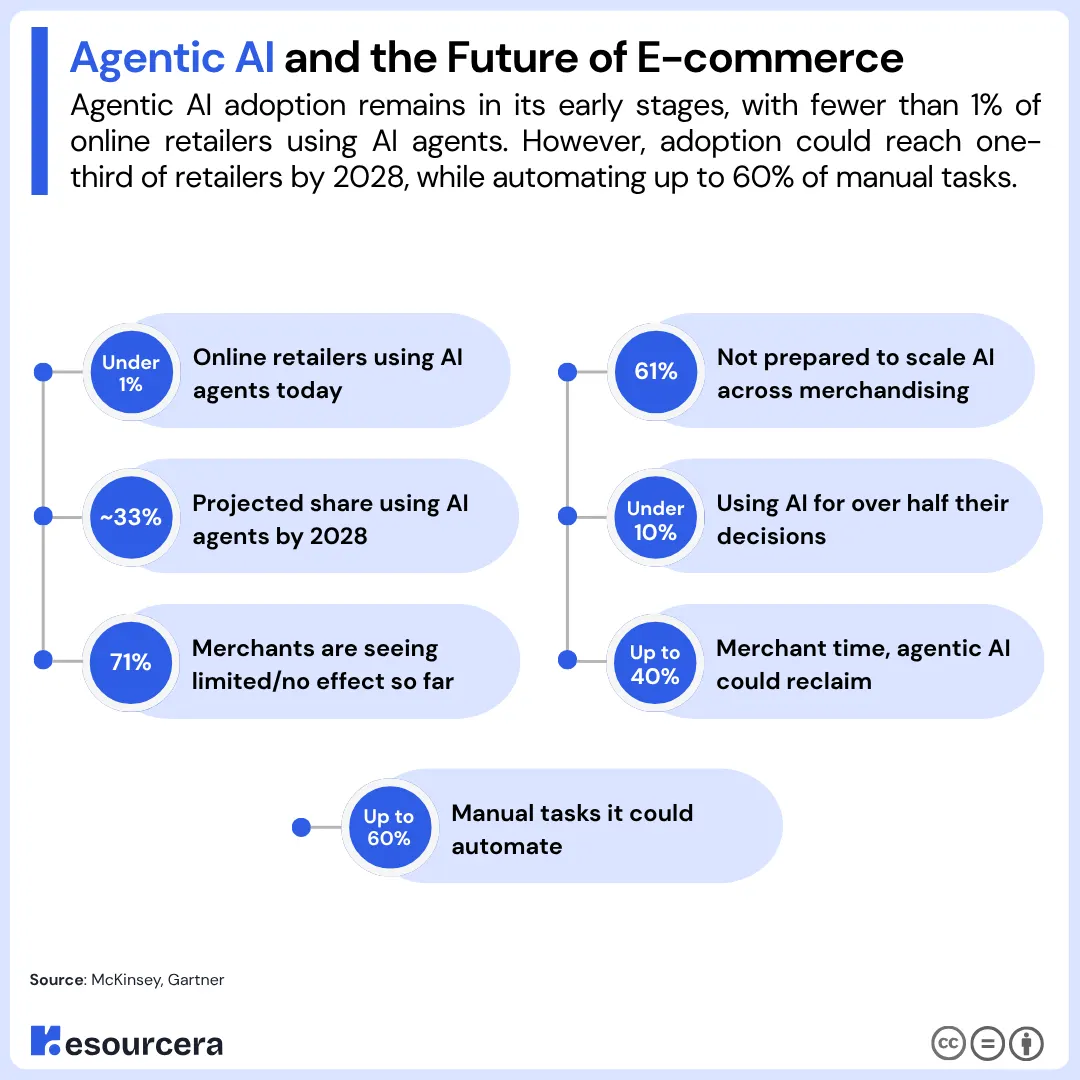
The table below shows where agentic AI stands in retail merchandising today:
| Agentic AI in Ecommerce | Figure |
|---|---|
| Online retailers using AI agents today | Under 1% |
| Projected share using AI agents by 2028 | ~33% |
| Merchants are seeing limited/no effect so far | 71% |
| Not prepared to scale AI across merchandising | 61% |
| Using AI for over half their decisions | Under 10% |
| Merchant time, agentic AI could reclaim | Up to 40% |
| Manual tasks it could automate | Up to 60% |
Benefits and ROI of AI in Ecommerce
From the ROI perspective, 69% of retailers report revenue increases they can trace directly to AI, and 72% have used it to reduce costs.
The investment case holds up across nearly every measure. 97.3% of companies that invest in data and AI see a return, 90.9% of Fortune 1000 companies are increasing their AI investment, and 51% of ecommerce businesses already use AI specifically to deliver a smoother shopping experience.
Furthermore, AI chatbots run about 30% cheaper than human customer service agents. Businesses report customer satisfaction gains of around 25% after adding AI personalization, and 90% of companies that have tried AI plan to use it for sales forecasting next.
Looking ahead, AI is expected to handle 80% of all customer interactions by 2030, up from the 15% it already managed back in 2021, which will reshape the cost of service for online stores.
The table below represents the main reported benefits of AI in ecommerce:
| Benefit | Figure |
|---|---|
| Retailers tying revenue gains to AI | 69% |
| Retailers using AI to cut costs | 72% |
| Companies are seeing ROI on data and AI | 97.3% |
| Average revenue lift from AI strategy | 10% to 12% |
| Customer satisfaction lifted by AI | ~25% |
| Lead conversion lift from AI bots | ~25% |
| Cost saving of AI vs human agents | ~30% |
(Source: Capital One Shopping, Market.us)
Challenges of AI Adoption in Ecommerce
Data security and privacy are the biggest barriers to AI adoption in ecommerce.
53% of retail managers and employees cite them as a primary obstacle, along with 44% of CEOs.
Leaders and staff see the rest of the hurdles differently, and that split shapes how companies fix them. Executives worry more about financial risk and ROI, while employees point more often to a lack of expertise and infrastructure, as the table shows.
Beyond the workforce, 52% of businesses name data privacy as the top barrier to generative AI; specifically, 38% face a shortage of skilled talent, and 31% struggle to integrate AI into outdated systems.
Fraud raises the stakes further, since nearly 70% of fraud experts believe criminals use AI more effectively than defenders do, and more than half of companies lost between $5 million and $25 million to AI-driven fraud in a single year.
The table below compares how CEOs and employees rank the challenges of AI adoption:
| Challenge in AI Adoption | CEOs | Managers and Employees |
|---|---|---|
| Data security and privacy | 44% | 53% |
| Risk of costly AI recommendations | 39% | 21% |
| Business case and ROI justification | 39% | 26% |
| Fear of workforce impact | 33% | 21% |
| Lack of control or insight into AI | 28% | 32% |
| Lack of awareness or expertise | 28% | 43% |
| Costs | 28% | 34% |
| Lack of infrastructure | 17% | 32% |
(Source: Statista 4, Harvard Business Review Analytic Services, HelloRep)
Final Thoughts
AI in ecommerce has crossed the line from experiment to infrastructure.
With 96% of online retailers using it and the market on track to grow more than six times to $74.93 billion by 2035, the question is no longer whether to adopt AI but how deeply.
That means adoption is nearly universal, but use is shallow. 71% of merchants say AI has had limited effect so far, fewer than 10% use it for most of their decisions, and most companies still confine generative AI to writing product copy.
The next phase is agentic. The retailers that clean up their data and rebuild their workflows now will be the ones ready when AI agents move from less than 1% of stores today to roughly a third by 2028.
