As of 2026, Amazon Prime Video reaches more than 315 million ad-supported viewers every month across 16 countries, up from 200 million in April 2024. That makes it one of the largest streaming platforms on the planet, and the only major streamer whose audience is bigger than its parent subscription base of roughly 250 million Amazon Prime members.
Prime Video also just delivered the most-watched Thursday Night Football season in the 20-year history of the NFL package, captured a record 4.3% of all US television viewing in December 2025, and helped push Amazon’s advertising business past $68 billion in annual revenue.
This post covers the state of Amazon Prime Video as of 2026. We include data on viewers, the Amazon Prime membership base that powers the service, country-level audiences, share of TV viewing, market share against Netflix and other streamers, live sports, user behaviour, revenue, content spending, and pricing.
Highlights From Amazon Prime Video Statistics (2026)
- Prime Video reaches more than 315 million ad-supported viewers per month worldwide, up 58% from the 200 million reported in April 2024.
- In the US, Prime Video’s ad-supported audience passed 130 million monthly customers in 2025, up from 115 million a year earlier.
- Amazon has an estimated 250 million paying Prime members globally, and 168.3 million adults in the US use Amazon Prime.
- Prime Video captured a record 4.3% of all US TV viewing in December 2025, its best share ever measured by Nielsen.
- Prime Video holds 17% of the US streaming market as of Q2 2026, second only to Netflix at 20%.
- Thursday Night Football averaged 15.33 million viewers in 2025, the most-watched season in the franchise’s 20-year history.
- Prime Video’s NFL Wild Card playoff game drew 31.6 million viewers, the most-streamed NFL game ever.
- Amazon spent $22.4 billion on video and music content in 2025, around 25% more than Netflix.
- Amazon’s subscription services segment generated $49.62 billion in 2025, and its advertising business crossed $68 billion, with Prime Video ads contributing meaningfully.
- 88% of Prime Video viewers in the US also shop on Amazon.
How Many People Watch Amazon Prime Video?
Amazon does not publish a traditional subscriber count for Prime Video. Instead, it reports average monthly ad-supported reach, which counts everyone who watches series, films, live sports, and free ad-supported channels on the platform each month.
Prime Video Reaches Over 315 Million Ad-Supported Viewers Per Month Globally
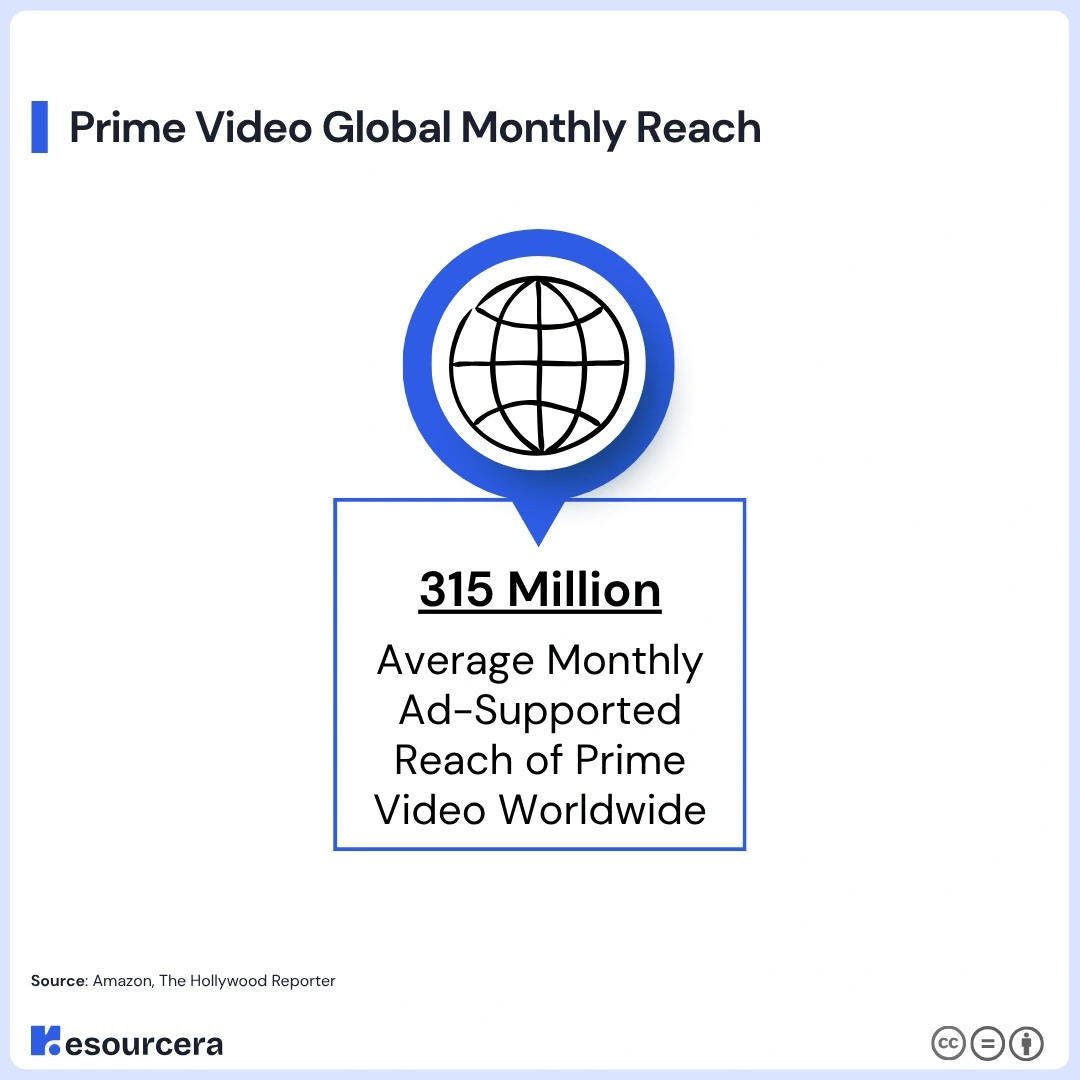
Prime Video’s average monthly ad-supported reach passes 315 million viewers worldwide across 16 countries.
That is a jump of more than 115 million viewers from the 200 million monthly reach Amazon reported in April 2024. Ads launched on Prime Video in early 2024, when Amazon made the ad-supported experience the default for all subscribers, so nearly the entire viewing base now sits inside this measurement.
Here is a table showing the growth of Prime Video’s ad-supported monthly reach:
| Period | Global Ad-Supported Monthly Reach | US Ad-Supported Monthly Reach |
|---|---|---|
| 2024 | 200 million | 115 million |
| 2025 | 315+ million | 130+ million |
Source: Amazon 1, The Hollywood Reporter
Prime Video’s User Base Grew From 90 Million to 230 Million in Five Years
Before Amazon began reporting ad-supported reach, Prime Video’s estimated user base grew two and a half times between 2019 and 2024, adding roughly 140 million users in five years. The pandemic years did the heavy lifting, with 65 million users added across 2020 and 2021 alone, and growth has stayed remarkably steady at 20 to 30 million new users a year since.
Here is a table showing Prime Video user growth year over year:
| Year | Prime Video Users |
|---|---|
| 2019 | 90 million |
| 2020 | 125 million |
| 2021 | 155 million |
| 2022 | 185 million |
| 2023 | 210 million |
| 2024 | 230 million |
Prime Video’s Monthly Audience Count is Over 130 Million in United States
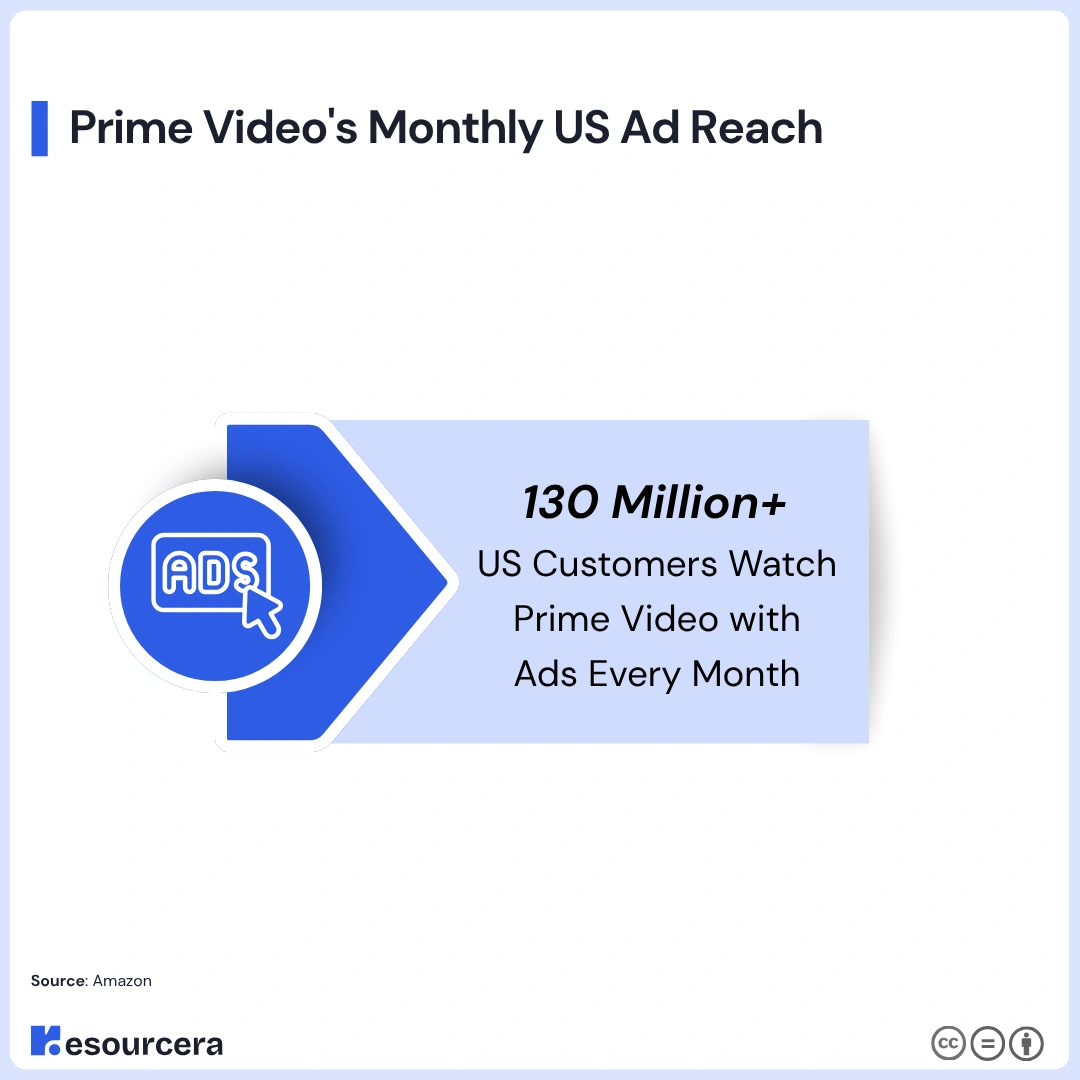
More than 130 million US customers watch Prime Video with ads every month on average, up 15 million from the 115 million Amazon reported in 2024.
Alongside the reach update, Amazon said engagement rose sharply, with monthly ad-supported viewing hours up nearly 40% year over year. In other words, the audience is not just bigger, it is watching more.
Source: Amazon 1
How Many Amazon Prime Members Are There?
Prime Video’s scale starts with Amazon Prime itself, since every Prime membership includes Prime Video at no extra cost. Amazon Prime has an estimated 250 million paying members worldwide across 27 countries.
Here is the interesting part of the maths. Prime Video’s 315 million monthly viewers exceed the 250 million Prime membership base by around 65 million people. That gap exists because Prime Video is also sold as a standalone subscription and is available in more than 240 countries and territories, far beyond the 27 countries where full Prime membership operates. Prime Video’s audience has outgrown the shopping programme that created it.
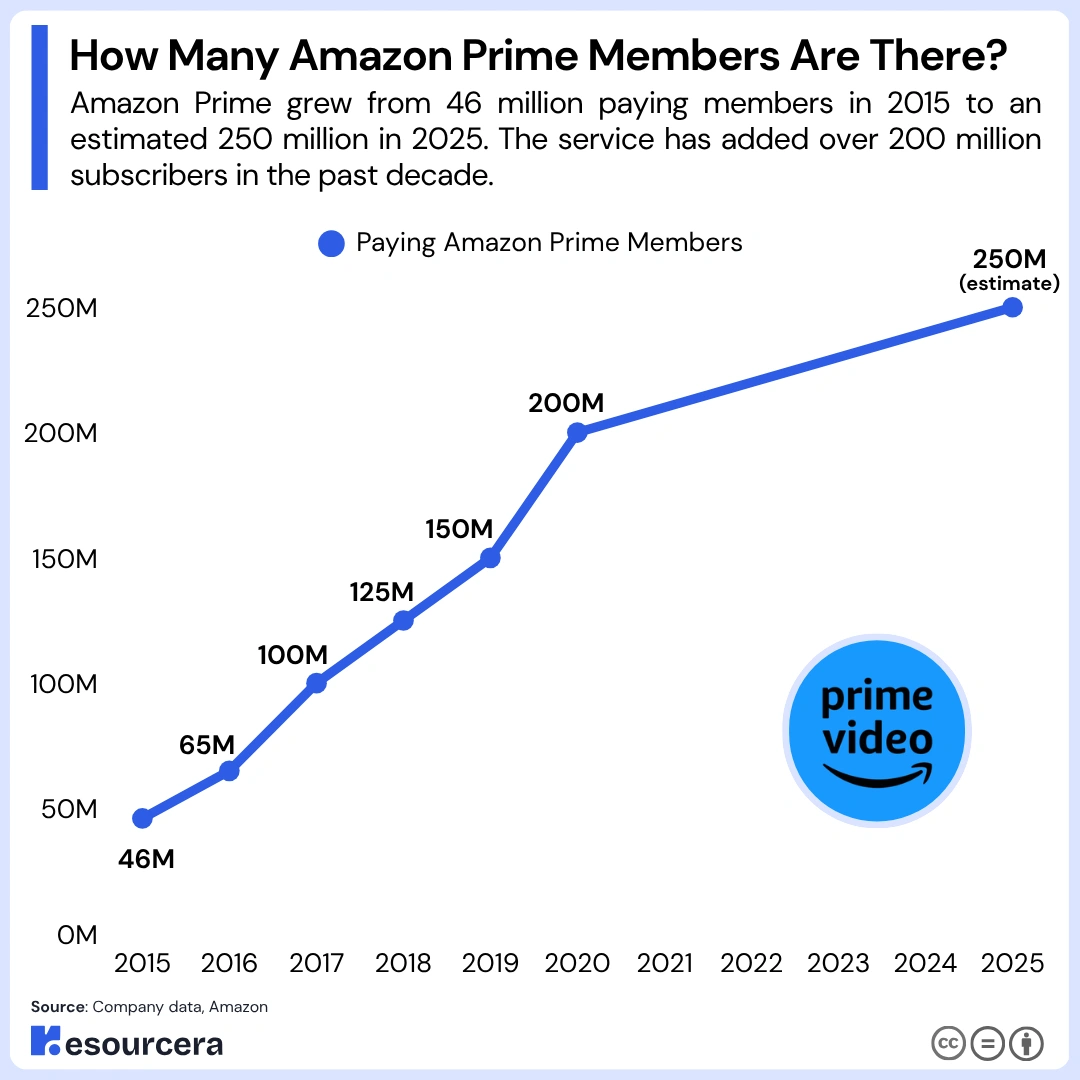
Here is a table showing the growth of paying Amazon Prime members worldwide:
| Year | Paying Amazon Prime Members |
|---|---|
| 2015 | 46 million |
| 2016 | 65 million |
| 2017 | 100 million |
| 2018 | 125 million |
| 2019 | 150 million |
| 2020 | 200 million |
| 2025* | 250 million (estimate) |
Source: Resourcera Survey Data, Amazon 2
168.3 Million Adults in the US Use Amazon Prime
The US remains Amazon Prime’s largest market, with 168.3 million adult users as of 2025, according to eMarketer estimates. That is roughly 62% of the US population, and it gives Prime Video an enormous built-in audience before a single standalone subscription is sold.
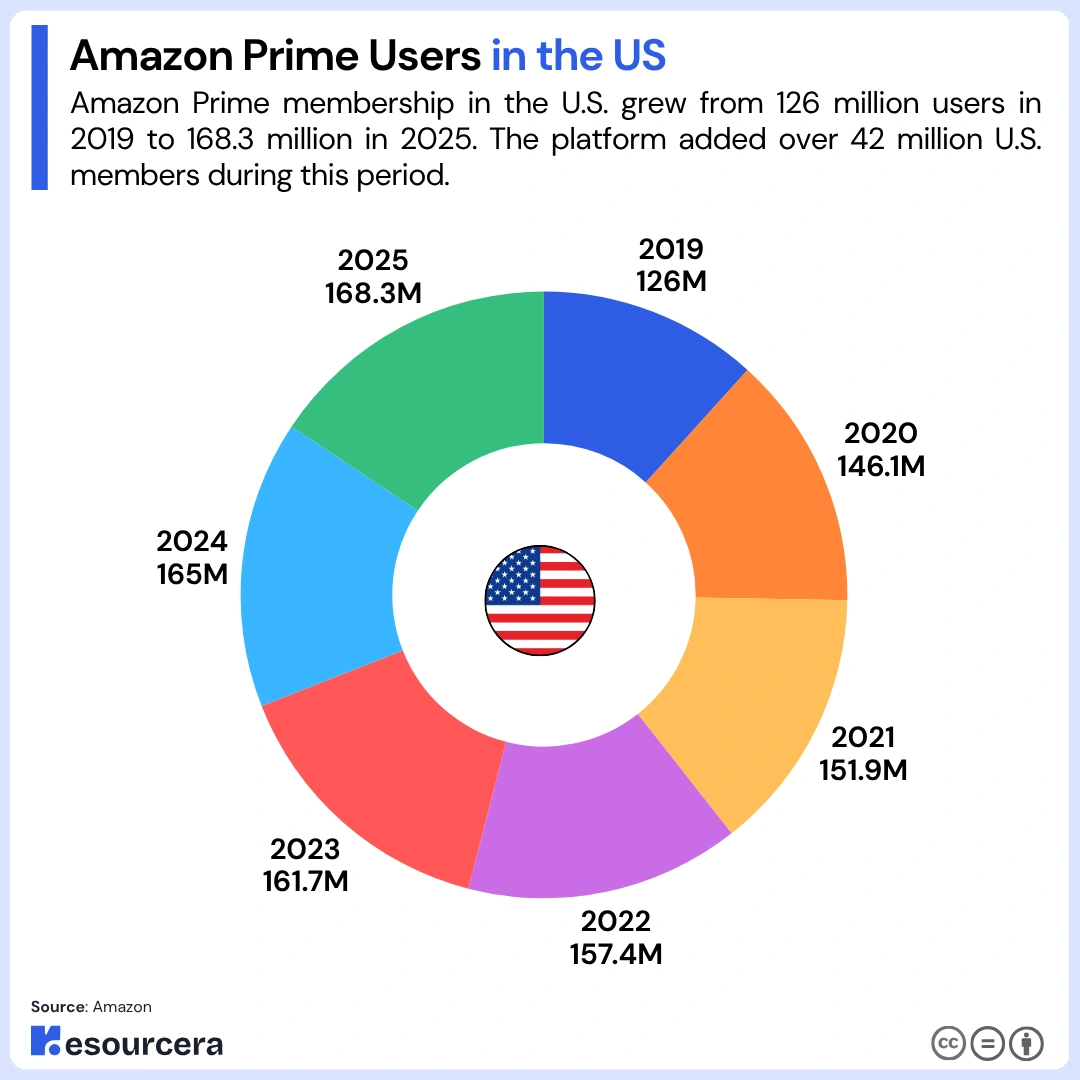
Here is a table showing Amazon Prime user growth in the US:
| Year | US Amazon Prime Users |
|---|---|
| 2019 | 126 million |
| 2020 | 146.1 million |
| 2021 | 151.9 million |
| 2022 | 157.4 million |
| 2023 | 161.7 million |
| 2024 | 165 million |
| 2025 | 168.3 million |
Source: Amazon 1
Prime Video Viewers by Country
The United States is Prime Video’s biggest single audience with 163.6 million viewers, followed by India at 65.9 million. Together, the top eight markets account for well over 300 million viewers.
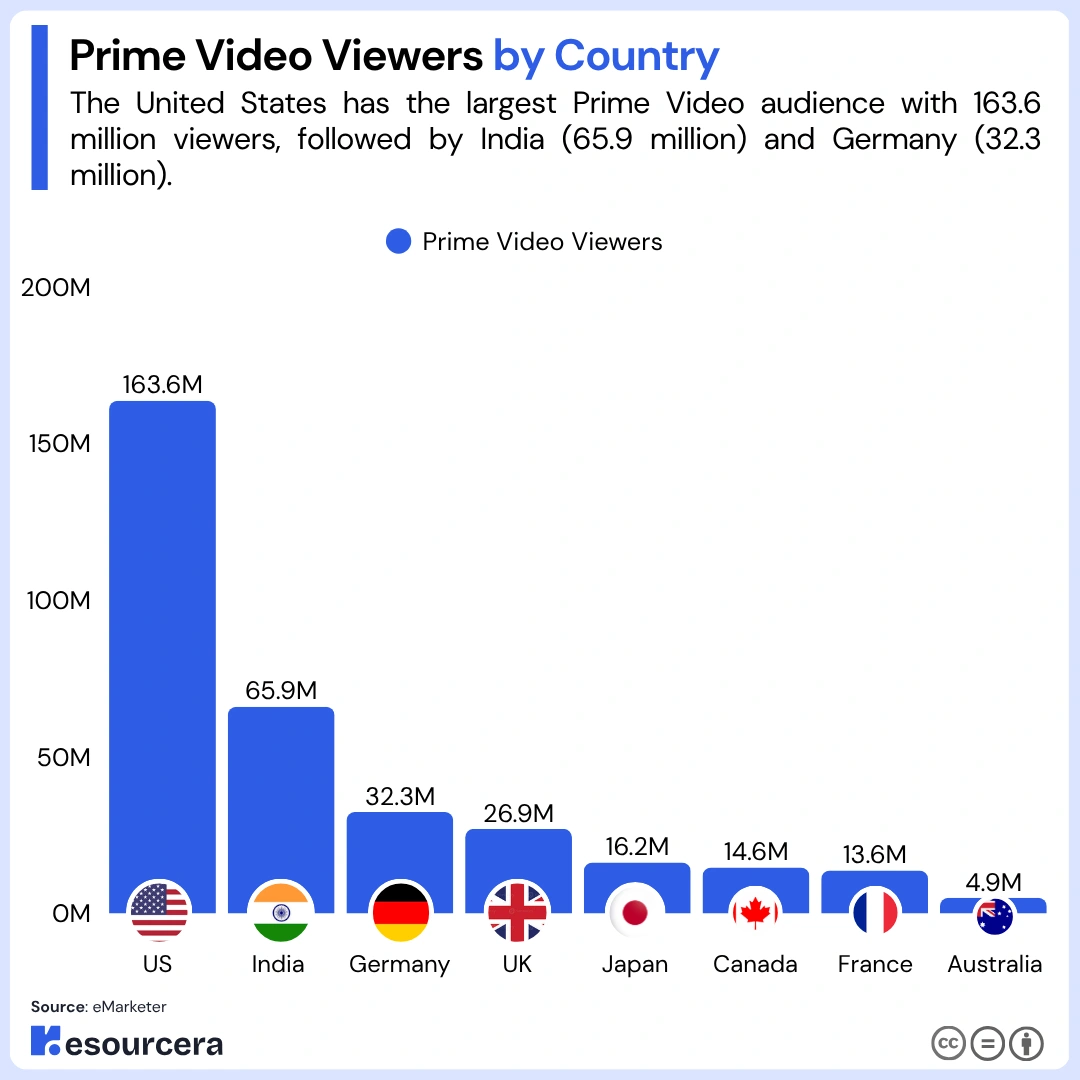
Here is a table showing Prime Video viewers in selected countries, based on the latest available country-level estimates (2024):
| Country | Prime Video Viewers |
|---|---|
| United States | 163.6 million |
| India | 65.9 million |
| Germany | 32.3 million |
| United Kingdom | 26.9 million |
| Japan | 16.2 million |
| Canada | 14.6 million |
| France | 13.6 million |
| Australia | 4.9 million |
Source: eMarketer
Prime Video’s Share of US TV Viewing
Prime Video Holds 4.5% of All US TV Viewing as of May 2026
Prime Video captured 4.5% of total US television viewing in May 2026. That puts it above the 4.3% share it recorded in December 2025, which was a platform record at the time, and makes Prime Video the fourth-largest streaming platform on American TV screens, behind only YouTube TV, Netflix, and Disney.
Streaming as a whole reached 48.6% of all TV viewing in May 2026, more than cable (20.4%) and broadcast (19.2%) combined. The category has not looked back since December 2025, when Christmas Day became the most-streamed day in history with more than 55 billion viewing minutes, led by NFL games on Netflix and Prime Video.
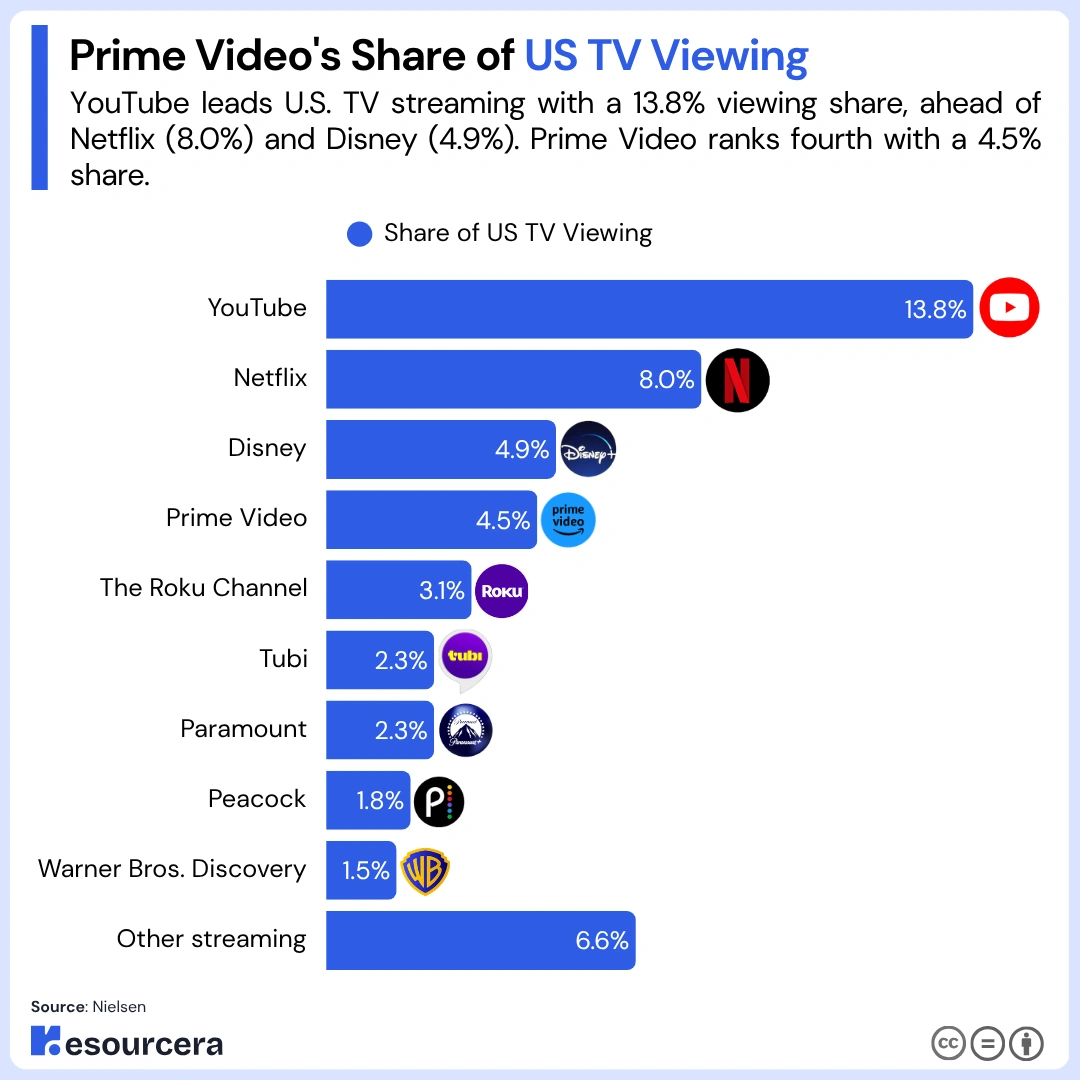
Here is a table showing the share of US TV viewing by streaming platform in May 2026:
| Streaming Platform | Share of US TV Viewing |
|---|---|
| YouTube | 13.8% |
| Netflix | 8.0% |
| Disney | 4.9% |
| Prime Video | 4.5% |
| The Roku Channel | 3.1% |
| Tubi | 2.3% |
| Paramount | 2.3% |
| Peacock | 1.8% |
| Warner Bros. Discovery | 1.5% |
| Other streaming | 6.6% |
Prime Video’s momentum has been building for years. Nielsen data shows the platform’s share of TV viewing has grown 62% since July 2021, driven by a slate that spans big originals like Ballard and The Summer I Turned Pretty and live sports that pull in tens of millions of viewers at a time.
Prime Video accounted for 4.5% of US TV viewing in May 2026, supported by Amazon’s large global base of OTT subscribers and viewers.
Source: Nielsen
Prime Video vs Netflix: US Streaming Market Share
While Nielsen measures how much time Americans spend watching each platform, market share among streaming services themselves tells a different story.
Prime Video is the second-largest streaming service in the United States with a 17% share of streaming engagement in Q2 2026, behind Netflix at 20%. A year earlier the two were effectively tied, but Prime Video shed 4 percentage points over the year while mid-tier rivals such as Apple TV+ and Disney+ gained ground.
Here is a table showing US streaming market share in Q2 2026:
| Streaming Service | US Market Share |
|---|---|
| Netflix | 20% |
| Amazon Prime Video | 17% |
| Disney+ | 15% |
| Apple TV+ | 13% |
| Hulu | 11% |
| HBO Max | 10% |
| Peacock Premium | 4% |
| Paramount+ | 3% |
| PBS | 2% |
| Starz | 1% |
| Others | 4% |
The top four platforms, Netflix, Prime Video, Disney+, and Apple TV+, account for 65% of all measured streaming engagement in the US. The figures are based on more than 45 million streaming interactions between April and June 2026.
Source: JustWatch, Peacock Statistics
Prime Video Sports Statistics
Live sports have become Prime Video’s biggest audience engine. Amazon pays roughly $1 billion a year for exclusive NFL Thursday Night Football rights and holds a share of the NBA’s 11-year, $76 billion media rights deal that began with the 2025-26 season.
Thursday Night Football on Prime Delivered Its Most-Watched Season Ever With 15.33 Million Average Viewers
The 2025 season of Thursday Night Football on Prime Video averaged 15.33 million viewers across its 15-game slate, per Nielsen’s Big Data + Panel measurement. That is the most-watched season in the 20-year history of the TNF package, across every network that has ever carried it.
The 2025 season was up 16% on 2024 and marked the third consecutive year of double-digit growth. Since Prime Video took exclusive rights in 2022, TNF viewership has climbed 60%, and the 2025 season reached 122.09 million unique US viewers, an expansion of more than 50 million since the first season. The audience also skews young, with a median age of around 48, nearly eight years younger than NFL viewers on traditional linear networks.
Here is a table showing Prime Video’s record NFL audiences from the 2025 season:
| Game / Metric | Viewers |
|---|---|
| Wild Card playoff game | 31.6 million (most-streamed NFL game ever) |
| Christmas night, Broncos vs Chiefs | 21.06 million (TNF franchise best) |
| Week 14, Lions vs Cowboys | 19.39 million |
| Season opener, Commanders vs Packers | 17.76 million |
| Black Friday Football, Bears vs Eagles | 16.33 million (up 21% YoY) |
| Full-season TNF average | 15.33 million |
Source: Amazon MGM Studios, Nielsen 1
NBA on Prime Averaged 1 Million US Viewers in Its Debut Season
Prime Video’s first season as an NBA rights holder in 2025-26 averaged 1.00 million US viewers across 67 regular-season games, and the Emirates NBA Cup Final on Prime topped 3 million average viewers.
Two things stand out from the debut year. First, in the 53 game windows that mirrored the previous season’s linear TV schedule, Prime Video averaged 1.09 million viewers, essentially matching traditional network performance. Second, the audience was younger, with a median viewer age of 46.9 against 56.0 for NBA games on linear television. Prime Video was also part of a record league-wide year, in which 170 million people in the US watched NBA games across all national partners, the most in 24 years.
Source: Amazon Prime Video via Barrett Media, NBA
Prime Video User Behaviour Statistics
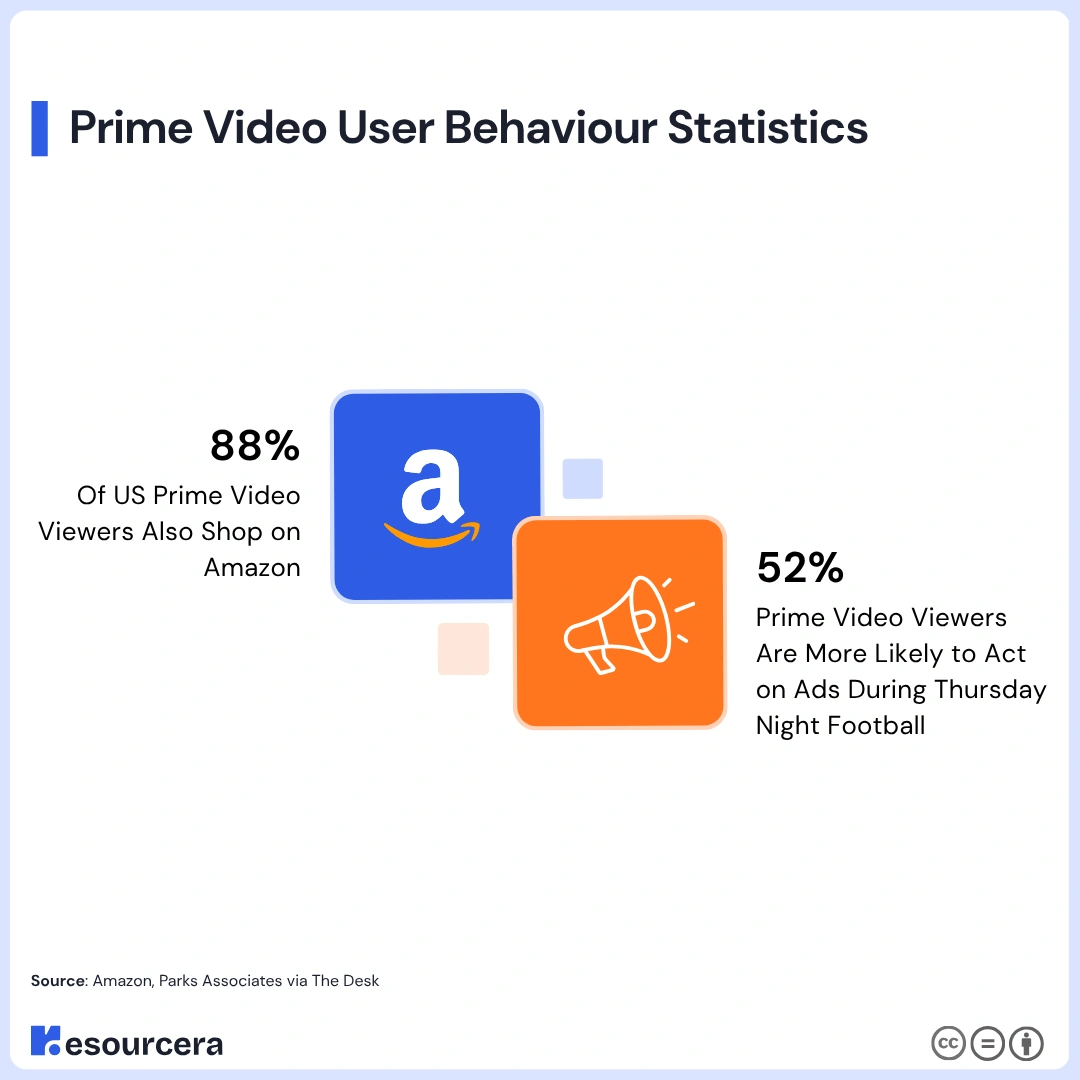
What makes Prime Video unusual is not just its size, but how its viewers behave. The platform sits inside the world’s largest online store, and the viewing and shopping habits feed each other.
- 88% of Prime Video viewers in the US also shop on Amazon, which is why Amazon pitches the platform to advertisers as a direct line from watching to buying.
- Monthly ad-supported viewing hours on Prime Video grew nearly 40% year over year in 2025, showing engagement is rising faster than the audience itself.
- Prime Video viewers are 52% more likely to act on advertising they see during Thursday Night Football than viewers of traditional TV.
- Live sports pull younger audiences to the platform, with median viewer ages of roughly 48 for TNF and 46.9 for NBA games, both well below linear TV equivalents.
- Prime Video is the most-used subscription streaming service in the US, according to Parks Associates, helped by the fact that it comes bundled with the Prime membership most American households already pay for.
Source: Amazon 3, Parks Associates via The Desk
Amazon Prime Video Revenue Statistics
Amazon does not break out Prime Video revenue on its own. The service is monetised through two reported lines: subscription services, which covers Prime membership fees plus digital video, music, and audiobook subscriptions, and advertising, where Prime Video ads now play a growing role.
Amazon’s Subscription Services Generated $49.62 Billion in 2025
Amazon’s subscription services segment brought in $49.62 billion in 2025, up roughly 12% from $44.37 billion in 2024. The segment kept growing into 2026, with $13.43 billion in Q1 alone, up 15% year over year.
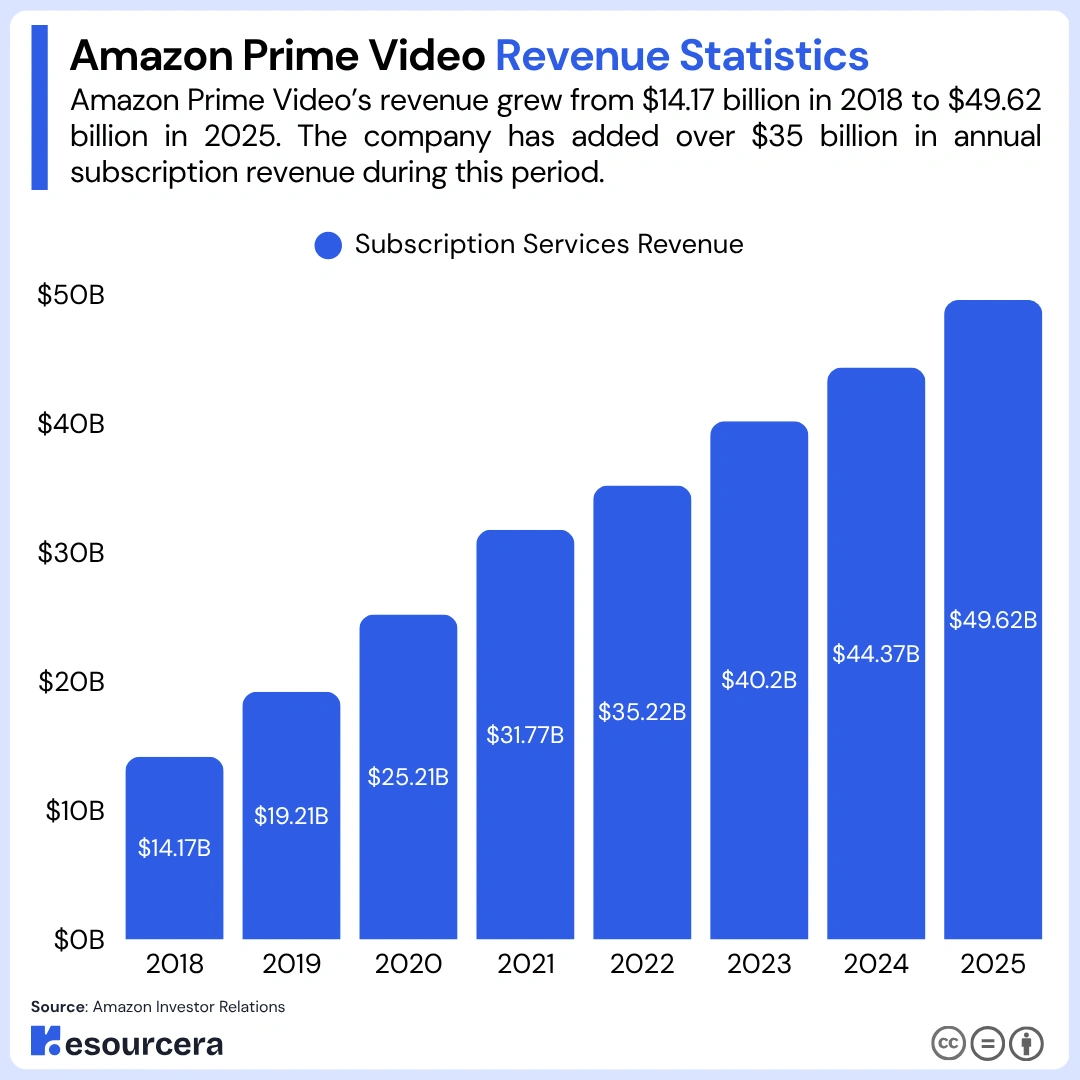
Here is a table showing Amazon’s subscription services revenue by year:
| Year | Subscription Services Revenue |
|---|---|
| 2018 | $14.17 billion |
| 2019 | $19.21 billion |
| 2020 | $25.21 billion |
| 2021 | $31.77 billion |
| 2022 | $35.22 billion |
| 2023 | $40.2 billion |
| 2024 | $44.37 billion |
| 2025 | $49.62 billion |
Source: Amazon Investor Relations
Prime Video Ads Helped Push Amazon’s Advertising Revenue Past $68 Billion in 2025
Amazon’s advertising business generated more than $68 billion in 2025, including $21.3 billion in Q4 alone, up 22% year over year. CEO Andy Jassy said Prime Video contributed meaningfully to the segment in Q4, and Amazon’s full-funnel advertising strategy, which pairs Prime Video’s 315 million ad-supported viewers with its retail data, added over $12 billion in incremental revenue during the year.
For context on how quickly this business scaled: Prime Video only introduced adverts in January 2024. Within two years, its audience became a core pillar of the third-largest digital advertising business in the world, behind only Google and Meta.
Source: Amazon Q4 2025 Results, Marketing Dive
Amazon Prime Video Content Spend
Amazon Spent $22.4 Billion on Content in 2025, Around 25% More Than Netflix
Amazon spent $22.4 billion on video and music content in 2025, up 10% from $20.4 billion in 2024, according to the company’s 10-K annual filing. The figure covers Prime Video originals, licensed films and series, live sports rights, and Amazon Music, and it comfortably exceeds Netflix’s roughly $18 billion content budget for the same year.
The 2025 slate this money paid for included Fallout season 2, Reacher season 3, Invincible season 3, and The Summer I Turned Pretty, alongside the NFL and the first year of the NBA deal.
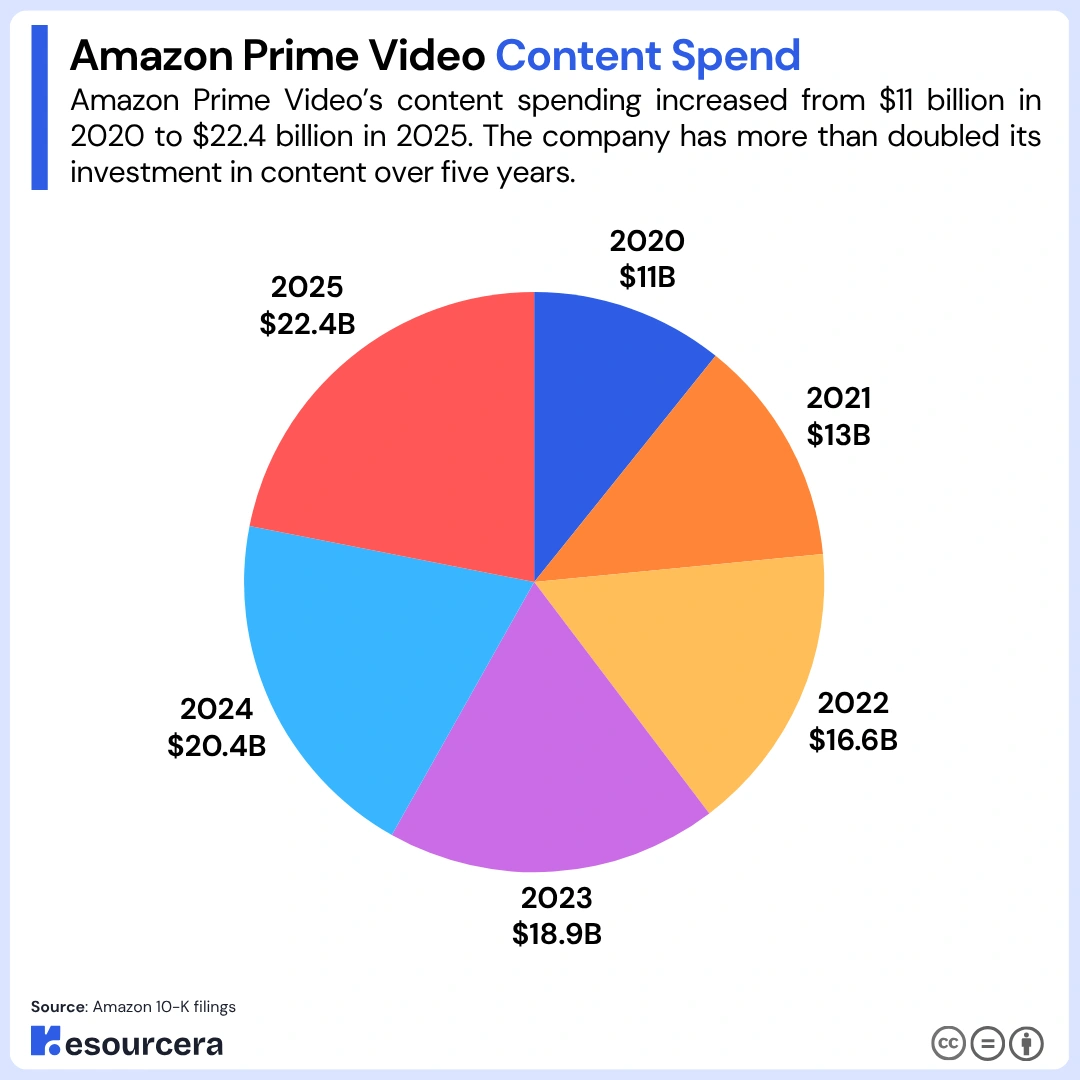
Here is a table showing Amazon’s annual video and music content spend:
| Year | Content Spend |
|---|---|
| 2020 | $11 billion |
| 2021 | $13 billion |
| 2022 | $16.6 billion |
| 2023 | $18.9 billion |
| 2024 | $20.4 billion |
| 2025 | $22.4 billion |
Source: Amazon 10-K filings
Amazon Prime Video vs Netflix: User Base Compared
Netflix remains the larger platform by paying customers, closing 2025 with 325 million paid subscribers worldwide against Prime Video’s estimated 230 million users at the end of 2024. The gap between the two has hovered between 70 and 95 million for the past six years, and neither side has meaningfully closed it.
The two services count their audiences differently. Netflix reports paid subscribers directly, while Amazon has never disclosed a Prime Video subscriber count, so the Prime Video figures are industry estimates of its user base. That distinction matters because most Prime Video users get the service bundled with an Amazon Prime membership rather than paying for it on its own.
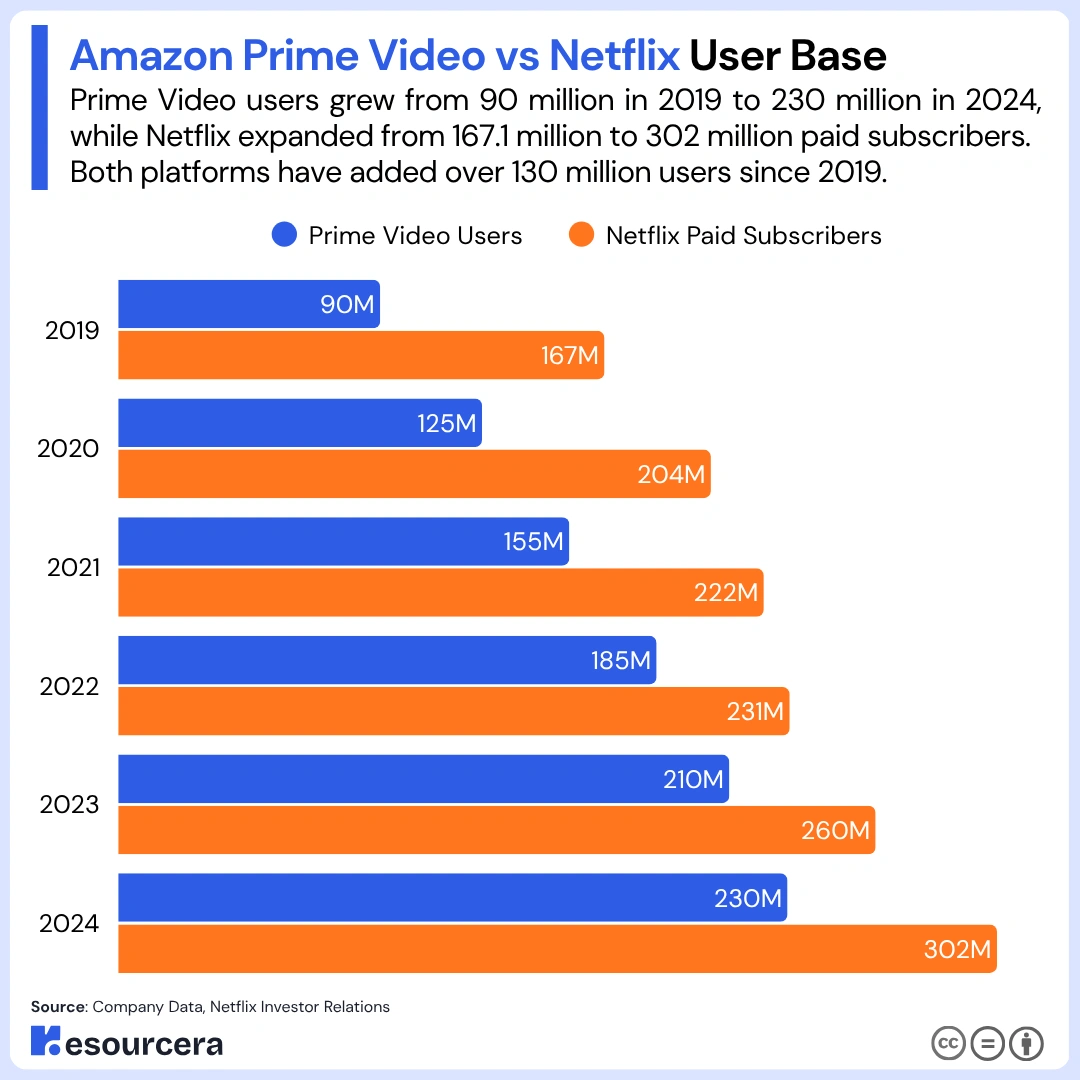
Here is a table showing Prime Video and Netflix user growth year over year:
| Year | Prime Video Users | Netflix Paid Subscribers |
|---|---|---|
| 2019 | 90 million | 167.09 million |
| 2020 | 125 million | 203.66 million |
| 2021 | 155 million | 221.84 million |
| 2022 | 185 million | 230.75 million |
| 2023 | 210 million | 260.28 million |
| 2024 | 230 million | 302 million |
Source: Company Data
Two things stand out from the trend. First, Prime Video has actually grown faster in percentage terms, expanding 156% between 2019 and 2024 against Netflix’s 81%, but from a much smaller base. Second, Netflix reaccelerated hard in 2023 and 2024 on the back of its password-sharing crackdown, adding over 41 million subscribers in 2024 alone, its biggest annual gain ever, which widened the gap again just as Prime Video’s growth was steadying.
The picture changes once ad audiences enter the frame. In 2025, Prime Video’s ad-supported reach passed 315 million monthly viewers, closing in on Netflix’s 325 million paid subscribers, while Netflix’s own ad tier reached over 250 million monthly active viewers. On the metric advertisers care about, monthly viewers, the two platforms are now nearly the same size.
Conclusion: The Streaming Service Built on a Shopping Membership
Prime Video in 2026 is a genuine streaming heavyweight rather than a free perk. Its 315 million monthly ad-supported viewers now exceed the 250 million Prime members who anchor the service, it holds a 17% share of the US streaming market, and it just produced the most-watched Thursday Night Football season in history along with the most-streamed NFL game ever.
The business model behind it is unlike any other streamer. Amazon spends $22.4 billion a year on content, more than Netflix, but recovers it through a flywheel of $49.62 billion in subscription revenue, a $68 billion advertising machine that Prime Video increasingly powers, and the simple fact that 88% of its viewers also shop on Amazon.
The pressure point to watch is engagement share. Prime Video lost 4 percentage points of US streaming market share over the past year as Apple TV+ and Disney+ gained, even as its total reach and viewing hours grew. With the NBA now on board, an expanding ad business, and the deepest pockets in streaming, Prime Video has the tools to defend its position. The question for 2026 is whether audiences keep choosing it for the content, and not just because it comes with the shipping.