

Businesses are increasingly adopting AI tools such as virtual assistants and chatbots to enhance efficiency, improve customer satisfaction, and reduce costs.
66% of global managers are using AI to tailor responses just for each customer, while 70% rely on it to read sentiments across chats, calls, and emails.
And not just that, it is predicted that I could handle 95% of all customer interactions this year, solving 75% of questions without a human stepping in.
But from customers perspective, things are different. 90% of Americans still pick a real person over AI every time, and 63% say it can’t replace humans for good.
Key AI Customer Service Statistics (2026)
- AI is expected to handle 95% of all customer interactions in 2026, by resolving 75% of questions without any human involvement.
- More than half of all customer support units have already implemented AI, with more investments planned ahead.
- 84% of executives are already using AI to engage with customers, and 91% of businesses feel positive about AI-driven customer engagement.
- 96% of business leaders believe generative AI will improve customer interactions in the future.
- AI saves customer service agents an average of 2 hours and 20 minutes every single day.
- 90% of Americans still prefer speaking to a real person, and 63% do not believe AI can ever truly replace humans in customer service.
- 50% of consumers say they would cancel a service entirely if it became fully AI-driven.
AI Adoption in Customer Service
Artificial intelligence has moved well beyond the experimental phase in customer service.
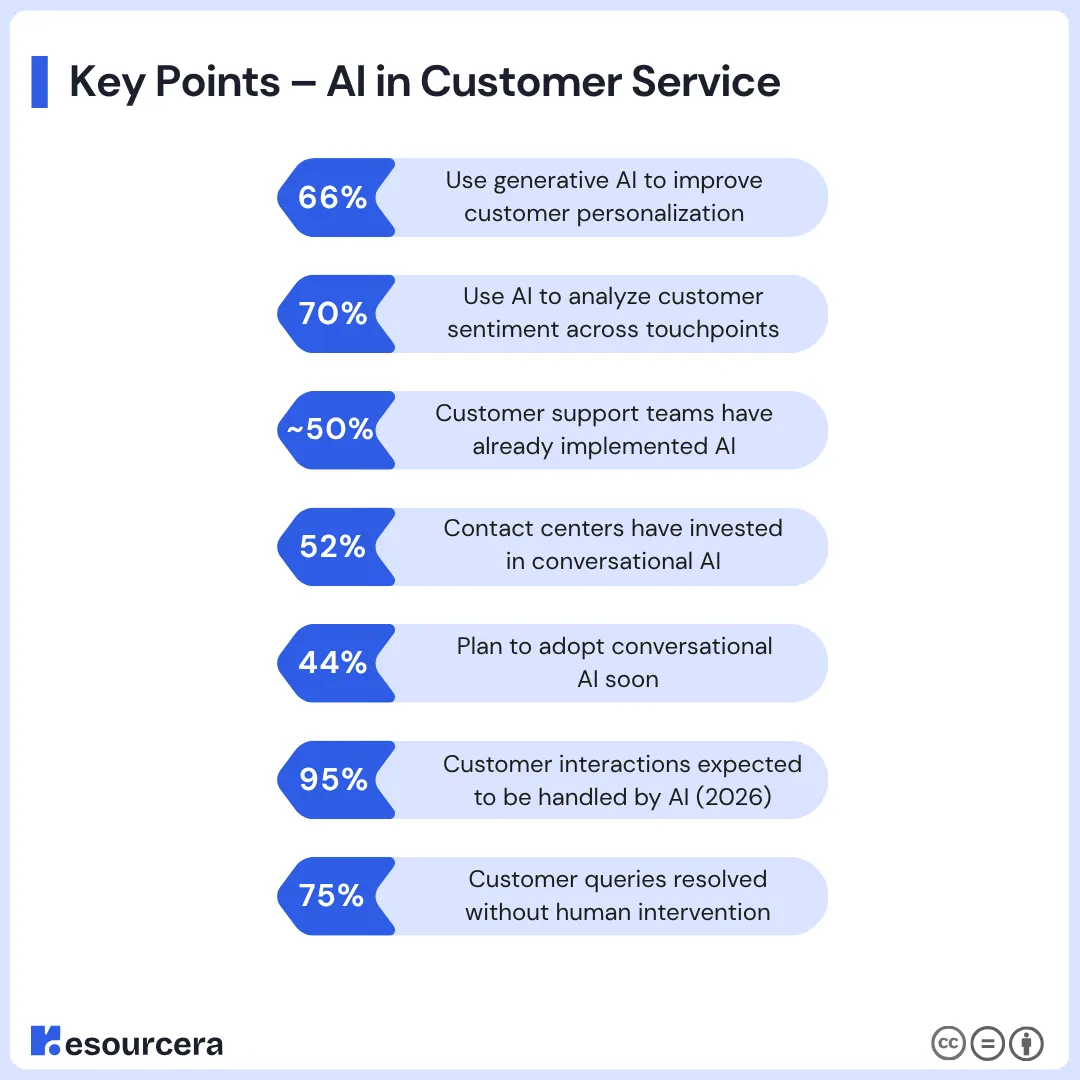
66% of global customer service managers are optimizing AI using generative AI to increase personalization, and 70% use it to analyze customer sentiment across multiple touchpoints.
Read on to learn how AI is reshaping the customer service landscape, right from automating routine tasks to significantly improving response time and service quality.
Nearly half of all customer support units have already implemented AI, with additional investments planned in the pipeline.
Moreover, 52% of contact centers have invested in Conversational AI, while 44% plan to adopt it in the near future.
In 2026, 95% of customer interactions were predicted to be handled by AI, while 75% of customer inquiries can now be resolved by AI tools without requiring human intervention.
Business leaders are driving this shift with clear intent. 84% of executives are already using AI to interact with customers, 91% of businesses are positive about using AI for consumer engagement, and 96% believe Generative AI will enhance customer interactions.
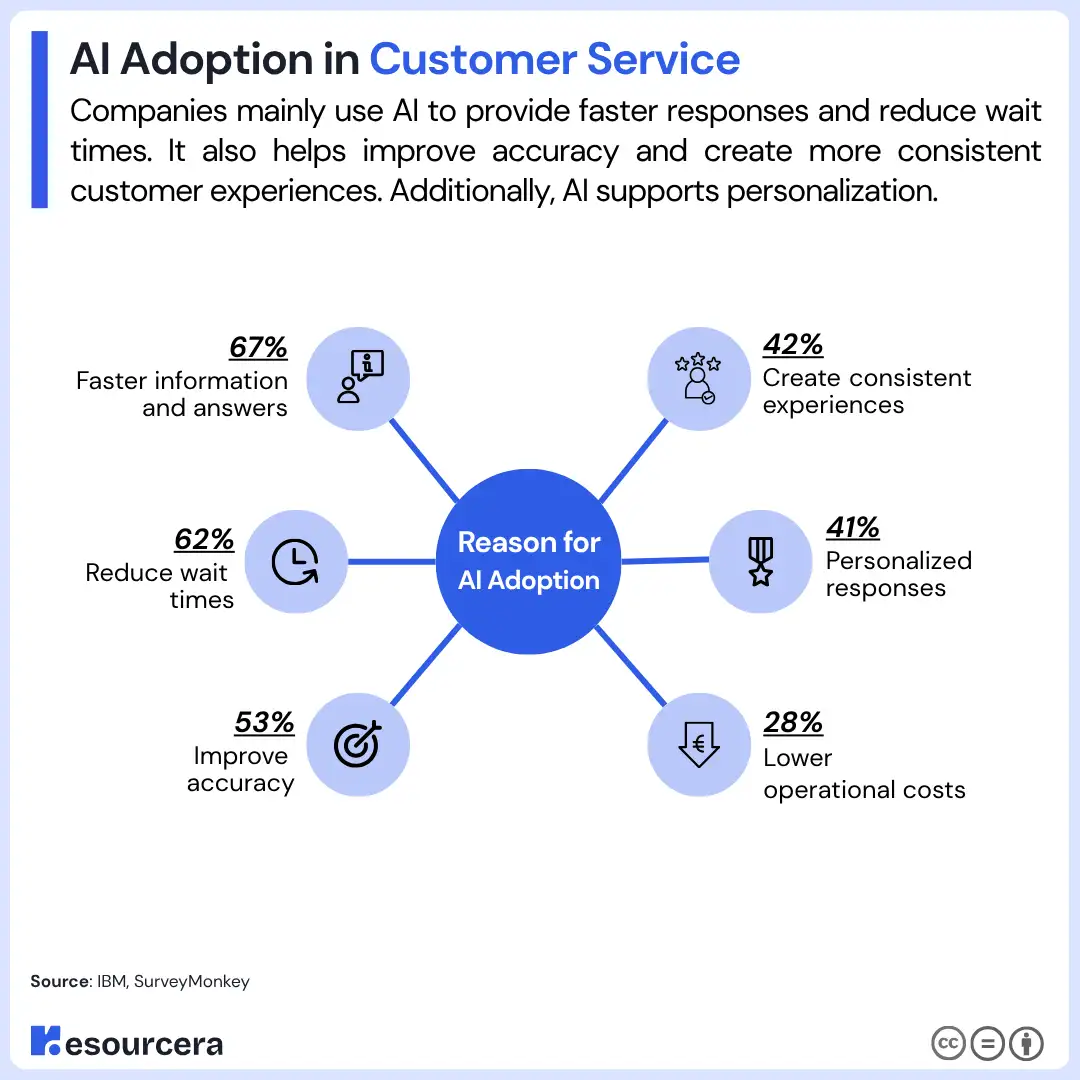
Here is what businesses say they are using AI in customer service for:
| Reason for AI Adoption | % of Companies |
|---|---|
| Faster information and answers | 67% |
| Reduce wait times | 62% |
| Improve accuracy | 53% |
| Create consistent experiences | 42% |
| Personalized responses | 41% |
| Lower operational costs | 28% |
Source: IBM, SurveyMonkey
On the operational side, 36% of customer service experts highlight AI’s role in ensuring 24/7 availability, 31% appreciate it for automating manual tasks, and 30% note it helps respond faster to support requests.
Conversational AI and chatbots have boosted customer service specialist productivity by 94%.
Here is how AI helps in operational tasks in customer service:
| Operational Benefit | Impact |
|---|---|
| Boost in CS specialist productivity | 94% |
| Faster issue resolution | 92% |
| Reduction in agent effort | 87% |
| Teams reporting lower costs | 65% |
| Reduction in average handle time (with agent assist) | 27% |
However, here is the catch, 90% of Americans strongly prefer interacting with a human over an AI agent, and 63% don’t believe AI could ever replace human beings in customer service roles.
On the other hand, 56% of people have negative feelings about companies using AI as part of their customer experience, and 81% believe companies use AI primarily to save costs rather than improve service.
Source: Survey Monkey
AI Customer Service Adoption by Industry
The telecommunications and Banking are the major industries making maximum use of Artificial intelligence for customer service.
In fact, 80% of banking, insurance, and financial services are implementing AI into their customer service tasks.
Similarly, over 79% of the companies in Travel, transport, and hospitality have already implemented AI into their daily customer experience tasks.
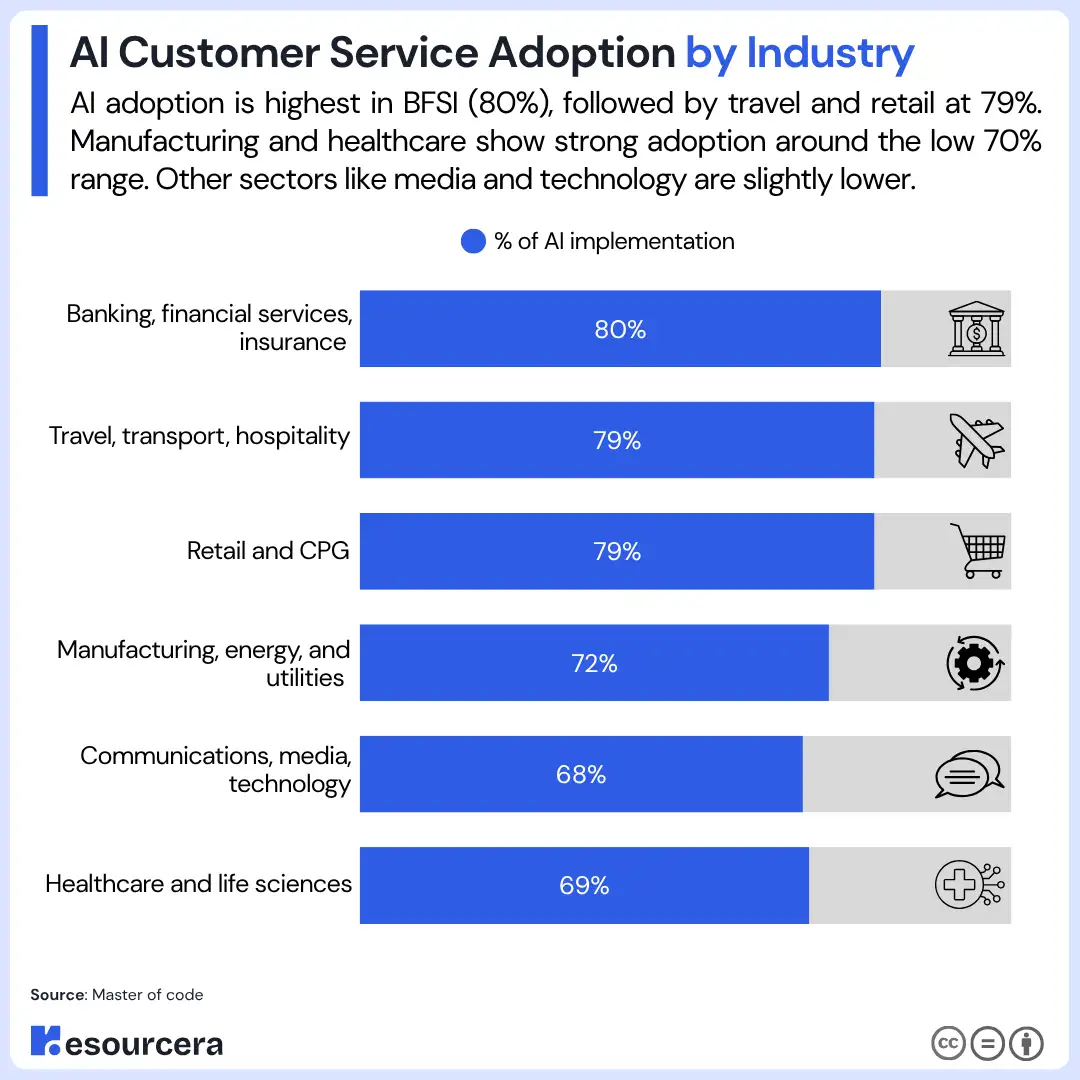
Here is how different industries are implementing AI into their customer experience functions:
| Industry | % of AI implementation |
|---|---|
| Banking, financial services, insurance | 80% |
| Travel, transport, hospitality | 79% |
| Retail and CPG | 79% |
| Manufacturing, energy, and utilities | 72% |
| Communications, media, technology | 68% |
| Healthcare and life sciences | 69% |
Source: Master of code
To get a complete insight into AI customer service trends across different industries, you can check out the data below.
Healthcare Industry
- The AI healthcare market has reached around $56 billion in 2026 and is expected to hit $505.59 billion by 2033.
- Around 87% of the healthcare organizations are investing or planning to invest in AI Technologies.
- 75% of the top healthcare companies are actively experimenting with generative AI or planning to scale the use of AI across their organizations.
- Around 69% of users consider AI-generated health information to be very or extremely reliable.
Banking and Financial Industry
- The banking sector is expected to invest more than $97 billion in AI technologies by the end of 2027, representing a 17% year-over-year increase in spending.
- Approximately 54% of customer interactions in U.S. banks are automated through AI-driven systems.
- Around 46% of financial institutions using AI report noticeable improvements in customer experience.
- 79.5% are increasing CX investments, prioritizing digital service innovation (58.5%) and self-service solutions for both simple (47%) and complex queries (42%).
- Future AI initiatives include analyzing contact center data (82.5%), improving chatbots (72.5%), and deploying virtual assistants for customer self-service (65.5%).
| AI Initiative | Adoption / Focus (%) |
|---|---|
| Contact Center Data Analysis | 82.5% |
| Chatbot Optimization | 72.5% |
| Virtual Client Assistants | 65.5% |
Retail
- 63% of the retail businesses make use of artificial intelligence, especially for customer interactions, with 40% allocating dedicated teams and budgets toward AI initiatives.
- Consumers identify AI’s biggest advantage in enabling price-sensitive shopping (28%), driven by ongoing cost-of-living concerns.
- The global AI market in retail and e-commerce is projected to expand significantly from $9.4 billion in 2024 to $85.1 billion by 2032, with a CAGR of 31.8%.
- 57% of shoppers are comfortable using AI in eCommerce, provided businesses maintain transparency.
- Additional use cases include loyalty programs and personalized rewards (23%), product discovery (23%), item validation (19%), and AI-driven recommendations (19%).
| Use Case in Retail | Percentage (%) |
|---|---|
| Loyalty & Personalized Rewards | 23% |
| Online Product Discovery | 23% |
| Item Validation | 19% |
| AI-Powered Recommendations | 19% |
Telecommunications
- 97% of communication service providers report that conversational AI has a positive impact on customer satisfaction.
- Around 91% of executives believe automation and digital workflows will dominate by the end of 2026.
- 60% of the inquiries are handled by AI-powered chatbots in most of the telecommunication firms.
- AI-powered chatbots enable 82% of users to access services quickly without long wait times.
- Personalization in telecom contributes to a 5–15% increase in revenue, driven by AI-based digital assistants.
- Implementing AI-driven automation can help telecom companies cut operational costs by up to 30%.
AI in Customer Service Market Size
The Artificial Intelligence in the customer service market is valued at $19.94 billion in 2026 and is projected to grow to $83.9 billion by 2033.
The value is expected to reach $47.82 billion by 2030, expanding at a CAGR of 25.8% over the forecast period.

The table below represents the estimated value of AI in Customer Service from 2024 to 2033.
| Year | Estimated Value |
|---|---|
| 2024 | $12.60 billion |
| 2025 | $15.85 billion |
| 2026 | $19.94 billion |
| 2027* | $25.08 billion |
| 2028* | $31.56 billion |
| 2029* | $39.70 billion |
| 2030* | $47.82 billion |
| 2031* | $60.17 billion |
| 2032* | $75.62 billion |
| 2033* | $83.9 billion |
- In 2024, the United States dominated the North American AI for customer service market, generating the highest revenue share in the region.
- The global chatbot market share is expected to reach around $27.29 billion by 2030.
- Machine learning and deep learning made up the largest part of the AI customer service market, contributing 43.5% of the total revenue.
- Among applications, the virtual assistants and chatbots were most widely used, holding a market share of 28.1%.
Impact of AI on Modern Customer Experience
Well, AI is reshaping customer service teams by taking over routine tasks and sharpening overall operations.
It ramps up 24/7 support availability by 50%, delivers 45% time savings, and speeds up issue resolution by 44%, all while boosting cost efficiency by 37% and support quality by 35%.
Agents can now zero in on high-value work. Here’s a quick look at the biggest agent-level gains:
| Benefit | Percentage Impact |
|---|---|
| Complex service roles | 31% |
| Time saved on manual tasks | 31% |
| Faster doubt resolution | 28% |
| Daily time gains (avg. 2 hours + 20 min/chat) | 25% |
| Full ticket resolution via automation | 22% |
Customer service professionals report an average daily time saving of 2 hours and 20 minutes through the use of AI-powered chatbots alone.
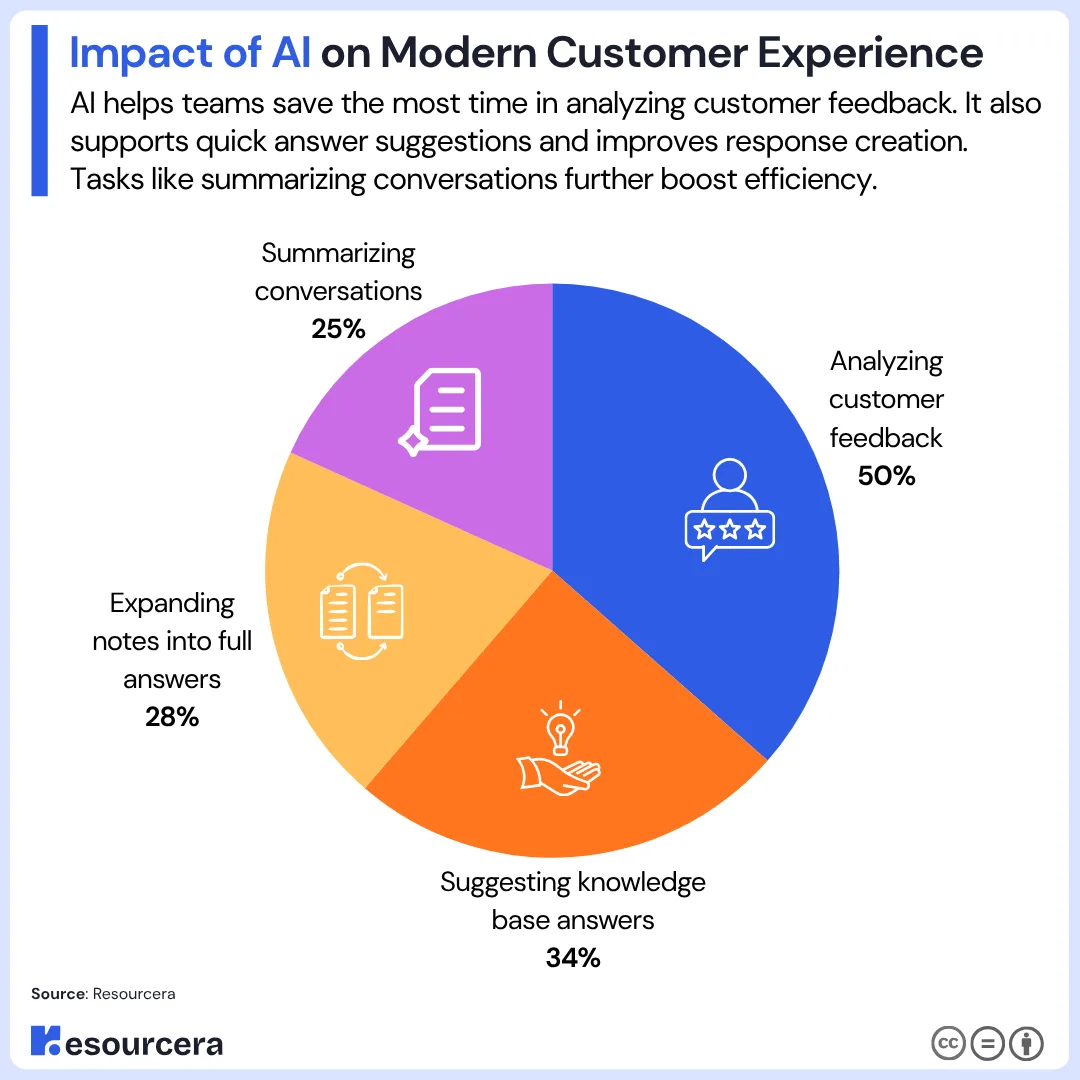
When asked where AI saves them the most time, here is what customer service teams reported:
| AI Time-Saving Activity | % of Teams |
|---|---|
| Analyzing customer feedback | 50% |
| Suggesting knowledge base answers | 34% |
| Expanding notes into full answers | 28% |
| Summarizing conversations | 25% |
On top of that, AI powers 27% faster average handle times through smart virtual tools, lifts team productivity by 43%, pushes client ratings up 40%, sparks 32% revenue growth, and nets an average $4.3 million in staff cost savings per center.
Contact centers see major gains from AI applications, with 91% of teams reporting sharper tech insights that directly boost results.
Here is a quick look at AI’s impact scales across efficiency layers:
| Key Metric | % Gain |
|---|---|
| Sharper insights | 91% of teams |
| Consumer service | 93% |
| Wait times | 85% |
| Data workflows | 84% |
| Customer productivity | 81% |
| Stream handling | 78% |
| Agent effort | 72% |
| Lower costs/reporting | 68% |
| OpEx reduction | 65% |
Nearly 42% of customer experience leaders expect generative AI to impact voice-based interactions in the next 2 years.
AI chatbots offer 24/7 customer support, making them an ideal solution for global businesses that can handle inquiries across different time zones.
Artificial Intelligence has the potential to lower the operational costs in customer service, where studies show the reduction of costs by 30% to 35% for several organizations.
How does AI contribute to personalized customer experience?
Artificial intelligence is revolutionizing personalized customer experiences by allowing businesses to analyze, anticipate, and meet customer needs on a large scale.
The AI-powered personalization has the potential to boost revenue by up to 15% as it allows businesses to deliver more timely and relevant experiences across the customer journey.
- A significant 82% of consumers are willing to share their personal data when it results in more tailored and personalized experiences.
- According to SurveyMonkey, 65% of customers use AI to order food and drinks, while 59% are open to using AI for processing product returns.
- Yum Brands reported that AI-powered personalized marketing boosted their purchases and lowered customer churn, showing its effectiveness.
Source: SurveyMonkey 2
Cost Savings & ROI of AI in Customer Service
81% of consumers believe companies use AI primarily to save money rather than improve service.
The average return on AI investment in customer service sits at $3.50 for every $1 spent, with top-performing organizations reporting returns as high as 8x.
Conversational AI directly interacting with external customers is attributed with reducing cost per contact by 23.5% and increasing annual revenue by 4% on average.
Over half of customer service teams (53%) say AI-based capabilities have reduced overall operational costs in their contact centers. At the contact center level specifically, organizations pairing human agents with virtual assistants handle 7.7% more simultaneous chats and report an average of $4.3 million in staffing cost savings.
Moreover, Gartner forecasts that conversational AI will reduce contact center labor costs by $80 billion by 2027.
Among organizations measuring AI’s impact, 34% reported a revenue increase, 40% saw improvement in client ratings, and 32% recorded gains in team member productivity.
Do People Actually Like AI Support in Customer Service
The short answer is, some people do, but most still prefer humans. While businesses are quickly adopting AI, customers still prefer human agents for most important issues.
A 2025 SurveyMonkey study found that 90% of Americans prefer a human over AI for customer service, mainly because humans are seen as better at understanding needs, giving clearer explanations, causing less frustration, and offering more ways to solve a problem.
The same study also found that only 8% of people prefer AI over humans in customer service, which shows that AI is still not the first choice for most customers.
This preference is stronger among women than men and grows even more pronounced with age:
| Generation | Prefer AI Over Human |
|---|---|
| Gen Z | 14% |
| Millennials | 11% |
| Gen X | 7% |
| Baby Boomers | 4% |
There are clear reasons why people lean toward humans. According to SurveyMonkey research:
| Reason for Preferring Human Agents | % of Consumers |
|---|---|
| Better understand their needs | 61% |
| Provide more thorough explanations | 53% |
| Less likely to cause frustration | 52% |
| Offer more options to resolve issues | 50% |
On top of this, 84% of consumers believe human agents are simply more accurate than AI.
Consumers are willing to use AI for lower-stakes tasks, 65% are comfortable using it to order food and drinks, 59% for returning an item, and many are open to it for completing work or school tasks.
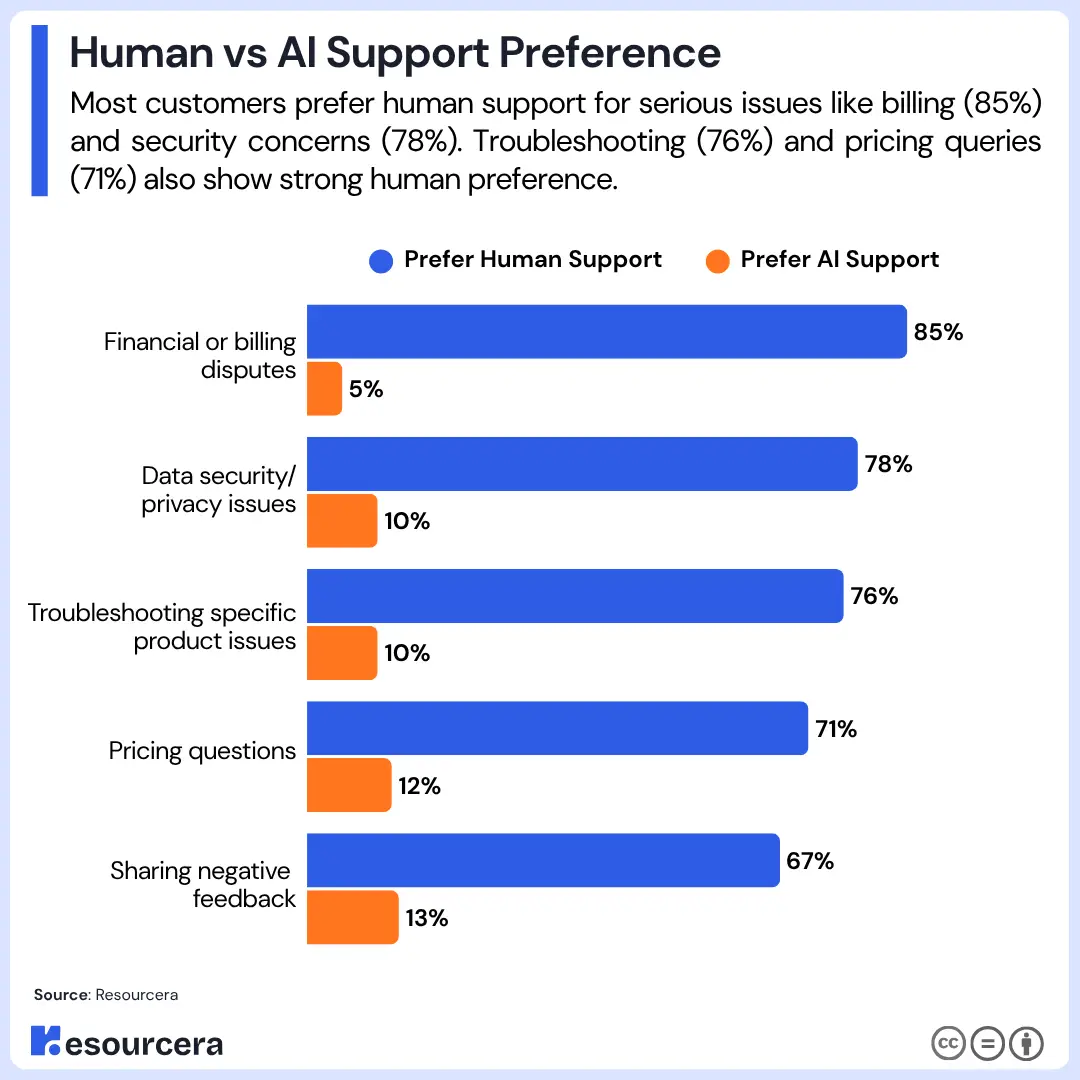
But for anything more serious, people want a human. The table below shows just how strong that preference is:
| Situation | Prefer Human Support | Prefer AI Support |
|---|---|---|
| Financial or billing disputes | 85% | 5% |
| Data security/privacy issues | 78% | 10% |
| Troubleshooting specific product issues | 76% | 10% |
| Pricing questions | 71% | 12% |
| Sharing negative feedback | 67% | 13% |
What is more interesting is that 81% of consumers believe companies use AI in customer service primarily to cut costs, not to improve the experience.
This distrust runs deep. 41% of consumers already feel customer service has gotten worse because of AI, and 63% don’t believe AI could ever truly replace a human.
As a result, 89% of consumers believe companies should always offer the option to speak with a human.
According to the study report from Twilio, with 78% of consumers said the ability to switch from an AI agent to a human is important to them. Half of consumers (50%) say they would cancel a service entirely if it became fully AI-driven, and 42% would even pay extra just to have access to a human representative.
This is in stark contrast to how businesses view the situation. 83% of business leaders believe conversational AI can fully replace human agents
One more thing worth noting is that consumers are becoming increasingly adept at identifying AI. Around 54% say they can confidently identify when they’re interacting with an AI chatbot, and 47% believe they can also detect AI-generated content.
Challenges in AI in Customer Service Applications
Even though AI has transformed customer service through 24/7 availability and faster response time, it still faces significant limitations. Below are a few limitations associated with AI in customer service.
- As per a report from SurveyMonkey, 61% of customers say that their needs are understood better by humans as compared to AI.
- AI chatbots fail to understand the customer intent in 20% to 30% interactions.
- As AI systems depend on data algorithms, if these algorithms are not updated frequently, there is a risk of providing misleading information.
- AI detects the emotional tone accurately only 60% to 70% time.
The following study from Forbes highlights the level of trust in businesses in implementing artificial intelligence.
| Level of trust | Percentage |
|---|---|
| Very Likely | 33% |
| Somewhat likely | 32% |
| Very Unlikely | 7% |
| Somewhat Unlikely | 7% |
| Neither likely nor unlikely | 21% |
Source: Forbes
The most significant barrier is data quality (77%), indicating that many organizations lack the structured and accessible data required for effective AI deployment. Closely following this is the challenge of identifying relevant use cases (76%).
Here are the limitations faced by using AI in customer service:
| Limitation | Percentage (%) |
|---|---|
| Data quality or availability issues | 77% |
| Difficulty identifying use cases | 76% |
| Ethical, security, regulatory concerns | 73% |
| Technical infrastructure limitations | 73% |
| Skill or expertise shortages | 73% |
| High operational costs | 67% |
| Lack of strategic AI framework | 60% |
Customer perception remains a major limitation. 44% of users still prefer human agents, while 36% find AI interactions less personal.
From an organizational perspective, 30% of enterprises are concerned about over-reliance on AI, and 23% highlight cost-related risks, reinforcing the idea that AI adoption is still approached cautiously.
Below are the major concerns consumers and the workforce face:
| Concern | Percentage (%) |
|---|---|
| Customers prefer human agents | 44% |
| AI interactions feel less personal | 36% |
| Fear of over-dependence on AI (enterprises) | 30% |
| Cost concerns (enterprises) | 23% |
| Employees fear ai job replacement | 39% |
| AI may provide incorrect information | 55% |
| Confidence in detecting AI errors | 42% |
More than 90% of businesses and consumers emphasize the need for disclosure when AI is used in customer interactions.
Furthermore, 77% of companies and 73% of consumers support human oversight, indicating that AI is not yet seen as a fully independent solution.
Instead, hybrid models combining AI efficiency with human judgment are preferred.
Chatbot in Customer Service Statistics 2026
According to the IBM, every business leader surveyed said their organization planned to use AI in customer service, and 67% had already started.
Gartner has gone further, predicting that by 2029, agentic AI combined with conversational chatbots will autonomously resolve 80% of common customer service issues without any human involvement. This is a shift expected to cut operational costs by 30%.
On the consumer side:
- More than 67% of people worldwide have already used a chatbot for customer support at some point in the past year.
- 54% say they can confidently identify when they’re interacting with an AI chatbot.
- Interestingly, 40% of consumers say they don’t care whether a chatbot or a human helps them, as long as they get the help they need.
For businesses, chatbots can save businesses up to 30% in customer support costs by speeding up response times and handling up to 80% of routine questions on their own.
Beyond cost savings, conversational AI that directly interacts with customers has been shown to reduce cost per contact by 23.5% and increase annual revenue by 4% on average.
63% of service professionals believe generative AI will help them serve customers faster. Gartner also noted that by 2027, 80% of customer service and support organizations were expected to apply generative AI in some form to improve agent productivity and customer experience.
When people do turn to chatbots, they tend to use them for specific, practical purposes. According to Invesp data, the most common use cases are getting a quick answer in an emergency (37%).
The top reasons consumers appreciate chatbots are clear:
| Benefit | % of Consumers |
|---|---|
| 24-hour service availability | 64% |
| Getting an instant response | 55% |
| Answers to simple questions | 55% |
| Easy communication | 51% |
| Friendliness and approachability | 32% |
Similarly, when talking about industries, online retail leads the way, with 34% of consumers comfortable using AI chatbots in that space. Healthcare follows at 27%, then telecommunications at 25%.
| Industry | Consumer Acceptance of AI Chatbots |
|---|---|
| Online Retail | 34% |
| Healthcare | 27% |
| Telecommunications | 25% |
| Banking | 20% |
| Financial Advice | 20% |
| Insurance | 15% |
| Government | 10% |
AI in Customer Service: Future Outlook and Evolving Trends
The future of AI in customer service is about working smoothly alongside humans, giving smart and timely help, and supporting customers across different channels.
- By the end of 2026, artificial intelligence is projected to manage 95% of customer interactions, including both voice and text-based communication.
- The generative AI in customer service is projected to grow to $3.23 billion by 2033, with a compound annual growth rate of 24.17%.
Omnichannel support allows businesses to connect all customer communication channels, such as email, social media, SMS, and phone, into one seamless system, ensuring a consistent and uninterrupted experience.
- Gartner forecasts that by 2029, agentic AI will be able to resolve 80% of customer issues independently.
- By 2027, AI chatbots will reduce global contact center labor expenses by $80 billion
Social Media as a Customer Service
- Social media has become one of the most powerful tools for customer service, as nearly 70% of people use social media platforms to contact brands for customer support.
Here’s the list of top platforms that consumers and brands use for customer service.
| Platforms | Use of platforms by Consumers | Use of platforms by brands |
|---|---|---|
| 60% | 69% | |
| 35% | 60% | |
| YouTube | 33% | 31% |
| TikTok | 21% | 29% |
| 15% | 32% | |
| Snapchat | 13% | 14% |
| 10% | 7% | |
| 9% | 9% | |
| 7% | 20% |
Source: SproutSocial.
Facebook and Instagram are the most widely used social media platforms by consumers as well as different brands for customer service.
Their broad user base and built-in messaging tools make them ideal for handling inquiries, resolving issues, and maintaining real-time customer engagement.
Final Thoughts
AI is clearly transforming customer service, making it faster, cheaper, and more efficient for businesses. The numbers speak for themselves, from massive cost savings to productivity gains and round-the-clock availability.
However, the human side of the equation cannot be ignored. Most customers still want to talk to a real person, especially when it matters most. Trust in AI remains low, and many consumers feel that service quality has gone down rather than up.
Businesses that use AI to handle routine tasks while keeping humans available for complex and sensitive issues are the ones most likely to win customer loyalty in the long run.

