


Starting a business, launching a product, or entering a new market always involves some risk. A company may believe customers will like its idea, but assumptions alone are not enough to support an important business decision.
Market research helps businesses replace assumptions with reliable information. This is important because around 70% of new consumer products fail after launch. In many cases, failure happens because there is a gap between what a business believes customers want and what customers actually need.
Market research helps close this gap by providing a clearer understanding of customers, competitors, demand, and market conditions.
This guide explains what market research is, why it matters, the different types and methods, and how to conduct market research step by step.
What Is Market Research?
Market research is the structured process of collecting, analyzing, and interpreting information about a market, its customers, and its competitors, so that a business decision can be made on evidence instead of instinct.
It helps organizations understand what customers need, what influences their buying behavior, how the market is changing, and where the best opportunities may exist.
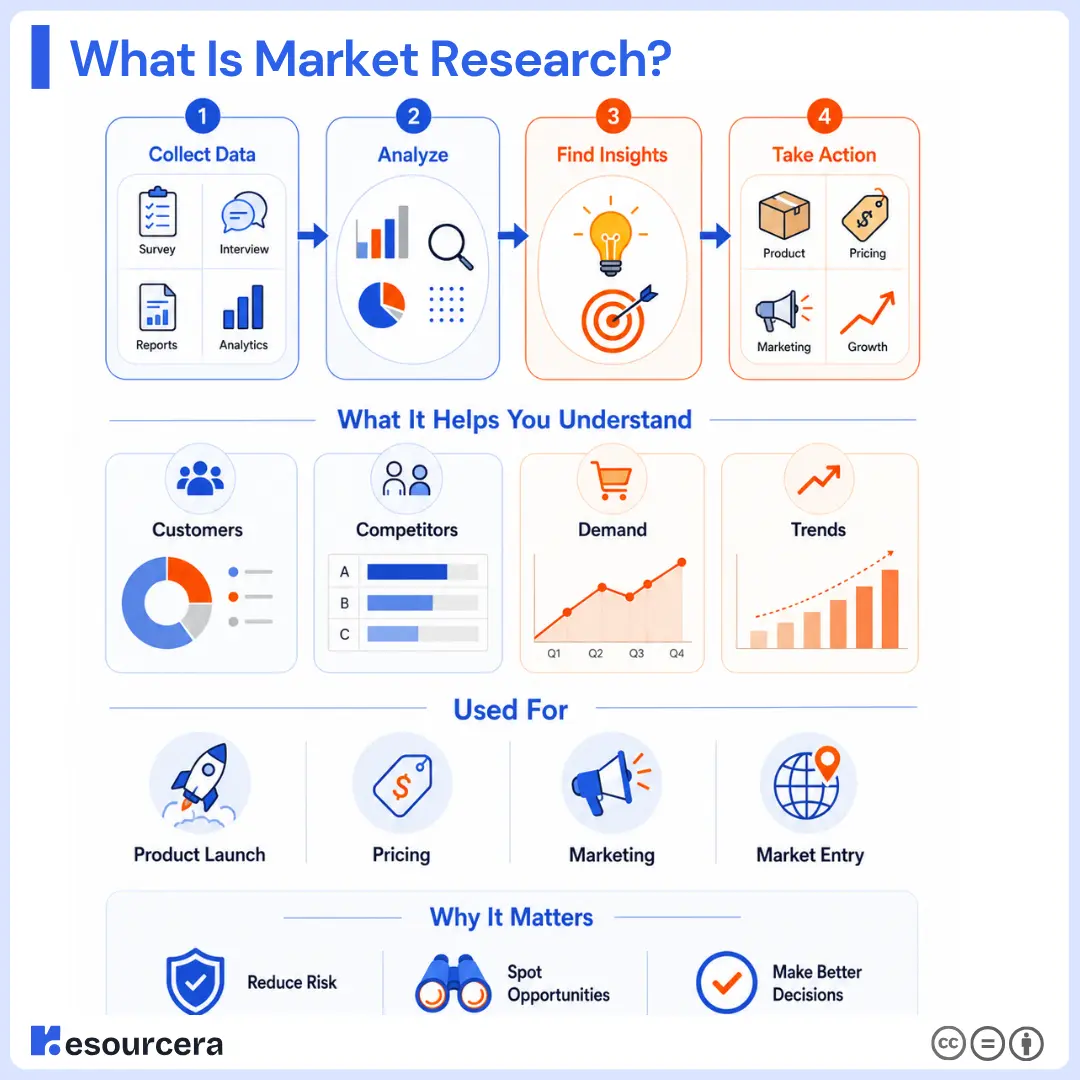
Effective market research goes beyond collecting data. Researchers examine patterns, test assumptions, and turn raw information into practical insights. Businesses use these insights to improve products, set prices, refine marketing messages, understand competitors, enter new markets, and reduce the risk of costly decisions.
In simple terms, market research helps businesses replace guesswork with evidence.
A Simple Example of Market Research in Action
In practice, market research is how a business answers the questions it would otherwise be guessing at. Questions like these.
- Who is my customer base and what are their preferences?
- What problem are they trying to solve, and how are they solving it today without me?
- How much will they pay, and what would persuade them to pay more?
- How large is this market, and is it growing or quietly shrinking?
- Who else is competing for this customer, and where exactly are they weak?
- What do people believe about my brand, whether or not those beliefs are fair?
- Is there enough real demand here to build a business on?
Market Research Companies may collect survey responses, customer interviews, sales records, competitor prices, and industry reports. The company then studies this information to identify patterns and decide what action to take.
To explain in a simple example, let’s say a company wants to launch a plant-based snack.
Before producing and selling the product, the company may want to know
- Who is most likely to buy it
- Which flavors customers prefer
- How much customers are willing to pay
- Which ingredients matter to buyers
- Which similar products are already available
- Where customers usually buy snacks
- What may stop someone from purchasing the product
The company could collect this information through surveys, interviews, product testing, competitor research, and industry reports.
The findings may show that customers are interested in the product but consider the planned price too high. The company could then reduce production costs, adjust the package size, or target customers who are willing to pay more.
This is how market research helps connect information with action.
How Does Market Research Work?
Market research normally begins with a question or business problem.
A company may want to know whether it should launch a product, why sales are falling, which customers it should target, or how much it should charge.
Once the question is clear, the company decides what information is needed. It then chooses the right research method, collects the information, studies the results, and uses the findings to make a decision.
A basic market research process follows these steps.
- Identify the business problem
- Decide what information is needed
- Select the right research method
- Collect information from suitable sources
- Organize and analyze the information
- Identify useful findings
- Use the findings to make a decision
The goal is not to collect as much information as possible. It is to collect the right information and use it to answer a specific question.
A simple market research flow looks like this.
Business question → Data collection → Analysis → Insight → Decision
For example, a business may want to know why customers are cancelling a subscription.
It could review cancellation data, interview former customers, and send a survey. The research may show that customers do not understand how to use an important feature.
The business can then improve the onboarding process, create clearer instructions, and measure whether cancellations decrease.
Why Is Market Research Important?
Market research helps businesses make decisions based on evidence rather than guesses.
It cannot guarantee that a product or strategy will succeed. However, it can reveal risks, customer concerns, and market conditions before a company invests too much time or money.
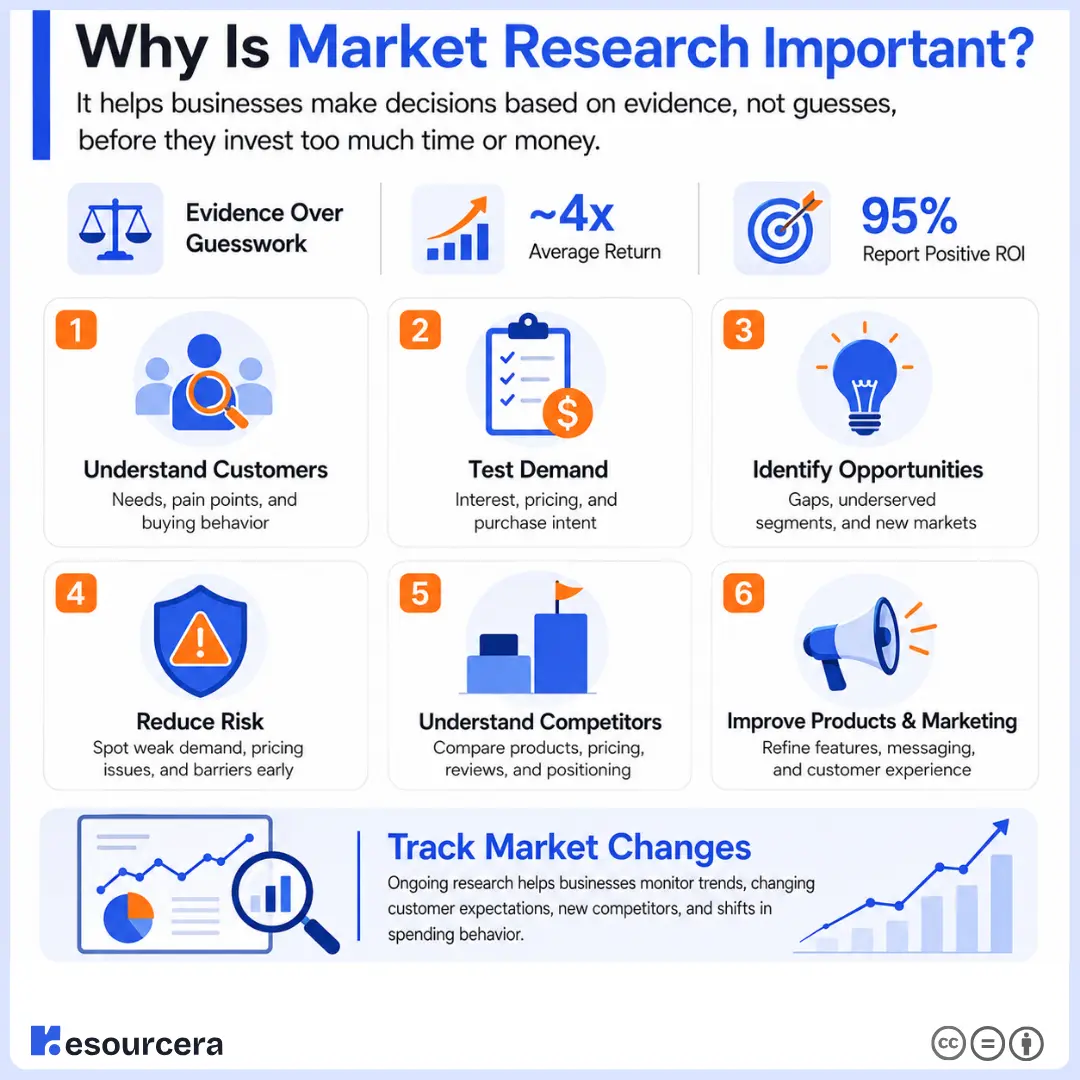
Businesses that research consistently report a return of roughly four times the cost, and around 95% of companies that invest in it report a positive return.
Market Research Helps Businesses Understand Customers
A business may know what it wants to sell, but customers may have different priorities.
Market research helps companies understand customer needs, problems, expectations, and buying behavior. It can show which product features matter most, what customers dislike about existing options, and what influences their purchase decisions.
For example, a software company may believe that customers want more advanced tools. Interviews may show that users are struggling with the basic setup process. In this case, improving onboarding may be more valuable than adding another feature.
Research helps businesses focus on what customers actually need rather than what the company assumes they need.
Market Research Helps Test Demand
A business idea may sound promising, but that does not always mean enough customers are willing to pay for it.
Market research can help a company estimate whether demand exists before making a full investment. The business may test customer interest, preferred features, buying frequency, expected price, and purchase intent.
If the results show limited interest, the company may decide to improve the idea, target a different audience, or avoid the launch.
This does not mean every decision should depend on one survey. It means research provides additional evidence that can help a business judge whether an opportunity is worth pursuing.
Market Research Helps Identify Opportunities
Research can reveal opportunities that are not immediately visible.
A business may discover that a certain customer group is not being served well. It may find that customers are unhappy with competitor pricing, product quality, customer service, or ease of use.
Research may also show that demand is growing in a specific region or that customers are using a product in an unexpected way.
These findings can help companies create new products, enter new markets, improve their positioning, or focus on customer groups with stronger needs.
Market Research Helps Reduce Risk
Every major business decision includes uncertainty.
A company may not know whether customers will accept a higher price, whether a new product will solve the right problem, or whether a new market has enough demand.
Research can identify weak customer interest, pricing concerns, strong competition, legal barriers, and distribution difficulties before the company makes a large investment.
Finding a problem early is usually less expensive than discovering it after a full launch.
Market Research Helps Businesses Understand Competitors
Customers usually compare several options before making a decision.
Competitor research helps a business understand which companies serve the same audience, what they offer, how they price their products, and how customers respond to them.
A company may study competitor websites, product pages, customer reviews, advertising, pricing, and brand messages.
The goal is not to copy competitors. It is to understand what customers already have, where competitors perform well, and where gaps may exist.
For example, customer reviews may show that competing products are powerful but difficult to use. A new company could focus on offering a simpler experience.
Market Research Helps Improve Products and Marketing
Market research can support product development, pricing, advertising, sales, customer service, and brand positioning.
A company may use research to choose between product designs, test packaging, improve website messaging, or understand why customers do not complete a purchase.
Research can also help businesses identify which benefits matter most to customers.
If customers value reliability more than advanced features, the company can make reliability a stronger part of its product and marketing message.
Market Research Helps Track Market Changes
Markets do not remain the same.
Customer expectations change. New competitors enter the market. Technology affects buying behavior. Economic conditions influence how much people are willing to spend.
A business that conducted research three years ago may no longer have an accurate view of the market.
Ongoing research helps companies monitor customer feedback, competitor activity, changing demand, and industry trends. This allows them to respond before small changes become larger problems.
When Should You Conduct Market Research?
Market research is useful at almost every stage of a business.
It is often associated with starting a company, but established businesses also use research to improve products, understand customers, and identify growth opportunities.
- Before Starting a Business
Research helps determine whether there is enough demand for a product or service. It can also identify target customers, competitors, market prices, and potential barriers before major investments are made.
- Before Launching a Product or Service
Businesses can test features, pricing, packaging, names, or early product versions with potential customers. This helps uncover problems and make improvements before launch, when changes are usually easier and less expensive.
- Before Entering a New Market
Customer behavior can vary across countries, regions, industries, and age groups. Research helps businesses understand local demand, competitors, regulations, pricing, culture, and customer expectations.
- When Sales Are Declining
Sales may fall because of pricing, changing customer needs, stronger competitors, or reduced product value. Market research helps identify the real cause instead of relying on assumptions..
- When Customer Retention Is Falling
Interviews, cancellation surveys, usage data, and support records can reveal why customers leave. Businesses can then address issues such as poor usability, unclear value, or weak customer support.
- Before Changing Prices
Pricing research shows how much customers may be willing to pay, which features they value, and whether they prefer monthly plans, annual subscriptions, or smaller packages.
- Before Changing Brand Positioning
Before targeting a new audience or changing its message, a business should understand how customers currently view the brand. Research can show whether the new positioning is believable or likely to confuse existing customers.
Types of Market Research
Market research can be grouped in several ways.
A single project may belong to more than one category. A customer interview, for example, may be primary, qualitative, exploratory, and customer-focused.
Understanding the main types helps businesses select the right approach for each question.
1. Primary Market Research
Primary research uses new data collected for a specific project.
Common methods include surveys, interviews, focus groups, observations, experiments, and product testing.
It allows businesses to ask questions related to their exact needs. However, it can take more time and money, and the quality depends on how the research is designed and analyzed.
2. Secondary Market Research
Secondary research uses information that has already been collected or published.
Sources may include government databases, market reports, academic studies, company reports, trade associations, and public surveys.
It is usually faster and less expensive than primary research. However, the information may be outdated, too broad, or unrelated to the exact target audience.
Many projects begin with secondary research and then use primary research to answer the remaining questions.
3. Qualitative Market Research
Qualitative research explains why people think, feel, or behave in a certain way.
It focuses on customer opinions, experiences, motivations, and problems. Common methods include interviews, focus groups, observations, and open-ended questions.
The findings are usually presented as themes and explanations rather than numbers or percentages.
4. Quantitative Market Research
Quantitative research uses numbers and measurable data.
It can show how many customers prefer a product, how often they buy, how much they are willing to pay, or what percentage are satisfied.
Common methods include surveys, polls, experiments, website analytics, sales data, and market datasets.
Businesses often use quantitative research to measure a trend and qualitative research to understand the reasons behind it.
5. Exploratory Market Research
Exploratory research is used when a business does not fully understand a problem.
For example, a company may know that sales are falling but may not know whether pricing, competition, product quality, or customer service is responsible.
Interviews, focus groups, and open-ended questions can help identify possible causes and guide further research.
6. Conclusive Market Research
Conclusive research is used when a business has a clear question or idea it wants to test.
It may be used to measure demand, compare products, test prices, evaluate advertising, or track customer satisfaction.
This type of research follows a structured method and provides evidence for a specific business decision.
Market Research Methods
The best method depends on the question the business needs to answer.
No single method is suitable for every project. Businesses often combine several methods to get a more complete understanding.
| Method | Best Used For | Main Data Type | Effort |
|---|---|---|---|
| Surveys | Measuring opinions and preferences | Quantitative or mixed | Medium |
| Interviews | Understanding motivations | Qualitative | Medium to high |
| Focus groups | Testing reactions and ideas | Qualitative | High |
| Observation | Studying actual behavior | Qualitative | Medium |
| Product testing | Comparing concepts | Mixed | Medium to high |
| Secondary research | Understanding markets and trends | Mostly quantitative | Low to medium |
| Competitive analysis | Comparing companies and products | Mixed | Medium |
1. Surveys
Surveys collect answers from a group of people using a set of questions.
They are useful for measuring customer satisfaction, product preferences, purchase intent, brand awareness, and customer characteristics.
Surveys can reach a large number of people, but the questions must be clear and neutral.
A confusing or leading question can affect the results. The participants should also represent the audience the business wants to understand.
2. In-Depth Interviews
Interviews involve speaking with individual participants.
They are useful when a company wants detailed information about customer problems, motivations, or buying decisions.
An interviewer can ask follow-up questions and explore answers in greater detail.
Interviews usually involve fewer participants than surveys, but they can provide a deeper understanding of customer experiences.
3. Focus Groups
A focus group is a guided discussion with a small group of participants.
A moderator asks questions about a product, brand, advertisement, package, or idea.
Focus groups can show how people react to different concepts and how opinions change during a discussion.
However, one participant may influence others, so the moderator needs to manage the conversation carefully.
4. Observational Research
Observational research studies what people actually do.
A researcher may watch customers use a website, shop in a store, complete a task, or interact with a product.
This method can reveal problems that people may not remember or mention during an interview.
For example, a customer may say that a website is easy to use but still struggle to find the payment button.
5. Product and Concept Testing
Product testing involves showing customers a product, design, advertisement, package, or early idea and asking for feedback.
Participants may test one version or compare several options.
This method helps businesses understand which concepts are most attractive and what should be improved before launch.
6. Competitive Analysis
Competitive analysis studies companies that offer similar products or target the same audience.
Researchers may review competitor websites, pricing, products, customer reviews, advertisements, social media, and public reports.
The findings can help a business understand customer expectations and identify gaps.
7. Secondary Research
Secondary research uses existing information to understand a market.
It may include government data, market reports, academic research, company information, news articles, and public databases.
It is often a useful starting point because it helps the business understand what is already known.
8. Social Listening and Review Analysis
Customers often share useful opinions in product reviews, online communities, app stores, social media posts, and support discussions.
These sources can reveal common complaints, desired features, reasons for dissatisfaction, and customer language.
Public comments should be used carefully because the people posting them may not represent the full market.
9. Internal Business Data
A company may already have valuable information in its sales records, website analytics, support tickets, customer feedback, return requests, and cancellation data.
Internal data shows how real customers behave.
However, it mainly reflects current or past customers and may not represent people who have never purchased from the company.
How to Do Market Research: A Six-Step Process
A clear process helps keep research focused and useful.
Step 1. Define the Business Problem
Begin with the decision that the research should support.
A company may want to know whether it should launch a product, why customers are leaving, or which audience it should target.
The question should be specific.
Instead of asking what customers want, a software company could ask which three features matter most to small businesses choosing accounting software.
A focused question makes it easier to choose the right method and collect useful information.
Step 2. Set the Research Objectives
Research objectives explain what the company needs to learn.
A product launch study may aim to measure customer interest, identify preferred features, understand willingness to pay, compare competing options, and find purchase barriers.
The objectives should remain connected to the main business question.
Without clear objectives, the team may collect interesting information that does not help with the decision.
Step 3. Identify the Target Audience and Sample
The target audience is the full group the company wants to understand. The sample is the smaller group included in the research.
The audience may be defined by age, location, income, occupation, industry, company size, buying behavior, or product usage.
The sample should be relevant to the research question.
A company studying software for restaurant owners should collect responses from restaurant owners or managers, not from a general audience.
A large sample is not always better. A smaller sample from the right audience can be more useful than a large sample from people who are not potential customers.
Step 4. Choose the Research Type and Method
The research method should match the information the company needs.
Surveys are useful for measuring how common an opinion is. Interviews help explain why people hold that opinion. Secondary research can provide market size and industry information. Product testing can compare designs, features, or prices.
Many projects use more than one method.
A company may begin with interviews to understand customer problems and then use a survey to measure how common those problems are.
Step 5. Create the Research Plan
The research plan explains how the project will be completed.
It should cover the main question, objectives, audience, sample, selected methods, data sources, timeline, budget, and responsibilities.
The plan should also explain how participant privacy and consent will be handled.
Questions should be tested with a small group before the full research begins. This can reveal confusing wording, missing answer options, and technical problems.
Step 6. Collect and Analyze the Information
Information should be collected consistently.
Researchers should record where the data came from, when it was collected, and how participants were selected.
Quantitative data may be analyzed through percentages, averages, comparisons, and changes over time.
Qualitative data may be studied by grouping responses into themes and identifying repeated problems, opinions, or unexpected ideas.
The analysis should remain focused on the research objectives.
Step 7. Present the Findings and Take Action
The final report should explain what the research found, what the findings mean, what limitations exist, and what the company should do next.
It is useful to separate findings, insights, and actions.
A finding describes what the data shows. An insight explains why it matters. An action explains what the business should do.
For example, research may show that many customers leave during the payment stage. The insight may be that the payment process feels too long or confusing. The recommended action may be to reduce the number of steps and test whether more users complete their purchase.
Common Market Research Mistakes
Market research can produce weak results when the project is not planned carefully.
- One common mistake is starting without a clear objective. A company may collect a large amount of information without knowing which decision it needs to support.
- Another mistake is researching the wrong audience. A survey may receive hundreds of responses, but the results will not be useful if most participants are not potential customers.
- Biased samples can also create misleading conclusions. For example, a company may survey only its most loyal customers and receive an unrealistically positive view of satisfaction.
- Poorly written questions are another problem. Leading questions may push participants toward a certain answer, while confusing questions may be interpreted in different ways.
- Businesses should also avoid depending on one method. A survey may show what customers prefer, but interviews may be needed to understand why.
- Outdated information can also create problems, especially in markets where technology, pricing, and customer behavior change quickly.
- Researchers should be careful not to confuse correlation with causation. Two things may happen at the same time without one causing the other.
- Companies should also avoid ignoring findings that challenge the original idea. Negative research results can help a business avoid a bad investment or improve a weak product.
- The final mistake is collecting research but taking no action. A report has limited value if the findings are not connected to a decision.
How Much Does Market Research Cost?
Market research costs vary depending on who does the work and how detailed the research needs to be. The figures below are working ranges, not quotes, but they should give you a rough idea of what to budget.
| Approach | Typical cost | What you get |
|---|---|---|
| Fully DIY | $0 to $200 | Free tools, your own list, secondary data |
| DIY with a paid panel | $500 to $3,000 | A targeted survey of 300 to 600 respondents |
| Self-serve research platform | $50 to $500 per month | Survey tooling, templates, basic analysis |
| Freelance researcher | $2,000 to $10,000 | A designed and executed project with findings |
| Full-service agency | $15,000 and upward | Design, fieldwork, analysis, recommendations |
One point about cost deserves emphasis, because it is counterintuitive. Cheap research that produces bad data is more expensive than no research at all, because you will go on to act on it with confidence.
A small study conducted properly is worth considerably more than a large study conducted carelessly. If your budget is tight, narrow the scope rather than lowering the standard.
Final Thoughts
Market research gets presented as a corporate function, something that needs a department, a budget line, and an agency on retainer.
That framing is exactly why so many small businesses skip it, and skipping it is exactly why so many of them end up surprised by outcomes that were entirely predictable.
At its core, market research is a habit rather than a project. Before you commit money to an assumption, go and find out whether the assumption is true. That is the whole discipline. Everything above is simply the set of tools that make the habit reliable at scale.
Start with the one decision you are least certain about. Write the question down in a single sentence. Then go and ask twenty real people. You will learn more in a fortnight than you would in six months of arguing about it internally.

