

Somewhere around 2020, people stopped “watching TV” and started “watching Netflix.”
That linguistic shift says everything. OTT streaming did not just compete with television; it replaced the habit.
In 2026, the global OTT market sits at $352.96 billion, serves 4.3 billion users worldwide, and shows no signs of slowing down.
This article breaks down exactly where the OTT industry stands in 2026. Read on to know the OTT market size, platform rankings, revenue models, viewer behaviour, and what the data says about where it’s heading.
Key OTT Statistics at a Glance (2026)
- The global OTT market is projected to reach $352.96 billion in 2026 and grow to $482.76 billion by 2030, at a CAGR of 8.14%.
- There are 4.33 billion OTT video users worldwide as of 2026. It is projected to reach 4.91 billion by 2029.
- The OTT Video Advertising segment alone is expected to reach $236.72 billion in 2026, making it the largest revenue segment within OTT video.
- Netflix leads globally with 325 million paid subscribers as of 2026.
- 99% of U.S. consumers hold at least one streaming subscription, averaging 2.9 services each.
- Americans stream an average of 3 hours and 9 minutes every day on OTT platforms.
- Globally, OTT users spend an average of 17 hours per week watching content on streaming platforms.
- Over 70% of OTT users binge-watch content.
- Combined OTT subscription and ad revenue models are expected to grow over 12% annually, with the US generating $21.6 billion in AVOD revenue by 2029.
Sources: Statista 1; Statista 2; FlixPatrol; Forbes; Statista 3; Mordor Intelligence; Market Reports World; Statista 4
How Big Is the OTT Market in 2026?
The global OTT video market is projected to reach $352.96 billion in 2026, growing at a CAGR of 8.14% through 2030. The United States alone accounts for $154.40 billion, the largest national share worldwide.
The OTT video market has grown nearly 11x in under a decade, from $31.88 billion in 2017 to $352.96 billion in 2026. Growth is now moderating to a CAGR of 8.14% through 2030, down from the 30–40% annual surges of the pandemic era. Growth rates have slowed compared to the pandemic period, but the market continues to expand.
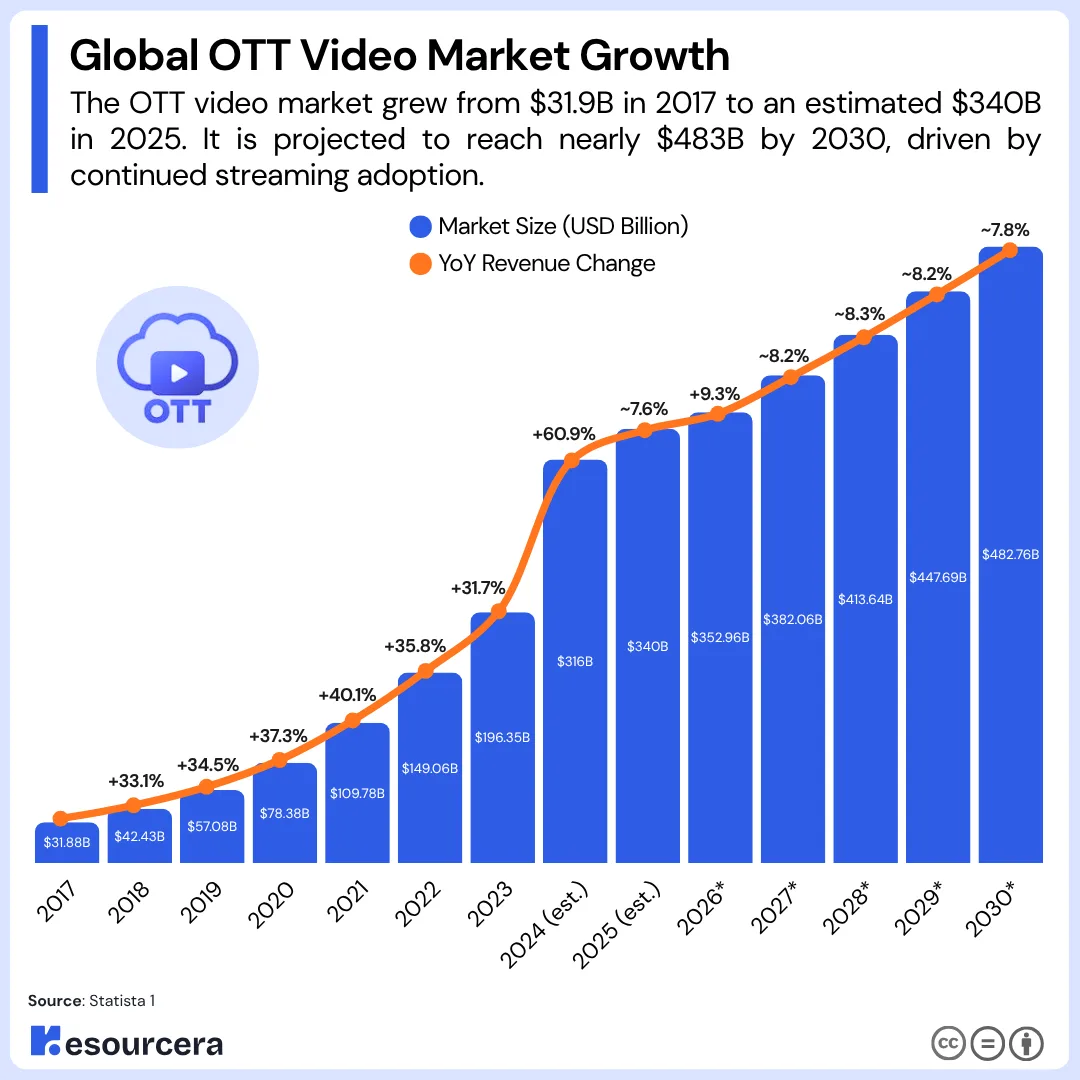
The table below tracks OTT video market revenue from 2017 to 2030.
| Year | Market Size (USD Billion) | YoY Revenue Change |
|---|---|---|
| 2017 | $31.88B | – |
| 2018 | $42.43B | +33.1% |
| 2019 | $57.08B | +34.5% |
| 2020 | $78.38B | +37.3% |
| 2021 | $109.78B | +40.1% |
| 2022 | $149.06B | +35.8% |
| 2023 | $196.35B | +31.7% |
| 2024 (est.) | $316B | +60.9% |
| 2025 (est.) | ~$340B | ~7.6% |
| 2026* | $352.96B | +9.3% |
| 2027* | $382.06B | ~8.2% |
| 2028* | $413.64B | ~8.3% |
| 2029* | $447.69B | ~8.2% |
| 2030* | $482.76B | ~7.8% |
From 2026 onward, annual growth settles into the 8% range. This is not a slowdown in the negative sense. It is the natural behavior of a maturing, large-scale market. An 8% CAGR on a $352 billion base still adds roughly $130 billion in new revenue by 2030, which is more than the entire market was worth in 2021.
Source: Statista 1
Top OTT Platforms and Their Market Share
A handful of platforms dominate the global OTT market, with Netflix holding a commanding lead and Amazon Prime Video, HBO Max, and Disney+ competing closely behind. The top ten platforms hold most of the world’s paid streaming subscribers.
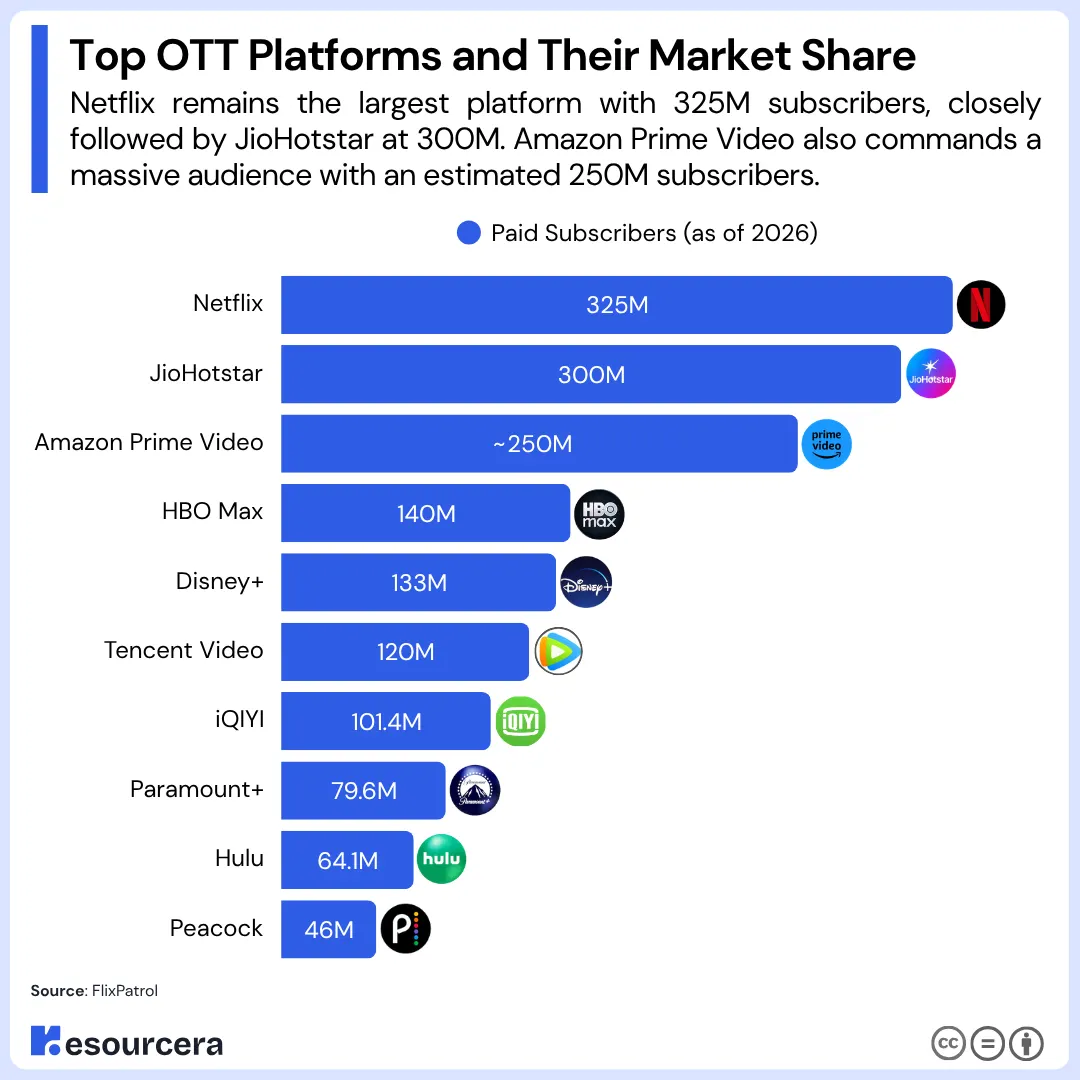
The table below ranks the leading platforms by subscriber count using the most recent available figures.
| Platform | Paid Subscribers (as of 2026) |
|---|---|
| Netflix | 325 million |
| JioHotstar | 300 million |
| Amazon Prime Video | ~250 million |
| HBO Max | 140 million |
| Disney+ | 133 million |
| Tencent Video | 120 million |
| iQIYI | 101.4 million |
| Paramount+ | 79.6 million |
| Hulu | 64.1 million |
| Peacock | 46 million |
Source: FlixPatrol
Netflix sits at 325 million paid subscribers, well ahead of every other platform. JioHotstar follows with 300 million, primarily serving India. Amazon Prime Video comes in at approximately 250 million, though that figure reflects total Prime memberships rather than video-only subscribers.
In most Western markets, Prime Video comes bundled with the broader Amazon subscription, so the actual number of dedicated video users is lower.
HBO Max reported 140 million subscribers as of March 2026, ranking third globally. Disney+ follows at 133 million, a notable drop from its peak of 164.2 million in early 2023.
That decline came after the platform raised prices and trimmed parts of its content library. Tencent Video and iQIYI, at 120 million and 101.4 million, respectively, are dominant within China but operate in a largely closed market.
OTT Platform Snapshots
Netflix holds 325 million paid subscribers as of 2026, up from around 302 million a year prior. Its ad-supported tier has driven much of its recent growth and is now available across most major markets.
Amazon Prime Video last disclosed 240 million Prime members globally as of 2025 (a Prime membership figure, not a Video-only subscriber count). Amazon has not released updated numbers since, so current estimates vary widely. Prime members in most Western markets get it by default as part of their subscription.
HBO Max (rebranded as Max in most markets since 2023) reported 140 million subscribers as of March 2026, covering HBO, Discovery+, and other Warner Bros. Discovery content. It now ranks third globally by subscriber count.
Disney+ held 133 million subscribers as of December 2025. It peaked at 164.2 million in Q1 FY2023 and has stabilised since, after raising prices and trimming its content library.
Paramount+ reached 79.6 million subscribers as of March 2026, while Hulu and Peacock, both with significant U.S. footprints, stood at 64.1 million and 44 million, respectively.
Sources: Netflix Q4 2025 Shareholder Letter; FlixPatrol; Amazon About Page, Netflix Statistics
Pricing of the OTT Platforms
If you subscribe to the ad-free tiers of Netflix, Disney+, Hulu, HBO Max, Peacock, and Paramount+ together, you are spending over $100 a month. That is roughly what a standard cable package costs. The very problem streaming was meant to solve has quietly crept back in.
Netflix Premium sits at $24.99 a month, HBO Max Premium at $22.99, and Hulu and Disney+ at $18.99 each. Even the mid-tier ad-free plans from Peacock and Paramount+ add another $30 combined.
Pricing now varies significantly across platforms, and most offer two versions of the same service: one with ads at a lower price, and one without ads at a higher price.
| Platform & Plan | Monthly Price | Ads |
|---|---|---|
| ESPN Unlimited | $29.99 | Yes |
| Netflix Premium | $24.99 | Yes |
| HBO Max Premium | $22.99 | No |
| FOX One | $19.99 | Yes |
| Hulu | $18.99 | No |
| Disney+ | $18.99 | No |
| HBO Max | $18.49 | No |
| Netflix Standard | $17.99 | No |
| Peacock | $16.99 | No |
| Paramount+ | $12.99 | No |
| Apple TV+ | $12.99 | No |
| Hulu | $11.99 | Yes |
| Disney+ | $11.99 | Yes |
| HBO Max | $10.99 | Yes |
| Peacock | $10.99 | Yes |
| Paramount+ | $7.99 | Yes |
| Netflix Standard | $7.99 | Yes |
Source: Statista 5
A few things stand out in this table. First, the ad-supported plans are priced at roughly half the cost of their ad-free counterparts across almost every platform. Netflix Standard with ads is $7.99 versus $17.99 without. Disney+ follows the same pattern at $11.99 versus $18.99.
Platforms have deliberately made the price gap wide enough to push cost-conscious subscribers toward the ad tier rather than canceling altogether.
Second, sports remain the most expensive category. ESPN Unlimited tops the list at $29.99 per month with ads. Platforms know that sports viewers are less likely to cancel, which justifies the premium pricing.
Apple TV+ at $12.99 stands out as relatively lean given the size of the company behind it. Apple has kept its content library smaller and more curated than competitors, which allows it to price below the mid-tier crowd without the same content cost burden.
OTT Users and Viewership Statistics
As of 2026, an estimated 4.33 billion people use OTT platforms globally. Streaming platforms now reach people across every age group, device type, and income level. In the US alone, 83% of adults use streaming services, with Netflix and Amazon Prime Video leading adoption.
By 2029, the global OTT user base is projected to hit 4.91 billion, a 25.46% increase from 2024.
Global OTT Users by Year
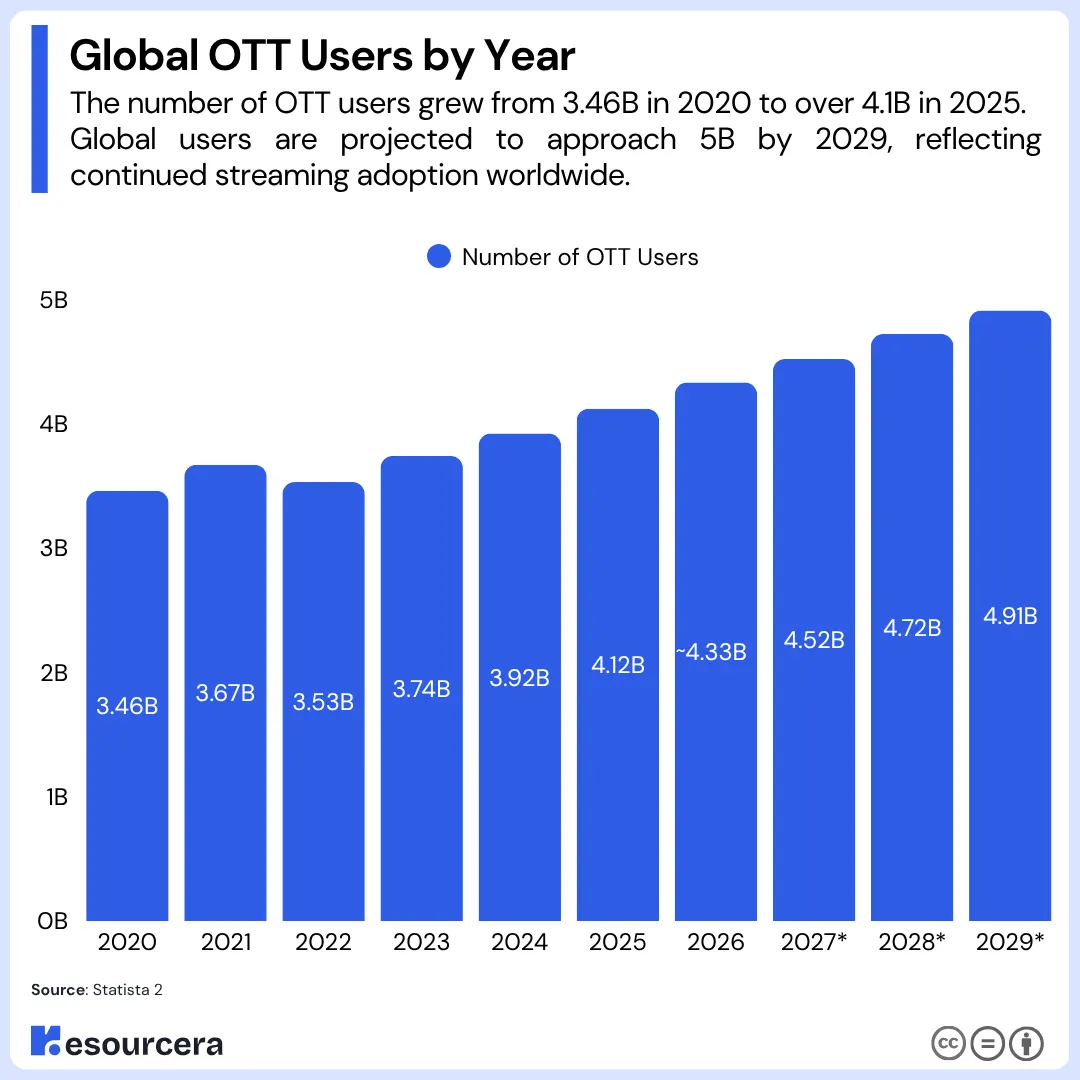
Here is the snapshot of the number of OTT users over the years:
| Year | Number of OTT Users |
|---|---|
| 2020 | 3.46 billion |
| 2021 | 3.67 billion |
| 2022 | 3.53 billion |
| 2023 | 3.74 billion |
| 2024 | 3.92 billion |
| 2025 | 4.12 billion |
| 2026 | ~4.33 billion |
| 2027* | 4.52 billion |
| 2028* | 4.72 billion |
| 2029* | 4.91 billion |
Source: Statista 2
Despite a dip between 2021 and 2022, the OTT user base recovered, adding roughly 200 million users per year. Growth to 2029 is driven by mobile expansion in Asia-Pacific, rising 5G coverage, and cheaper ad-supported tiers attracting users in price-sensitive markets.
OTT Users by Age Group
OTT subscribers are not spread evenly across all age groups. The data shows a clear pattern; streaming is largely a habit of the 25 to 45-year-old age group. People outside that range either do not hold subscriptions or access content through someone else’s account.
The 30 to 40 age group dominates, accounting for a combined 55% of all OTT subscribers.
The numbers drop sharply after 45. The 45 to 50 group holds just 2% of subscriptions, and above 50 drops to 0.9%. This does not mean older audiences are not watching.
In most households, a younger member holds the subscription while older family members watch on the same account. The data captures who pays, not who watches.
The same applies at the younger end. The 18 to 25 group at 14% seems low for a generation that grew up with streaming. But a large share of this group still relies on a family plan rather than paying for their own subscription.
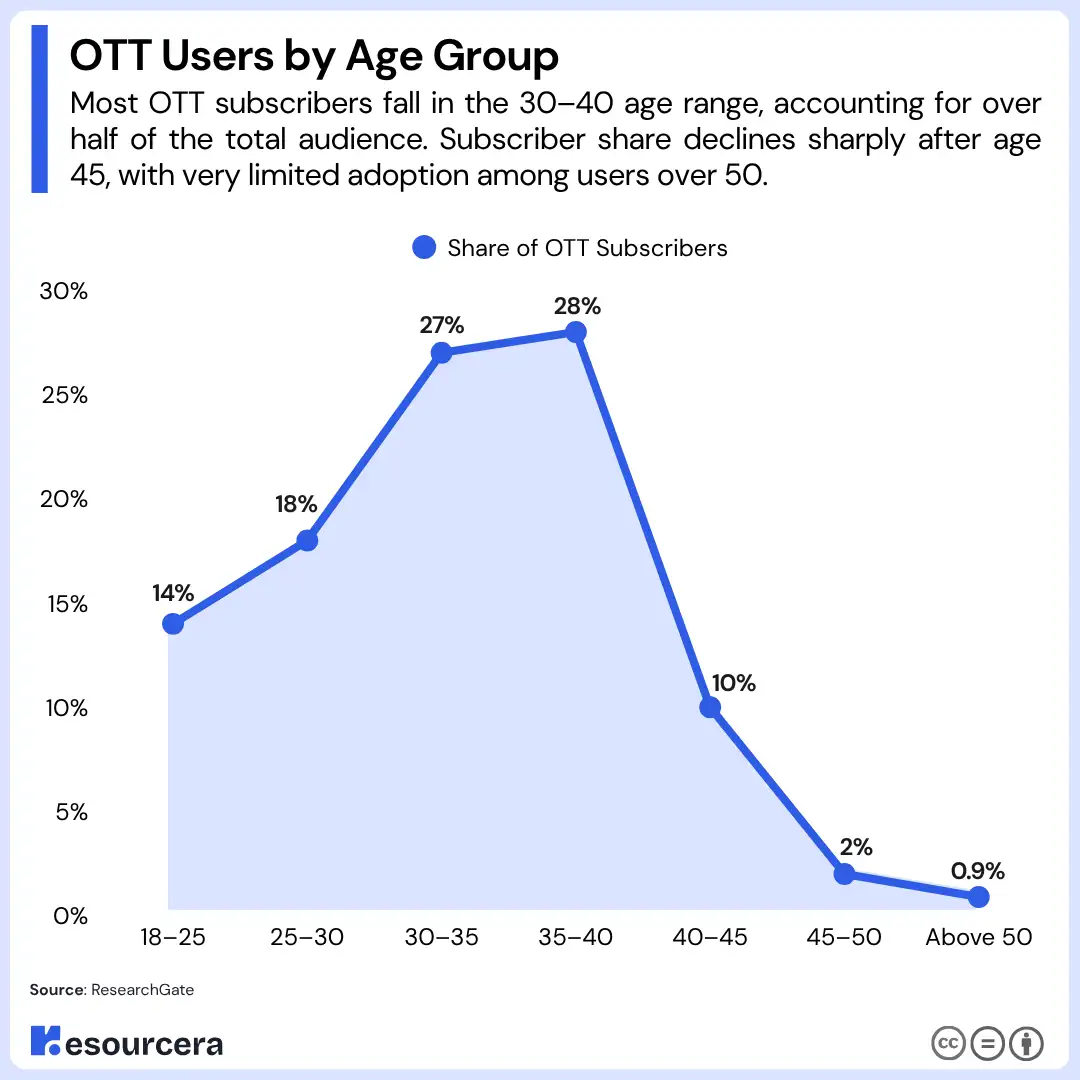
Here is the age-wise OTT subscriber data as of 2026:
| Age Group | Share of OTT Subscribers |
|---|---|
| 18–25 | 14% |
| 25–30 | 18% |
| 30–35 | 27% |
| 35–40 | 28% |
| 40–45 | 10% |
| 45–50 | 2% |
| Above 50 | 0.9% |
Source: ResearchGate
OTT Viewership by Device
The device people use to stream says a lot about how and when they watch.
Connected TVs and smart TVs account for 58% of all global streaming hours. This is a significant finding because the early narrative around OTT was that mobile would eventually dominate viewing.
That has not happened, as smart TV prices have dropped, more households have upgraded to internet-connected screens.
Smartphones account for 37%. While tablets and desktops together sit at just 5%.
| Device | Share of Total Streaming Hours |
|---|---|
| Connected TV / Smart TV | 58% |
| Smartphones | 37% |
| Tablets & Desktops | 5% |
Source: Market Reports World
OTT Users by Region
North America leads global OTT consumption, but Asia-Pacific is the fastest-growing region by subscriber volume. The rest of the world is still in the early stages of adoption.
Here is how usage breaks down across major regions.
| Region | Market Share | Key Stat |
|---|---|---|
| North America | 41% | 86% of regional users are in the US; Average. Daily viewing exceeds 140 minutes |
| Asia-Pacific | 29% | 61% of watch time is on mobile; India, China, Japan, and South Korea drive 74% of regional usage |
| Europe | 21% | Germany, the UK, and France contribute 58% of regional platform usage |
| Latin America | 6% | Smallest tracked region with limited available data |
| Middle East & Africa | 3% | 71% of consumption is mobile-first; smart TV adoption stands at 29% of households |
Source: Market Reports World, May 2026
North America holds 41% of the global market share, with the US driving 86% of that regional total. Asia-Pacific accounts for 29% of the global share, with India, China, Japan, and South Korea driving 74% of regional usage.
Europe holds 21%, concentrated heavily in Germany, the UK, and France. Latin America, at 6%, is constrained by currency volatility and lower disposable incomes.
The Middle East and Africa sit at 3% but are projected to be the fastest-growing OTT region globally through 2031 at a 12.64% CAGR.
OTT Penetration Rate 2026
In 2019, fewer than half of all internet users globally accessed OTT content. By the end of 2026, that figure is projected to reach 73.2%. That is a 25 percentage point shift in seven years, which by any measure is a rapid mainstream transition.
Between 2021 and 2022, penetration barely moved, gaining just 0.04 percentage points. The 2020 and 2021 jumps were pandemic-driven. Once restrictions were lifted, growth normalized.
By 2029, nearly 4 in 5 internet users globally will access OTT content. The remaining 21% is largely made up of regions with limited internet access, older non-adopters, and lower-income households where even ad-supported pricing is a stretch.
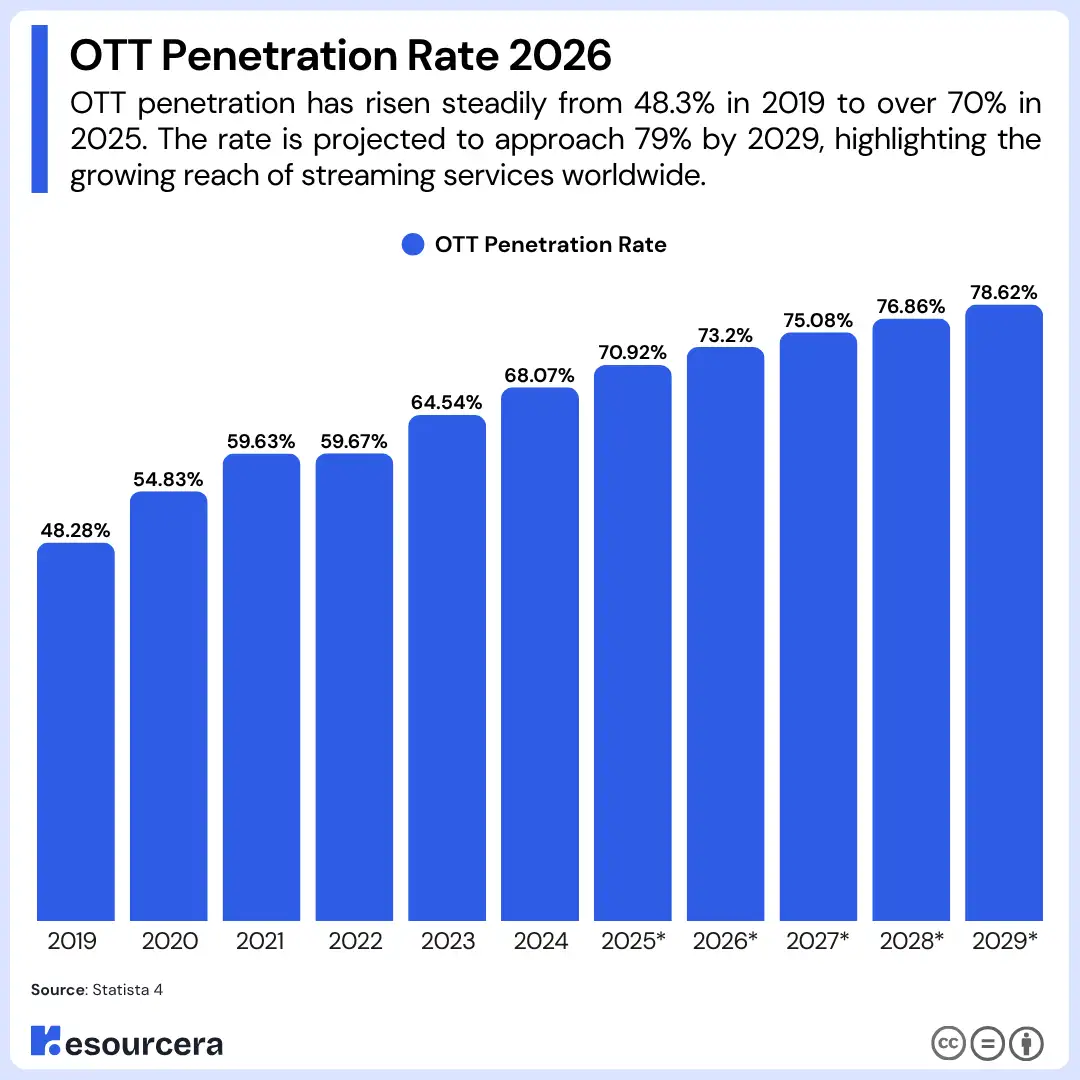
Here is how the global OTT penetration rate has changed over the years.
| Year | OTT Penetration Rate |
|---|---|
| 2019 | 48.28% |
| 2020 | 54.83% |
| 2021 | 59.63% |
| 2022 | 59.67% |
| 2023 | 64.54% |
| 2024 | 68.07% |
| 2025* | 70.92% |
| 2026* | 73.2% |
| 2027* | 75.08% |
| 2028* | 76.86% |
| 2029* | 78.62% |
Source: Statista 4
OTT Penetration Rate by Country
In some markets, OTT penetration has gone past 100%. This does not mean every single person subscribes. It means the average household holds more than one paid subscription at the same time.
Canada and the UK lead at 135% and 132% respectively.
| Country | OTT Penetration Rate |
|---|---|
| Canada | 135.35% |
| United Kingdom | 132.33% |
| Belgium | 113.08% |
| Norway | 109.25% |
| New Zealand | 104.84% |
Source: Statista 4
All five countries on this list are high-income, English-speaking, or Western European markets with strong broadband infrastructure and high disposable income.
OTT Revenue Statistics 2026
The global OTT market is expected to generate $352.96 billion in revenue in 2026, and that number has been climbing steadily. Subscription-based models (SVOD) remain the biggest revenue driver, while ad-supported video (AVOD) is closing the gap quickly.
Together, they explain how OTT platforms generate revenue today and where future growth is expected.
Global SVOD Revenue
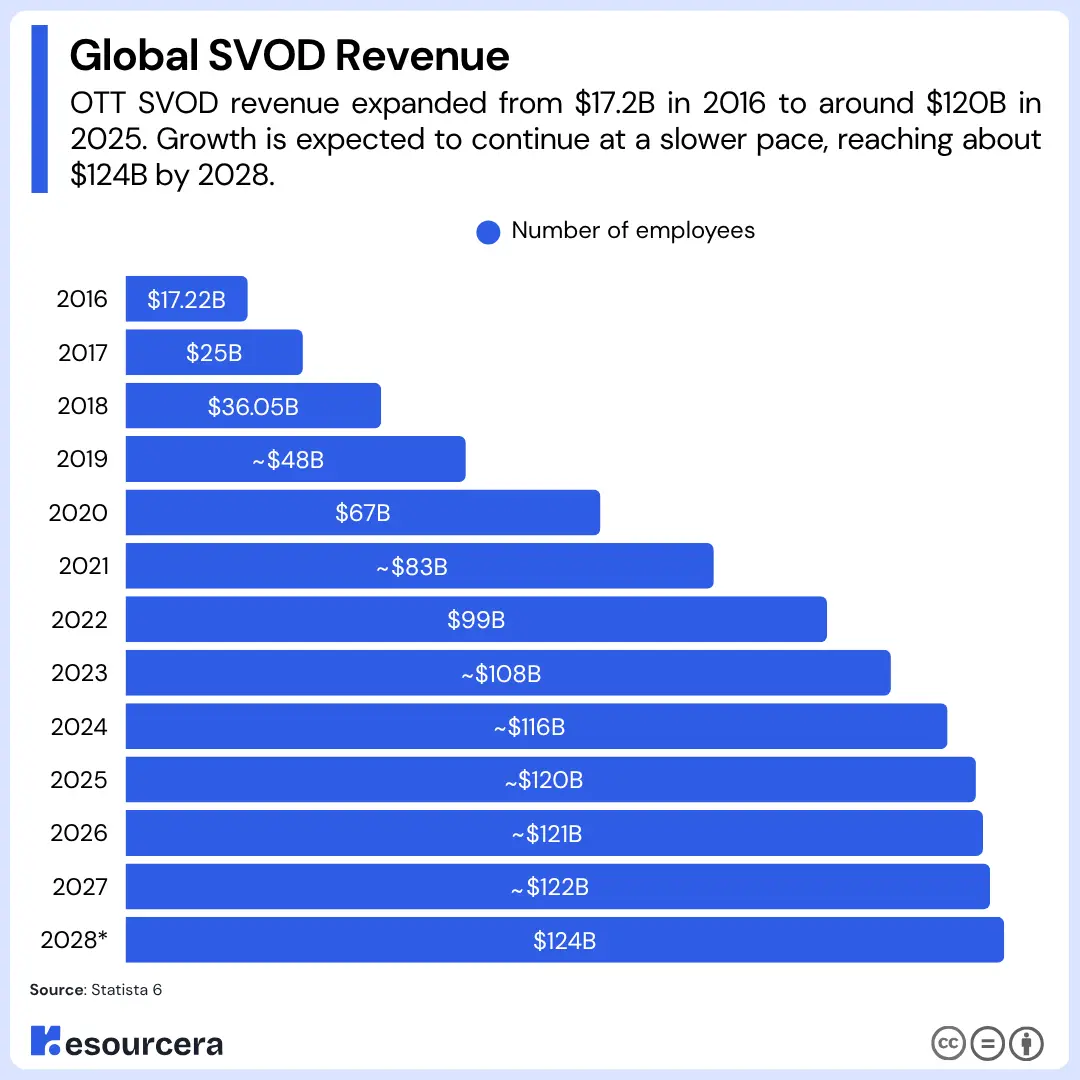
Subscription video-on-demand remains the backbone of OTT monetization, with revenue rising from $67 billion in 2020 to $99 billion in 2022.
| Year | OTT SVOD Revenue |
|---|---|
| 2016 | $17.22 billion |
| 2017 | $25 billion |
| 2018 | $36.05 billion |
| 2019 | ~$48 billion |
| 2020 | $67 billion |
| 2021 | ~$83 billion |
| 2022 | $99 billion |
| 2023 | ~$108 billion |
| 2024 | ~$116 billion |
| 2025 | ~$120 billion |
| 2026 | ~$121 billion |
| 2027 | ~$122 billion |
| 2028* | $124 billion |
* Projected. Confirmed figures sourced from Statista. Intermediate years are estimates interpolated from confirmed data points.
SVOD revenue has grown sevenfold since 2016, from $17.22 billion to an estimated $120 billion by 2025.
The steepest climb came between 2020 and 2022, when revenue jumped over $32 billion in two years on the back of pandemic-driven subscriptions that largely held afterward.
With $124 billion projected by 2028, subscription models still have room to grow, even as competition among platforms pushes prices down.
Source: Statista 6
Global OTT AVOD Revenue expected to grow over 12% year-over-year
Ad-supported video-on-demand is no longer the budget option. It is becoming a primary revenue engine, with the U.S. leading all markets.
| Country | Projected AVOD Revenue (2029) |
|---|---|
| United States | $21.6 billion |
| China | $7.4 billion |
| United Kingdom | $3.6 billion |
| Canada | $3.5 billion |
| India | $3 billion |
| Germany | $2.9 billion |
| Brazil | $2.6 billion |
| Japan | $2.5 billion |
| Others | $22.2 billion |
Source: Statista 7
The U.S. AVOD figure alone, $21.6 billion, is almost three times that of second-place China, showing how dominant the U.S. remains for streaming advertisers.
Meanwhile, emerging markets like India and Brazil are closing in. Platforms are increasingly treating hybrid models as the default, not the exception.
Average Revenue Per User (ARPU) in OTT Video
OTT platforms are earning more from each user every year. Global ARPU has grown steadily since 2020, driven by price increases, the shift toward premium tiers, and the addition of advertising revenue on top of subscriptions.
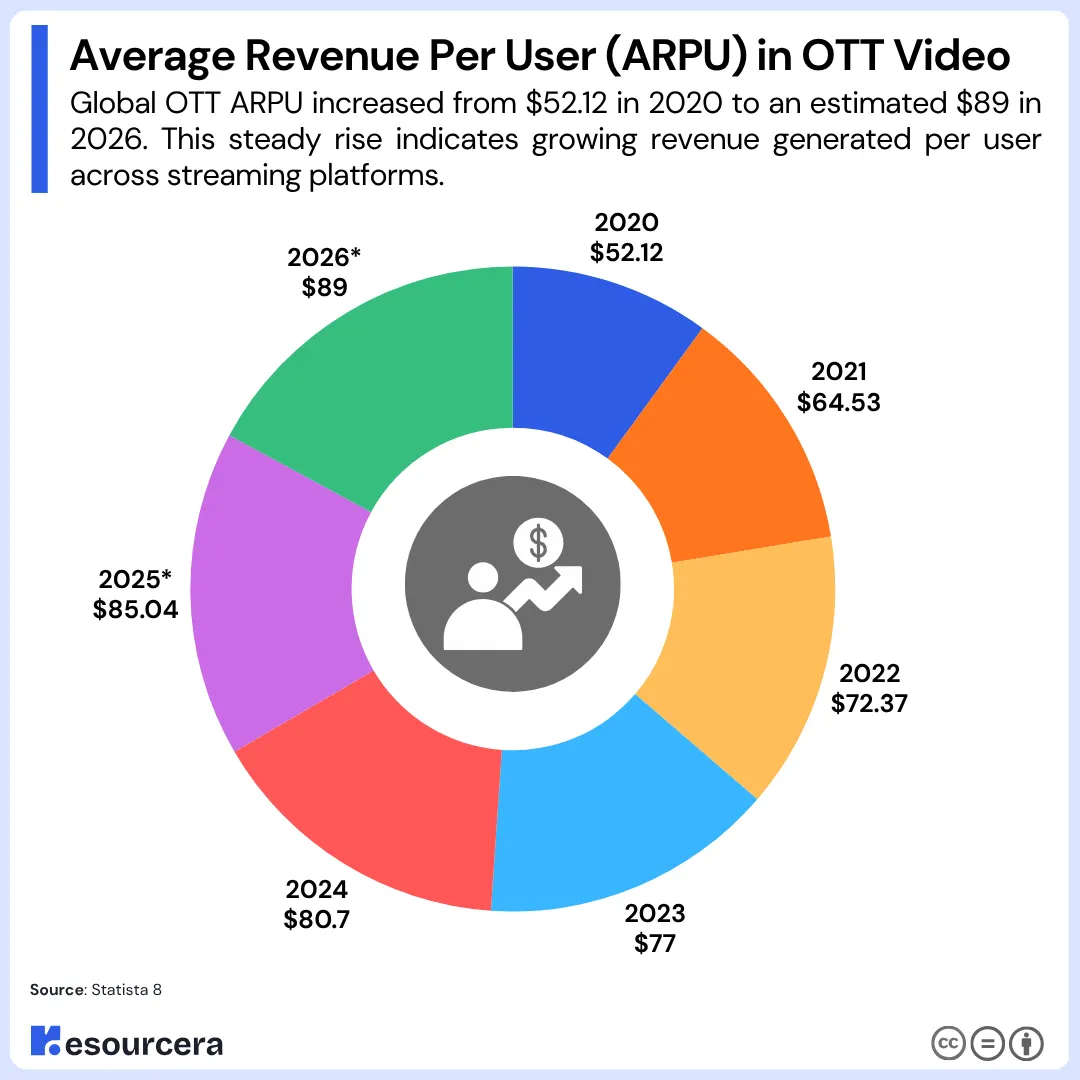
Here is how global OTT ARPU has changed from 2020 to 2026:
| Year | ARPU (Global OTT Video) |
|---|---|
| 2020 | $52.12 |
| 2021 | $64.53 |
| 2022 | $72.37 |
| 2023 | $77.00 |
| 2024 | $80.70 |
| 2025* | $85.04 |
| 2026* | $89 |
Source: Statista 8
ARPU grew by $28.58 between 2020 and 2024, averaging roughly $7 per year. The sharpest single-year jump came between 2020 and 2021, when ARPU rose by $12.41. That spike reflects the post-pandemic pricing confidence platforms gained once they had demonstrated sustained subscriber growth.
Growth has been more gradual since 2022, adding roughly $4 to $5 per year.
OTT Advertising Statistics
Ad-supported streaming is growing fast, with the top OTT platforms alone projected to generate tens of billions in AVOD revenue by 2026.
OTT platforms are adding ad-supported tiers to drive revenue beyond subscriptions. By 2028, the top platforms are expected to pull in significant ad dollars globally.
| OTT Platform | AVOD Revenue (2026) |
|---|---|
| Disney+ | $11.4 billion |
| Paramount+ | $5.4 billion |
| YouTube | $5 billion |
| Hulu (U.S.) | $4.7 billion |
| Netflix | $4.6 billion |
| Peacock (U.S.) | $4.6 billion |
| HBO | $4.3 billion |
| Roku (U.S.) | $3.1 billion |
| Pluto TV (U.S.) | $3 billion |
| Tencent (China) | $2.3 billion |
| $2.2 billion | |
| Others | $40 billion |
Source: Statista 9
Disney+ tops the list at $11.4 billion, more than double Paramount+’s projected $5.4 billion. Netflix, which only launched ads in 2022, is projected to match Peacock at $4.6 billion.
The “Others” category accounts for $40 billion, more than any single platform, showing that AVOD revenue is spread across hundreds of smaller and regional services.
User Behaviour: OTT Streaming Habits & Engagement
Americans are watching more OTT content every year. Daily viewing time on subscription streaming has risen steadily, with COVID-19 accelerating the jump between 2019 and 2020.
Time Spent by Users on OTT Platforms
Daily time spent on subscription OTT platforms in the U.S. has grown every year since 2018, climbing from 44 minutes to a projected 70 minutes by 2022.
| Year | Avg. Daily Time Spent on OTT (U.S.) |
|---|---|
| 2018 | 44 minutes |
| 2019 | 49 minutes |
| 2020 | 62 minutes |
| 2021 | 66 minutes |
| 2022 | 70 minutes |
Source: Statista 3
The biggest single-year jump happened between 2019 and 2020, when daily viewing time rose by 13 minutes. That spike lines up directly with pandemic lockdowns. Since then, growth has continued but at a slower pace, suggesting that viewing habits have stabilised at a higher baseline.
The 2022 figure of 70 minutes reflects time spent on paid subscription platforms only. More recent data measuring total OTT consumption across all platforms, including free, ad-supported, and social video, puts average daily viewing time for Americans at 3 hours and 9 minutes as of 2026.
Future OTT Trends to Watch
The OTT market continues to expand, with user growth, streaming adoption, and advertising revenue expected to increase over the coming years.
- Global OTT penetration will reach 78.62% by 2029, up from 68.07% in 2024, adding over a billion new users.
- Platforms are using AI for personalized recommendations, automated subtitles, and targeted advertising, making content delivery faster and more efficient.
- Ad-supported tiers are now the primary driver of platform revenue growth, with combined SVOD and AVOD models expected to grow over 12% annually.
- Asia-Pacific is the fastest-growing region, driven by mobile-first consumption and rapid broadband expansion.
- Connected TVs are likely to remain the dominant viewing device, accounting for the largest share of global streaming hours.
Sources: Mordor Intelligence; Statista 4
The next five years are expected to be shaped by investments in AI, advertising technology, and monetization strategies.
The growth of OTT services is closely linked to cord cutting, as more households replace traditional cable and satellite TV with streaming platforms. In the US, the number of households without a traditional pay-TV subscription is expected to reach 80.7 million by the end of 2026. See our latest cord-cutting statistics for more data on this shift.
Wrap Up
OTT platforms have become the preferred way for billions of people to watch video content worldwide. The market is projected to reach $352.96 billion in 2026, with more than 4.3 billion users expected globally.
Netflix remains the largest streaming platform by subscribers, while ad-supported tiers continue to gain traction across the industry.
As internet access expands and streaming adoption rises, OTT services are expected to play an even larger role in entertainment consumption over the coming years.

