

Every business idea starts with a question. Will people actually buy this?
Market research is how you answer that question with facts instead of hope. It tells you who your customers are, what they need, what they already pay, and who else is trying to sell to them. Businesses that skip this step often end up with a product nobody asked for.
The good news is that you do not need a big budget or a research team to do it. Most of the work can be done by one person with a few weeks and a clear plan.
This guide explains what market research is, the different types you can use, and the seven steps to run it from start to finish.
What Is Market Research?
Market research is the process of collecting and studying information about your market so you can make better business decisions.
It usually covers five things.
- Who your customers are and where to find them
- What problem they have and how they solve it today
- How much they are willing to spend
- Who your competitors are and how they position themselves
- Which way the market is moving
You will rarely need all five at once. What you research depends on the decision you are trying to make.
It also helps to know the difference between two terms people often mix up. Market research looks at the market itself, such as whether demand exists and how big it is. Marketing research looks at how to sell into that market, such as which message or channel works best. Market research usually comes first.
Types of Market Research
There are two ways to sort research types. The first is based on where the data comes from. The second is based on what kind of data you collect.
Primary research
Primary research is information you collect yourself, directly from people in your market. Surveys, interviews, focus groups, and product tests all count as primary research.
The advantage is that it answers questions specific to your business. Nobody else has this data because nobody else asked. The drawback is that it takes time and effort, and small samples mean you have to be careful about how much you conclude from it.
Secondary research
Secondary research uses information someone else has already collected and published. Government statistics, industry reports, trade publications, and competitor websites are all secondary sources.
It is fast and usually free. You can cover a lot of ground in a single day. The drawback is that none of it was written about your business, so it can give you context but rarely settles a decision on its own.
Most projects use both. Start with secondary research because it is cheap and quick, then use primary research on the questions that are left.
Quantitative research
Quantitative research produces numbers. Surveys, polls, and website data are common examples. It tells you how many people feel a certain way, how often something happens, and how much people spend.
Use it when you need to measure something or when you need results you can compare over time.
Qualitative research
Qualitative research produces explanations. Interviews, focus groups, and watching people use a product all fall into this category. It tells you why people behave the way they do.
Use it when you are still trying to understand the problem rather than measure it.
The two work best together. Start with a few interviews to learn what the real issues are, then run a survey to find out how common each one is.
Common Market Research Methods
Once you know which type of research you need, you have to pick a method. These are the ones most small businesses use.
Surveys
A survey asks the same set of questions to a large group of people. You can run one by email, on social media, on your website, or through a paid panel.
Surveys are good for measuring how widespread something is. They are not good for exploring a problem you do not understand yet, because you can only learn from the questions you thought to ask.
Interviews
An interview is a one-to-one conversation, usually thirty to forty-five minutes long. You ask open questions and follow up on the answers.
Interviews give you the richest information of any method. They are the best way to find out why customers do what they do. The tradeoff is that they take time, so you cannot speak to hundreds of people.
Focus groups
A focus group brings six to ten people together to discuss a product or an idea. You can show them a design, a package, or a price and watch how they react.
They are useful for seeing how people talk about a product when other people are in the room. The risk is that one confident person can steer the whole group, so a skilled moderator matters.
Observation
Observational research means watching people use a product or shop for one, rather than asking them about it afterwards.
It is useful because people often cannot explain their own behavior accurately. Watching someone struggle with a setup screen tells you more than asking them if the setup was easy.
Competitor analysis
Competitor analysis means studying the businesses already serving your market. You look at their pricing, their marketing, their products, and what customers say about them.
It is free, and you can do most of it in an afternoon. Customer reviews of competitors are especially useful because they show you what the market wants and is not getting.
Demand testing
Demand testing means putting a real offer in front of real people before you build anything. A landing page with a signup form, a small ad campaign, or a pre-order page all work.
This is the only method that shows you what people will actually do rather than what they say they will do.
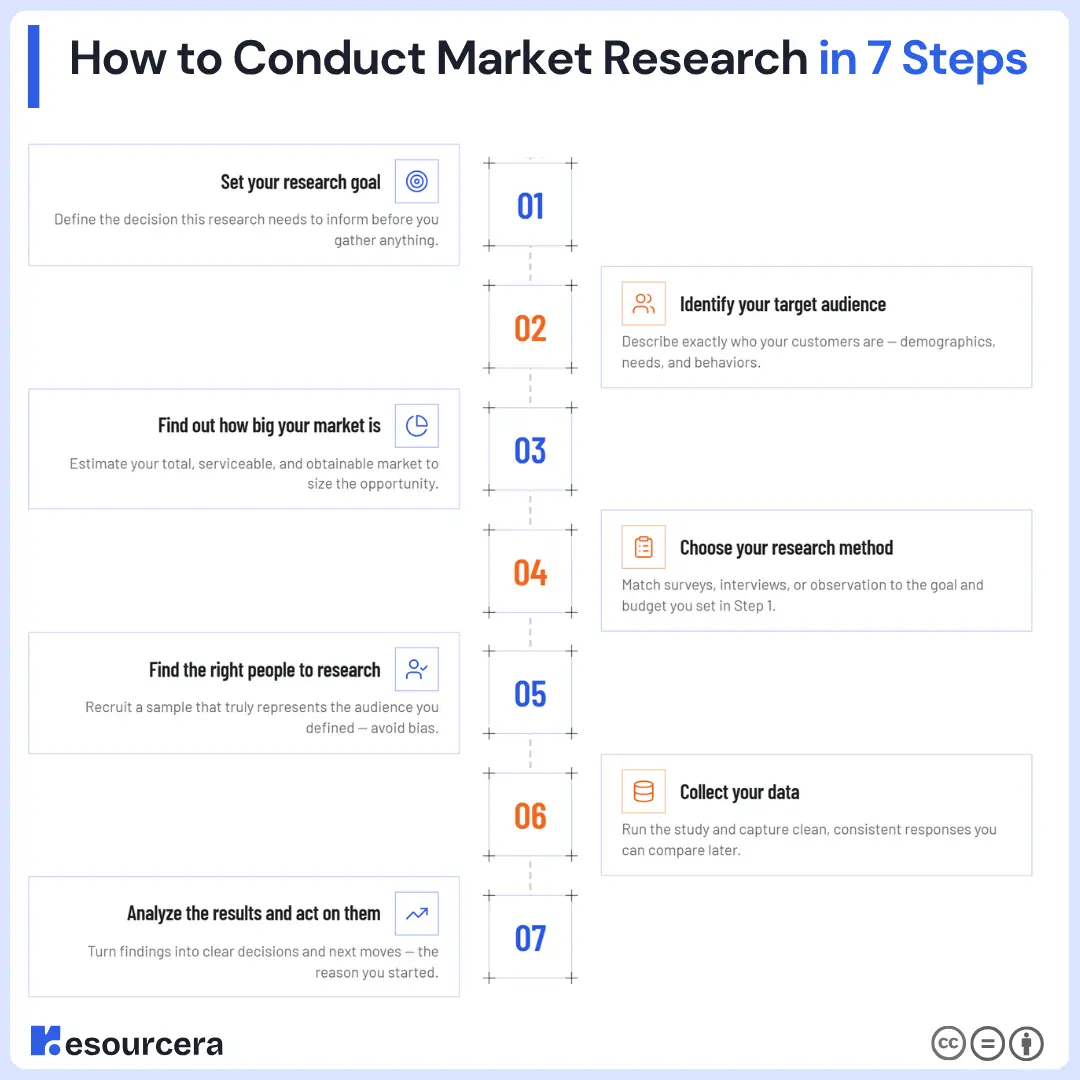
How to Conduct Market Research in 7 Steps
Every business runs this a little differently, but the order below works for most situations.
Step 1. Set your research goal
Before anything else, write down what you want to find out and why.
A goal should be tied to a decision you have to make. “Learn about our customers” is too vague to research. “Find out why trial users do not buy the paid plan” is clear enough to act on.
Write your goal as a short sentence. For example, you might write that you want to find out whether freelancers in your city would pay for a monthly bookkeeping service before you spend money building one.
Then list the questions you need answered to reach that goal. Three to five questions is enough. More than that and your research loses focus.
Good questions sound like these.
- What do people use to solve this problem today?
- What do they pay for that solution?
- What made them choose it?
- What would make them switch?
Step 2. Identify your target audience
You cannot research everyone, so the next step is deciding exactly who you are studying.
Describe your audience using specific traits. There are four kinds worth using.
- Demographic traits such as age, income, gender, and location
- Psychographic traits such as interests, values, and lifestyle
- Firmographic traits such as company size, industry, and revenue, if you sell to businesses
- Behavioral traits such as what they already buy and which tools they already use
A weak description sounds like “small business owners.” A strong one sounds like “freelance designers in the United States who earn between sixty and one hundred fifty thousand dollars and already pay for at least one subscription tool.”
The second version is better because you can picture where to find those people and how to check whether someone qualifies.
If you have more than one audience, that is fine. Splitting your market into groups like this is called segmentation. Keep it to two or three groups, though, or your research will be spread too thin to say anything useful about any of them.
Once you have your groups, turn each one into a buyer persona. A persona is a short profile of a typical customer that includes their situation, their problem, their budget, and how they prefer to be reached. It gives everyone on your team the same picture of who you are serving.
Step 3. Find out how big your market is
Knowing your audience is not enough. You also need to know whether there are enough of them to support a business.
The usual approach works down from the widest number to the most realistic one, in three stages.
- Total addressable market is everyone who could possibly buy a product like yours
- Serviceable available market is the part of that group you can actually reach, based on your location, language, and product
- Serviceable obtainable market is the share you could realistically win in the first year or two
Here is a simple example. Say you want to start a meal delivery service in your city.
You start with the number of households in the city, which you can get from census data. Say that is one million. If national spending data shows that around eighteen percent of households regularly buy prepared meals, your total addressable market is about one hundred eighty thousand households.
Your delivery vans can only cover about forty percent of the city while the food is still fresh, so your serviceable available market drops to around seventy-two thousand households.
Three competitors already operate in that area, and you are new, so you estimate winning two percent in the first year. That is about fourteen hundred customers.
The final number matters less than the fact that every step is visible. If someone questions your two percent, you can discuss that assumption directly. And if you cannot find a source for one of the percentages, you have learned something about how much you actually know.
You can find these numbers in census data, government statistics, industry reports, and trade association publications.
Step 4. Choose your research method
Now match the method to the questions you wrote in Step 1.
If you are trying to understand a problem, use interviews. If you are trying to measure how common something is, use a survey. If you want to know whether people will pay, run a demand test. If you want context on the market, start with secondary research.
Sample size depends on the method.
- Interviews need eight to fifteen people. By the sixth or seventh conversation, you will start hearing the same answers, which is a sign you have enough.
- Surveys need two hundred to four hundred responses before the percentages are stable enough to rely on.
- Usability sessions need only five to eight people, because the same problems trip up almost everyone.
- Demand tests need one live test with enough traffic to produce a clear result.
Also decide at this point what market research tools you need. That usually means a survey tool, a video call tool for interviews, and a spreadsheet to record what you find.
Step 5. Find the right people to research
Good questions asked of the wrong people give you the wrong answers. This step decides whether your research is worth anything.
Some sources are better than others.
- Current customers are easy to reach but already like you, so they are best for product questions rather than market questions.
- Former customers are the most useful group and the one most businesses ignore. They had the problem, they looked at you, and they chose something else.
- Strangers reached through paid ads let you target the exact traits you defined in Step 2. It costs money but you control who you get.
- Online communities and groups work well if you follow their rules. Check whether research posts are allowed before you post.
- Research panels are fast and will get you survey responses in a day, though some people answer quickly for the reward.
- Friends and family are the worst option. They will protect your feelings without meaning to.
Before anyone takes part, ask them to complete a short screener. A screener is a set of five to seven quick questions that confirms the person matches your target group.
Two rules make screeners work. Ask about behavior rather than opinions, so ask how many times they bought something recently rather than whether they like it. And do not reveal what you are looking for, because people will give you the answer they think you want.
Offering a small reward improves response rates. A gift card is normal. When you offer it, say clearly that it is for their time and their honest opinion.
Step 6. Collect your data
Now you run the research. The main thing to protect against here is getting the answer you were hoping for.
The biggest cause of that is leading questions. A leading question points the person toward a particular answer without either of you noticing.
Here are some examples of the difference.
| Leading question | Better question |
|---|---|
| Do you think this is easier than a spreadsheet? | How does this compare with how you work today? |
| How much would you happily pay for this? | What do you pay right now for something similar? |
| Was the setup process frustrating? | Tell me what happened when you set it up. |
| Would you use a feature that saves you time? | Walk me through the last time this task took too long. |
A few more habits will keep your data clean.
- Ask about what people did in the past, not what they think they would do in the future. Past behavior is far more reliable.
- Have someone else run your interviews if you can. Founders find it hard to hear bad news about their own idea.
- Do not show your product during an interview about the problem. Once people see it, they start being polite instead of honest.
- Change the order of answer options in survey questions, because people tend to pick the first or last option without thinking.
- Test your survey on five people before sending it to hundreds. You will always find at least one question that confused them.
Keep your notes organized as you go, and store any personal details safely.
Step 7. Analyze the results and act on them
The last step is turning what you collected into a decision.
Start by counting. Interview notes feel impossible to measure, but they are not. Make a simple spreadsheet with one row for each person you spoke to and one column for each theme that came up. Mark which themes each person mentioned, then add up the columns.
That turns a vague impression into a clear finding. Instead of saying that people seemed worried about setup time, you can say that eleven of fourteen people raised setup time without being asked.
When two pieces of evidence disagree, trust the one that cost the person more. A completed purchase means more than a signup. A signup means more than a survey answer. A survey answer means more than a compliment.
Pay attention to what surprised you. The findings that matched your expectations were things you already believed. The unexpected ones are what the research was for.
Then write it down. One short page per question is enough. Include the question, the evidence you found, what you decided, and the first action you will take.
If the answer is no, that is still a useful result. Work out which part failed. Was the problem not real? Was it real but not painful enough? Was the problem right but your solution wrong? Each of those points to a different next step, and usually only one thing needs to change.
Questions to Ask Your Customers
Good questions are specific and focused on the past. These work in most interviews and can be adjusted for your business.
- Walk me through the last time you dealt with this problem.
- What are you using to solve it right now?
- How did you find that solution?
- What do you pay for it?
- What did you try before that, and why did you stop?
- What is the most frustrating part of the current process?
- What would have to change for you to switch to something else?
- If this tool disappeared tomorrow, what would you do?
Notice that none of them ask whether the person likes your idea. That is deliberate. People say yes to ideas and no to invoices, so questions about what they already do are more reliable.
Where to Find Free Market Research Data
Most secondary research can be done without paying anybody. These are the sources worth knowing, with a note on what each is actually good for, since the usual problem is not finding data but knowing which source answers which question.
| Source | What it is good for |
|---|---|
| US Census and Census Business Builder | Population, household numbers, and local spending |
| Bureau of Labor Statistics | Industry size, wages, and hiring trends |
| Consumer Expenditure Survey | What households spend money on by category |
| SBDCNet Business Snapshots | Industry profiles and typical startup costs |
| Trade.gov Country Commercial Guides | Conditions and demand in export markets |
| World Bank and IMF data | Country level economic indicators |
| Google Trends | Seasonality and direction of demand |
| Industry associations and trade press | Market size estimates for your sector |
| Customer reviews of competitors | Unmet needs and common complaints |
Two tips make secondary research more reliable. Always track down the original source rather than an article quoting it, because numbers change as they get repeated. And check the date, because a market size from four years ago is history rather than data.
Using AI for Market Research
AI tools can speed up parts of this process, but only some parts.
They are useful for drafting screener questions and interview guides, sorting large numbers of open survey answers into themes, and summarizing competitor websites.
They are not reliable for facts. AI tools still invent market sizes, statistics, and sources that look correct. Anything with a number in it needs to be checked against a real source you have opened yourself.
The simple rule is that AI can help you write the questions and organize the answers, but it cannot be the evidence.
When to Conduct Market Research
Market research is most valuable before a decision that is expensive or hard to reverse. These are the usual moments.
- Before launching a new product, service, or business
- Before expanding into a new city, region, or country
- Before changing your prices
- When sales drop and you cannot explain why
- When a new competitor enters your market
- Before raising money or applying for a loan
- Once a year as a general check, even when nothing seems wrong
The yearly check matters more than people expect. Customer needs change slowly, and businesses often keep serving the customer they had three years ago without noticing.
Final Thoughts
Market research does not guarantee that a business will work. What it does is move the moment you find out you were wrong, from after you have spent the money to before.
Start small. Pick one decision you are facing, write down the questions you need answered, talk to ten people in your target market, and write down what you learned. That single round will teach you more about your customers than months of guessing.
Then repeat it whenever the next big decision comes around.

