

Nearly half of all Google searches have local intent. When people search for a nearby service, they usually want fast answers and often choose the business that appears first with clear, useful information.
With Google handling around 8.5 billion searches per day, and 46% of those searches having local intent, nearly 3.9 billion local searches happen daily.
In fact, around 76% of people who search “near me” visit a business within a day, and 28% make a purchase within 24 hours.
Still, many businesses are missing this opportunity. About 58% do not optimize for local search, and only 30% have a proper local SEO plan.
This report looks at the key local SEO statistics for 2026, including how people search, the platforms and devices they use, and how factors like Google Business Profiles and reviews influence rankings.
Read on to get full insights.
Key Local SEO Statistics for 2026
- 46% of Google searches have local intent, which is close to 3.9 billion local searches a day.
- 80% of US consumers search for a local business at least once a week, and 32% search daily.
- The US saw more than 200 million “near me” searches a month in early 2026.
- 76% of near-me searchers visit a business within a day, and 88% of smartphone local searchers visit or call within a week.
- Businesses in the Google map pack get 126% more traffic and 93% more calls, clicks, and direction requests than those ranked 4 to 10.
- A complete Google Business Profile makes customers 2.7 times more likely to view a business as reputable and 70% more likely to visit.
- 97% of consumers read online reviews for local businesses, and 78% will not consider a business rated below 4 stars.
- AI Overviews grew from roughly 8% to 40% of local searches across 2025, reaching up to 68% of local queries in 2026.
- 45% of consumers now use ChatGPT or another AI tool for local business recommendations.
- 57% of local searches happen on mobile, rising to 84% for “near me” queries.
How Big Is Local Search in 2026?
Local search is a big part of Google. Around 46% of all Google searches have local intent. Since Google gets about 8.5 billion searches per day, this means nearly 3.9 billion local searches happen every day.
People also search for local businesses often. About 80% of US consumers search for a local business online at least once a week, and 32% do it every day.
“Near me” searches are also very popular. In early 2026, the US had more than 200 million “near me” searches per month. Semrush data also shows that “near me” keyword variations get 7.1 million searches per month, with common searches including pizza places, restaurants, and breakfast spots.
This shows that people are not just searching for business names. They are looking for nearby places they can visit, contact, or buy from right away.
Here is how some local search terms have grown in recent years:
| Search term type | Reported growth |
|---|---|
| “Can I buy” / “to buy” (mobile) | +500% |
| “Near me” / “close by” | +900% |
| “Open now near me” | +400% |
| “Shopping near me” (Google Maps) | +100% or more |
(Source: Search Engine Roundtable, SOCi, Shopify, Google, Backlinko)
How Consumers Search for Local Businesses
Google is still the main platform people use to find local businesses. About 72% of consumers use Google Search, while 51% use Google Maps.
However, local search is no longer limited to Google. Facebook is used by 49% of consumers, Instagram by 33%, and TikTok by 27%. This shows that social media now plays an important role in how people discover nearby businesses.
For businesses, the right platform depends on where their customers search. A local restaurant, salon, retail store, or visual brand may need a strong presence on Instagram and TikTok, not just Google.
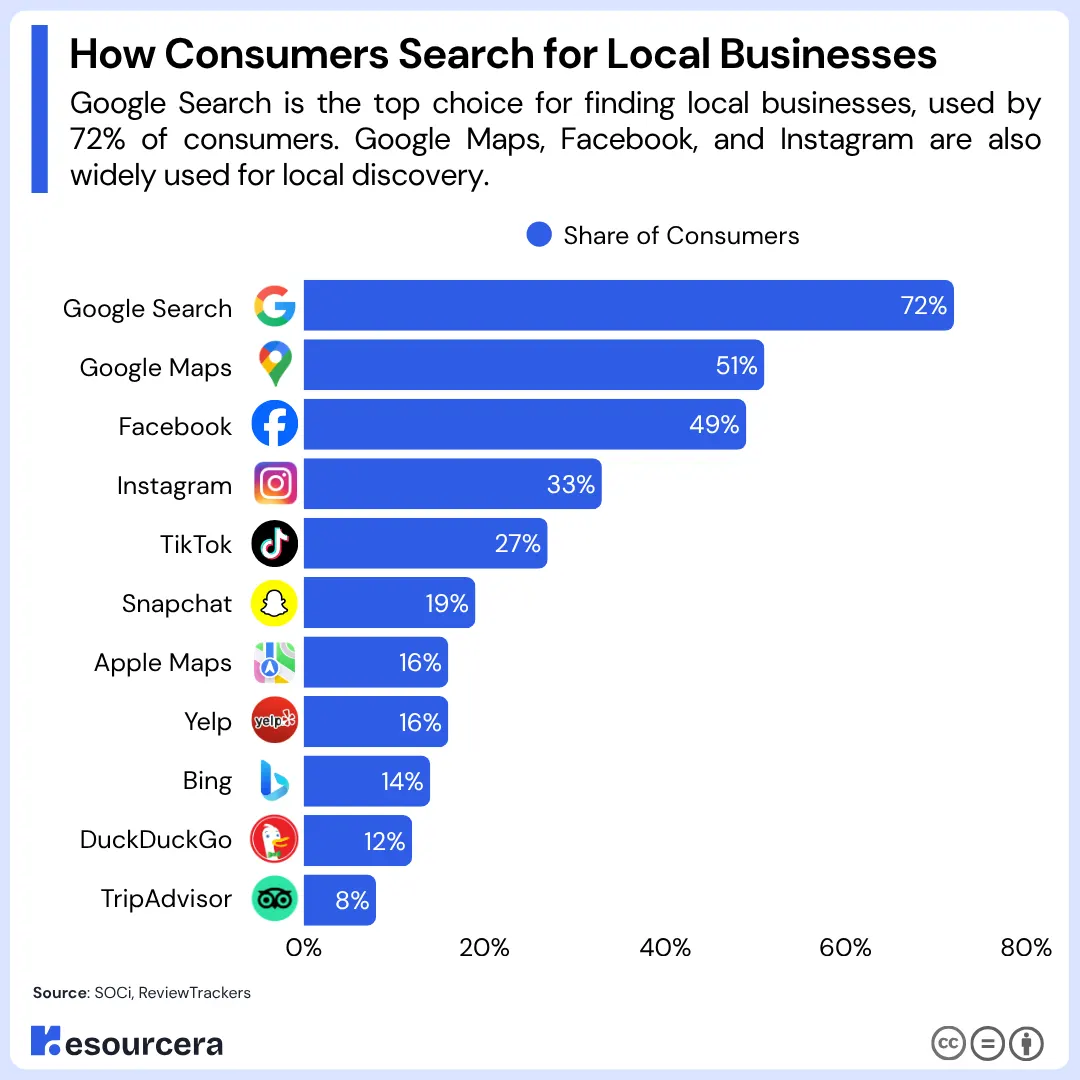
The table below shows which platforms consumers use most to find local businesses.
| Platform Used for Local Searches | Share of Consumers |
|---|---|
| Google Search | 72% |
| Google Maps | 51% |
| 49% | |
| 33% | |
| TikTok | 27% |
| Snapchat | 19% |
| Apple Maps | 16% |
| Yelp | 16% |
| Bing | 14% |
| DuckDuckGo | 12% |
| TripAdvisor | 8% |
Younger consumers search differently. Among people aged 18 to 24, Instagram is used by 67% and TikTok by 62% to find local businesses. Both are slightly ahead of Google Search, which is used by 61% in this age group.
This means businesses targeting younger customers should treat Instagram and TikTok as local discovery channels, not just social media platforms.
Mobile also plays a major role in local search. Around 57% of all local searches happen on mobile. For “near me” searches, the mobile share rises to 84%. Around 30% of all mobile searches are also related to location.
Because of this, a fast, mobile-friendly website is important. If a local business site is slow, hard to use, or difficult to contact from a phone, it can lose customers who are ready to visit, call, or buy.
(Source: SOCi, ReviewTrackers, Forbes)
Local Search Conversions And Consumer Actions
People who search locally are usually ready to take action.
About 76% of people who search “near me” visit a business within one day. Also, 88% of people who search for a local business on a smartphone either visit or call a store within a week.
These are not casual searches. Most of these users are close to making a decision.
The purchase data shows the same pattern. Around 28% of “near me” searches lead to a purchase within 24 hours. Local mobile searches also convert better than general searches. About 18% of local mobile searches lead to a same-day purchase, compared to 7% of non-local searches.
This means local mobile searches are about 2.6 times more likely to turn into a same-day sale.
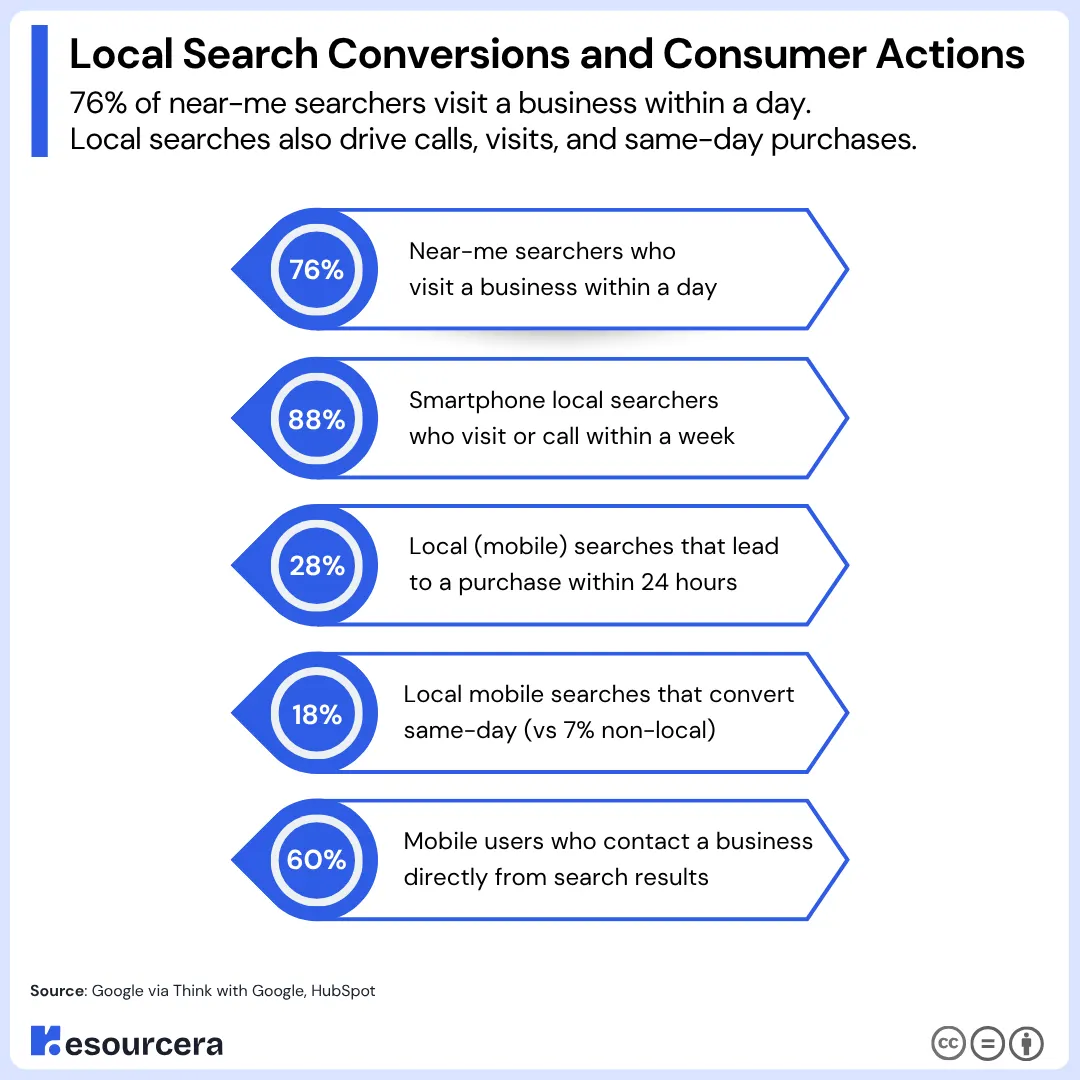
The table below shows what local searchers usually do after searching:
| Action taken by consumers after local searches | Share |
|---|---|
| Near-me searchers who visit a business within a day | 76% |
| Smartphone local searchers who visit or call within a week | 88% |
| Local (mobile) searches that lead to a purchase within 24 hours | 28% |
| Local mobile searches that convert same-day (vs 7% non-local) | 18% |
| Mobile users who contact a business directly from search results | 60% |
(Source: Google via Think with Google, HubSpot, Backlinko, Search Engine Watch)
Google Business Profile Statistics
A Google Business Profile is often the first thing people see when they search for a local business. It can affect whether someone trusts the business, visits the location, calls, or clicks through to the website.
A complete Google Business Profile can make a big difference. Customers are 2.7 times more likely to see a business as reputable when its profile is complete. They are also 70% more likely to visit and 50% more likely to consider buying from that business.
Since Google Business Profile is free to claim and manage, leaving it incomplete can mean losing trust, clicks, and visits.
(Source: Google, Backlinko, and BrightLocal)
GBP Views, Clicks, And Calls
Verified Google Business Profiles also receive strong engagement. On average, a verified profile gets around 21,643 views per year. Some estimates also show that an average local profile gets more than 1,200 views per month.
Profiles with accurate and complete information can receive up to seven times more clicks than incomplete profiles.
The table below shows the average engagement a verified profile earns.
| Metric | Average per verified profile |
|---|---|
| Annual profile views | 21,643 |
| Monthly clicks/interactions | 200 |
| Monthly website visits | 105 |
| Annual phone calls | 595 (about 50 per month) |
Website visits are the single biggest action people take from a profile.
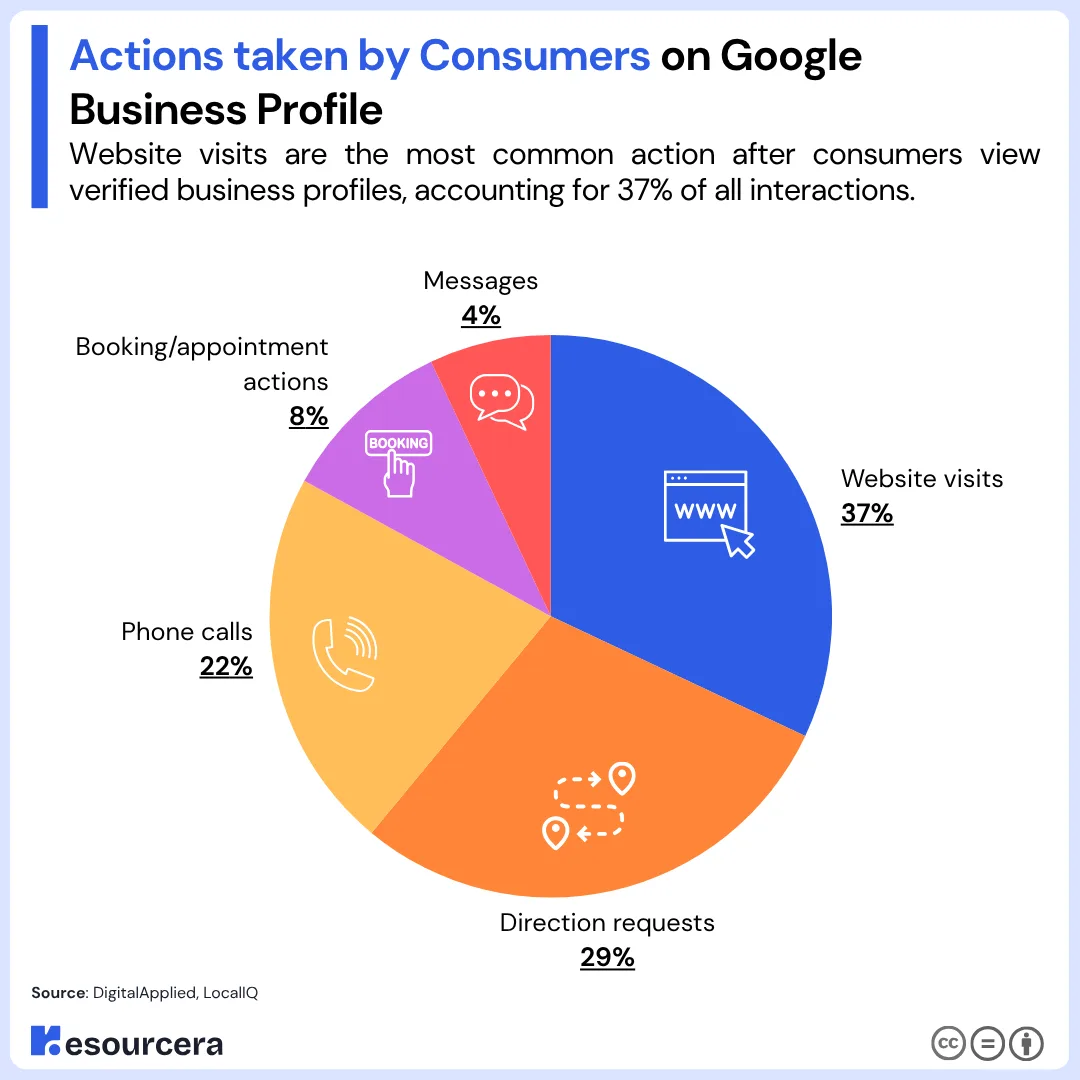
The table below shows the most common actions people take after viewing a Google Business Profile.
| Action taken by consumers after seeing verified profiles | Share of total actions by consumers |
|---|---|
| Website visits | 37% |
| Direction requests | 29% |
| Phone calls | 22% |
| Booking/appointment actions | 8% |
| Messages | 4% |
Many businesses still do not fully optimize their profiles. Around 56% of Google Business Profiles are missing important details such as photos, categories, or complete descriptions.
Top-ranking local businesses usually have stronger profiles and more trust signals. Businesses in the top three local results average 561 Google reviews, a 4.8-star rating, 993 backlinks, and 216 referring domains.
Photos also help. Adding photos to a Google Business Profile can lead to 42% more direction requests and 35% more website clicks.
One point needs caution. Around 38% of top-three businesses include a target keyword in their Business Profile name. However, this should not be copied as a tactic. Google does not allow keyword stuffing in business names, and doing so can lead to verification issues or even a profile lock.
(Source: DigitalApplied, LocalIQ, Semrush, DigitalApplied, WebFX, RankMax)
Google Map Pack and Local Ranking Factors
The local map pack is the group of three business listings that appear at the top of many local Google results. It gets a large share of local clicks, so ranking inside the map pack can make a big difference.
Businesses that appear in the map pack get 126% more traffic than businesses ranking in positions 4 to 10. They also get 93% more calls, website clicks, and direction requests.
About 42% of local searchers click a result inside the map pack. Overall, the map pack gets around 44% of local clicks, compared to 29% for regular organic results and 19% for ads.
The map pack also appears on about 93% of local-intent searches. Within the map pack, the top three profiles get around 31% of clicks, and the first listing has a click-through rate of about 18%.
(Source: Semrush, Backlinko, FitSmallBusiness, DigitalApplied)
Top Local Ranking Factors
Google uses many signals to decide which businesses appear in the local map pack. However, Google Business Profile signals are the most important. These include things like the business category, profile completeness, business name, location, reviews, and other profile details.
For regular local organic rankings, on-page signals are more important. These include the content on your website, service pages, location pages, keywords, and internal linking.
Here is how different ranking signals affect local map pack rankings:
| Ranking signal | Weight (local pack) |
|---|---|
| Google Business Profile signals | 32% |
| On-page signals | 19% |
| Review signals | 16% |
| Link signals | 15% |
| Behavioral signals | 8% |
| Citation signals | 7% |
| Personalization signals | 3% |
The strongest map pack factors usually include the main Google Business Profile category, proximity to the searcher, reviews, and how relevant the profile is to the search.
For local organic rankings, businesses need strong service pages, location-focused content, relevant keywords, and good backlinks.
In simple terms, a business should first optimize its Google Business Profile and service pages. After that, it should focus on getting more reviews, building local links, and keeping business information accurate across the web.
(Source: Whitespark, DigitalApplied)
Online Review Statistics
Reviews play a major role in local SEO. They affect both customer trust and local rankings.
Most people read reviews before choosing a local business. Around 97% of consumers read reviews for local businesses, and 75% read them always or regularly. This means a business with very few reviews, poor ratings, or no recent feedback can lose customers before they even call or visit.
Consumers also compare reviews across different platforms. About 74% read reviews on at least two platforms, and 34% check three or more platforms before making a decision.
Google is the most important review platform. Around 81% of consumers use Google to read local reviews, and 66% say it is the review source they trust most.
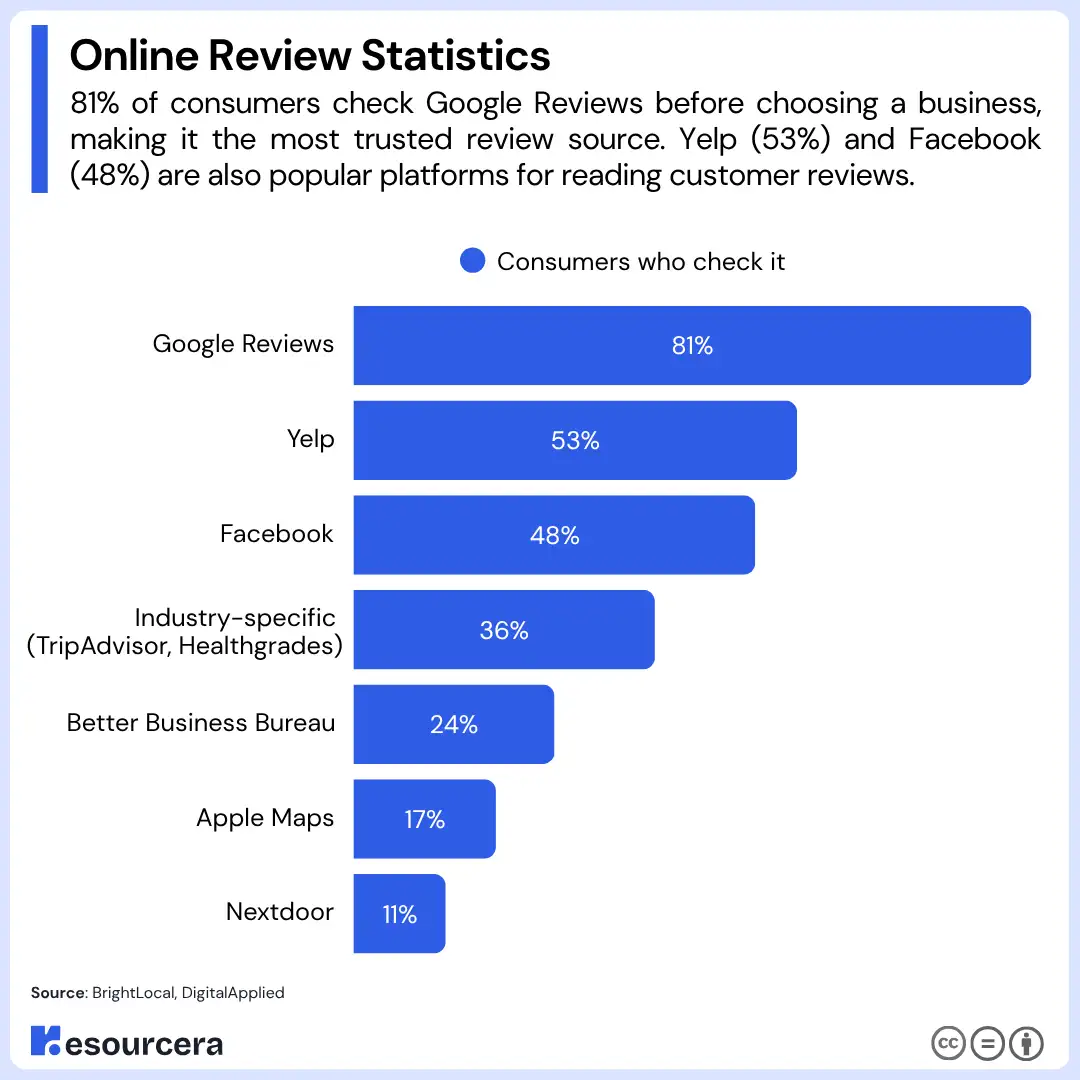
The table below compares platforms trusted by consumers to check online reviews:
| Review platform | Consumers who check it |
|---|---|
| Google Reviews | 81% |
| Yelp | 53% |
| 48% | |
| Industry-specific (TripAdvisor, Healthgrades) | 36% |
| Better Business Bureau | 24% |
| Apple Maps | 17% |
| Nextdoor | 11% |
(Source: BrightLocal, DigitalApplied)
How Ratings and Responses Affect Conversions
About 78% of consumers will not consider a business with less than a 4-star rating. Also, 71% rule out businesses rated below 3 stars.
Responding to reviews also matters. Around 88% to 89% of consumers prefer businesses that reply to all reviews. At the same time, 54% of Google reviews still receive no response.
Reviews also improve conversions. Every 10 new reviews can increase a profile’s conversion rate by 2.8%. Responding to more reviews can also help. For every additional 25% of reviews a business responds to, conversions can rise by 4.1%.
A higher rating can make an even bigger difference. Improving a rating by one full star can increase calls, clicks, and direction requests by 44%. Even a small jump from 3.5 to 3.7 stars can increase conversions by around 120%.
For multi-location businesses, reviews matter beyond one branch. About 91% of consumers say reviews for a local branch affect how they see the overall brand.
(Source: ReviewsOnMyWebsite, BrightLocal, Semrush)
Mobile and Voice Local Search Statistics
Mobile is a major part of local search. Many people use their phones to find nearby businesses, compare options, get directions, or call directly.
Half of mobile users visit a store within one day after doing a local search. Also, 61% of users are more likely to contact a business if its website works well on mobile.
Local mobile searches are also growing faster than general searches. They are increasing about 50% faster than overall search activity.
Voice search is also becoming more important for local discovery. People often use voice assistants when they want a quick answer, such as a nearby store, restaurant, service, or direction.
The table below shows how consumers use voice search for local business information.
| Voice search metric | Figure |
|---|---|
| Consumers who used voice search for local info in the past year | 58% |
| Smart speaker owners who search for local businesses weekly | 76% |
| Share of mobile queries done by voice | 20% |
| Voice searches that are near-me or local | 76% |
In simple terms, local businesses need to be easy to find and contact from a phone. They should also keep their business details clear and accurate, so they can appear in mobile and voice-based searches.
(Source: WebFX, SeoProfy, Loopex)
AI and the Future of Local Search
AI is starting to change local search. Google AI Overviews are now appearing for many local searches.
In early 2025, AI Overviews showed up for about 7.9% of local searches. By mid-2025, that increased to 40.2%. In 2026, some data shows AI Overviews appearing on up to 68% of local searches.
That means AI Overviews have grown quickly in local search results. However, not every local search is affected the same way.
Searches that clearly need a map result, such as “primary care clinic Phoenix,” still usually show the local map pack more often than an AI Overview.
Here is how quickly AI Overviews have expanded across local search results:
| Point in time | Local searches showing an AI Overview |
|---|---|
| Early 2025 | 7.9% |
| Mid-2025 | 40.2% |
| 2026 | Up to 68% |
Consumers are also using AI tools to find local businesses. Around 45% now use ChatGPT or another generative AI tool for local business recommendations. This makes AI one of the top sources for local business discovery.
For local businesses, this creates two challenges.
First, it is harder to appear in AI recommendations. Showing up in ChatGPT’s local recommendations is estimated to be about 30 times harder than ranking in Google’s local results. Also, fewer than half of the businesses ranking well in Google local results appear in AI answers.
Second, AI results are not always accurate. Only 68% of business contact details in ChatGPT and Perplexity match the information on Google Business Profiles. Because of this, 21% of users go back to Google to check whether the AI answer is correct.
Businesses that do appear in AI results usually have strong reviews. The average rating of recommended local businesses is 4.3 on ChatGPT, 4.1 on Perplexity, and 3.9 on Gemini.
Below is an insight into the average ratings of local businesses recommended by major AI platforms:
| AI platform | Average rating of recommended local businesses |
|---|---|
| ChatGPT | 4.3 |
| Perplexity | 4.1 |
| Gemini | 3.9 |
AI traffic can also convert well. In one set of operator data, AI-referred visitors converted at 6.24%, compared to 3.29% for traditional organic visitors. That makes AI traffic about 1.9 times more likely to convert.
Local SEO professionals are already paying attention. About 92% have tested ChatGPT, and 88% of multi-location marketers use generative AI in their work.
(Source: Search Engine Journal, LocalFalcon, Shopify, BrightLocal, RankMax)
Local SEO Adoption, Strategy, and ROI
Many businesses still do not invest properly in local SEO, even though it can bring strong results.
About 58% of businesses do not optimize for local search, and only 30% have a local SEO plan. This creates a clear opportunity for businesses that take local SEO seriously.
High-performing brands are much more likely to have a local strategy. Around 94% of high-performing brands use a dedicated local SEO strategy, compared to 60% of average-performing brands.
Many business owners also handle local SEO on their own. About 56% manage it themselves. While 70% have done a local SEO audit at some point, 67% have never done a technical SEO audit.
Another major gap is Google Business Profile usage. Only 35% of small businesses have a Google Business Profile, even though 79% of marketers say local SEO is a highly effective strategy.
(Source: Semrush, BrightLocal, SEO.com)
Business Information Accuracy
Accurate business information is also very important. Around 62% of consumers avoid a business if they find incorrect information online. Also, 47% will choose a nearby competitor if a business is listed as closed.
Wrong information is common. About 56% of people find incorrect business details every few months, and 23% come across fake business listings every month.
(Source: BrightLocal, Semrush)
ROI and Most Valuable Services
Local SEO can also deliver strong returns. On average, local SEO is estimated to return around 2.5 times the investment. About 40% of local SEO campaigns achieve a 500% ROI or higher.
Local SEO leads also convert well. They close at nearly 15%, while local-intent keywords convert 15% to 30% better than general keywords.
Marketers say Google Business Profile management is the most valuable local SEO service, followed by content creation and citation work.
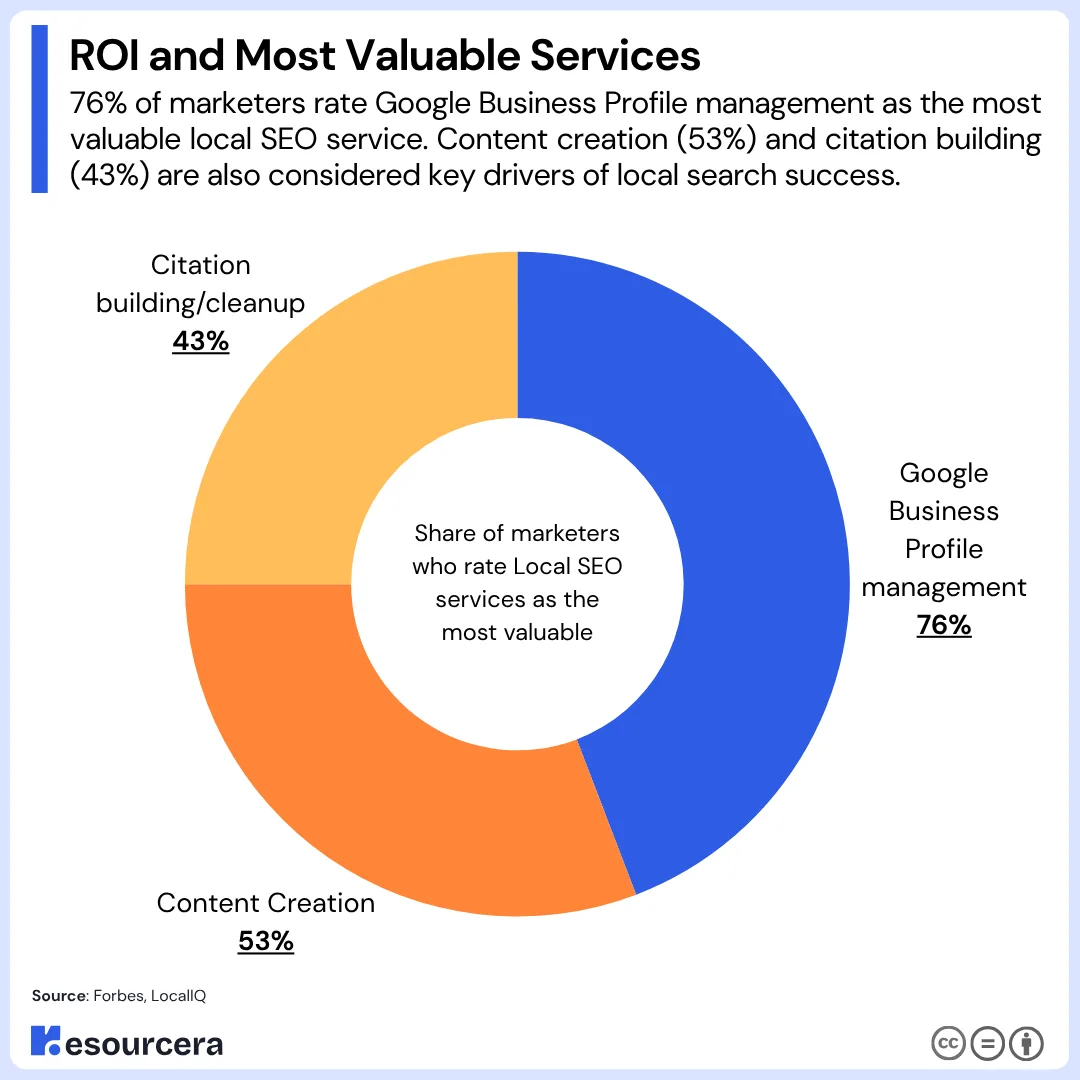
The table below compares which local SEO services marketers and local businesses find most valuable.
| Local SEO service | Share of marketers who rate it most valuable | Share of Local Businesses Who Rate It Most Valuable |
|---|---|---|
| Google Business Profile management | 76% | 52% |
| Content creation | 53% | 39% |
| Citation building/cleanup | 43% | – |
| Website design | – | 34% |
Local businesses also rate Google Business Profile management as the most valuable service. After that, they value content creation and website design.
Local SEO tools are also not very expensive for most businesses. A single-location business may spend around $40 to $80 per month. Multi-location businesses may spend around $100 to $300 per month. Larger enterprise businesses with 50 or more locations may spend $500 or more per month.
(Source: Forbes, LocalIQ, Backlinko, RankMax, MarketingLTB)
Final Thoughts
Local search is still one of the best ways for businesses to reach nearby customers. People search locally in large numbers and often take action quickly by visiting, calling, or buying.
The basics matter most: a complete Google Business Profile, strong reviews, accurate contact details, and a mobile-friendly website.
In 2026, AI is also changing local search. More people use AI tools for business recommendations, but AI results are not always accurate. Businesses that keep their information updated across Google, directories, social platforms, and AI sources will have a better chance of getting found when customers are ready to act.

