Netflix has 325 million paid subscribers as of 2026 across more than 190 countries and generated around $45.18 billion in revenue in 2025, up 15.8% from the prior year.
Its cheaper ad-supported plan is growing just as fast. By May 2026, that tier had reached 250 million monthly active viewers, and more than 60% of new sign-ups now choose the $8.99 ad plan over the pricier options.
In this article, we will cover Netflix’s subscriber counts, revenue, regional breakdown, advertising growth, demographics, content performance, and market share.
Let’s quickly get into the details.
Netflix Statistics 2026: At a Glance
- Netflix reached 325M paid subscribers globally as of 2026, with the US contributing 87.8M of that total.
- Netflix generated $45.18B in revenue in 2025, and pulled in $12.25B in Q1 2026 alone.
- Netflix’s ad tier reached 250M monthly active viewers in May 2026, and more than 60% of new sign-ups in Q1 2026 chose the $8.99 ad plan.
- EMEA tops all regions with 101.3M subscribers, while APAC posted the fastest growth at 27% in 2024.
- Wednesday Season 1 leads Netflix’s all-time viewing chart with 252.1M views, and every title in the top 10 is a Netflix original.
- Netflix’s ad revenue is on track to double in 2026 to roughly $3B, as its advertiser base crossed 4,000, up 70% year over year.
Sources: Netflix Q4 2025; Netflix Q1 2026 Shareholder Letter; Netflix Upfront 2026; Netflix Top 10
Netflix Overview
Netflix dominates global streaming with 325 million subscribers, $45.18 billion in annual revenue, and operations in over 190 countries.
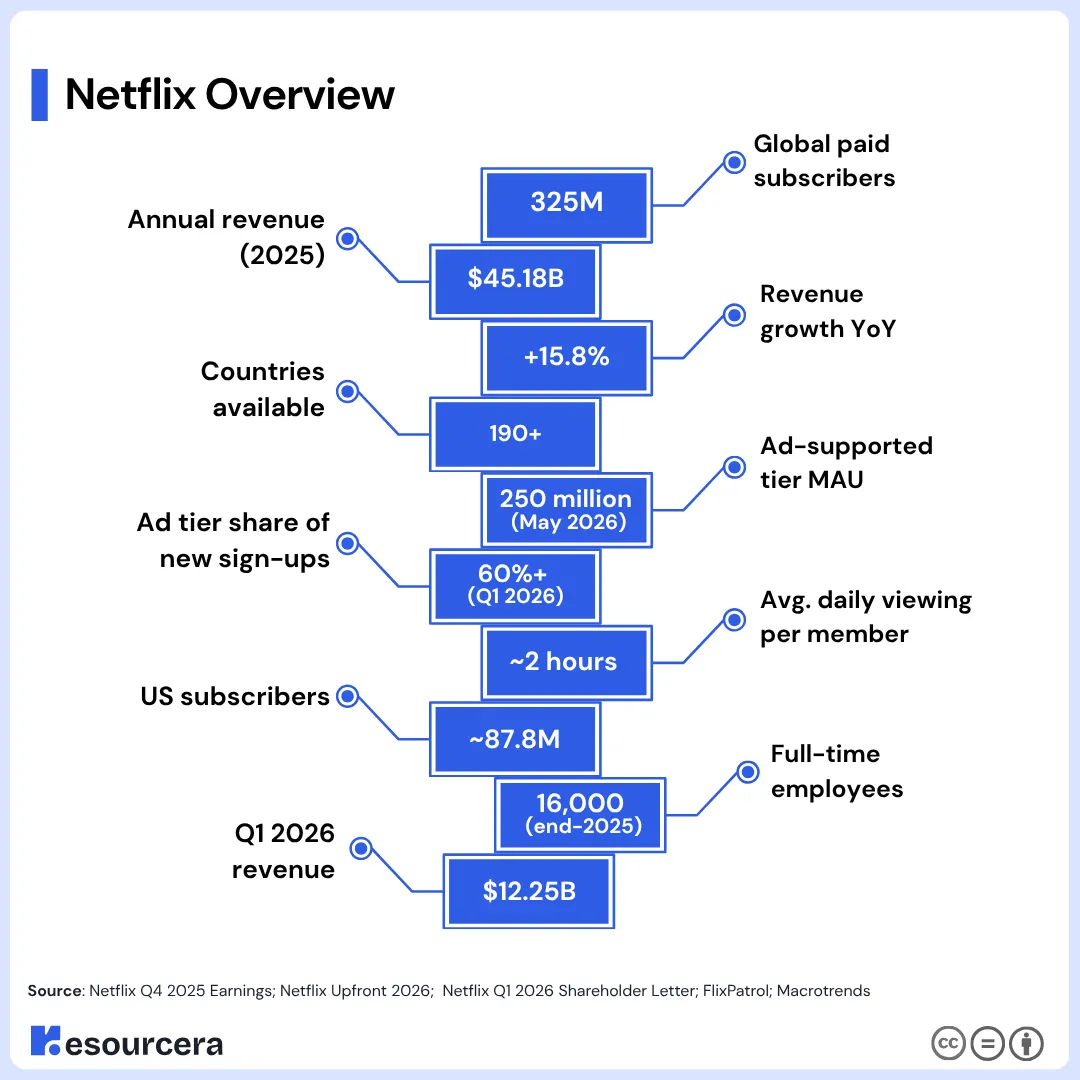
| Metric | Data |
|---|---|
| Global paid subscribers | 325 million |
| Annual revenue (2025) | $45.18 billion |
| Revenue growth YoY | +15.8% |
| Countries available | 190+ |
| Ad-supported tier MAU | 250 million (May 2026) |
| Ad tier share of new sign-ups | 60%+ (Q1 2026) |
| Avg. daily viewing per member | ~2 hours |
| US subscribers | ~87.8 million |
| Full-time employees | 16,000 (end-2025) |
| Q1 2026 revenue | $12.25 billion |
Source: Netflix Q4 2025 Earnings; Netflix Upfront 2026; Netflix Q1 2026 Shareholder Letter; FlixPatrol; Macrotrends
Netflix generates more revenue per subscriber in the US than in any other region, at $17.26 per member per month. Separately, the ad tier now drives the majority of new sign-ups globally.
Netflix Market Share 2026
In 2026, the OTT market is worth an estimated $352.96 billion, and it’s projected to grow to around $482.76 billion by 2030 at a steady annual rate of about 8%.
Within that market, Netflix is the biggest player by a wide margin.
With 325 million paid subscribers, it sits ahead of JioHotstar (around 300 million, mostly in India) and Amazon Prime Video (roughly 250 million, though that figure reflects bundled Prime memberships rather than people who chose the video service on its own).
The picture gets more interesting in the United States. By US streaming (SVOD) market share, Amazon Prime Video leads slightly at 22%, with Netflix just behind at 21%. But that one-point gap is misleading.
Prime Video comes free with an Amazon Prime membership, so millions of Americans have it automatically without ever choosing it as their streaming service. Netflix’s 21% comes almost entirely from people who decided to subscribe and pay for it directly.
The table below shows how the major platforms compare.
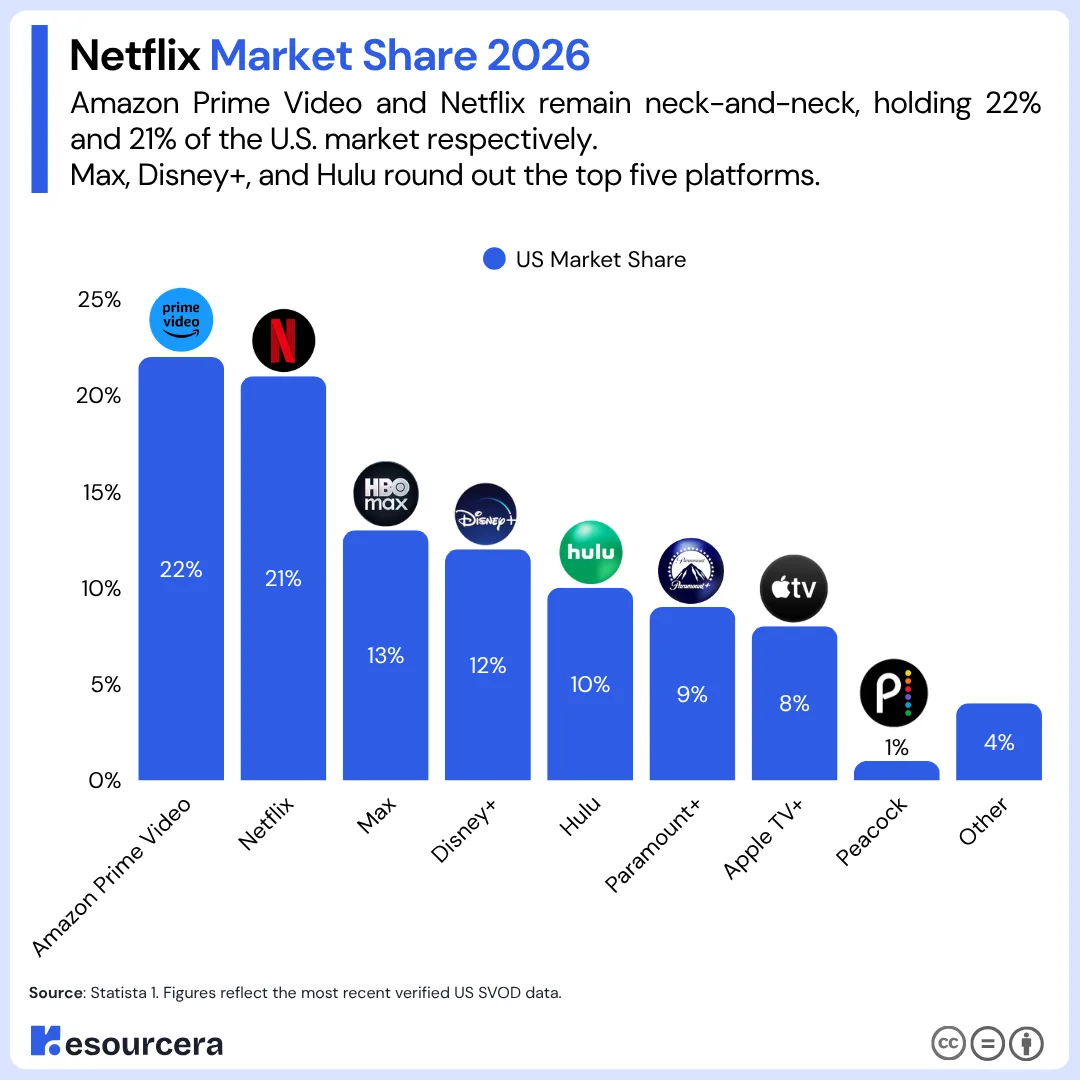
| Platform | US Market Share |
|---|---|
| Amazon Prime Video | 22% |
| Netflix | 21% |
| Max | 13% |
| Disney+ | 12% |
| Hulu | 10% |
| Paramount+ | 9% |
| Apple TV+ | 8% |
| Peacock | 1% |
| Other | 4% |
Source: Statista 1. Figures reflect the most recent verified US SVOD data.
Netflix Revenue Statistics 2026
Netflix revenue grew from $3.1 billion in 2011 to $45 billion in 2025. Q1 2026 hit $12.25 billion, its highest Q1 on record.
Below is a full breakdown of how that revenue has grown, where it comes from, and what Netflix earns per subscriber.
Netflix Annual Revenue Growth
Netflix revenue has grown consistently for over a decade, reaching $45 billion in 2025. The table below tracks that growth year by year alongside the year-over-year change.
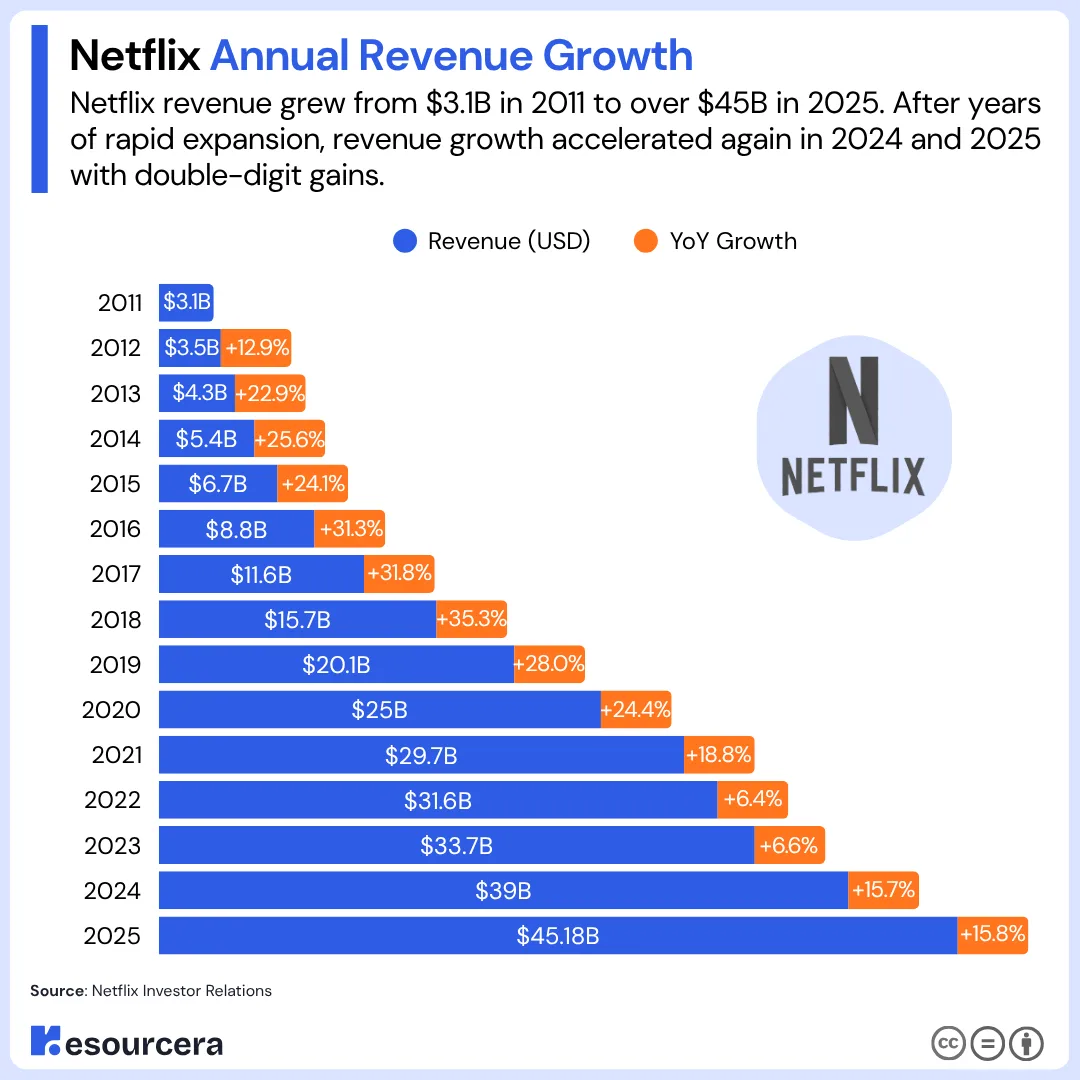
| Year | Revenue (USD) | YoY Growth |
|---|---|---|
| 2011 | $3.1B | — |
| 2012 | $3.5B | +12.9% |
| 2013 | $4.3B | +22.9% |
| 2014 | $5.4B | +25.6% |
| 2015 | $6.7B | +24.1% |
| 2016 | $8.8B | +31.3% |
| 2017 | $11.6B | +31.8% |
| 2018 | $15.7B | +35.3% |
| 2019 | $20.1B | +28.0% |
| 2020 | $25.0B | +24.4% |
| 2021 | $29.7B | +18.8% |
| 2022 | $31.6B | +6.4% |
| 2023 | $33.7B | +6.6% |
| 2024 | $39.0B | +15.7% |
| 2025 | $45.18B | +15.8% |
Sources: Netflix Investor Relations
Revenue growth slowed sharply in 2022 and 2023, the same years Netflix lost and then recovered subscribers. Growth returned to the mid-teens from 2024 onward, driven by password-sharing enforcement, ad-tier expansion, and price increases across markets.
Netflix Revenue by Region
Netflix earns revenue across four regions: UCAN, EMEA, LATAM, and APAC. The table below shows Q1 2026 revenue for each region alongside Q1 2025 figures and year-over-year growth.
| Region | Q1 2025 Revenue | Q1 2026 Revenue | YoY Growth | FX-Neutral Growth |
|---|---|---|---|---|
| UCAN | $4.62B | $5.25B | +14% | +14% |
| EMEA | $3.40B | $3.99B | +17% | +12% |
| LATAM | $1.26B | $1.50B | +19% | +18% |
| APAC | $1.26B | $1.51B | +20% | +19% |
| Total | $10.54B | $12.25B | +16% | +14% |
Source: Netflix Q1 2026 Shareholder Letter
UCAN remains the largest revenue region by far. LATAM and APAC are growing fastest on both a reported and FX-neutral basis.
EMEA has the widest gap between reported growth (+17%) and FX-neutral growth (+12%) of any region, meaning currency movements are currently making its numbers look stronger than the underlying trend.
Netflix Average Revenue Per User (ARPU) by Region
ARPU measures the monthly revenue earned per paying subscriber. UCAN has the highest ARPU of any region. APAC has the lowest, because Netflix prices its plans lower in high-growth markets like India to prioritise subscriber volume over per-user revenue.
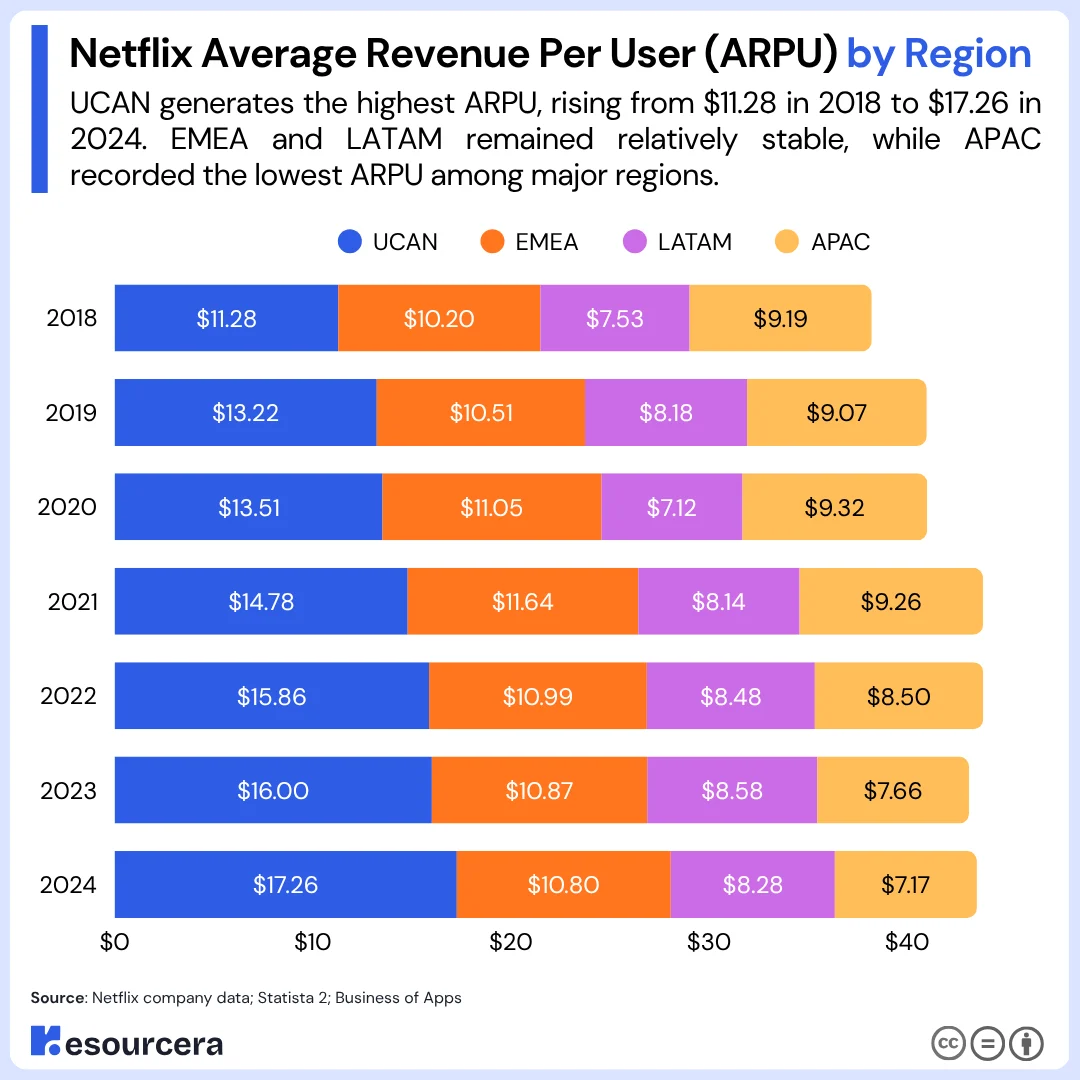
| Year | UCAN | EMEA | LATAM | APAC |
|---|---|---|---|---|
| 2018 | $11.28 | $10.20 | $7.53 | $9.19 |
| 2019 | $13.22 | $10.51 | $8.18 | $9.07 |
| 2020 | $13.51 | $11.05 | $7.12 | $9.32 |
| 2021 | $14.78 | $11.64 | $8.14 | $9.26 |
| 2022 | $15.86 | $10.99 | $8.48 | $8.50 |
| 2023 | $16.00 | $10.87 | $8.58 | $7.66 |
| 2024 | $17.26 | $10.80 | $8.28 | $7.17 |
Note: 2024 is the most recent year with verifiable regional ARPU data. Netflix stopped reporting per-member revenue from Q1 2025.
UCAN ARPU rose every year from 2018 to 2024, reaching $17.26, more than double the APAC figure of $7.17. The gap between the two regions grew from $2.09 in 2018 to $10.09 in 2024. Netflix charges less in Asia-Pacific to grow subscriber numbers, accepting lower revenue per user in exchange.
Sources: Netflix company data; Statista 2; Business of Apps
Netflix Advertising Statistics 2026
Netflix’s ad business has grown fast. Its ad tier now reaches 250 million viewers worldwide, ad revenue is on track to double in 2026, and Netflix is selling ads using an AI-powered platform it calls the Netflix Ads Suite. For marketers, Netflix has shifted from a platform worth watching to one worth advertising on.
| Stat | Figure |
|---|---|
| Ad-supported monthly active viewers | 250 million (May 2026) |
| Weekly active ad viewers | Over 80% of ad-tier members |
| Ad viewers are unreachable elsewhere | 44% cannot be reached on linear TV or other platforms |
| Advertising clients | Over 4,000, up 70% year over year |
| Projected ad revenue in 2026 | ~$3 billion, up 2x from 2025 |
| Ad tier sign-ups (Q1 2026) | Over 60% of all new sign-ups in ad countries |
| New ad inventory | Podcasts and vertical video, starting 2027 |
| Geographic expansion | 15 new countries joining the ad tier from 2027 |
Sources: Netflix Q1 2026 Shareholder Letter, Variety, Netflix Advertising Upfront 2026
Netflix’s strongest pitch to advertisers is the 44% exclusivity claim, that nearly half its ad viewers cannot be reached on linear TV or other platforms.
The ad tier is also driving sign-ups: over 60% of new subscribers in ad countries chose the ad plan in Q1 2026. With podcast and vertical video inventory coming in 2027, Netflix is building an ad business well beyond standard mid-roll placements.
Netflix Spending On Advertising (Marketing) 2020 to 2025
Netflix spent more than $2 billion marketing its own service in 2025, the highest figure on record. The table below shows how that spending has changed since 2020.
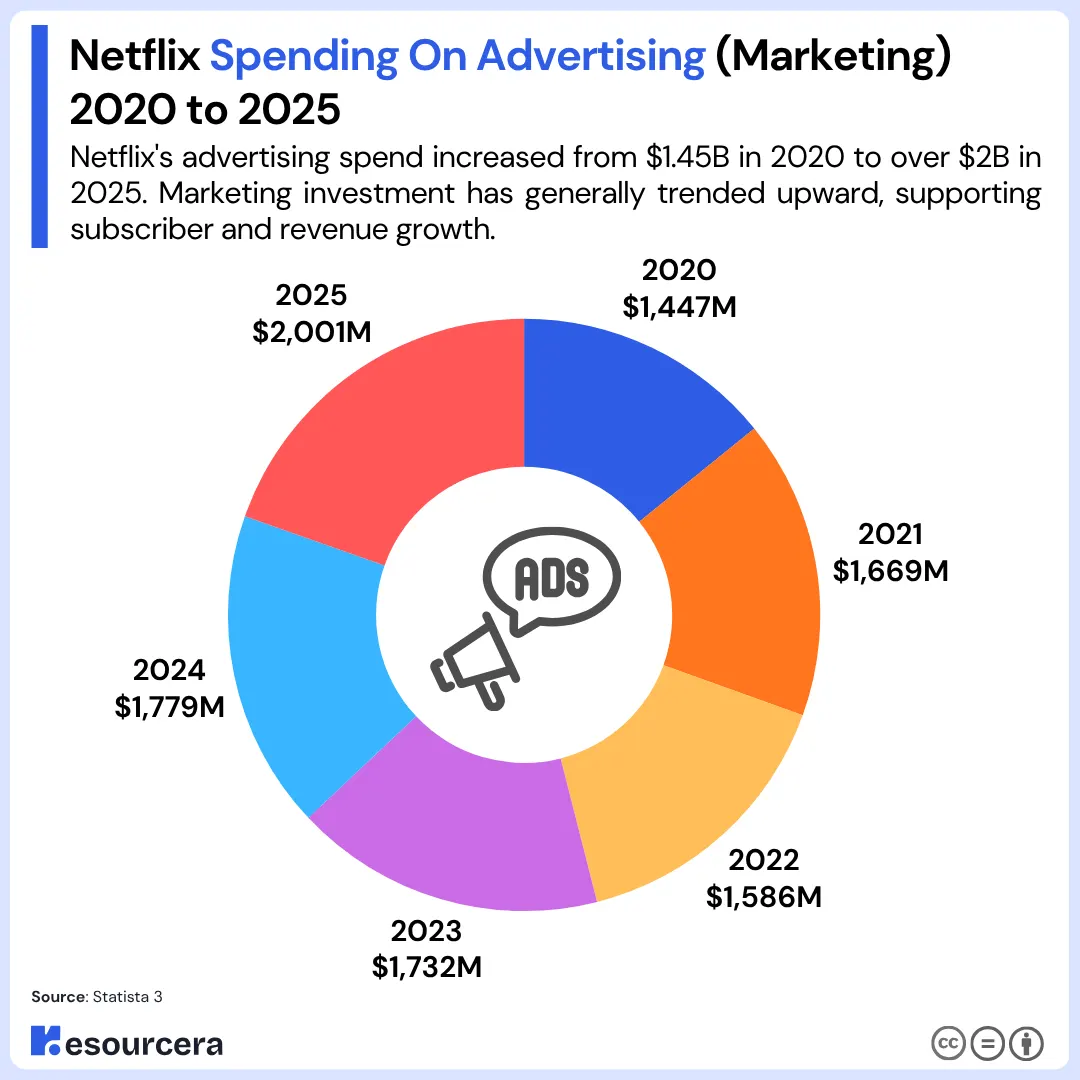
| Year | Advertising Spend (USD) |
|---|---|
| 2020 | $1,447M |
| 2021 | $1,669M |
| 2022 | $1,586M |
| 2023 | $1,732M |
| 2024 | $1,779M |
| 2025 | $2,001M |
Source: Statista 3
Spending dipped in 2022 during Netflix’s subscriber crisis but has risen every year since. The 2025 figure of $2 billion is up more than 12% from 2024. As Netflix builds its own ad revenue business, it is also spending more to grow the subscriber base that makes that ad business worth buying into.
How Many Subscribers Does Netflix Have?
As of 2026, Netflix has 325 million subscribers worldwide, making it the largest paid streaming service on the planet.
Netflix crossed 300 million paid subscribers heading into 2025, driven in large part by its password-sharing crackdown. When Netflix enforced paid sharing globally in 2023–24, it converted millions of freeloading accounts into paying ones, adding 19 million new subscribers in Q4 2024 alone. The platform has grown from 70.83 million subscribers in 2015 to 325 million by 2026.
Netflix’s ad tier grew 166% in roughly six months, from 94 million MAUs in November 2025 to 250 million by May 2026. That figure counts household members, not just account holders, so it runs higher than the paid subscriber count. Over 80% of those ad-tier viewers watch every week, which is the number Netflix is selling to advertisers.
Netflix Subscribers Over the Years
Back in 2010, it had just over 18 million paid subscribers. By early 2026, that number had climbed to 325 million, and it’s projected to reach around 350 million in 2026.
But the growth hasn’t been smooth every year. Netflix added subscribers at a rapid pace through the 2010s, got a huge boost during the 2020 pandemic, then hit a rough patch in 2022 before bouncing back strongly.
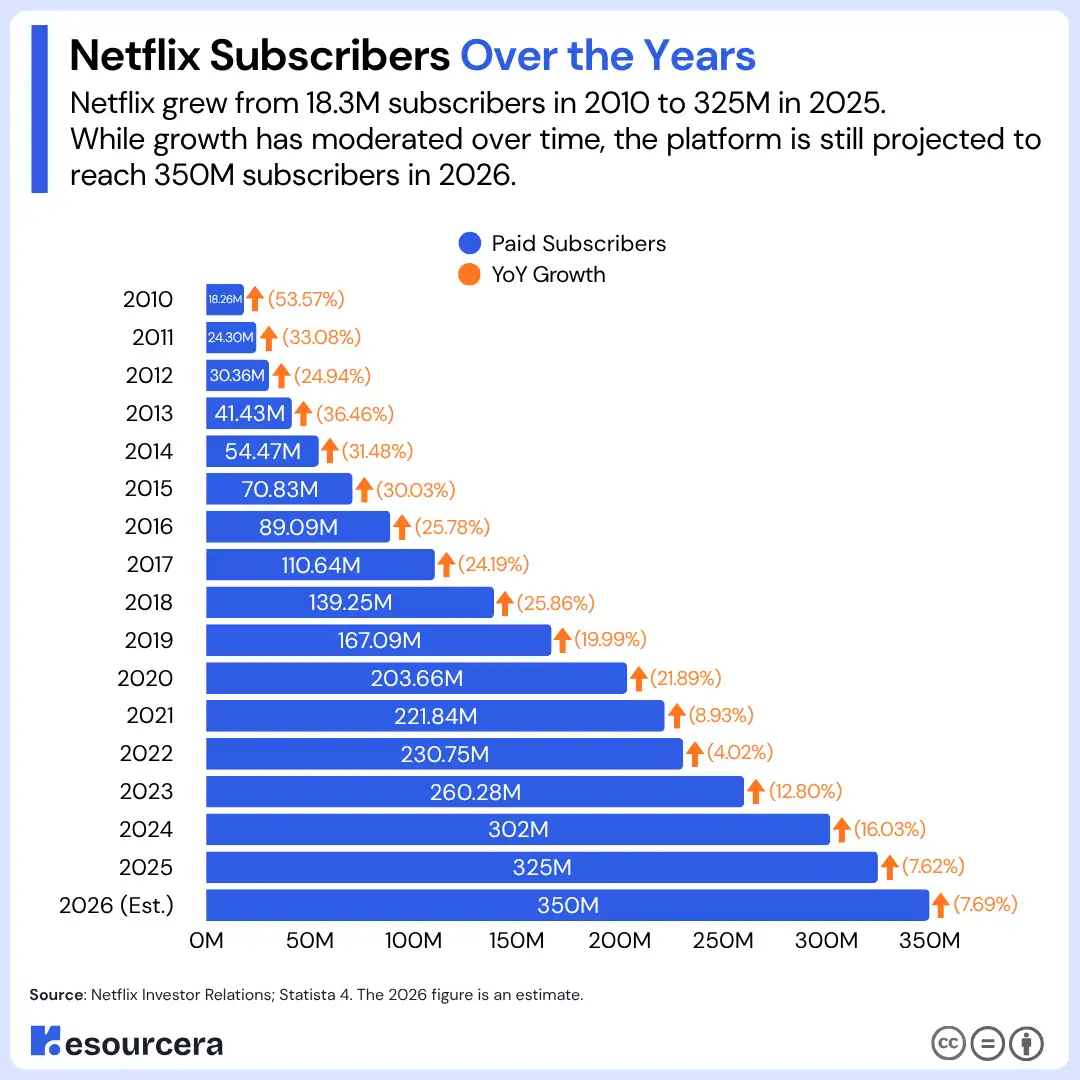
The table below shows the full picture, year by year.
| Year | Paid Subscribers | YoY Growth |
|---|---|---|
| 2010 | 18.26 million | +53.57% |
| 2011 | 24.30 million | +33.08% |
| 2012 | 30.36 million | +24.94% |
| 2013 | 41.43 million | +36.46% |
| 2014 | 54.47 million | +31.48% |
| 2015 | 70.83 million | +30.03% |
| 2016 | 89.09 million | +25.78% |
| 2017 | 110.64 million | +24.19% |
| 2018 | 139.25 million | +25.86% |
| 2019 | 167.09 million | +19.99% |
| 2020 | 203.66 million | +21.89% |
| 2021 | 221.84 million | +8.93% |
| 2022 | 230.75 million | +4.02% |
| 2023 | 260.28 million | +12.80% |
| 2024 | 302.00 million | +16.03% |
| 2025 | 325.00 million | +7.62% |
| 2026 (estimated) | 350.00 million | +7.69% |
Netflix Subscribers by Region
The regional breakdown below reflects Q4 2024 figures, the most recent full-year data available, when Netflix had 302 million paid subscribers. EMEA is the largest region by headcount, APAC is the fastest-growing, and UCAN generates the most revenue per subscriber despite ranking second overall.
Note that the global total reached 325 million as of early 2026, but regional splits have not been reported at that level since Q4 2024.
| Region | Subscribers (Q4 2024) | Share of Global Total |
|---|---|---|
| UCAN (US & Canada) | 89.63 million | 29.68% |
| EMEA (Europe, Middle East & Africa) | 101.3 million | 33.54% |
| LATAM (Latin America) | 53.33 million | 17.66% |
| APAC (Asia-Pacific) | 57.54 million | 19.05% |
Source: Netflix Annual Report, Statista 5
EMEA leads with 101.3 million subscribers, 11.67 million ahead of UCAN. The US sits at 87.8 million, making up roughly 98% of the UCAN total and about 27% of Netflix’s entire global base. Despite being the slowest-growing region, UCAN earns the most per subscriber, at $17.26 per member per month in 2024, more than double APAC’s $7.17.
The table below tracks regional subscriber counts from 2018 to 2024.
| Year | UCAN | EMEA | LATAM | APAC |
|---|---|---|---|---|
| 2018 | 64.76M | 37.82M | 26.08M | 10.61M |
| 2019 | 67.66M | 51.78M | 31.42M | 16.23M |
| 2020 | 73.94M | 66.70M | 37.54M | 25.49M |
| 2021 | 75.22M | 74.04M | 39.96M | 32.63M |
| 2022 | 74.30M | 76.73M | 41.70M | 38.02M |
| 2023 | 80.13M | 88.81M | 45.60M | 45.34M |
| 2024 | 89.63M | 101.30M | 53.33M | 57.54M |
Source: Netflix Annual Report 2025; Statista 5
UCAN lost subscribers in 2022, dropping from 75.22 million to 74.30 million, the only region to experience a decline that year. APAC grew 442% between 2018 and 2024, adding nearly 47 million subscribers, and re-accelerated to 27% growth in 2024 after slowing mid-decade. LATAM more than doubled in the same period. EMEA overtook UCAN in 2022 and has grown its lead every year since.
Netflix User Demographics Statistics
Netflix’s user base spans every age group and is split almost evenly between men and women. Younger adults subscribe at the highest rates, but adoption among older groups is stronger than most streaming platforms. The data below breaks down who watches Netflix by age, gender, and country.
Netflix Users by Age Group
Subscription rates are highest among adults under 50 and drop sharply after 65. The table below shows what share of each US age group holds an active Netflix subscription.
| Age Group | Share with a Netflix Subscription |
|---|---|
| 18–29 years | 72% |
| 30–49 years | 70% |
| 50–64 years | 69% |
| 65+ years | 44% |
Sources: Statista 6; Statista 7; WallStreetZen
Adults aged 18 to 64 subscribe at nearly identical rates, between 69% and 72%. The real gap appears at 65 and over, where the rate drops to 44%. For marketers, Netflix reaches working-age adults more consistently than almost any other streaming platform.
Netflix Users by Gender
Netflix’s global user base is split almost equally between men and women. The table below shows the gender breakdown.
| Gender | Share of Netflix Users |
|---|---|
| Women | 51% |
| Men | 49% |
Source: Search Logistics
A near-even gender split is rare among streaming platforms. Most services skew toward one gender based on content focus. Netflix’s broad library, covering drama, true crime, action, comedy, and documentary, attracts both audiences in roughly equal numbers.
Netflix Subscribers by Country
Netflix is available in 190+ countries, but subscriber density varies sharply by market. The table below shows the top 10 countries by estimated subscriber count as of 2026.
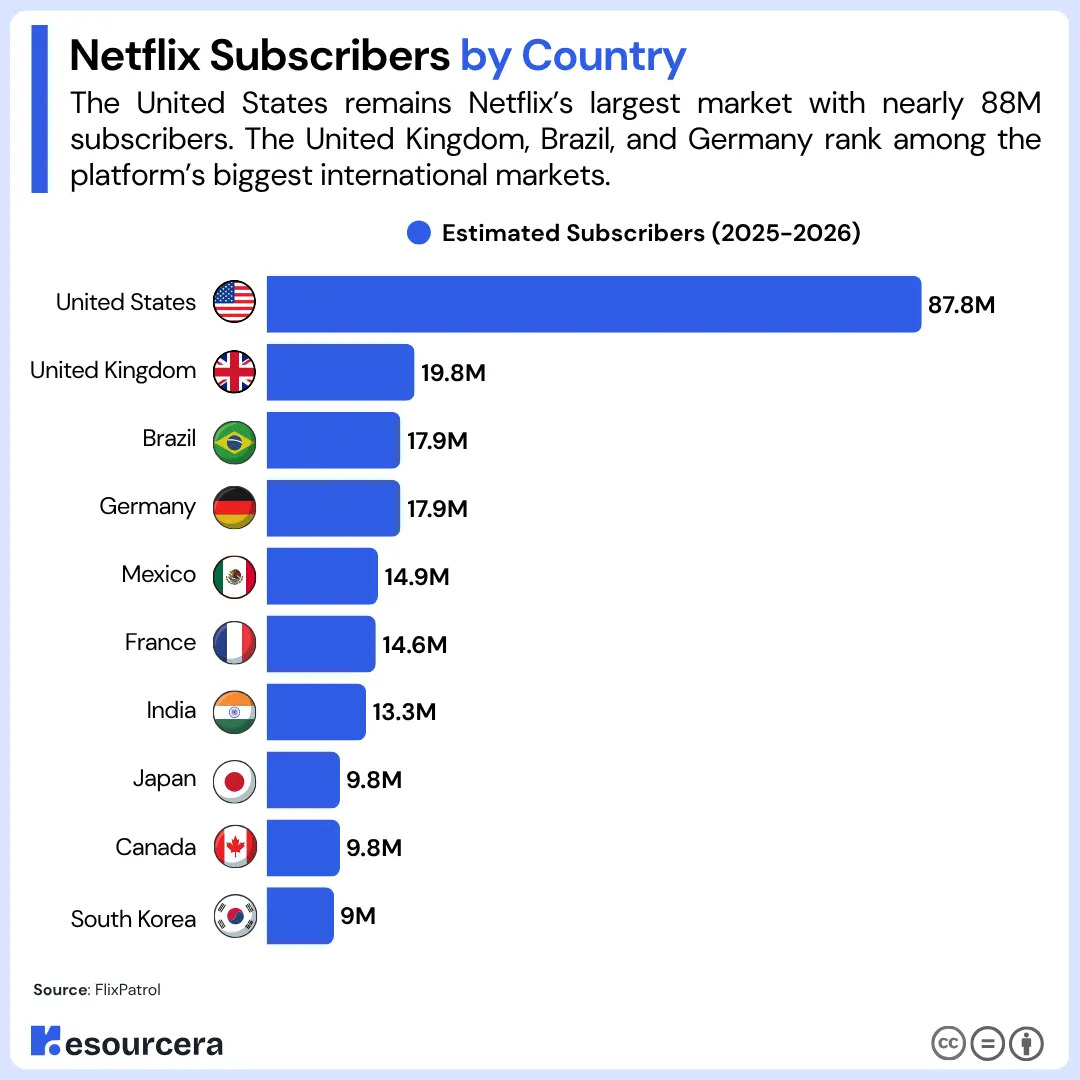
| Country | Estimated Subscribers (2025-2026) |
|---|---|
| United States | 87.8M |
| United Kingdom | 19.8M |
| Brazil | 17.9M |
| Germany | 17.9M |
| Mexico | 14.9M |
| France | 14.6M |
| India | 13.3M |
| Japan | 9.8M |
| Canada | 9.8M |
| South Korea | 9M |
Source: FlixPatrol
The US leads with nearly 88 million subscribers, more than four times the second-ranked UK at 19.8 million. India and South Korea rank lower by raw numbers but are among Netflix’s fastest-growing markets, driven by investment in local original content. Brazil and Mexico together make up the bulk of Netflix’s Latin American base.
Netflix Subscription Plan Statistics
Netflix offers three plans in the US in 2026, ranging from $8.99 to $26.99 per month. The Basic plan was discontinued. The ad tier is now the most popular entry point for new subscribers.
The table below shows all current Netflix plans in the US, including pricing, screens, quality, and ad tiers.
| Plan | Monthly Price | Screens | Video Quality | Downloads | Ads |
|---|---|---|---|---|---|
| Standard with Ads | $8.99 | 2 | 1080p Full HD | 2 devices | Yes |
| Standard | $19.99 | 2 | 1080p Full HD | 2 devices | No |
| Premium | $26.99 | 4 | 4K Ultra HD + HDR | 6 devices | No |
Extra members: $7.99/month (with ads) or $9.99/month (without ads).
Source: Netflix Help Centre
Standard with Ads costs less than half the Standard plan. That price gap is why it now drives over 60% of new sign-ups in ad-supported markets. Premium is the only plan with 4K, HDR, and spatial audio. Only Standard and Premium support adding extra members outside the household.
How Netflix US Plan Prices Have Changed Over Time
Netflix has raised prices consistently since 2014. The table below tracks how the Standard and Premium plan prices have changed year over year in the US.
| Year | Standard Monthly Price | Premium Monthly Price |
|---|---|---|
| 2013 | – | $11.99 |
| 2014 | $8.99 | – |
| 2015 | $9.99 | – |
| 2017 | $10.99 | $13.99 |
| 2019 | $12.99 | $15.99 |
| 2020 | $13.99 | $17.99 |
| 2022 | $15.49 | $19.99 |
| 2023 | – | $22.99 |
| 2025 | $17.99 | $24.99 |
| 2026 | $19.99 | $26.99 |
Source: CNBC
Note: The Standard tier was introduced in 2014 at $8.99.
The Standard plan reached $19.99 for the first time in 2026, up from $8.99 in 2014, a 122% increase over 12 years. Premium has risen from $11.99 to $26.99 in the same period. Each price increase has been followed by a short spike in cancellations and then a return to growth, suggesting subscribers accept the higher cost.
Netflix Business & Industry Trends
Three things are shaping Netflix in 2026: a collapsed acquisition, an AI-powered ad overhaul, and a password crackdown that keeps converting free riders into paying subscribers.
- Netflix overhauled its ad business at Upfront 2026. At its May 13 Upfront in New York, Netflix introduced the AI-powered Netflix Ads Suite, expanding its offering to include programmatic buying and new ad formats, with podcast and vertical video inventory planned for 2027.
- Netflix’s password crackdown keeps working. Since launching paid sharing in May 2023, Netflix has added tens of millions of new subscribers by converting account sharers into paying members. The policy remains in force as of May 2026.
- The ad-supported plan has become the dominant entry point for new subscribers, reinforcing that the lower price point is now one of Netflix’s biggest drivers of new sign-ups.
Sources: Netflix Q1 2026 Shareholder Letter, Netflix Upfront, Netflix
Netflix’s current growth rests on two pillars. The password-sharing policy converts free riders into paying subscribers, while the cheaper ad plan monetises that expanded base through advertising. The fact that both subscriber counts and revenue grew simultaneously in 2025 and into 2026 shows both strategies are delivering.
Time Spent On Netflix
Netflix users in the US average 1 hour and 3 minutes per day on the platform. Globally, paid members average around 2 hours per day. Users also spend roughly 18 minutes just browsing before picking something to watch.
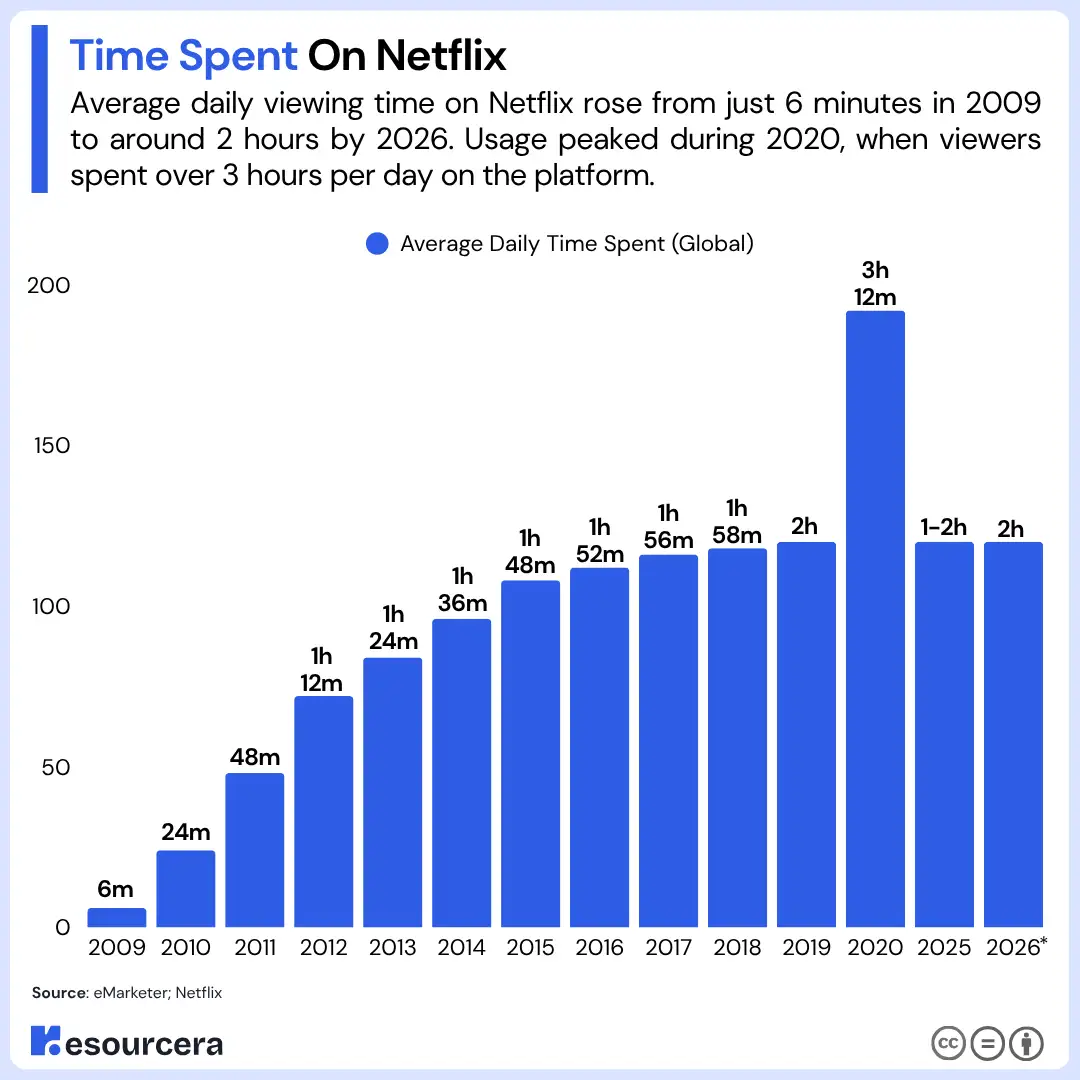
Here is the Average Daily Time Spent on Netflix Per User (Global):
| Year | Average Daily Time Spent (Global) |
|---|---|
| 2009 | 6 minutes |
| 2010 | 24 minutes |
| 2011 | 48 minutes |
| 2012 | 1 hour 12 minutes |
| 2013 | 1 hour 24 minutes |
| 2014 | 1 hour 36 minutes |
| 2015 | 1 hour 48 minutes |
| 2016 | 1 hour 52 minutes |
| 2017 | 1 hour 56 minutes |
| 2018 | 1 hour 58 minutes |
| 2019 | 2 hours |
| 2020 | 3 hours 12 minutes |
| 2025 | 1 to 2 hours |
| 2026* | 2 hours |
Sources: eMarketer; Netflix
Daily viewing time grew steadily from 6 minutes in 2009 to 2 hours by 2019, then spiked to over 3 hours during the 2020 pandemic lockdowns. It has since settled back to 1 to 2 hours. The 18-minute average browse time suggests that Netflix holds user attention during the discovery phase, not just while content is playing.
Netflix Original Content Statistics
Netflix originals have dominated the platform’s all-time viewing charts. The top 10 most-watched shows globally are all Netflix originals, collectively pulling in over 1.3 billion views.
Here are the top 10 Most-Watched Netflix Original Shows of All Time (Global):
| Rank | Title | Total Views | Hours Viewed |
|---|---|---|---|
| 1 | Wednesday: Season 1 | 252.1M | 1.72B |
| 2 | Adolescence: Limited Series | 142.6M | 546.5M |
| 3 | Stranger Things 4 | 140.7M | 1.84B |
| 4 | Stranger Things 5 | 133.8M | 1.39B |
| 5 | Wednesday: Season 2 | 119.3M | 928.5M |
| 6 | DAHMER: Monster | 115.6M | 1.03B |
| 7 | Bridgerton: Season 1 | 113.3M | 929.3M |
| 8 | The Queen’s Gambit | 112.8M | 746.4M |
| 9 | Bridgerton: Season 3 | 106M | 846.5M |
| 10 | HIS & HERS: Limited Series | 98.2M | 428.9M |
Rankings based on total views in the first 91 days of release.
Source: Netflix Top 10
Wednesday Season 1 leads by a wide margin with 252.1M views, nearly 110 million ahead of second place. Notably, shorter limited series like Adolescence and The Queen’s Gambit rank high despite compact runtimes, proving that tight storytelling drives massive engagement without needing extended episode counts.
Wrap Up
Netflix has 325 million paid subscribers as of 2026, earns $45.18 billion a year, and now runs one of the fastest-growing ad businesses in streaming.
Regional growth in APAC and LATAM shows the platform still has room to expand, and the shift toward ad-supported viewing suggests the next phase of growth will be driven as much by advertising revenue as by subscriber additions.
If you are a marketer, researcher, or just tracking where media is headed, this page will be updated as new data is published.