

Backlinks still decide who wins the top of Google in 2026.
The page ranking first has 3.8 times more backlinks than the pages sitting in positions 2 to 10, and backlinks remain one of Google’s top three ranking factors.
Yet around 95% of all pages on the web have zero backlinks pointing to them, which leaves most content invisible in search.
That gap creates a clear opportunity. Websites that build quality links consistently are more likely to move ahead, while others fall behind.
This report brings together the latest link-building statistics for 2026. It covers market size, costs, outreach performance, link-quality factors, and the growing impact of AI.
Read on to get full insights.
Key Link Building Statistics for 2026 (Editor’s Pick)
- The global link-building services market is worth $25.97 billion in 2026 and is projected to reach $57.07 billion by 2030.
- The #1 Google result has 3.8 times more backlinks than pages in positions 2 to 10.
- Around 95% of all web pages have zero backlinks.
- Pages with at least one backlink are 77% more likely to rank in the top 10.
- Digital PR is rated the most effective link-building strategy by 48.6% of SEO professionals.
- 98% of guest posting sites are low quality, defined as a Domain Rating under 40 and fewer than 10,000 monthly visitors.
- The average high-quality backlink costs $508.95.
- 93.8% of link builders say link quality matters more than link quantity.
- 78.1% of SEO professionals report a positive ROI from link building.
- Long-form content of 3,000 or more words earns 77.2% more backlinks than short-form articles.
Link Building Market Size 2026
The global link-building services market is estimated to reach $30.32 billion in 2026, up from $25.97 billion in 2025. This represents a year-over-year increase of approximately 16.8%.
The market is projected to continue expanding rapidly and reach $57.07 billion by 2030. Based on these estimates, the industry will grow by approximately 88% between 2026 and 2030.
This means the industry could nearly double in size within four years while maintaining yearly growth of about 17%.
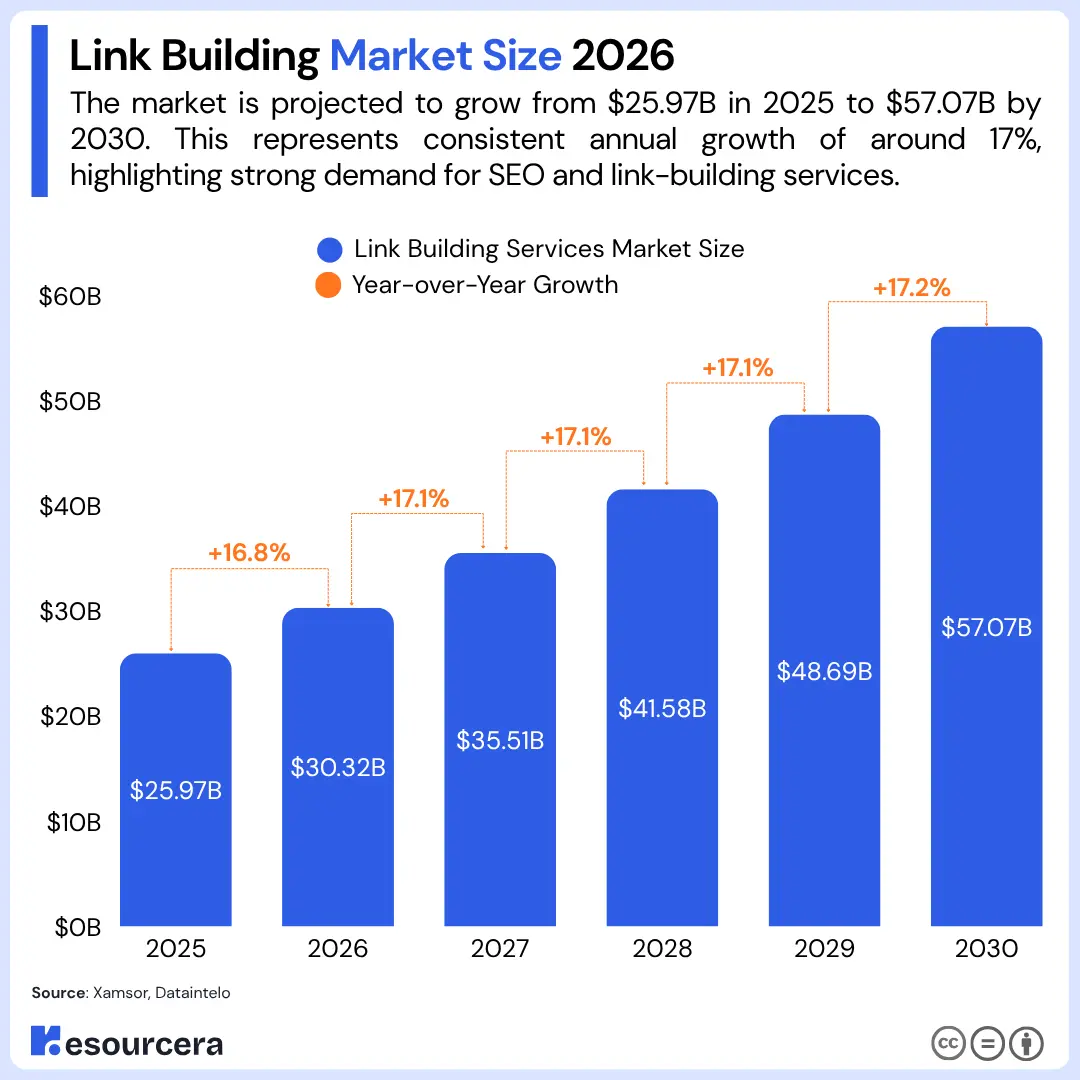
The table below provides insights into the link-building services market size over the years.
| Year | Link Building Services Market Size | Year-over-Year Growth |
|---|---|---|
| 2025 | $25.97 billion | — |
| 2026 | $30.32 billion | +16.8% |
| 2027 | $35.51 billion | +17.1% |
| 2028 | $41.58 billion | +17.1% |
| 2029 | $48.69 billion | +17.1% |
| 2030 | $57.07 billion | +17.2% |
The market is projected to add approximately $4.35 billion in value during 2026 alone. The annual increase then becomes progressively larger, rising from around $5.19 billion in 2027 to approximately $8.38 billion in 2030.
This means that even though the percentage growth rate remains relatively stable, the amount of new revenue added each year continues to increase as the overall market becomes larger.
Link-Building Software Market Size
Alongside managed services, the market for link-building software is also expanding.
The global link-building software market was valued at approximately $2.8 billion in 2025 and is projected to reach $7.1 billion by 2034.
This represents a compound annual growth rate of approximately 10.9% and an overall increase of more than 150% during the forecast period.
However, software remains considerably smaller than the services segment. In 2025, the link-building services market was more than nine times larger than the software market.
Moreover, the digital PR market is also projected to reach approximately $25.4 billion by 2032.
(Source: Xamsor, Dataintelo, Reboot Online 1)
Are Backlinks Still a Ranking Factor in 2026?
Yes, backlinks remain one of Google’s top three ranking factors in 2026, alongside content quality and keyword relevance.
However, backlinks do not work in isolation. Google evaluates links alongside many other signals, including content quality, search intent, topical relevance, page experience, keyword usage, and the overall credibility of a website.
In fact, backlinks account for about 13% of ranking influence.
While publishing consistently useful and satisfying content has 23% influence, and including the target keyword in the title tag accounts for around 14%.
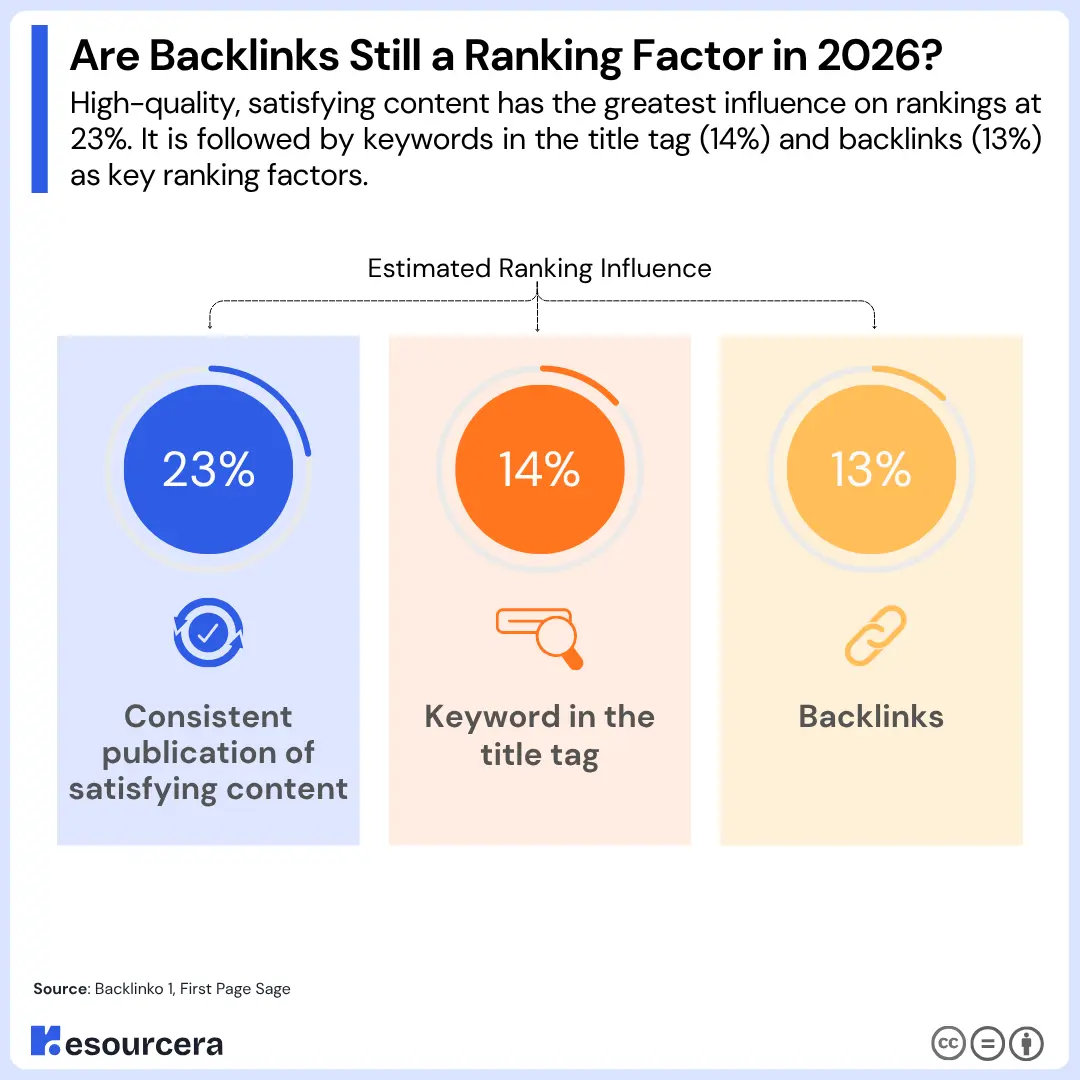
Here is how the top ranking factors compare in estimated influence.
| Ranking Factor | Estimated Ranking Influence |
|---|---|
| Consistent publication of satisfying content | 23% |
| Keyword in the title tag | 14% |
| Backlinks | 13% |
Backlinks also support organic traffic. Around 65% of users still click traditional organic search results instead of paid ads or AI-generated answers.
(Source: Backlinko 1, First Page Sage, Ahrefs 1)
The #1 Result Has 3.8x More Backlinks Than Positions 2 to 10
The page ranking in the first position on Google has an average of 3.8 times more backlinks than pages ranking in positions 2 through 10.
This finding comes from Backlinko’s analysis of 11.8 million Google search results and shows a clear relationship between backlinks and higher rankings.
Pages with at least one backlink are also 77% more likely to rank in the top 10 than pages with no backlinks.
Links from different websites matter more than getting many links from the same source.
In fact, 96% of first-page results have more than 1,000 referring domains.
Backlinks can be especially important for local SEO because they help Google understand a business’s local authority and credibility.
(Source: Backlinko 1, Ahrefs 1, RankTracker, Search Engine Land)
How Many Backlinks Does a Page Need to Rank?
There is no exact number of backlinks that guarantees higher rankings.
However, available benchmarks suggest that pages with around 30 to 35 quality backlinks often attract stronger organic traffic.
Pages within this range receive an average of more than 10,500 organic visits per month, while pages with five or fewer backlinks generally receive around 1,000 visits per month or less.
Each additional referring domain is also associated with approximately 700 to 800 more monthly organic visits across the observed range.
In addition, 92.3% of the top 100 ranking domains have at least one backlink, showing that backlinks are common among websites with strong search visibility.
These figures should be treated as general benchmarks rather than fixed targets. A smaller number of relevant, high-quality backlinks can be more valuable than a large number of weak or unrelated links.
(Source: uSERP, Ahrefs 2, Semrush)
The Share of Pages With Zero Backlinks
Around 95% of web pages have no backlinks at all.
This is one of the main reasons many pages struggle to gain visibility in search results.
More than 66% of pages have no referring domains, while another 26.29% receive links from only one to three websites.
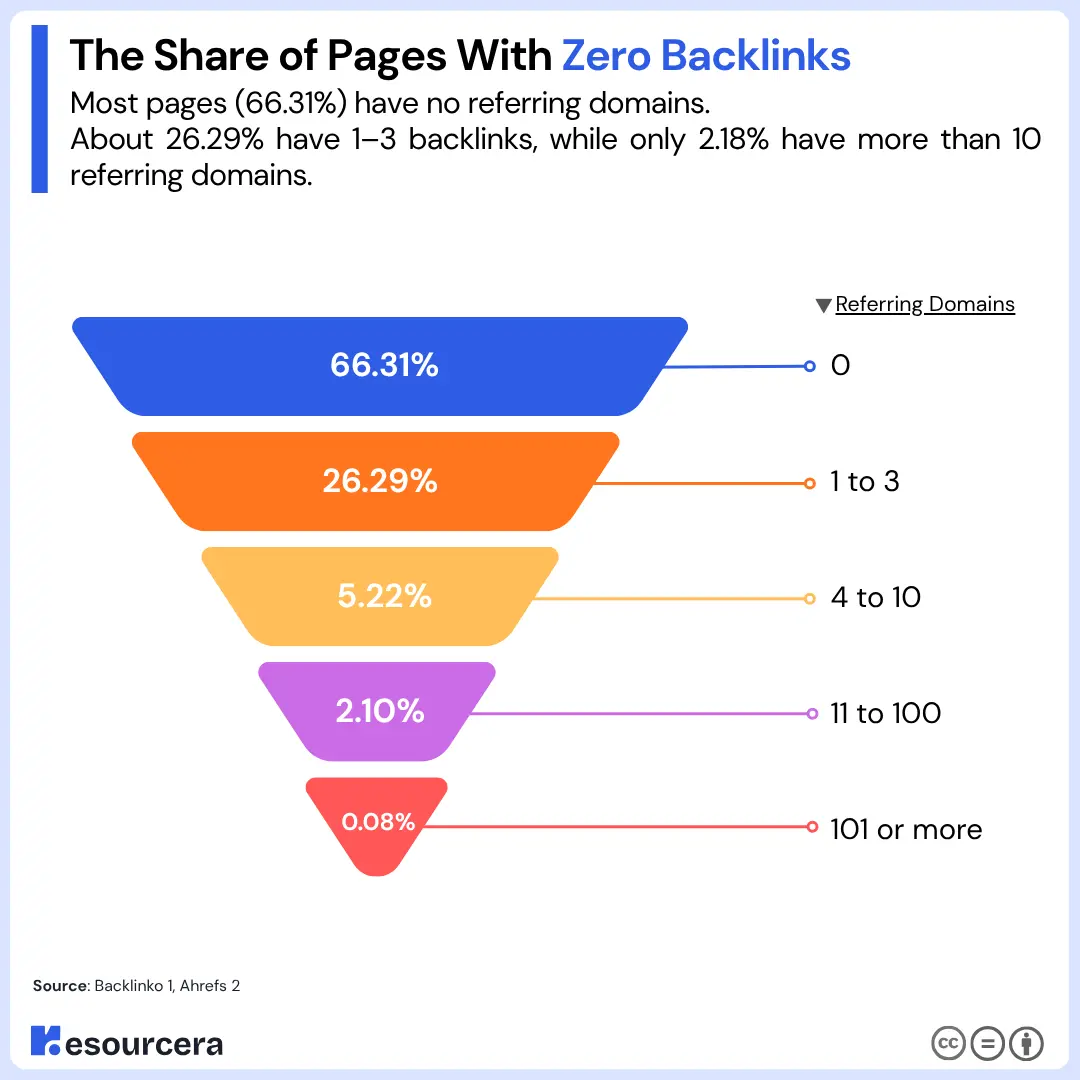
The distribution below shows how referring domains are spread across the web.
| Referring Domains | Share of Pages |
|---|---|
| 0 | 66.31% |
| 1 to 3 | 26.29% |
| 4 to 10 | 5.22% |
| 11 to 100 | 2.10% |
| 101 or more | 0.08% |
That means, fewer than 3% of pages have links from more than 10 referring domains. This means that even a modest and consistent link-building strategy can help a page build a stronger backlink profile than most content published on the web
(Source: Backlinko 1, Ahrefs 2)
Most Effective Link Building Tactics in 2026
Digital PR is considered the most effective link-building strategy in 2026. Around 48.6% of SEO professionals rated it as their top strategy
Moreover, Guest posting remains one of the most commonly used tactics, but only 16% of professionals consider it the most effective.
This shows a clear difference between the tactics marketers use most often and the tactics that deliver the strongest results.
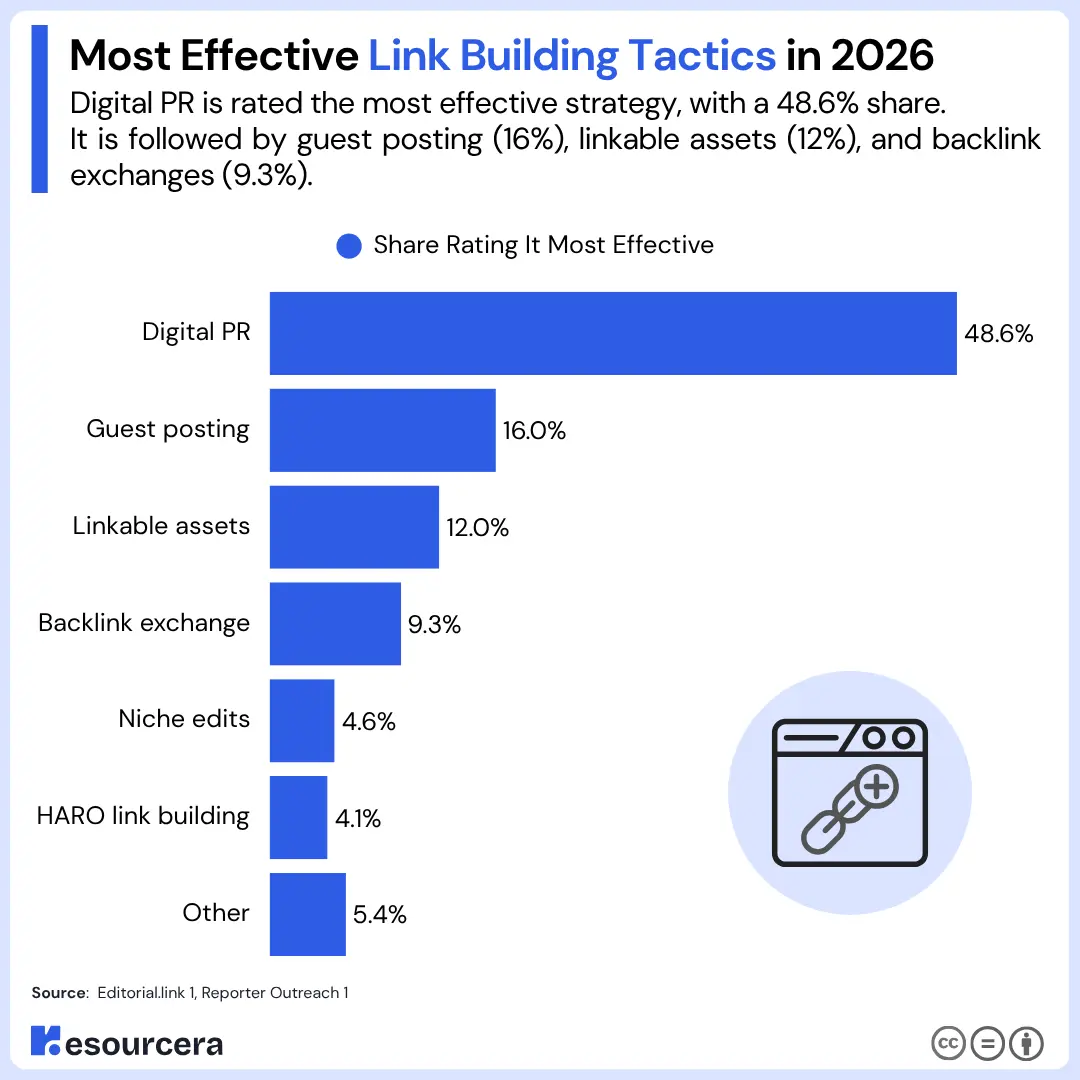
The following table ranks link building strategies by how effective SEO professionals rate them.
| Strategy | Share Rating It Most Effective |
|---|---|
| Digital PR | 48.6% |
| Guest posting | 16% |
| Linkable assets | 12% |
| Backlink exchange | 9.3% |
| Niche edits | 4.6% |
| HARO link building | 4.1% |
| Other | 5.4% |
(Source: Editorial.link 1, Reporter Outreach 1)
Digital PR
Digital PR performs well because it helps brands earn editorial links from established news sites, industry publications, and other authoritative websites.
A typical digital PR campaign earns backlinks from around 42 different websites. More than 20% of these links come from high-authority domains with a Domain Rating between 70 and 79.
Beyond the 48.6% effectiveness rating, 67% of SEO and content teams now use digital PR, and 78% of SEOs say it delivers better ROI than traditional outreach.
Besides that, approximately 95% of digital PR professionals use original data, surveys, research, or statistics in their campaigns.
Digital PR is also more searched than the term “link building” itself in the US, by 31.7%, which signals where the industry’s attention has moved.
Guest Posting
Guest posting is still the most widely used tactic, used by 64.9% of link builders, but 98% of guest posting sites are low quality.
Low quality here means a Domain Rating under 40 and fewer than 10,000 monthly organic visitors, which describes almost the entire guest post marketplace.
On a list of more than 257,000 guest post sites, 62.4% received between 0 and 100 visits per month, making them close to worthless for rankings.
Higher-quality placements can have a much stronger impact. Guest posts on websites with a Domain Rating of 50 or above produce 5.2 times more ranking impact than placements on lower-authority sites.
In short, cheap guest posts are plentiful and mostly useless, while the ones that move rankings are rare and costly.
(Source: BuzzStream 1, RankTracker)
The Content Types That Earn the Most Links
Long-form, research-based content earns significantly more backlinks than shorter or opinion-led content.
Articles with 3,000 words or more receive 77.2% more backlinks than short-form articles.
Original research and data studies generate 3.2 times more links than opinion pieces and how-to guides because journalists and publishers often need reliable statistics to support their content.
Visual format also matters. Infographics earn 178% more backlinks than standard blog posts. “Why” posts, “what” posts, and infographics collectively attract 25.8% more links than videos and how-to content.
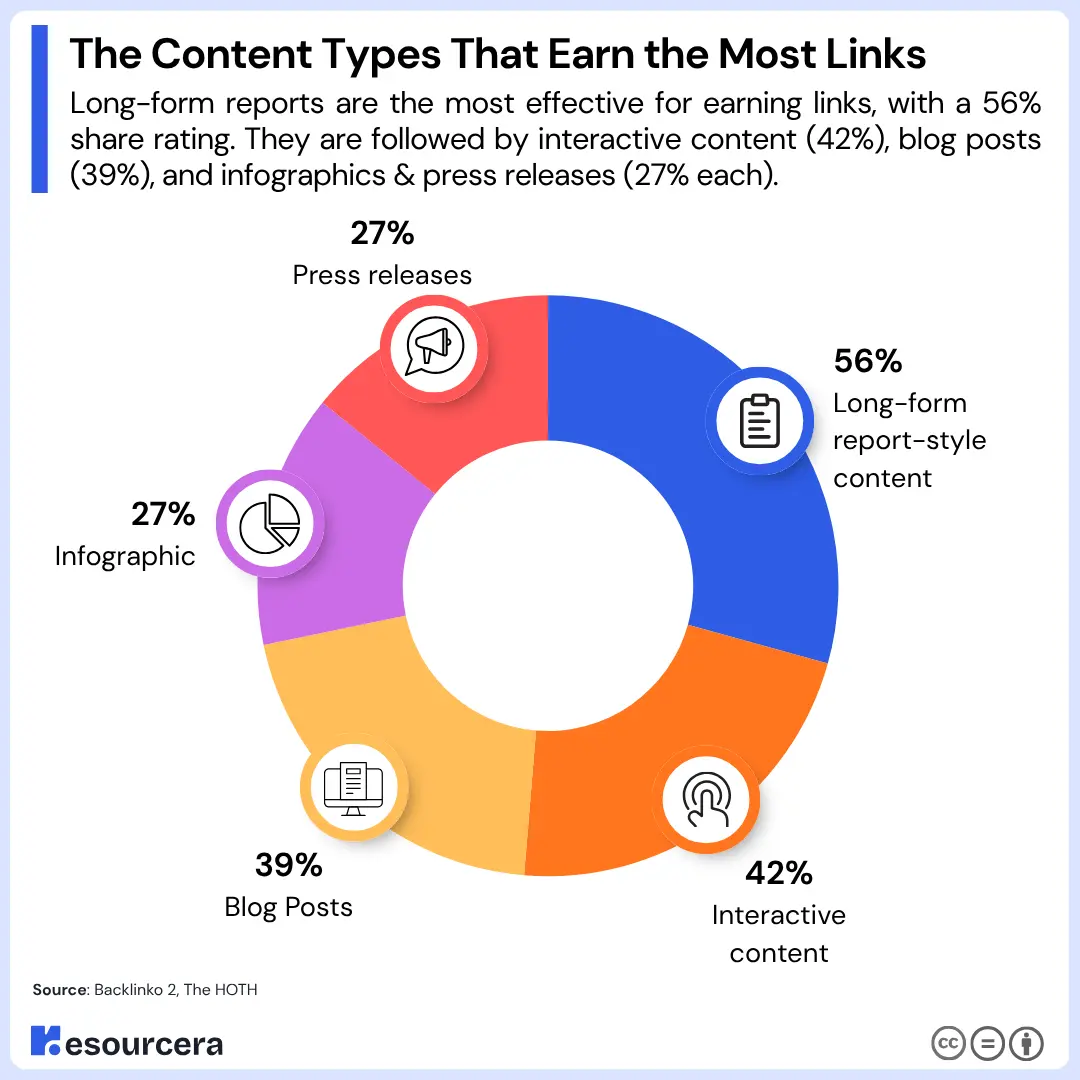
SEO professionals also rate long-form reports as the most effective content format for attracting backlinks, as shown below.
| Content Format | Share Rating: It is most effective for Links |
|---|---|
| Long-form report-style content | 56% |
| Interactive content | 42% |
| Blog posts | 39% |
| Infographics | 27% |
| Press releases | 27% |
Around 86% of marketers now create content specifically to earn backlinks. This shows that content creation and link building are increasingly treated as part of the same strategy.
(Source: Backlinko 2, The HOTH, Aira 1, Sure Oak)
Link Building Outreach Statistics
Link-building outreach has become increasingly difficult.
Only 8.5% of outreach emails receive a reply, meaning more than 91% are ignored.
This means sending more emails is no longer enough. Relevant prospects, personalized messages, and follow-ups now have a much greater impact on results.
The sections below break down both.
(Source: Backlinko 3, Editorial.link 1)
What Improves Outreach Results?
The baseline reply rate for link building outreach is 8.5%, based on an analysis of 12 million emails, and follow-ups are the single biggest lever for improving it.
Plus, contacting the same person more than once can roughly double the number of responses. A planned follow-up sequence can also generate 40% more backlinks than sending only one email.
The broader context is that cold email is getting quieter, with average response rates sliding from 8.5% in 2019 to about 3.43% in 2026, so precision now beats volume.
Here is how specific outreach factors change performance.
| Outreach Factor | Effect on Performance |
|---|---|
| Personalized subject line | +26% open rate |
| Personalized message body | +32.7% response rate |
| Subject line of 36 to 50 characters | +32.7% response vs short subject lines |
| Sending on Wednesday | Highest reply rate at 7.64% |
| Sending on Saturday | Lowest reply rate at 5.65% |
| Multiple contacts at one organization | +93% response rate |
However, relevance remains the most important factor. Around 73% of journalists reject pitches because the topic does not match their area of coverage.
(Source: Backlinko, Campaign Monitor, PR Daily)
Most Used Link-Building Tools
Google Search Console is the most widely used link building tool at 25% adoption, followed by Semrush and Ahrefs.
Ahrefs is the clear favorite specifically for backlink analysis, chosen by 68.1% of professionals, while Hunter.io leads for finding email addresses at 37.2%.
The full picture shows a mix of free platforms and paid specialist tools, with starting prices that range from nothing to a few hundred dollars per month.
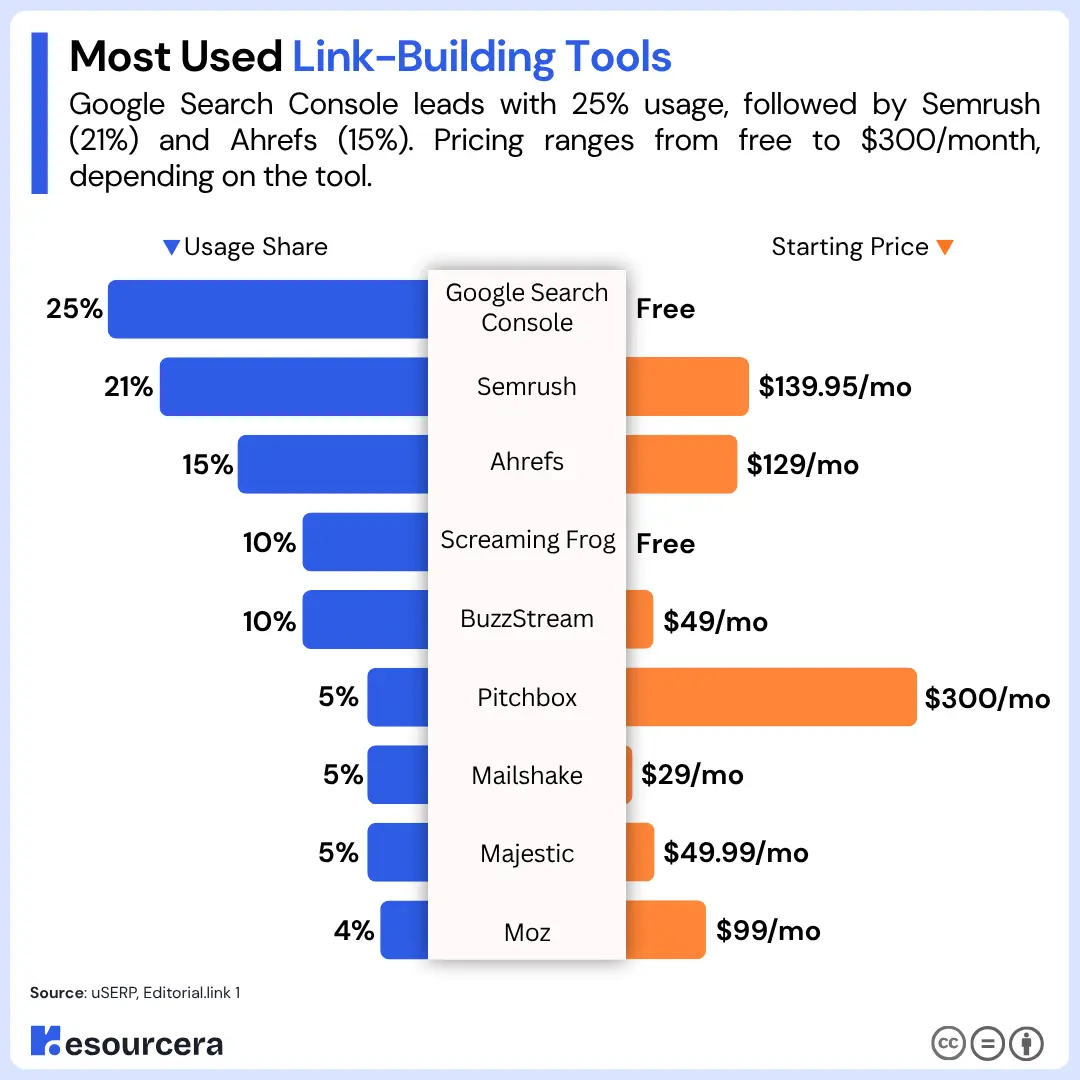
The breakdown below covers adoption rates and starting prices for the most used tools.
| Tool | Usage Share | Starting Price |
|---|---|---|
| Google Search Console | 25% | Free |
| Semrush | 21% | $139.95/mo |
| Ahrefs | 15% | $129/mo |
| Screaming Frog | 10% | Free |
| BuzzStream | 10% | $49/mo |
| Pitchbox | 5% | $300/mo |
| Mailshake | 5% | $29/mo |
| Majestic | 5% | $49.99/mo |
| Moz | 4% | $99/mo |
(Source: uSERP, Editorial.link 1)
Backlink Quality Statistics
Backlink quality matters more than the total number of links.
Around 93.8% of link builders say they prioritize quality over quantity, while 84.6% consider topical relevance the most important factor when evaluating a backlink.
Authority also plays a major role. About 52% of SEO professionals require a website to have a Domain Rating of at least 50 before considering a placement.
More than 60% believe one backlink from a DR 60+ website can be more valuable than ten links from lower-authority sites.
(Source: DesignRush, Editorial.link 1, Reporter Outreach 2)
What Makes a Backlink Valuable?
A strong backlink usually comes from a relevant website with real organic traffic and established authority.
93.8% who prioritize quality, 52% of agencies reject an opportunity if the referring domain gets fewer than 1,000 monthly organic visitors, regardless of its Domain Rating.
Topical relevance is the top criterion for 84.6% of link builders. Anchor text also matters, with 41.7% preferring partial-match anchors because they provide context without making the backlink profile look overly optimized.
Top-ranking pages also attract new backlinks passively, at a rate of 5% to 14.5% per month. This shows that useful and authoritative content can produce long-term link growth.
(Source: Editorial.link1)
Are Nofollow Links Valuable?
Yes, Nofollow links are still considered a useful part of a natural backlink profile.
Around 88% of SEO professionals believe nofollow links can support website authority and rankings, while 54% consider them valuable overall.
Google began treating the nofollow attribute as a hint rather than a strict instruction in 2019. This means Google may choose how to interpret these links, although nofollow links are not guaranteed to pass ranking value.
Even without directly passing link equity, nofollow links from trusted publications can still generate referral traffic, brand visibility, and credibility.
Around 10.6% of backlinks pointing to the top 110,000 websites are nofollow. In addition, 43.7% of top-ranking pages contain some reciprocal links.
(Source: uSERP, Google, Ahrefs 3)
Link Building Costs and ROI
A high-quality backlink in 2026 costs an average of $508.95, and 80.9% of SEO professionals expect prices to continue rising over the next two to three years.
Despite the higher cost, 78.1% of SEO professionals report a positive return from link building.
SEO overall has also been reported to generate returns of up to 748%, although the actual result depends on the industry, competition, link quality, and how well the campaign is measured.
(Source: Editorial.link 2, FatJoe 1)
Average Cost of a Backlink
Pricing is heavily tiered, running from under $200 for a link insertion to $20,000 for a full digital PR campaign.
Link insertions and standard guest posts are generally the cheapest options. High-authority guest posts and digital PR placements cost considerably more because they are harder to secure and often require original content, research, outreach, and media relationships.
The table below compares average costs across the main link types.
| Link Type | Average Cost |
|---|---|
| Niche edit or link insertion | $179 |
| Standard guest post | $365 |
| High-quality guest post | $692 to $957 |
| Premium guest post | $2,500 to $3,000 |
| Digital PR link | $1,250 to $1,500 |
| Digital PR campaign | $6,000 to $20,000 |
Link placement fees increased by around 20% to 40% between 2024 and 2026.
More than 76% of professionals now pay at least $300 per backlink, while 16% pay more than $1,000 for a single high-authority placement.
This suggests that businesses are increasingly buying fewer links while spending more on quality, relevance, and authority.
(Source: BuzzStream 1, Editorial.link 2)
Monthly Link-Building Budgets
The most common monthly link-building budget is between $1,000 and $5,000, reported by 38.43% of businesses.
Taken together, roughly 72% of businesses spend $5,000 or less each month. This clearly means that most companies prefer smaller, ongoing campaigns rather than investing in occasional large-scale link-building projects.
Monthly spending is distributed across the following brackets.
| Monthly Spend on Link Building | Share of Businesses |
|---|---|
| Up to $1,000 | 34.14% |
| $1,000 to $5,000 | 38.43% |
| $5,000 to $10,000 | 20.29% |
| Over $15,000 | 7.14% |
On the question of who runs it, 60% of companies outsource link building, 29% keep it fully in-house, and 11% use a mix of both.
In-house teams spend approximately 36.03% of their SEO budgets on link building, compared with 32.1% for agencies.
However, internal teams reportedly pay around 75% more for premium links, which may explain why many companies use agencies for high-authority placements.
(Source: uSERP, Editorial.link 1)
How Long Do Backlinks Take to Show Results?
Backlinks do not normally improve rankings immediately. On average, a new backlink takes around 3.1 months to show a measurable ranking impact.
Most teams measure link building ROI through organic performance, but a large share still cannot measure it reliably.
Almost 46.6% of link builders see results within one to three months, while another 35.2% report that links take three to six months to affect rankings.
The timeline below shows how long link builders wait before a link moves rankings.
| Time for a Link to Impact Rankings | Share of Link Builders |
|---|---|
| Less than 1 month | 7.5% |
| 1 to 3 months | 46.6% |
| 3 to 6 months | 35.2% |
| 6 to 12 months | 7.3% |
| Over 12 months | 3.3% |
This delay makes ROI difficult to measure. Around 70% of marketers say they cannot reliably calculate the impact of their link-building campaigns.
Around 67% of SEO professionals use organic traffic to judge backlink quality. Keyword rankings are the main KPI for 43% of SEOs, increasing to 51% among experienced professionals.
(Source: FatJoe 2, Sure Oak, Authority Hacker)
Link Building Challenges
Link building itself is widely seen as the hardest part of SEO.
Around 52.3% of digital marketers consider it the hardest SEO activity, while 41% of large enterprises report the same.
The main challenge is that link building depends on other website owners, editors, and journalists choosing to link to your content. Unlike on-page SEO, the outcome is not fully under a company’s control.
Another challenge is the cost. About 80.9% of SEO professionals expect link-building costs to increase over the next two to three years.
Further, 60.8% of professionals say finding relevant journalists is more difficult than it was a year ago, while 75% of digital PR professionals believe their work has become more challenging.
The table below summarizes the biggest pain points reported by link builders.
| Link-Building Challenge | Key Statistic |
|---|---|
| Marketers who consider link building the hardest SEO activity | 52.3% |
| Large enterprises that consider link building difficult | 41% |
| Professionals expect link-building costs to rise | 80.9% |
| Professionals are finding it harder to identify relevant journalists | 60.8% |
| Digital PR professionals who say the work has become harder | 75% |
| Teams that consider their link-building efforts successful | 30% |
| Teams that identify link decay as a major challenge | 42% |
Despite the time and money required, only around 30% of teams consider their link-building efforts successful.
Maintaining existing links creates an additional challenge. Around 42% of teams identify link decay, when backlinks are removed, broken, or lost, as one of their biggest problems.
(Source: FatJoe 2, BuzzStream 2)
Link Building Statistics by Industry
The cost and difficulty of link building vary significantly by industry.
iGaming and online betting demand the largest budgets (cited by 61% of respondents), while healthcare and heavily regulated fields are consistently the hardest verticals to earn links in.
Finance and law follow, with 18.4% and 16.4%, respectively.
The table below suggests budget allocation across industries.
| Industry | Link Building Budget Allocation |
|---|---|
| iGaming and online betting | 61% |
| Finance | 18.4% |
| Law | 16.4% |
| Health and wellness | 7.1% |
| SaaS | 5.8% |
(Source: Editorial.link 1, Aira 1)
Easiest Industries for Link Building
Beauty and personal care is considered the easiest industry for link building, selected by 35% of respondents. Marketing, tourism, retail, and technology also rank among the easier sectors.
These are the verticals where link builders report the least resistance.
| Industry | Share Rating It Easiest |
|---|---|
| Beauty and personal care | 35% |
| Marketing, advertising, or PR | 26% |
| Leisure, sport, or tourism | 24% |
| Retail | 16% |
| Computing or IT | 15% |
(Source: Aira 1)
Hardest Industries for Link Building
Healthcare and pharmaceuticals are the hardest industry for link building, cited by 31% of respondents.
Finance and law follow at 25% and 21%.
The list below shows where link builders struggle most.
| Industry | Share Rating It Hardest |
|---|---|
| Healthcare or pharmaceuticals | 31% |
| Accounting, banking, or finance | 25% |
| Law | 21% |
| Gaming | 18% |
| Engineering or manufacturing | 13% |
(Source: Aira 1)
What SEO Experts Say About Link Building
Most SEO professionals still believe backlinks have a strong effect on search rankings. Around 67.5% say backlinks have a major impact, while another 30% consider their impact moderate. Only 2.5% believe backlinks have little influence.
Expert sentiment on ranking impact splits as shown here.
| Expert Opinion | Share |
|---|---|
| Backlinks have a major ranking impact | 67.5% |
| Backlinks have a moderate ranking impact | 30% |
| Backlinks have a low ranking impact | 2.5% |
Confidence in the future of link building also remains high. Around 85% of marketers believe it will still be an important ranking factor five years from now, while 58% believe backlinks will always remain essential to SEO.
Beyond rankings, around 85% of marketers say it helps build brand authority, and 93.8% prioritize link quality over the total number of links.
In addition, 80.9% believe unlinked brand mentions can influence organic rankings. This suggests that modern link building is expanding beyond traditional backlinks to include brand mentions, citations, and wider online visibility.
(Source: uSERP, Aira 2)
Link Building and AI
AI is changing both how link builders work and how search engines evaluate online authority.
Around 73.2% of SEO professionals believe backlinks still influence visibility in AI search results. Meanwhile, 83% of link-building platforms use AI to assess backlink quality and identify spammy or harmful links.
(Source: Editorial.link 1, Ahrefs 4, Search Logistics)
What Influences AI Search Visibility?
Traditional Google rankings still have a strong connection with AI visibility. Around 76.1% of pages cited in Google AI Overviews also rank within the top 10 organic search results.
This suggests that the signals supporting traditional rankings, including useful content and authoritative links, can also improve the likelihood of being cited in AI-generated answers.
However, brand mentions may be an even stronger signal. A study of 75,000 brands found that unlinked brand mentions had a 0.664 correlation with AI visibility, compared with 0.218 for backlinks.
The comparison below shows how the two signals stack up.
| Visibility Signal | Correlation With AI Visibility |
|---|---|
| Unlinked brand mentions | 0.664 |
| Backlinks | 0.218 |
Content cited by AI was an average of 1,064 days old, compared with 1,432 days for standard organic results. This means AI-cited content was approximately 25.7% newer.
Moreover, brands distributing content through multiple publications can receive up to 325% more AI citations than those publishing only on their own websites.
(Source: Ahrefs 4, The HOTH, Foursets)
AI in Link Building
Around 44.2% of professionals already use AI tools for link building, while another 47.33% plan to adopt them within the next year.
AI can also reduce the time needed to find backlink opportunities by approximately 50%. It is commonly used for prospect research, website analysis, outreach personalization, and backlink quality checks.
Tracking AI visibility is growing as well. Around 66.2% of digital PR professionals now measure AI citations as a formal KPI. However, only 11% have a reliable and repeatable process for earning those citations.
The five factors that most drive citations in large language models are
- Domain authority
- Backlinks from websites with a Domain Authority of 60 or higher
- Mentions in “best of” articles
- Total backlink count
- Number of unique referring domains
The data shows that AI is making link building faster, but earning AI citations remains difficult.
(Source: Improvado, BuzzStream, Seer Interactive)
Final Thoughts
The data shows that link building still works, but only when quality leads the strategy.
With 93.8% of professionals prioritizing quality and high-quality links costing an average of $508.95, businesses should avoid chasing large volumes of cheap backlinks.
Future link-building decisions should focus on relevant, authoritative websites, digital PR, original research, and brand mentions.
Results should also be measured over several months using rankings, organic traffic, referral traffic, and AI citations.
The strongest strategy for 2026 is simple, build fewer links, choose better sources, and invest in content that publishers genuinely want to reference.

