

Search engines send 76% of all traffic to B2B websites, more than every other channel combined.
That single number explains why organic search now sits at the center of B2B growth.
B2B buyers run most of their research online before they ever speak to a sales rep, and 66% of them begin that research in a search engine.
If your pages are not there when buyers build their shortlist, you lose the deal before the conversation starts, and those shortlists keep getting shorter every year.
This article breaks down the latest B2B SEO statistics on adoption, traffic sources, buyer behavior, content, ROI, technical performance, and AI search, so you can see where SEO delivers and where the ground is shifting.
Key B2B SEO Statistics at a Glance
- 49% of B2B marketers use SEO, making it the single most-used marketing tactic.
- B2B companies put 11% of their marketing budget into SEO, ahead of market research and print advertising.
- The average organic search conversion rate is 5.0%.
- Organic search generates 44.6% of all B2B revenue, roughly twice the contribution of any other channel.
- B2B SaaS SEO returns an average 702% ROI with a 7-month break-even window.
- Organic search costs about $147 per lead in SaaS, compared with $280 for paid search.
- The top five organic results capture 67.6% of B2B search clicks.
- 91% of B2B buyers say they prefer to purchase online.
- The typical B2B buying cycle now runs 11.5 months and involves 10 to 11 stakeholders.
- 79% of B2B marketers have a documented content marketing strategy.
- Only 3% of B2B content earns links from multiple websites, while 93% earns none at all.
- 81% of B2B marketers now use AI tools, up from 72% a year earlier.
- AI Overviews cut clicks to websites by 34.5%, yet 76% of AI citations still come from pages ranking in the top 10 organic results.
The Role of SEO in B2B Marketing
SEO is the most widely used marketing tactic in B2B, and it holds a steady claim on both budgets and lead generation.
Nearly half of B2B marketers build it into their strategy, and most rank organic search among their strongest sources of leads.
49% of B2B Marketers Use SEO in Their Strategy
SEO is the top marketing tactic in B2B, with 49% of marketers using it, more than any other approach.
Content marketing and organic social media follow close behind at 43% each, which shows how much B2B teams lean on organic, search-adjacent work.
Beyond adoption, 30% of B2B companies name SEO a priority investment, placing it as the second most popular area of marketing spend.
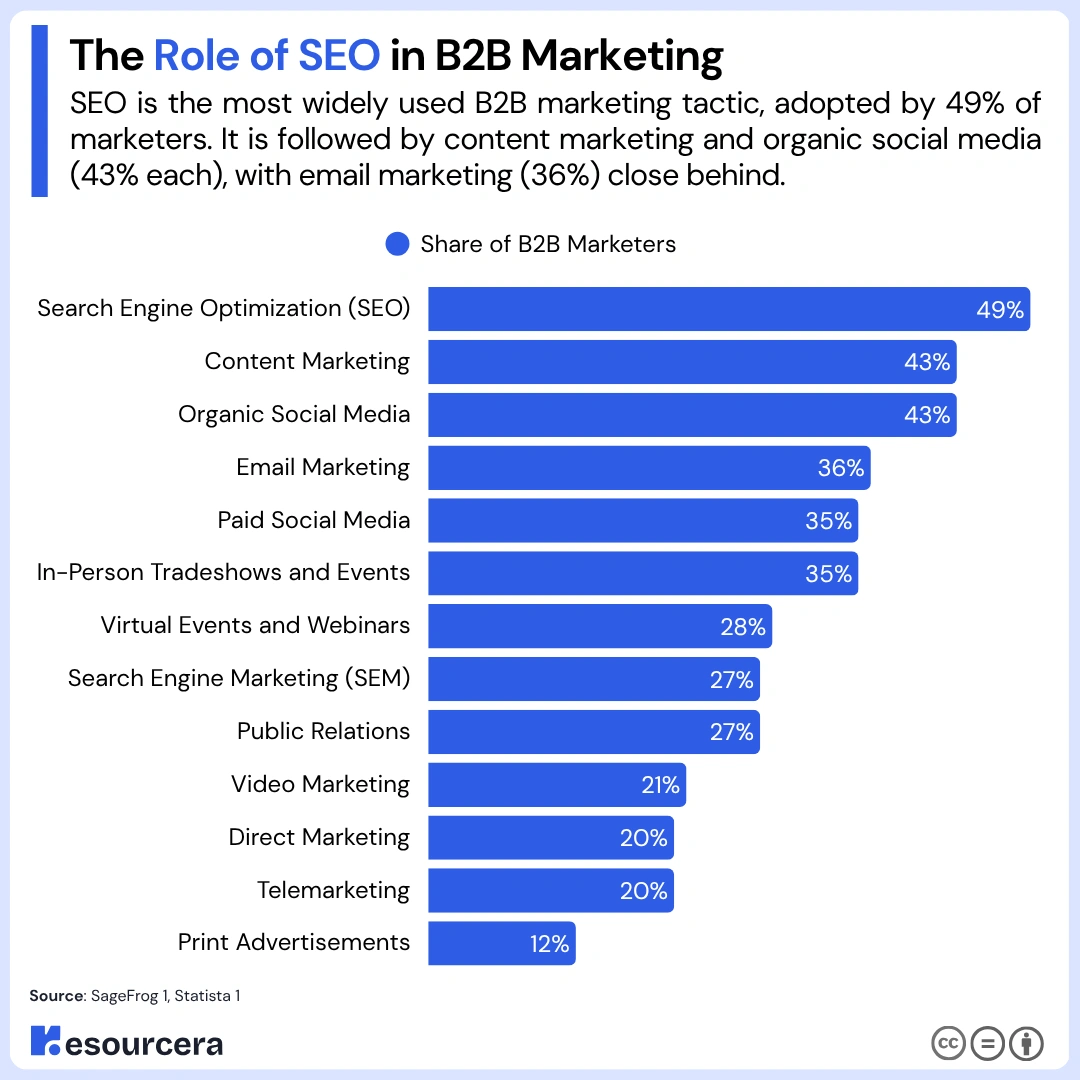
The table below ranks the marketing tactics B2B teams use most.
| Marketing Tactic | Share of B2B Marketers |
|---|---|
| Search Engine Optimization (SEO) | 49% |
| Content Marketing | 43% |
| Organic Social Media | 43% |
| Email Marketing | 36% |
| Paid Social Media | 35% |
| In-Person Tradeshows and Events | 35% |
| Virtual Events and Webinars | 28% |
| Search Engine Marketing (SEM) | 27% |
| Public Relations | 27% |
| Video Marketing | 21% |
| Direct Marketing | 20% |
| Telemarketing | 20% |
| Print Advertisements | 12% |
(Source: SageFrog 1, Statista 1)
How B2B Marketers Rate SEO Against Other Channels
B2B marketers consistently rate organic search among their most effective channels for leads and sales.
In fact, 61% of B2B marketers said SEO and organic traffic generate more leads than any other marketing initiative, and 70% said SEO produces more sales than PPC.
When marketers are asked to name a single top channel, 27% point to organic search, and a separate survey found 30% rank SEO as their most effective channel overall.
That effectiveness compounds when you group organic work together. In the same study where SEO led at 30%, content marketing added another 13% and organic social another 14%, so organic tactics as a whole outperformed paid alternatives on perceived effectiveness.
The pattern is consistent across sources; buyers now self-educate through search, so the channels that meet them there earn the most credit for the pipeline.
(Source: HubSpot, DataBox, Binary Demand, Surfer 1)
B2B Companies Allocate 11% of Marketing Spend to SEO
B2B organizations direct around 11% of their total marketing spend to SEO, which places it ahead of market research at 9% and print advertising at 8%.
That share puts SEO in the same tier as email marketing, and it sits inside a budget still led by marketing technology at 53%.
The figures show that while SEO is not the largest line item, it earns a durable slice of the budget because of the return it produces.
Here is how B2B companies split their marketing budgets across every tracked area.
| Area | Share of Marketing Spend |
|---|---|
| Marketing Technology | 53% |
| Direct Marketing | 36% |
| Content Marketing | 34% |
| Branding | 29% |
| Artificial Intelligence | 22% |
| Tradeshows and Events | 21% |
| Public Relations | 13% |
| Paid Social Media | 12% |
| Chatbots | 12% |
| Email Marketing | 11% |
| Search Engine Optimization | 11% |
| Market Research | 9% |
| Print Advertisements | 8% |
| Search Engine Marketing | 6% |
| Website Development | 6% |
| Virtual Events and Webinars | 5% |
| Account-Based Marketing | 5% |
| Directories and Sponsorships | 4% |
| Video Marketing | 2% |
| Geofencing | 1% |
| SMS Text Messaging | 1% |
(Source: SageFrog 2)
Where B2B Website Traffic Comes From
Search engines are the primary way B2B buyers reach company websites, and clicks cluster heavily at the very top of the results page.
Most B2B site traffic starts with a search, and the highest positions take the overwhelming majority of clicks.
76% of B2B Website Traffic Comes From Search Engines
Search engines drive 76% of all traffic to B2B websites, and unpaid Google results alone account for 53% of website visits.
That makes organic search the single largest doorway into B2B sites by a wide margin. Google is the platform that matters most here, holding 84.9% of the search engine market share among B2B audiences, so ranking well on Google is close to a requirement rather than an option.
The dominance of organic traffic is why B2B teams treat search visibility as foundational. When more than three-quarters of visits arrive through search engines, every ranking gain feeds directly into pipeline, and every lost position hands that traffic to a competitor.
(Source: BrightEdge 1, FirstPageSage 1)
The Top Five Organic Results Capture 67.6% of Clicks
Clicks concentrate sharply at the top of the results page, with the first five organic results capturing 67.6% of all organic clicks.
The top three positions alone take 54.4% of clicks, and 96.98% of clicks happen within the top 10 results, which means anything on page two is close to invisible.
Branded searches also make up 45.7% of all Google queries, so building brand recognition feeds directly back into search demand.
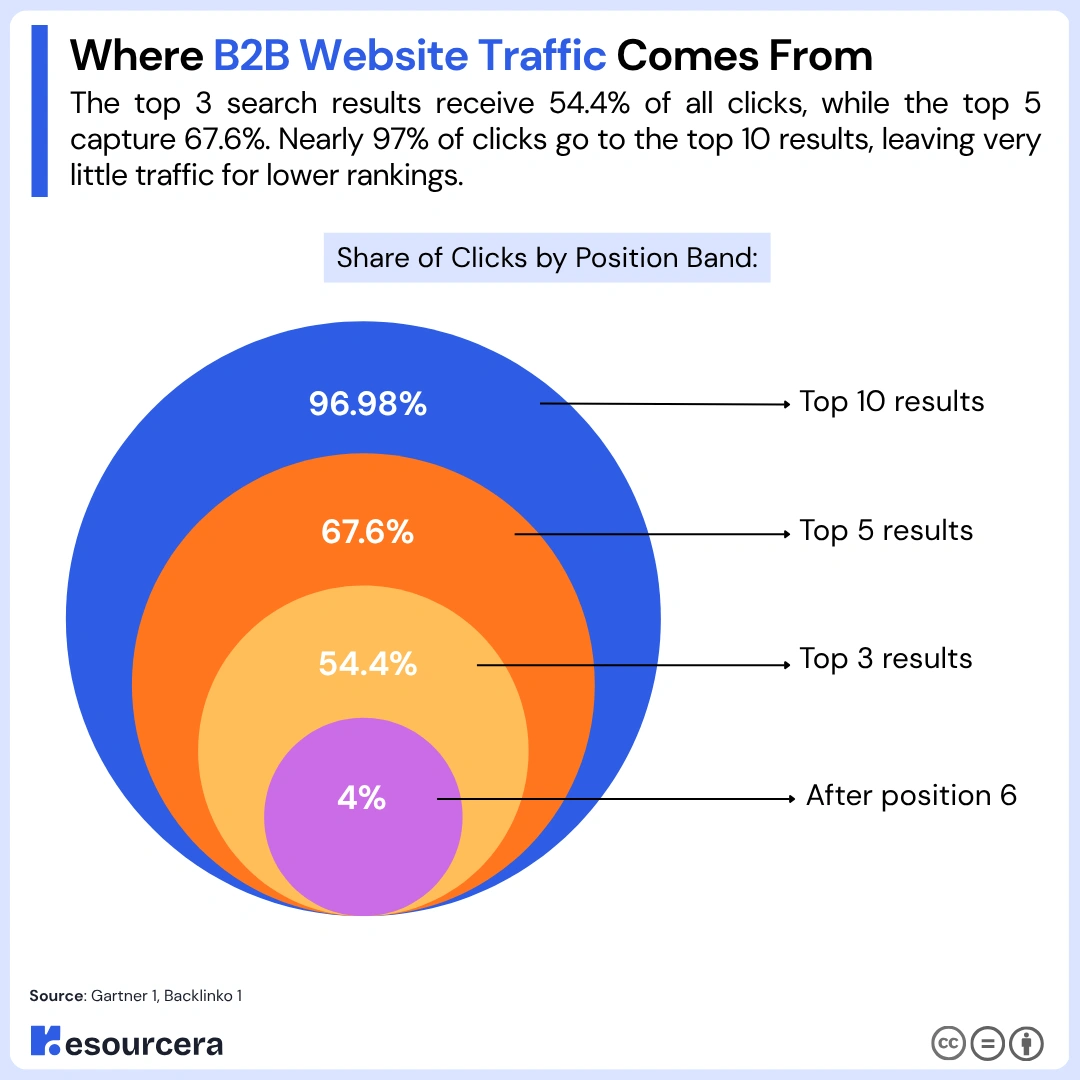
The figures below show how sharply clicks concentrate near the top of the results page.
| Position Band | Share of Clicks |
|---|---|
| Top 3 results | 54.4% |
| Top 5 results | 67.6% |
| Top 10 results | 96.98% |
| After position 6 | 4% |
(Source: Backlinko 1, Ahrefs 1)
How B2B Buyers Search and Make Decisions
B2B buyers now start their journeys online, run most of their research through search and company websites, and take longer to decide than ever.
Search is the first stop for product discovery, the company website is where buyers go to learn, and the buying cycle stretches across many months and many people.
The three subsections below cover discovery, research behavior, and the shape of the modern buying cycle.
66% of B2B Buyers Start Product Discovery With Search
Internet search results are the top channel for B2B product discovery, used by 66% of B2B buyers ahead of online marketplaces at 50% and product catalogs at 43%.
Search is not only the most popular discovery channel, it is also the starting line for the journey, with 67% of B2B buyers beginning their purchase process online.
On top of that, 91% of B2B buyers say they prefer to buy online, which reinforces how much of the journey happens on the open web before any sales contact.
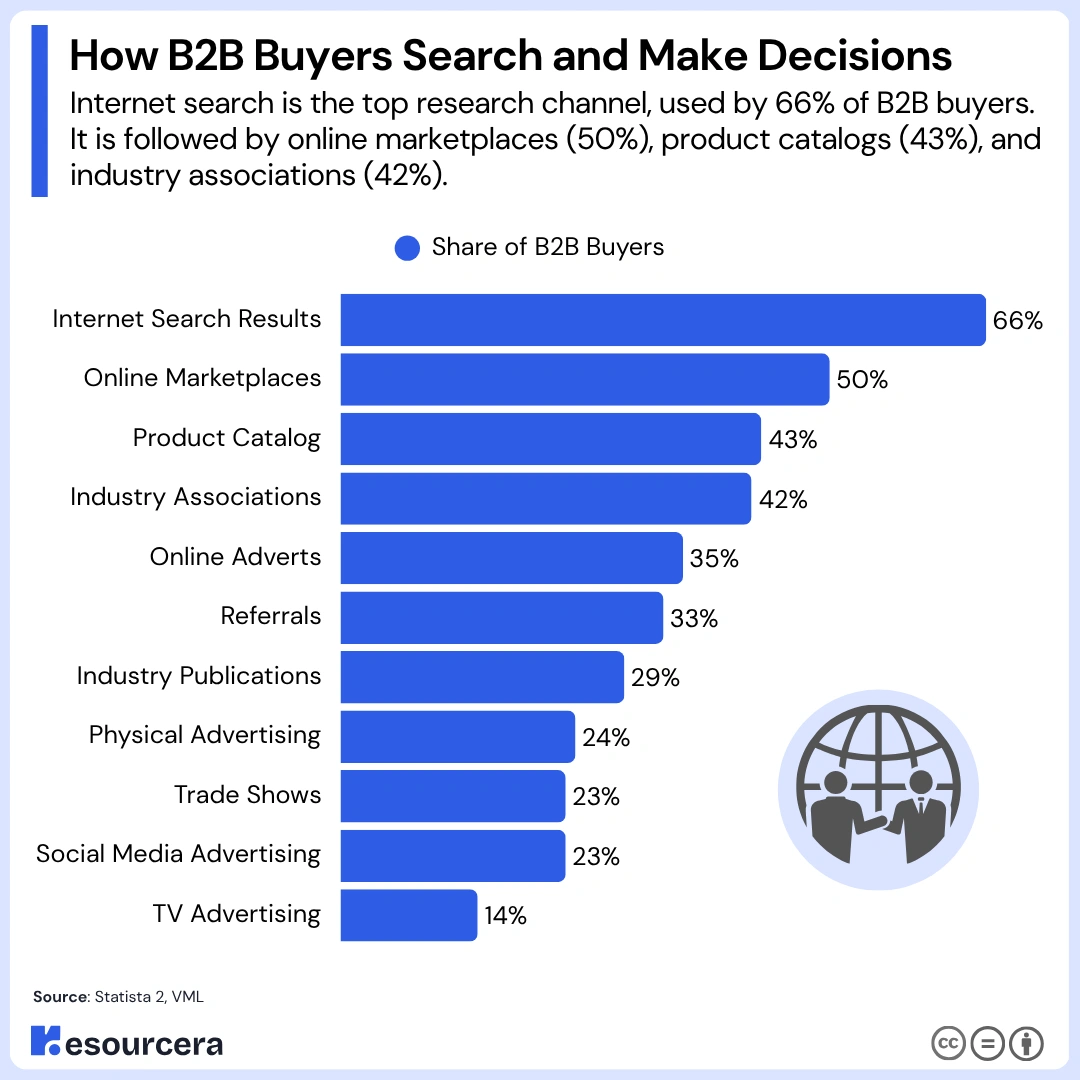
This breakdown shows every channel B2B buyers use to discover products.
| Channel | Share of B2B Buyers |
|---|---|
| Internet Search Results | 66% |
| Online Marketplaces | 50% |
| Product Catalog | 43% |
| Industry Associations | 42% |
| Online Adverts | 35% |
| Referrals | 33% |
| Industry Publications | 29% |
| Physical Advertising | 24% |
| Trade Shows | 23% |
| Social Media Advertising | 23% |
| TV Advertising | 14% |
(Source: Statista 2, VML, Amazon Business)
Where B2B Buyers Go to Research and Buy
Company websites remain the center of gravity for B2B research, with 63% of buyers going straight to a company’s site to find the information they need.
Buyers spend about 27% of their total purchase journey on online research, and 37% say they prefer to make the purchase through a business’s own website. Nearly half of all B2B spending, 49%, now happens online, which shows that the shift is not limited to research and reaches all the way to the transaction.
Content plays a heavy role in that research phase. A B2B audience consumes an average of 4.5 pieces of content before reaching out to a salesperson, and older studies place that range between three and seven pieces.
The takeaway is steady across sources, buyers arrive already educated, so the companies whose content shaped that education hold a clear advantage.
(Source: Isoline 1, Gartner, Statista 3, VML, Demand Gen Report 1)
The Typical B2B Buying Cycle Now Spans 11.5 Months
The B2B buying cycle has grown long and crowded, now spanning 11.5 months on average and involving a buying group of at least 10 to 11 stakeholders.
Buyers also use an average of 10 interaction channels across the journey, double the 5 channels they used in 2016. This means a single deal touches more people, more channels, and more months than it did a few years ago, and content has to serve all of them.
Two other patterns make search visibility even more important. Only 5% of B2B customers are in-market at any given time, so brands need steady presence rather than one-time campaigns, and 81% of buyers already have a preferred vendor before they make first contact.
Shortlists are also shrinking, with 49% of buyers keeping just 1 to 3 products on their shortlist in 2024 compared with 45% who kept 4 to 7 in 2023, and 71% end up choosing their first-choice product.
Early visibility, well before buyers are ready to talk, is what earns a place on that shrinking shortlist.
(Source: 6Sense, McKinsey, LinkedIn, Demand Gen Report 2, G2, TrustRadius, Gartner 2)
B2B Content Marketing and SEO
Content is the engine that powers B2B SEO, and most B2B teams now run it with a documented strategy. Buyers lean on specific formats, and a small set of high-effort content types earns most of the links and authority.
The three subsections below cover content strategy, the formats buyers prefer, and the role of original research, thought leadership, and backlinks.
79% of B2B Marketers Have a Content Marketing Strategy
Content marketing is close to universal in B2B, with 79% of marketers reporting that their organization has a content marketing strategy and 84% using a blog or corporate website to distribute it.
The payoff is clear, as 74% of marketers say content marketing helped them generate more demand and leads, 87% say it built brand awareness, and 49% say it helped generate sales and revenue.
Content marketing also costs 62% less than traditional marketing while producing about three times as many leads.
Even with those results, gaps remain. Around 24% of B2B companies say they do not have a dedicated content marketing team, and 40% name conversion as their biggest content challenge, followed by resource constraints at 39% and measuring effectiveness at 33%.
These pressure points explain why so many teams are turning to AI and outside help to keep output steady.
(Source: Content Marketing Institute, HubSpot)
Content Formats That B2B Buyers Prefer
B2B buyers gravitate toward content they can consume quickly, with 65% preferring short-form formats like blog posts and infographics, while long-form content ranks third in appeal.
Video has become the standout performer, and 55% of B2B buyers consider it the single most helpful content type. On the marketer side, 58% say video delivers the best results, with case studies coming next.
Video’s momentum shows up in the results teams report. Among video marketers, 93% say video marketing gives them a good ROI, 96% say it increased brand awareness, and 84% say it keeps visitors on the page longer, which is a signal search engines reward.
Short-form video is now the most popular content format for business-facing brands, followed closely by images, so B2B SEO strategies increasingly pair written content with video to hold attention and improve rankings.
(Source: Isoline 2, Wyzowl, Content Marketing Institute, HubSpot)
Original Research, Thought Leadership, and Backlinks
Links are hard to earn in B2B, which is exactly why the brands that produce original research and thought leadership pull ahead.
Only 3% of B2B content earns links from multiple websites, and 93% of B2B content earns no external links at all, so most published content never builds authority. The content that breaks that pattern tends to be original research, which drove 42.2% average backlink growth in one study, with 96.9% of research-backed sites gaining more links overall.
Original research also lifts traffic, not just links. B2B SaaS sites that published original research grew organic traffic by 29.7% on average, versus 9.3% for those that did not, which is more than triple the growth.
Other high-effort tactics show similar gains, with industry segmentation driving 28.7% traffic growth versus 4.1% without it, free online tools like ROI or TCO calculators adding 35.6% year-over-year, and publishing nine or more posts a month producing 35.8% growth versus 16.5% for teams posting one to four times.
Thought leadership carries weight deep into the buying decision. Among B2B decision makers, 95% say strong thought leadership makes them more receptive to sales and marketing outreach, 79% are more likely to advocate for proposals from companies that consistently produce it during the RFP process, and 51% say it helps them convince C-level executives to back their choice of vendor.
On the link-building side, teams that favor organic link building report better results 50.6% of the time versus 35.3% for manual outreach, a high-quality guest post runs $692 to $957, and 48.6% of SEOs name digital PR the most effective link tactic.
(Source: Backlinko 2, SiegeMedia, Buzzstream, Editorial.Link)
What B2B SEO Delivers in ROI, Conversions, and Leads
SEO is one of the highest-return activities in B2B, with strong ROI, lower lead costs than paid search, and a large share of revenue and leads.
The numbers hold up across ROI, conversion rates, and channel comparisons. The three subsections below cover SEO returns and lead costs, conversion rates, and organic search as a revenue and lead source.
B2B SaaS SEO Delivers an Average ROI of 702%
In B2B SaaS, SEO returns an average ROI of 702% with a break-even point of just 7 months across a three-year window.
It also costs far less to acquire leads through organic search than through paid, at roughly $147 per lead versus $280 for paid search, which makes organic about 47% cheaper per lead and a difference of $133 on every lead.
That cost gap is why organic search and thought leadership are repeatedly cited as the highest-ROI marketing activities in B2B.
The math compounds over time. Paid search stops delivering the moment spend stops, while a page that ranks keeps producing leads at that lower cost for months or years, which is what pushes the multi-year ROI so high.
(Source: FirstPageSage 2)
B2B SEO Conversion Rates by Industry
B2B SEO conversion rates vary by industry, ranging from 1.1% to 7.4% depending on the sector, with organic search averaging around 5.0% overall.
Organic traffic also converts better than paid display, with one study putting the average organic search conversion rate at 3.75% versus 1.77% for display ads, more than double.
The quality of organic leads shows in close rates too, as leads from search engines close at 14.6% compared with 1.7% for outbound methods like cold calling, which is roughly eight times higher.
These conversion figures matter because they change the economics of the whole funnel. A channel that both costs less per lead and converts those leads at a higher rate carries an outsized share of efficient pipeline, which is exactly what the revenue data in the next section shows.
(Source: FirstPageSage 1, HubSpot, Ruler Analytics, WordStream)
Organic Search Generates 44.6% of B2B Revenue
Organic search generates 44.6% of all revenue in B2B, and B2B companies produce roughly twice as much revenue from SEO as from any other single channel.
When marketers rank channels by revenue impact, 23% name organic search among the most effective, and it remains a core lead source, credited by 19% of B2B marketers as a key sales and marketing lead source.
Search-driven strategies have also been named the top source of qualified leads, accounting for 34% of qualified leads in one survey year.
The ranking below shows which channels B2B marketers credit for driving revenue.
| Channel | Share of B2B Marketers |
|---|---|
| Social Media | 60% |
| Content Marketing | 49% |
| 45% | |
| Display Advertising | 36% |
| Paid Search | 32% |
| Organic Search | 23% |
| Streaming TV (CTV, OTT) | 23% |
SEO also contributes across the funnel, though its weight shifts by goal. The table compares how B2B marketers rate each tactic for top-of-funnel and bottom-of-funnel goals.
| Tactic | Top-of-Funnel Share | Bottom-of-Funnel Share |
|---|---|---|
| Social Media | 50% | 46% |
| 43% | 40% | |
| In-Person / Live Events | 34% | 30% |
| Video | 30% | 27% |
| Interactive Content | 30% | 26% |
| Influencer Marketing | 30% | 25% |
| Paid Search | 28% | 30% |
| Site Content | 26% | 21% |
| Direct Mail | 24% | 28% |
| Virtual Events | 23% | 23% |
| Account-Based Marketing | 22% | 22% |
| SEO | 19% | 17% |
| Podcasts | 16% | 18% |
| Converged TV | 11% | 14% |
Lead sourcing tells a similar story, with organic search holding a steady mid-table position behind event-driven and direct channels. Here is the full list of lead sources B2B marketers rank by contribution.
| Lead Source | Share of B2B Marketers |
|---|---|
| In-Person Tradeshows and Events | 45% |
| Virtual Events and Webinars | 35% |
| Direct Marketing | 29% |
| Email Marketing | 29% |
| Directories and Sponsorships | 25% |
| Paid Social Media | 20% |
| Print Advertisements | 20% |
| Referrals | 20% |
| Search Engine Marketing | 20% |
| Organic Search | 19% |
| Networking | 12% |
| Public Relations | 12% |
| Account-Based Marketing | 9% |
| Telemarketing | 3% |
(Source: BrightEdge 2, Wpromote, SageFrog 2)
Technical SEO and Mobile Performance in B2B
Technical health and mobile experience are the foundation that lets B2B content rank and convert, yet both are widely underinvested.
More than half of SEO professionals say technical SEO is undervalued, and many B2B teams lack the in-house skills to manage it. The figures below cover technical readiness signals and the growing weight of mobile in the B2B journey.
On the technical side, 55.6% of SEO professionals say technical SEO is often undervalued, and 40% of B2B companies say they lack the internal expertise to manage it.
Adoption of foundational elements is uneven, as 78% of websites use some form of schema or structured data, while only around 40% of websites pass all Core Web Vitals thresholds.
Site speed carries the most immediate weight, with mobile pages that load one second faster earning 20% more conversions.
The signals below capture where sites stand on technical SEO health.
| Technical Signal | Figure |
|---|---|
| SEO pros who say technical SEO is undervalued | 55.6% |
| B2B companies lacking internal technical SEO expertise | 40% |
| Websites using schema or structured data | 78% |
| Websites passing all Core Web Vitals | 40% |
Mobile has become central to the B2B experience, not just a B2C concern. Around 80% of B2B buyers use mobile at work, and more than 60% say mobile played a significant role in a recent purchase.
Buyers feel the gaps, with 71% wishing they had a better mobile experience and 29% saying mobile ordering is an area B2B websites need to improve.
Older research reinforces the trend, showing that over 90% of B2B users would buy again from a vendor after a superior mobile experience, while only 50% would return after a poor one, and that mobile interactions already drove more than 40% of revenue in surveyed B2B organizations.
(Source: TripleDart, Statista 4, W3Techs, Think With Google)
How AI Is Reshaping B2B Search
AI has moved from experiment to standard practice in B2B, changing how teams create content and how buyers find answers.
Most B2B marketers now use AI tools, AI Overviews are pulling clicks away from websites, and AI engines still lean heavily on traditional organic rankings to decide what to cite.
The three subsections below cover AI adoption, the impact of AI Overviews on clicks, and how AI search selects the content it cites.
81% of B2B Marketers Now Use AI Tools
AI adoption in B2B has climbed to 81% of marketers using AI tools, up from 72% the year before, a jump of 9 percentage points in a single year.
Content creation leads the way, with 87% of marketers using AI to help create content, and blog posts are the most common AI-generated format at 87%, followed by brainstorming at 76%, outlining at 73%, and content updates at 67%.
The efficiency gains are real, as marketers using AI publish 42% more content, with a median of 17 articles a month versus 12 for those not using it.
The economics push adoption further. AI content is about 4.7 times cheaper to produce than human-written content, companies spend an average of $188 per month on AI tools for content, and 51% plan to increase their spend on AI-generated content.
Over 70% of marketers say AI helped them produce more, faster, without expanding headcount, which is why more than half of B2B marketers now prioritize AI-powered automation and top uses have settled into content creation at 35%, data analysis at 30%, and workflow automation at 20%.
(Source: Content Marketing Institute, Ahrefs 2, Surfer, HubSpot, SiegeMedia)
AI Overviews Reduce Clicks to Websites by 34.5%
AI Overviews are reshaping the results page, and they reduce clicks to websites by 34.5% when they appear.
They now show up on an estimated 13% to 15% of searches and keep expanding, so their pull on clicks is growing. Visibility inside them is uneven, as 26% of brands have zero mentions in AI Overviews, and the top 50 brands account for 28.9% of all citations, which concentrates AI visibility among a small group.
Even so, traditional search still dwarfs AI as a traffic source. Google sends 345 times more traffic to websites than ChatGPT, Gemini, and Perplexity combined, and among AI referrers, ChatGPT alone accounts for over 80% of AI traffic and has grown 85% since January.
Marketers are cautiously optimistic overall, as three of four believe AI-powered search engines will help their blogs and 68% expect more traffic because of it, while 30% worry AI will hurt organic traffic over the next five years.
(Source: Ahrefs 3, SeoProfy, HubSpot)
76% of AI Citations Come From the Top 10 Organic Results
AI search still rewards strong traditional SEO, with 76% of AI Overview citations pulled from pages that already rank in Google’s top 10 organic results.
That overlap means the same work that earns high rankings also earns AI visibility, though AI adds its own preferences, favoring content that is 25.7% fresher than what traditional organic results cite. There is also a gap worth noting, as 28% of ChatGPT’s most-cited pages have zero organic visibility in Google, which shows AI does not copy Google exactly.
One finding challenges older assumptions. An analysis of 5 million AI citations found that domain authority, a third-party metric rather than a Google ranking factor, did not predict which pages AI engines cited, pointing instead to relevance and freshness.
For B2B teams, the practical read is to keep ranking in the top 10, keep content current, and stop leaning on authority scores as a proxy for AI visibility.
(Source: Ahrefs 4, Ahrefs 5, Ahrefs 6, Surfer 2)
Final Thoughts
Organic search remains a major driver of B2B growth, even as AI changes how search results appear. Buyers use search throughout long research cycles, while SEO delivers strong returns, high-quality leads, and an estimated 44.6% of B2B revenue.
B2B marketers are responding by increasing investment. Around 88% plan to maintain or raise search budgets, while more teams are spending on content, video, thought leadership, and AI-supported optimization.
The best approach for 2026 is to treat SEO and AI visibility as part of the same strategy. Pages that rank highly are also more likely to be cited by AI tools.
Companies that invest in original research, useful content, technical SEO, and a strong mobile experience will be better positioned wherever buyers search.

