

Google first introduced AI Overviews in the United States in May 2024 and globally in October 2024. Since then, AI Overviews have crossed 2 billion monthly active users across 200 countries and territories.
AI Overviews get triggered in over 55% Google searches, meaning over 4.7 billion search queries get an AI overview everyday! Additionally, about one in three AI Overviews responses are concise, typically falling within the 150 to 200-word range. However, search queries that include AI Overviews have seen organic CTR drop by 61% since mid-2024.
Although it’s a hit for organic results, the user intent is getting solved easily with this approach. Let’s understand this amazing feature through statistics in this post.
Key AI Overview Statistics 2026: (Editor’s Pick)
- Google’s AI Overviews now show up in over 55% of total search results.
- Wikipedia and .gov sites each account for 6% of the sources used in AI-generated summaries.
- AI Overviews usually cite a moderate range of sources, typically between 8 and 11.
- AI Overviews havereduced organic CTR by 61% since mid-2024.
- Google AI Overviews are the shortest, ChatGPT longest, while Perplexity offers a balanced middle ground.
How frequently do AI Overviews appear in search results?
- Google’s AI Overviews appear in more than 55% of all Google searches, meaning that over half of users see AI-generated summaries before traditional results. As of 2026, 8.5 billion searches are processed by Google every day, which means over 4.7 billion searches get an AIO.
- AI Overviews recorded a 116% growth in visibility across Google Search since the latest core updates. This drastic rise indicates a significant shift in how users search for information and how content gains visibility.
- Recent reports suggest that AI Overviews account for around 21% of the analyzed 146 million keywords.
- AI Overviews now show up for 16% to 21% of U.S. desktop searches. The figure has been fluctuating throughout 2025, hitting a high of about 25% mid-year before gradually stabilising at current levels.
- AI Overviews appear less for short searches, appearing in only 9.5% of single-word queries, but become far more common in longer searches, with 46.4% of seven-plus-word queries triggering them.
Sources: Ahrefs, SEO Statistics
AI Overviews Global Traffic Share Statistics
- About 58% of U.S. adults said they did at least one Google search that led to an AI-generated summary, showing these responses are now a common part of search.
- Users who saw an AI-generated summary in Google search clicked a traditional result link in just 8% of visits. While users who didn’t encounter an AI summary clicked on a search result about 15% of the time.
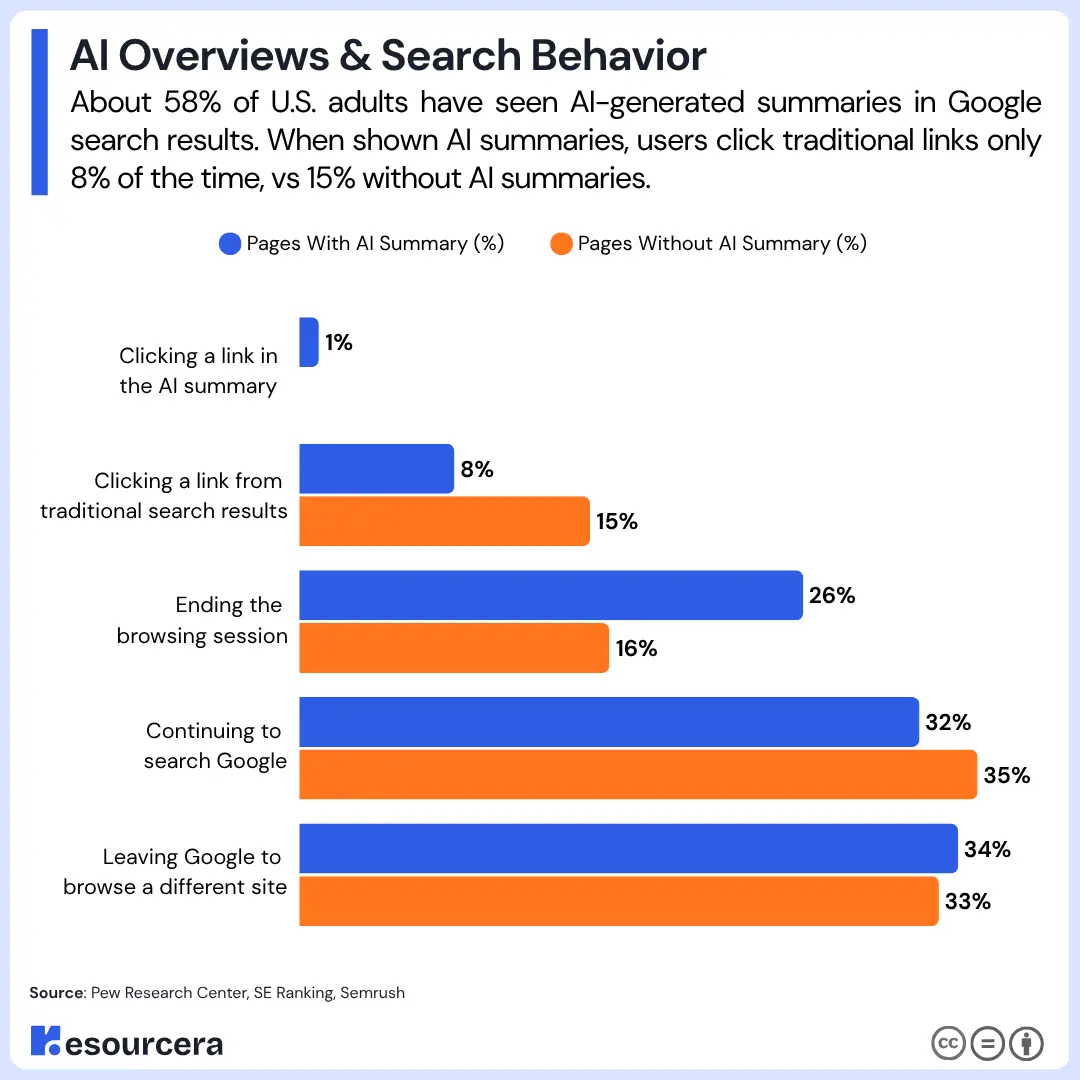
The table below shows users’ behavior while doing Google ai searches:
| User Action After Search | Pages With AI Summary (%) | Pages Without AI Summary (%) |
|---|---|---|
| Clicking a link in the AI summary | 1 | – |
| Clicking a link from traditional search results | 8 | 15 |
| Ending the browsing session | 26 | 16 |
| Continuing to search Google | 32 | 35 |
| Leaving Google to browse a different site | 34 | 33 |
- Users are more likely to exit their browsing session altogether after viewing a results page with an AI summary. About 26% of searches with AI summaries ended the session, compared to 16% of searches that displayed only standard search results.
- AI summaries prioritise authoritative sources, with Wikipedia and .gov sites each appearing in 6% of AI summary links, compared to 3% and 2% in standard results. Meanwhile, YouTube visibility drops from 8% to 4%, signalling a credibility-first approach.
Here is the table to showcase the details of the share of links in Google search results:
| Source Type | AI Summary (%) | Standard Search Results (%) |
|---|---|---|
| Wikipedia | 6 | 3 |
| Government (.gov) websites | 6 | 2 |
| 5 | 6 | |
| News websites | 5 | 5 |
| YouTube | 4 | 8 |
- AI summaries appeared in about 18% of Google searches. Almost all included multiple citations, with 88% referencing three or more sources, and only 1% relying on just one source.
- About 60% of queries starting with question words like “who,” “what,” “when,” or “why” triggered an AI summary. Meanwhile, 36% of searches phrased as full sentences with both a noun and a verb led to an AI summary.
Google AI Overviews Statistics USA
Across 5 U.S. locations, around 30% of searches generated an AI response, with only minor variation, typically ranging between 27% and 28%.
The table below shows the appearance rate of AI Overview across the US states:
| City & State | AI Overviews Appearance Rate (%) |
|---|---|
| Houston, Texas | 28.66% |
| Denver, Colorado | 28.49% |
| Washington, DC | 28.32% |
| Los Angeles, California | 28.28% |
| New York, New York | 27.75% |
- AI Overviews are most common in Relationships (60% to 62%), Business (56% to 58%), and Education (49% to 52%) queries. Whereas their presence is minimal in Fashion & Beauty (1% to 1.5%) and E-commerce (2% to 2.5%), reflecting clear differences by search intent.
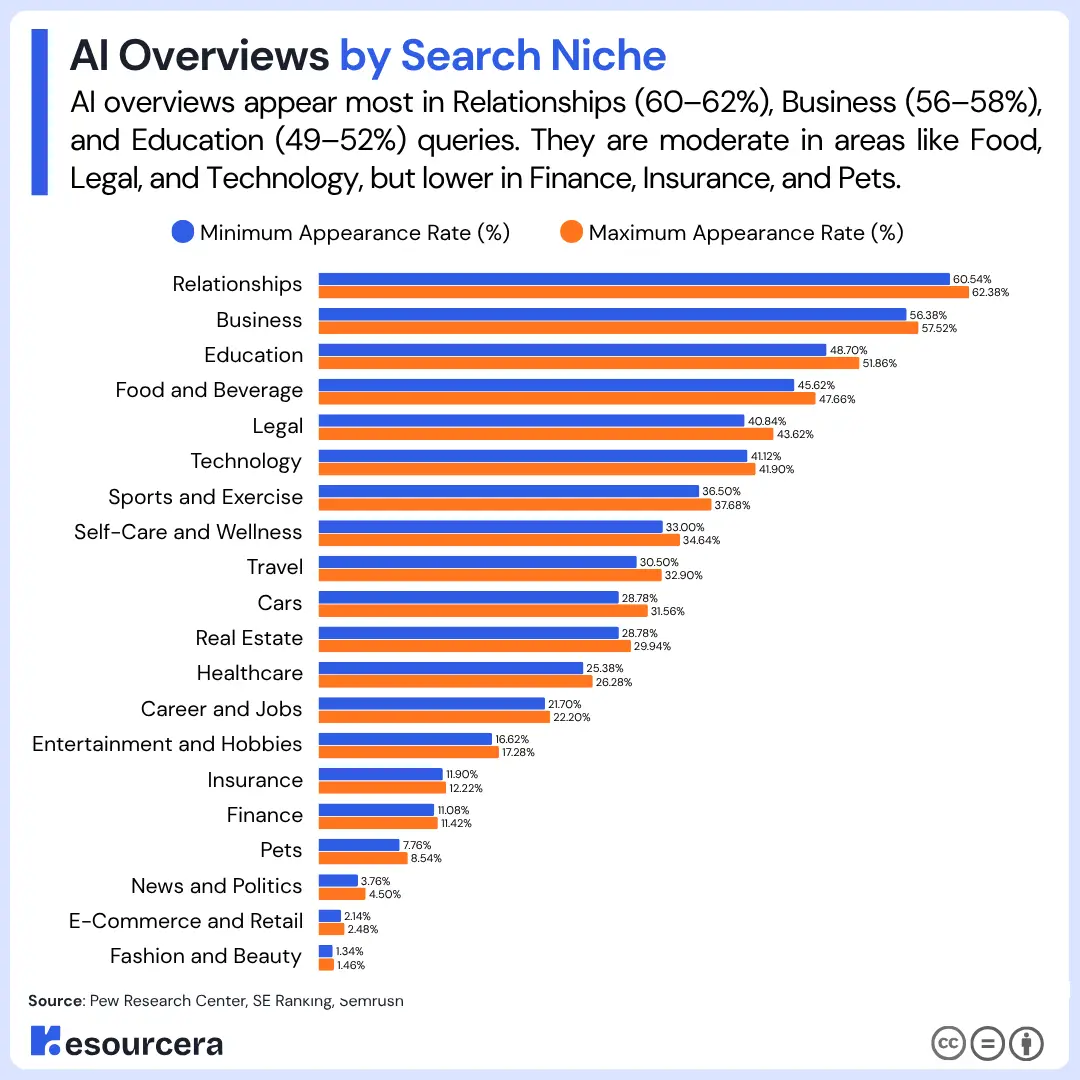
The table showcases the AI Overviews’ appearance rates across different niches:
| Niche | Minimum Appearance Rate (%) | Maximum Appearance Rate (%) |
|---|---|---|
| Relationships | 60.54% | 62.38% |
| Business | 56.38% | 57.52% |
| Education | 48.70% | 51.86% |
| Food and Beverage | 45.62% | 47.66% |
| Legal | 40.84% | 43.62% |
| Technology | 41.12% | 41.90% |
| Sports and Exercise | 36.50% | 37.68% |
| Self-Care and Wellness | 33.00% | 34.64% |
| Travel | 30.50% | 32.90% |
| Cars | 28.78% | 31.56% |
| Real Estate | 28.78% | 29.94% |
| Healthcare | 25.38% | 26.28% |
| Career and Jobs | 21.70% | 22.20% |
| Entertainment and Hobbies | 16.62% | 17.28% |
| Insurance | 11.90% | 12.22% |
| Finance | 11.08% | 11.42% |
| Pets | 7.76% | 8.54% |
| News and Politics | 3.76% | 4.50% |
| E-Commerce and Retail | 2.14% | 2.48% |
| Fashion and Beauty | 1.34% | 1.46% |
- AI Overviews generally include around 13 cited sources per response across major U.S. locations. Los Angeles records the highest average at 13.41 references, while Washington, DC, and New York rank fourth and fifth at 13.28, indicating only marginal differences by region.
Here is a deep analysis of AI Overviews citations across different US locations:
| City & State | Average Number of Sources Cited |
|---|---|
| Los Angeles, California | 13.41 |
| Houston, Texas | 13.38 |
| Denver, Colorado | 13.37 |
| Washington, DC | 13.28 |
| New York, New York | 13.28 |
Average Word Count Distribution of AI Overviews
AI Overviews generally stay brief, with 33% of responses falling between 150 and 200 words. Very short summaries under 100 words make up only 16%, while content exceeding 300 words is uncommon at 4%, reflecting Google’s focus on succinct answers.
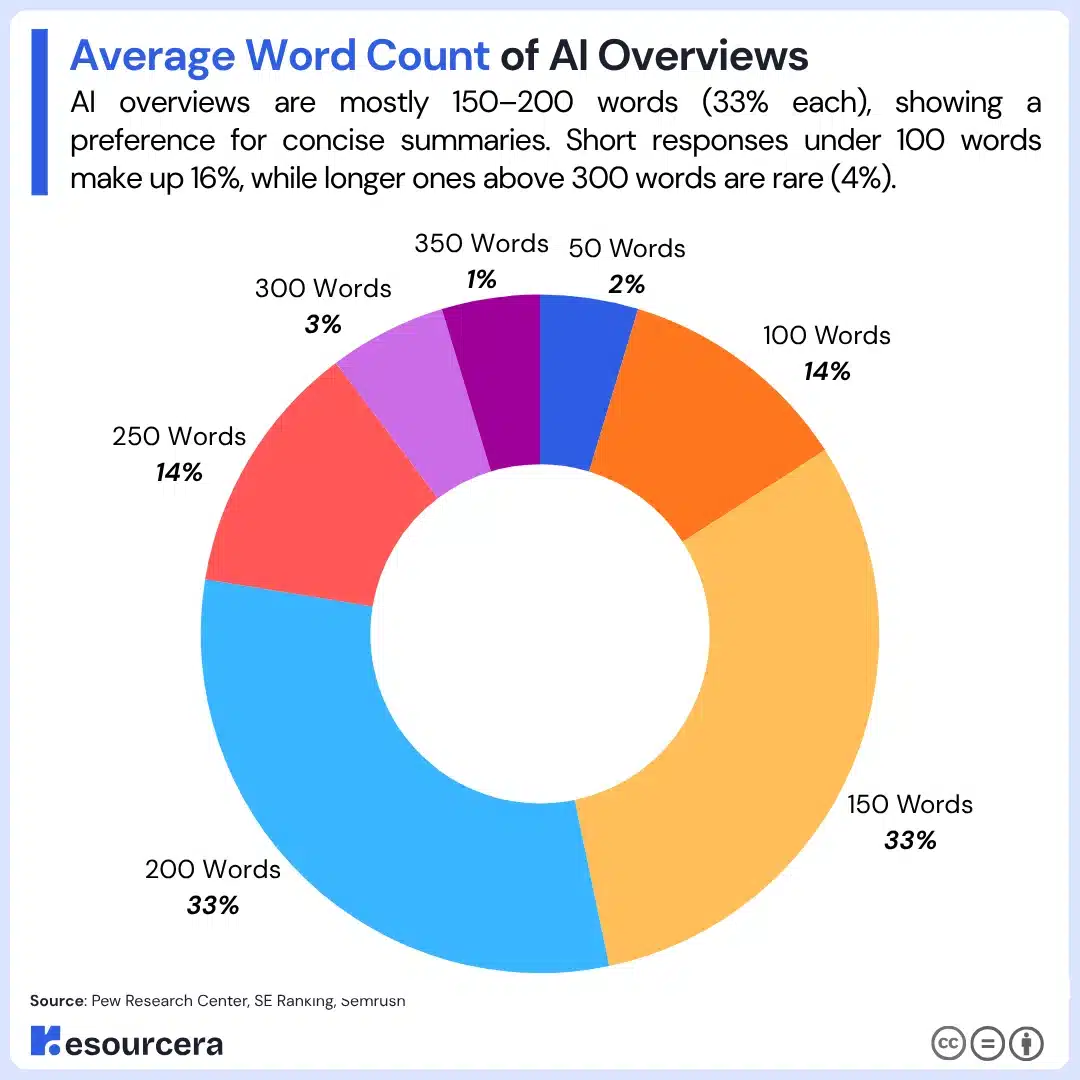
The table shows a detailed analysis of the average word count of AI Overviews:
| Word Count Range | Share of AI Overviews (%) |
|---|---|
| 50 words | 2% |
| 100 words | 14% |
| 150 words | 33% |
| 200 words | 33% |
| 250 words | 14% |
| 300 words | 3% |
| 350 words | 1% |
Sources: SE Ranking, Semrush
Google AI-Driven Search Ranking Statistics
Wikipedia, YouTube, and Reddit are the most commonly referenced platforms in both AI summaries and regular search results. Together, they represent 15% of links in AI-generated summaries and around 17% in traditional search results, highlighting consistent source usage across formats.
Wikipedia and .gov sites feature in 6% of AI summary citations, roughly twice their presence in standard search results, 3% and 2%, respectively. In comparison, YouTube’s share falls from 8% to 4%, reflecting AI summaries favour more authoritative sources.
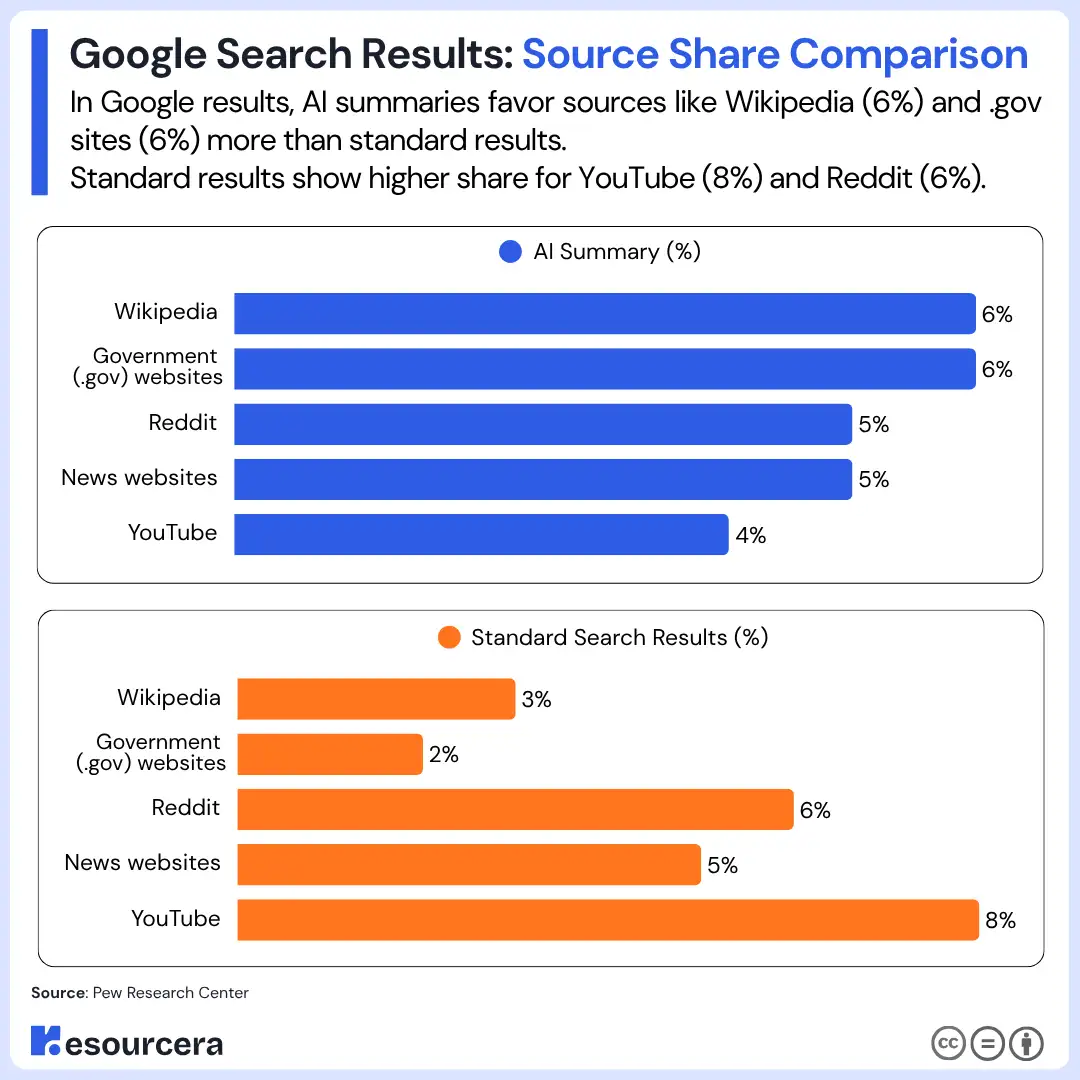
Here is the table to showcase the share of links in Google AI search results:
| Source Type | AI Summary (%) | Standard Search Results (%) |
|---|---|---|
| Wikipedia | 6% | 3% |
| Government (.gov) websites | 6% | 2% |
| 5% | 6% | |
| News websites | 5% | 5% |
| YouTube | 4% | 8% |
Sources: Pew Research Center
Average Number of Links in an AI Overview Result
AI Overviews typically contain a moderate number of citations, usually ranging from 8 to 11 sources. The most common occurrence is 9 sources, making up 6.55% of cases, followed closely by 8 sources at 6.47% and 10 sources at 6.27%. In comparison, very short or extremely long citation lists are much less common.
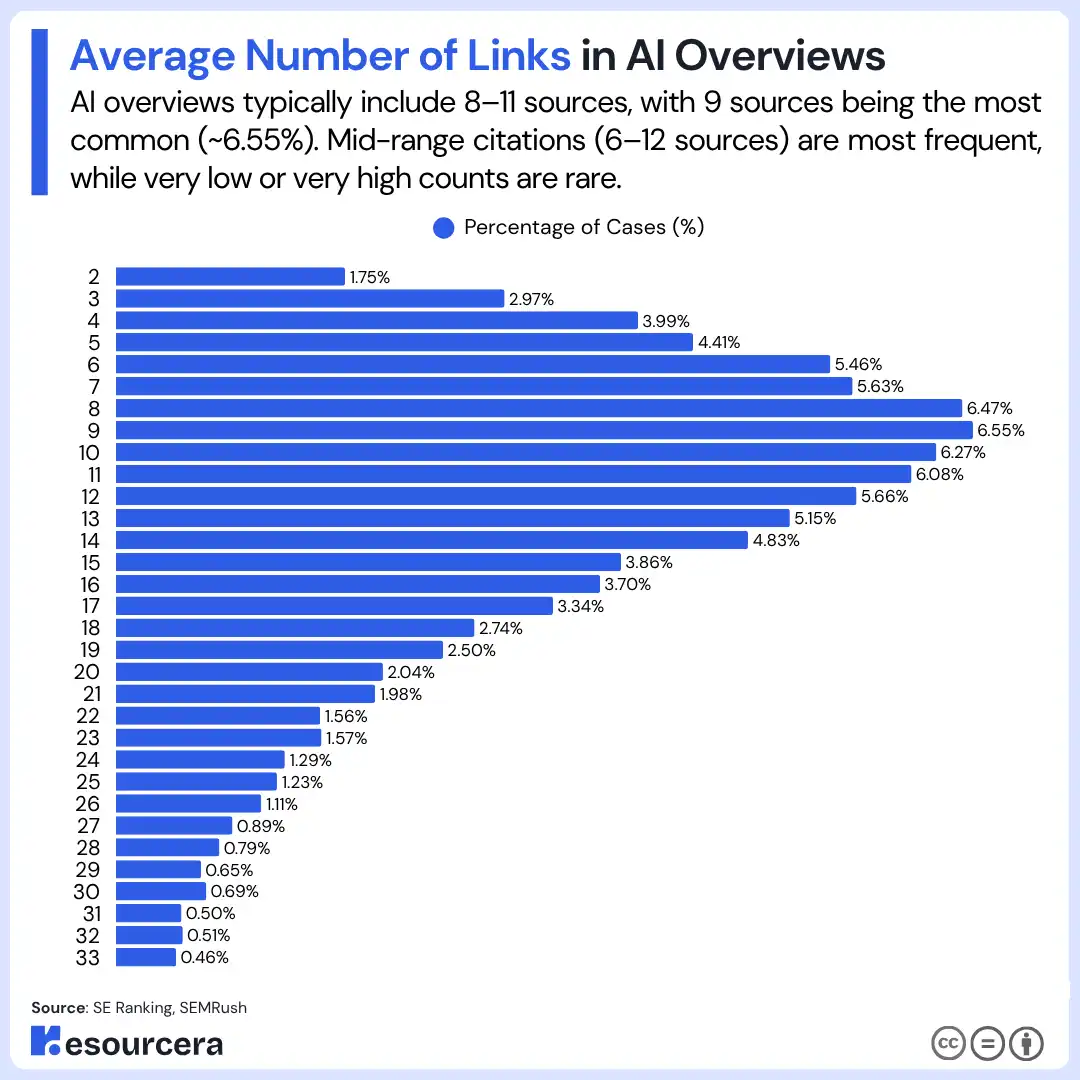
The table below shows how many sources AI Overviews typically cite:
| Number of Sources | Percentage of Cases (%) |
|---|---|
| 2 | 1.75% |
| 3 | 2.97% |
| 4 | 3.99% |
| 5 | 4.41% |
| 6 | 5.46% |
| 7 | 5.63% |
| 8 | 6.47% |
| 9 | 6.55% |
| 10 | 6.27% |
| 11 | 6.08% |
| 12 | 5.66% |
| 13 | 5.15% |
| 14 | 4.83% |
| 15 | 3.86% |
| 16 | 3.70% |
| 17 | 3.34% |
| 18 | 2.74% |
| 19 | 2.50% |
| 20 | 2.04% |
| 21 | 1.98% |
| 22 | 1.56% |
| 23 | 1.57% |
| 24 | 1.29% |
| 25 | 1.23% |
| 26 | 1.11% |
| 27 | 0.89% |
| 28 | 0.79% |
| 29 | 0.65% |
| 30 | 0.69% |
| 31 | 0.50% |
| 32 | 0.51% |
| 33 | 0.46% |
From March to October 2025, AI Overview SERPs showed clear changes. People Also Ask declined from 99.55% to 90.03%, while Organic Sitelinks increased from 67.10% to 77.67%. Related Searches remained widespread, dipping slightly from 99.04% to 95.32%.
Here is the table to showcase the top SERP features on AI Overview pages:
| SERP Feature | March 2025 (%) | October 2025 (%) |
|---|---|---|
| People Also Ask | 99.55% | 90.03% |
| Related / Related Searches | 99.04% | 95.32% |
| Organic Sitelinks | 67.10% | 77.67% |
| Organic Video | 89.85% | — |
| Video Carousel | — | 43.46% |
| Image Carousels | 39.84% | 17.74% |
| Organic Image | 33.92% | 19.29% |
| Featured Snippet | 32.53% | — |
| Discussions & Forums | 29.95% | 20.03% |
| Google Ads (Top/Middle/Bottom) | — | 12.76% to 25.01% |
Sources: SE Ranking, Semrush
Industries with the Highest Share of AI Overviews
AI Overviews were most common in Life Sciences (40%), Education Services (39%), and Healthcare Equipment (37%). While Knowledge-driven sectors lead in visibility, more execution-focused industries, such as Construction and Food Products, trail behind at 17% each.
The table below shows the share of AI Overviews’ appearance by industries:
| Industry | Keywords Generating AI Overviews (%) |
|---|---|
| Life Sciences Tools & Services | 40% |
| Education Services | 39% |
| Healthcare Equipment & Supplies | 37% |
| Biotechnology | 37% |
| Cruise Vacations | 34% |
| Pharmaceuticals | 34% |
| Internet Software & Services | 30% |
| Healthcare Providers & Services | 26% |
| Renewable Electricity | 24% |
| B2B SaaS | 24% |
| Skincare & Beauty | 22% |
| Communications Equipment | 22% |
| Telecommunication Services | 21% |
| Chemicals | 21% |
| Gas & Electric Utilities | 19% |
| Media & Publishing | 19% |
| Transportation | 18% |
| B2B Professional Services | 18% |
| Construction & Engineering | 17% |
| Food Products | 17% |
Source: Conductor.com
Effect of AI Overview on e-commerce
- Over 78% of companies in 2025 use generative AI in at least one business area, up from 55% the previous year, allowing e-commerce businesses to innovate faster.
- Over 50% of consumers in the United States report using AI-powered tools such as ChatGPT or Gemini to search for online information and make shopping decisions.
- Nearly 95% of e-commerce brands have adopted AI tools. They reported solid returns, highlighting how AI-driven solutions are helping boost both revenue growth and operational efficiency.
- AI delivers more personalized experiences, which boosts brand visibility and builds stronger customer relationships, leading to retention improvements of around 30%.
- AI tools not only assist sales but also streamline support, logistics, and decision-making, enhancing overall e-commerce performance.
The table showcases the effect of AI Overviews on the e-commerce industry:
| Impact Area | Statistical Insight |
|---|---|
| Generative AI adoption | 78% of companies use it |
| Previous year adoption | 55% |
| Consumer AI usage for shopping | Over 50% of U.S. consumers |
| E-commerce brands with positive ROI | 95% |
| Improved customer retention | Up to 30% increase |
Source: BigCommerce, AI SEO
Do Google’s AI Overviews impact CTR?
- Search queries with AI Overviews experienced a 61% decline in organic click-through rate (CTR) since mid-2024, indicating a significant decrease in user engagement with standard organic listings.
- Paid search performance dropped even more sharply, with click-through rates declining by 68% for queries that trigger AI Overviews.
- Even in searches where an AI Overview isn’t shown, organic click-through rates have fallen by around 41%, reflecting a broader shift in how users engage with search results.
- Independent studies indicate that the top-ranked organic listing can see a sharp drop in CTRs, often dropping from around 28% to 19%. This reflects the broader decline in clicks linked to the presence of AI Overviews.
Source: Search Engine Land
Google AI Overview vs ChatGPT vs Perplexity
- In the United States, Google’s AI Overviews appear in about 60% of searches. This shows they’re triggered selectively based on query intent and relevance, rather than appearing in every search.
- ChatGPT responds to almost every prompt, as it’s built to generate answers by default rather than filtering or suppressing queries, unlike traditional search systems.
- Google’s AI Overviews keep responses brief at around 191 words, while ChatGPT delivers more detailed, conversational answers averaging about 318 words. In comparison, Perplexity sits between the two at roughly 257 words, balancing depth with readability.
- ChatGPT responses cover the most citations, averaging 10.42 links per answer, while Google AI Overviews reference slightly fewer at 9.26 links, reflecting a lower overall volume of outbound sources.
- ChatGPT shows slightly more neutral language, with a subjectivity score of 0.44, compared to 0.48 for Google AI Overviews, indicating a modest difference in tone.
- ChatGPT shows the highest repetition, with about 71% domain duplication, compared to 58% in Google AI Overviews. In comparison, Perplexity stands out for source diversity, recording a lower duplication rate of 25%, indicating broader and more varied citations.
- Google AI Overviews primarily reference community and expert-driven platforms such as Reddit (21%) and YouTube (18.8%). ChatGPT draws nearly half of its citations from Wikipedia (47.9%), whereas Perplexity depends largely on Reddit (46.7%), highlighting contrasting sourcing approaches.
Here is the table to show a detailed analysis of citation patterns for Google AI Overviews vs ChatGPT vs Perplexity:
| Google AI Overviews | ChatGPT | Perplexity |
|---|---|---|
| Reddit (21%) | Wikipedia (47.9%) | Reddit (46.7%) |
| YouTube (18.8%) | Reddit (11.3%) | YouTube (13.9%) |
| Quora (14.3%) | YouTube (11.30%) | Gartner (7%) |
| LinkedIn (13%) | TikTok (<1%) | Yelp (5.8%) |
| Gartner (7.1%) | Other sources, including Forbes, G2, TechRadar | Moodle (4.08%) |
Source: SE Ranking

