

AI had been part of SEO long before, but its impact expanded rapidly after it went mainstream with the launch of ChatGPT in 2022. As a result, 86% of SEO professionals now use AI in their workflows, 84% of marketers depend on it to align content with search intent, and 61% consider AI a core strategic asset.
Today, core SEO platforms such as Semrush and Ahrefs have deeply integrated AI into their dashboards, changing how website metrics are analyzed and presented. AI-driven insights and citations are now among the most significant updates, helping users understand performance with more context and clarity.
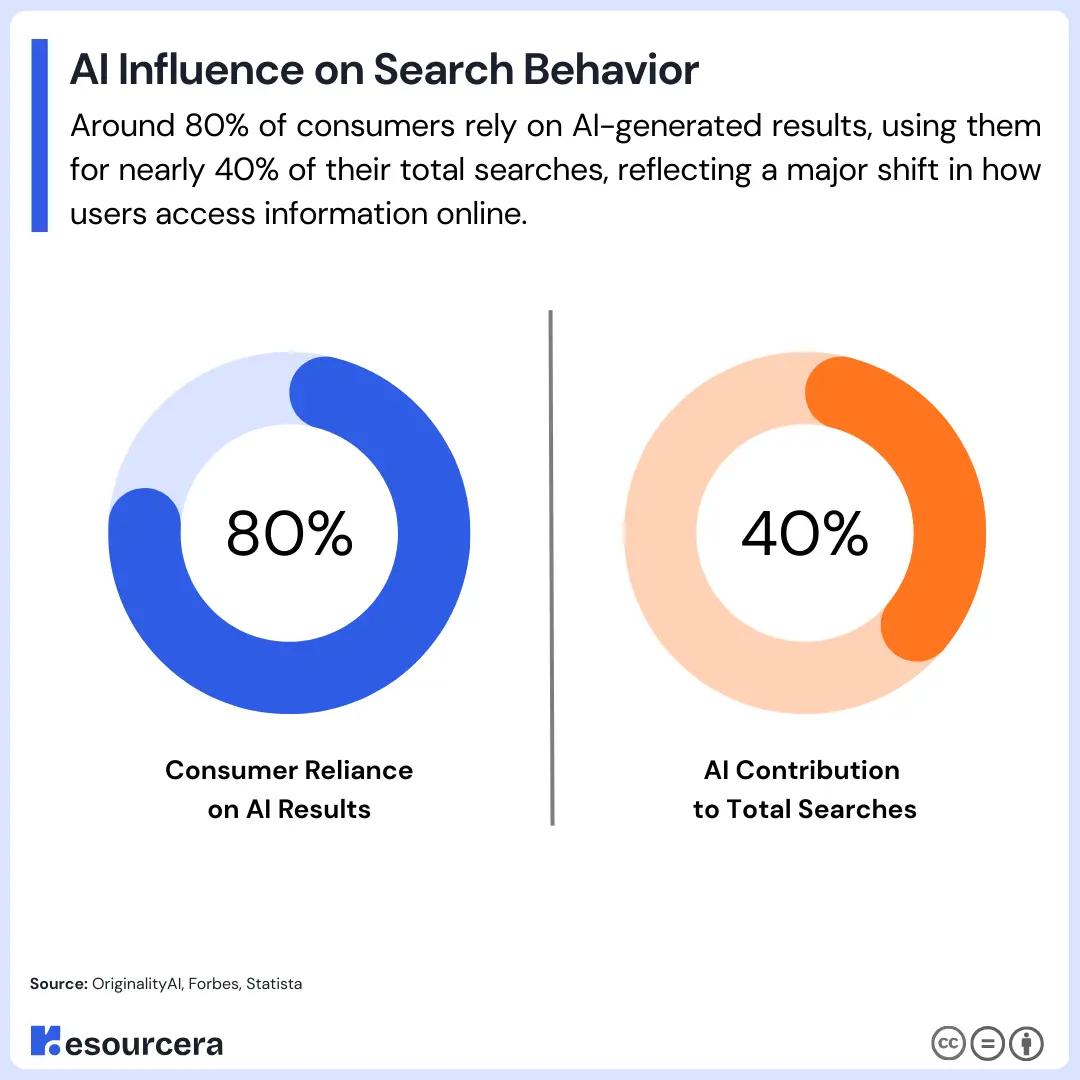
On the user side, behavior is changing just as fast, with 80% of consumers depending on AI-written results for nearly 40% of their searches.
In this post, we break down the key AI SEO statistics that explain how search behavior, traffic distribution, and ranking opportunities are changing in an AI-first world.
Top AI SEO Statistics for 2026
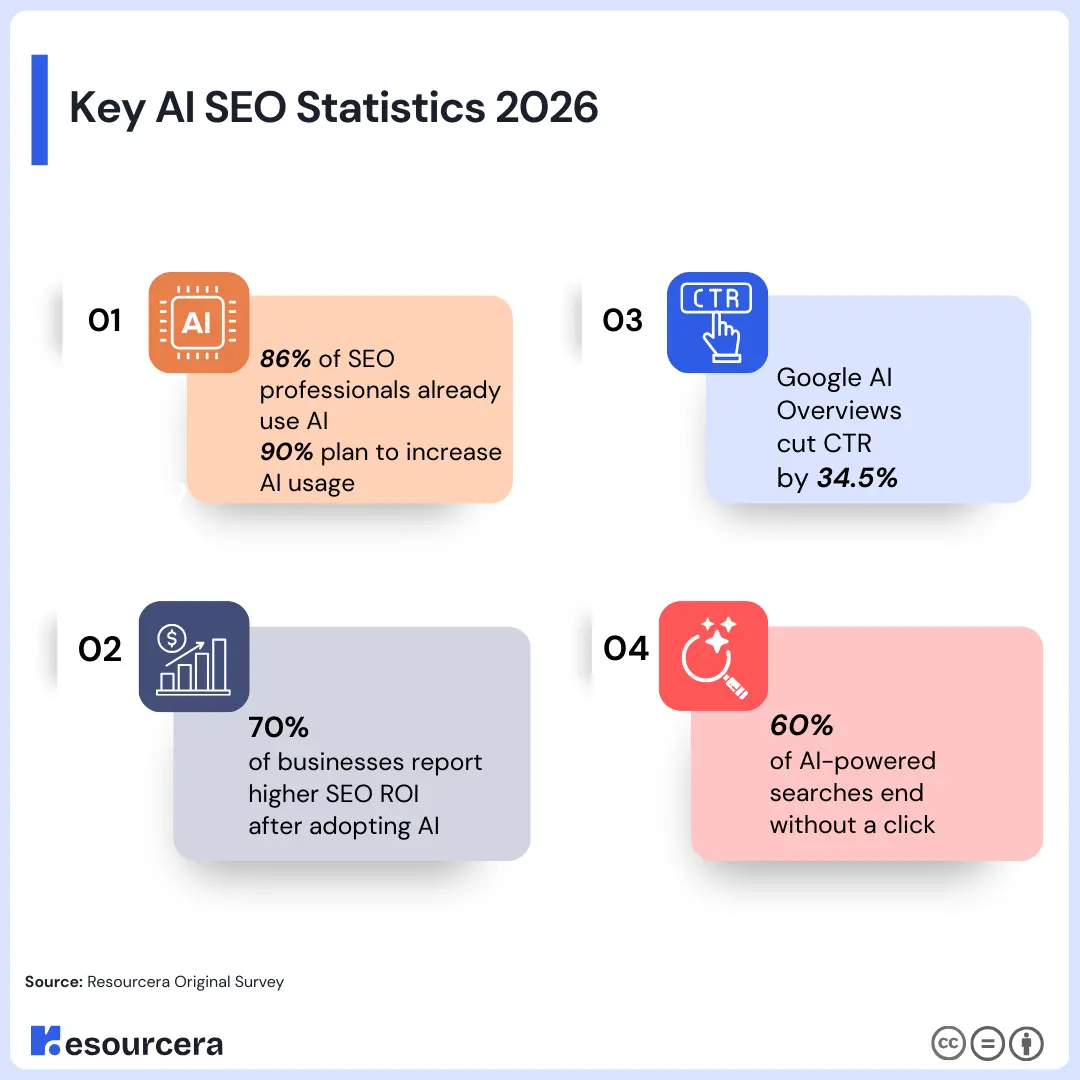
- 86% of SEO professionals already use AI, and 90% plan to increase usage.
- 84% of marketers use AI to align content with search intent.
- 65% of businesses report improved SEO performance after adopting AI, while 70% see higher ROI.
- Google AI Overviews reduce CTRs by an average of 39.8%, accelerating zero-click search behavior.
- Around 60% of searches with AI summaries end without a click.
Statistics On AI’s Adoption in SEO
- Nearly nine out of ten (86%), already integrate AI into their daily workflows, signaling a clear shift toward automation and intelligence-led optimization.
- This shift is even more pronounced at the enterprise level. Around 82% of enterprise SEO teams plan to increase their investment in AI, using it to scale performance, manage vast websites, and extract insights at speed.
- At the same time, 58% of SEO professionals are actively considering adding AI tools to their processes, showing that the transition is far from complete.
- More than 80% of businesses in the retail and consumer sector plan to implement AI-driven automation by 2026.
- Among businesses that have not yet adopted AI, 37% say the primary barrier is a lack of understanding of how AI actually works.
Sources: Semrush, BrightEdge, SEOProfy, Analytics Insight, Semrush 2
AI Adoption In Marketing SEO
- Today, 84% of marketers use AI to better align web content with user search intent. 61% of marketers consider AI a central pillar of their strategy, signaling a clear shift from experimentation to long-term adoption.
- 67% of marketers highlight automation as AI’s biggest advantage, particularly for repetitive SEO tasks like keyword research, meta tag creation, and routine optimizations.
- 78% of marketing teams rely on AI-driven content for tasks like SEO execution, A/B testing, and ongoing performance optimization.
- Generative AI, in particular, is gaining traction across SEO workflows. Around 56% of marketers actively use generative AI to support activities such as content creation, keyword research, and on-page optimization.
- Digging deeper, adoption intensity is also rising: 31% of marketers say they use generative AI extensively for SEO, while another 25% use it to a moderate degree. Together, this means over half of marketers (56%) have already integrated generative AI into their SEO processes in a meaningful way.
Sources: Search Atlas, MarketingLTB
Statistics on Online User Behaviour That Help Us Understand The Importance of AI SEO
- Today, 80% of consumers rely on AI-written results for nearly 40% of their searches, signaling a major behavioral shift toward machine-generated answers. This growing dependence is mirrored on the production side, where 70% of companies say tools like ChatGPT help them create content faster, reducing turnaround times without sacrificing scale.
- Personalization and efficiency are also driving adoption. Around 58% of marketers believe AI enables more tailored customer experiences, while 52% report noticeable gains in speed and operational efficiency. These benefits are increasingly visible within search ecosystems themselves.
- As of January 2026, 19% of Google search results include AI-generated content, and 13% of top-performing pages on Google are now created with AI support. Since the release of GPT-2, AI-generated content has increased by 2.3%, indicating a steady upward trend rather than a short-term spike.
- Trust, however, remains divided. While 25% of U.S. respondents feel AI-powered search results are more specific to their queries, only 12% say they find them more trustworthy. On the other end of the spectrum, 16% of users openly state they wouldn’t trust AI-generated search results at all.
Sources: MarketingWeek, Forbes, Statista, OriginalityAI
Google AI Overviews Statistics
- Google AI Overviews (AIOs) are redefining how users interact with search results and how publishers earn clicks. While overall search activity is rising, many websites are seeing a click-through rate drop of around 30%, largely because users now get direct answers without needing to visit a page.
- AIOs currently appear in roughly 13% to 30% of all searches, with a strong bias toward informational intent and low-volume or long-tail queries. These AI-generated summaries are typically 150 to 250 words long and pull citations from a wide range of sources, often well beyond the traditional top 10 results.
Google AI Overviews in SERPs: Key Statistics Across Industries
- Semrush Sensor data shows that Google AI Overviews appeared in just 6.71% of SERPs across all industries, indicating that adoption is still relatively limited overall.
- The presence of AI Overviews varies significantly by industry, with Health (23.02%) and Science (20.13%) seeing the highest visibility across U.S. search results.
- Technology-driven sectors show moderate adoption, as AI Overviews appear in 11.72% of Internet & Telecom, 9.99% of Travel, and 8.75% of Computers & Electronics SERPs.
- In contrast, commercial and lifestyle niches remain largely unaffected, with AI Overviews showing up in only 0.41% of Real Estate, 1.27% of Food & Drink, and 1.95% of Arts & Entertainment searches.
Sources: Semrush 4
AI SEO Search Traffic & Referral Growth Statistics
- AI platforms account for roughly 0.15% to 1% of total internet traffic, a modest share that masks how quickly behavior is shifting. By mid-2025, AI search traffic had surged more than 500% year over year, signaling a rapid change in how users seek information.
- Projections suggest that classic search engine volumes could decline by up to 25% by 2026 as users increasingly turn to AI chatbots and virtual assistants for direct answers. Within this ecosystem, ChatGPT dominates with over 77% of all AI-driven referral visits, far outpacing alternatives like Perplexity and Google’s Gemini.
- When AI Overviews appear, CTR for top-ranking pages drop by an average of 38.9%. In fact, around 60% of searches that include an AI summary end with no website visit at all.
- User behavior shifts sharply: only 8% of users click a traditional organic result when an AI summary is present, compared to 15% when no AI summary appears.
Sources: Pew Research, SEO.com, Semrush, ExposureNinja
AI SEO Statistics: User Trust & Behavior in AI Search
- Globally, only 46% of people say they’re willing to trust AI systems, and that confidence shifts widely depending on where users live and how AI is used.
- In the U.S., around 53% of users who have seen AI-generated summaries say they trust the information to some extent. Still, deep confidence remains rare, with just 6% saying they trust AI results “a lot.”
- Users respond best when AI search results point to credible sources, a factor that 68.3% of people say increases confidence. Consistency across multiple sources also matters, with 60% of users more likely to trust AI answers that align with information they see elsewhere.
- Gen Z and Millennials tend to be more open to AI and more comfortable relying on it than older generations.
- Income plays a role too; about 63% of upper-income Americans report some level of trust in AI summaries, compared to 53% of middle-income and 50% of lower-income users.
- The biggest worry in AI seo is accuracy, with 55.4% of users citing AI “hallucinations” or incorrect information as their top concern. Privacy and data usage follow closely, troubling 36.8% of respondents.
Sources: MBS, Pew Research 2, EthicalSEO, Search Engine Land
AI SEO Use Cases & Optimization Statistics
- 86% of SEO professionals actively use AI in their strategies, and 90% plan to increase usage, signaling that AI is now a core operating layer rather than an add-on.
- Performance data supports this shift. 65% of businesses report improved SEO results after adopting AI, while 70% say AI has directly increased ROI, mainly through faster execution and better optimization decisions.
- On the output side, marketers using AI publish 42% more content per month, giving them a clear scale advantage.
- Over 80% of users are at least somewhat skeptical of AI Overviews, and many report encountering inaccurate information. Reflecting this shift, 25.7% of marketers now prioritize authoritative, citation-ready content, understanding that branded mentions and trusted links are essential for AI SEO visibility.
Sources: SEO Site Checkup, Elementor, Semrush, McKinsey
AI SEO Statistics: Future Trends and Expectations
- By 2027, one in four organizations (25%) is expected to use AI chatbots as their primary customer service channel, underscoring long-term confidence in conversational AI.
- 75% of respondents expect to use ChatGPT to generate customer responses, signaling a strong shift toward AI-assisted support and engagement. 44% also anticipate using ChatGPT to create content in multiple languages, making localization faster and more scalable.
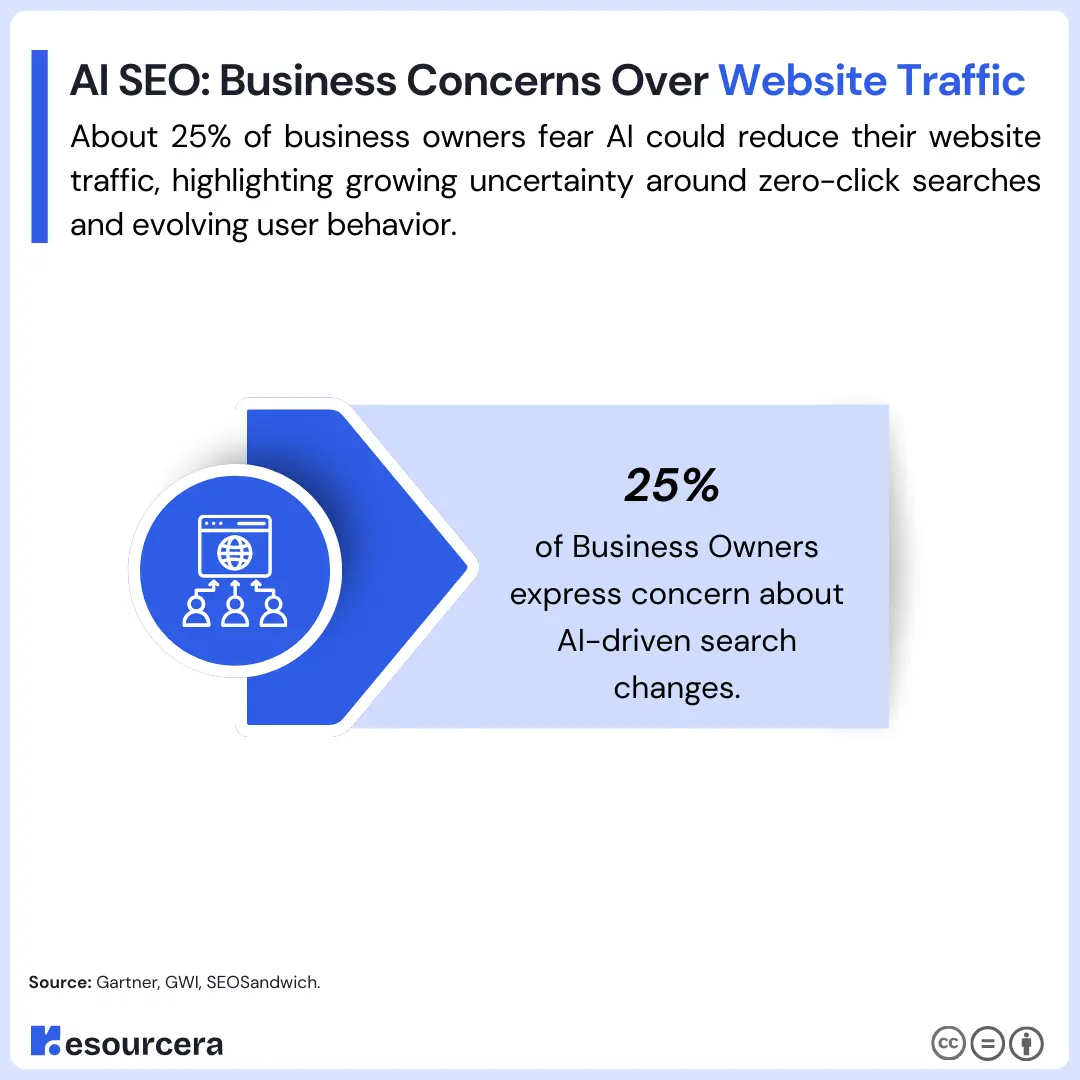
- 25% of business owners worry that AI could negatively impact their website traffic, reflecting uncertainty around changing search behavior and zero-click experiences.
- At the traffic level, AI-influenced SEO currently accounts for about 6.5% of organic traffic, and projections suggest this could climb to 14.5% by 2026.
- Looking further ahead, industry projections based on AI search adoption trends suggest that LLM-driven search traffic could surpass traditional search by the end of 2027 if current growth continues. This points to a fundamental change in discovery channels from link-based navigation to answer-first experiences.
Sources: Forbes, Statista 2, Gartner, GWI, SEOSandwich.

