

Digital PR continue to play a major role in media outreach and brand communication in 2026. Around 72% of journalists say press releases are the most useful resource PR teams can provide, while 66% use them to find story ideas.
As AI reshapes the PR industry, 76% of PR professionals now use generative AI in their workflow, and the global public relations market is projected to reach $115 billion in 2026.
To help you understand the latest trends, we’ve compiled the most important press release statistics for 2026. This report covers everything from journalist preferences and ideal press release length to the best time to send a release, the biggest reasons journalists reject pitches, distribution costs, AI adoption, and ROI measurement.
Whether you’re planning your first press release or looking to improve your PR strategy, these statistics will give you a data-backed view of what works in today’s media landscape.
Key Digital PR Statistics 2026
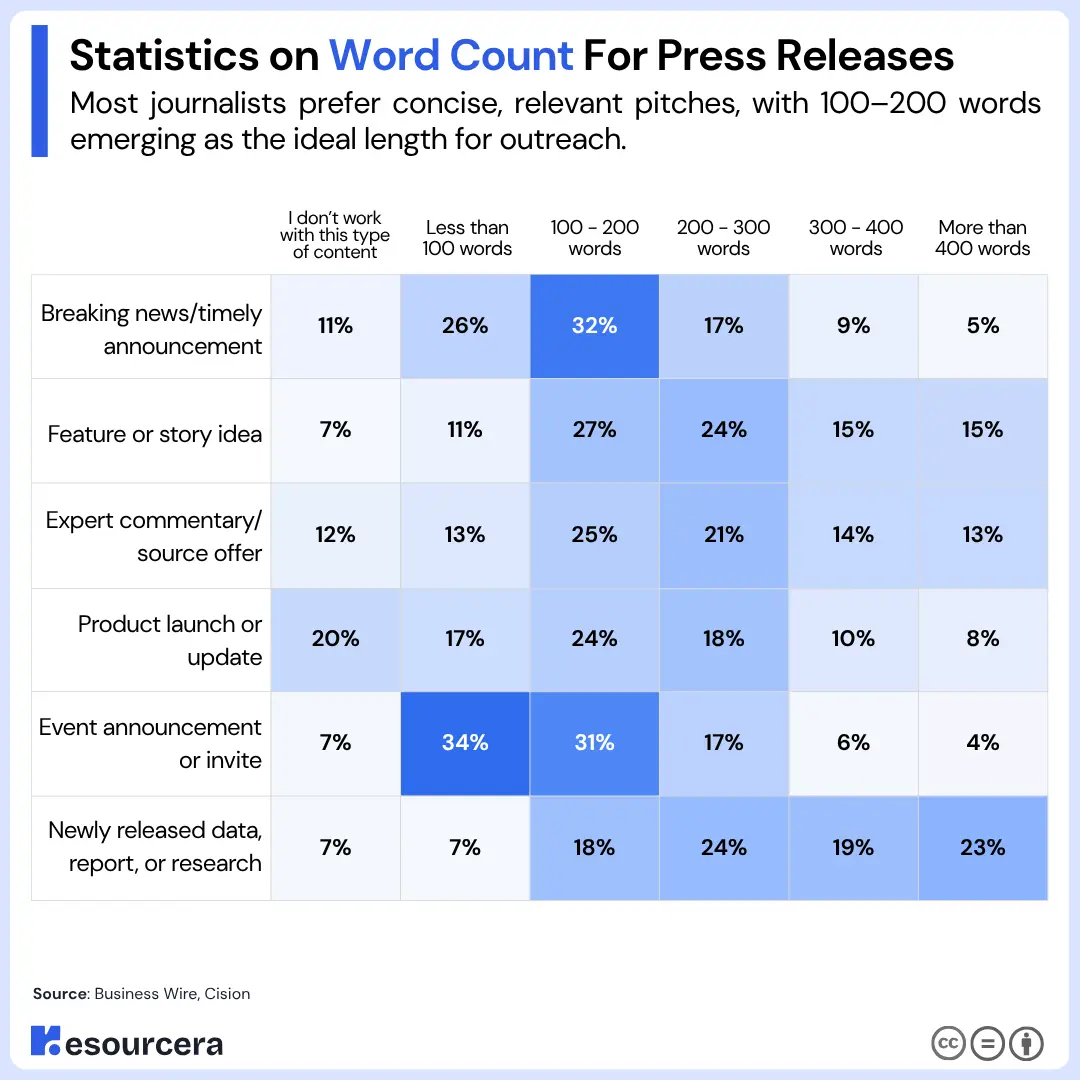
- 69% of journalists prefer PR pitches that are under 200 words.
- Among all outreach types, research and data announcements are the only category where nearly one in four journalists are comfortable receiving pitches longer than 400 words (23%).
- Only 2.2% of published online content earns multiple backlinks through digital PR.
- Around 67% of SEO professionals use digital PR as a link-building strategy.
- Nearly half 48.6% of businesses consider digital PR their most successful strategy for earning high-quality backlinks.
Journalist Demand and Adoption of Digital PR
- 72% of journalists globally name press releases as the single most useful resource a PR team can offer.
- 66% of journalists say they rely on press releases to generate story ideas.
- 86% of journalists say at least some of their work in the past year began with a PR pitch.
- 84% of PR professionals still name media relations, the discipline the press release sits within, as a core part of their job.
- 55% of journalists used news releases built around original research or data findings in their coverage.
- Cision has run its State of the Media survey for 16 consecutive years across more than 3,000 journalists in 19 markets, and the press release has stayed the top-requested content type throughout.
Source: Cision, Muck Rack, Mckinsey.
Word Count For Press Releases
- The industry-standard press release runs to roughly 400 words, the length most major newswires price their base distribution around.
- On the accompanying pitch, 28% of journalists prefer 100 to 200 words and only 2% want anything over 400 words.
- 86% of journalists say they will immediately reject a pitch that is not aligned with their beat or audience, making relevance the biggest single filter.
- 85% of journalists say the best way to open a relationship is a simple introductory email, even with no story attached.
Source: Business Wire, Cision, Muck Rack.
Things That Make a PR Stand Out
Relevance is by far the most important factor that makes a press release stand out. Nearly 4 in 5 journalists (79%) are more likely to engage with a PR pitch when it matches their beat, audience, or coverage area. Features like strong subject lines, media kits, and visuals help, but they matter much less than sending a relevant and newsworthy story to the right journalist.
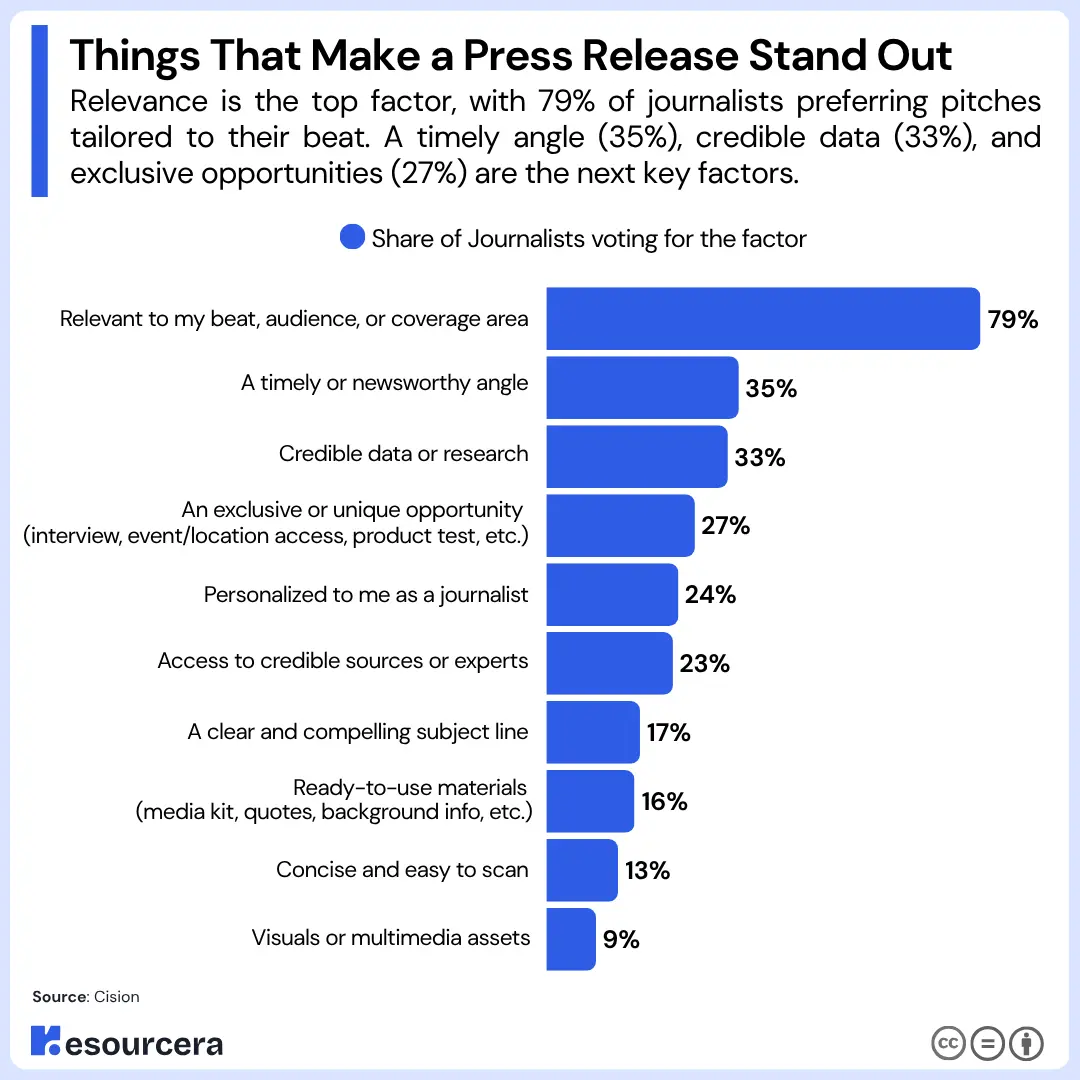
Here is a table showing the things cited by journalist that make a press release stand out
| Factor That Makes a PR Pitch Stand Out | Share of Journalists voting for the factor |
|---|---|
| Relevant to my beat, audience, or coverage area | 79% |
| A timely or newsworthy angle | 35% |
| Credible data or research | 33% |
| An exclusive or unique opportunity (interview, event/location access, product test, etc.) | 27% |
| Personalized to me as a journalist | 24% |
| Access to credible sources or experts | 23% |
| A clear and compelling subject line | 17% |
| Ready-to-use materials (media kit, quotes, background info, etc.) | 16% |
| Concise and easy to scan | 13% |
| Visuals or multimedia assets | 9% |
- Press releases that include well-crafted quotes have a pickup rate up to 40% higher than those without quotes.
- Headlines that use odd numbers, are phrased as questions, or contain a colon or hyphen see click-through rates up to 21% higher than average.
- 63% of companies include multimedia assets such as images, video, or graphics when sending a press release.
- Embedding relevant URLs within press releases can increase website traffic by up to 77% when those releases are picked up by media outlets.
Source: Cision.
Ideal Time to Send Digital PR
- Across more than 55,000 releases sent through its platform, Prowly found Thursday to be the strongest send day, with average open rates climbing above 26%.
- Tuesday ranked next, at roughly 19%, while Wednesday, Friday and weekends consistently underperformed.
- The 10am to 2pm window is the peak period for opens, once journalists have cleared their morning inbox triage.
- Muck Rack’s pitching data aligns on the front half of the week: the most effective pitches go out on Tuesday mornings, before noon, with a first follow-up three to six days later.
Source: Muck Rack, Prowly.
Common Reasons Journalists Reject Press Releases
More than four out of five journalists say they ignore pitches that don’t match what they cover. Another major turnoff is overly promotional content.
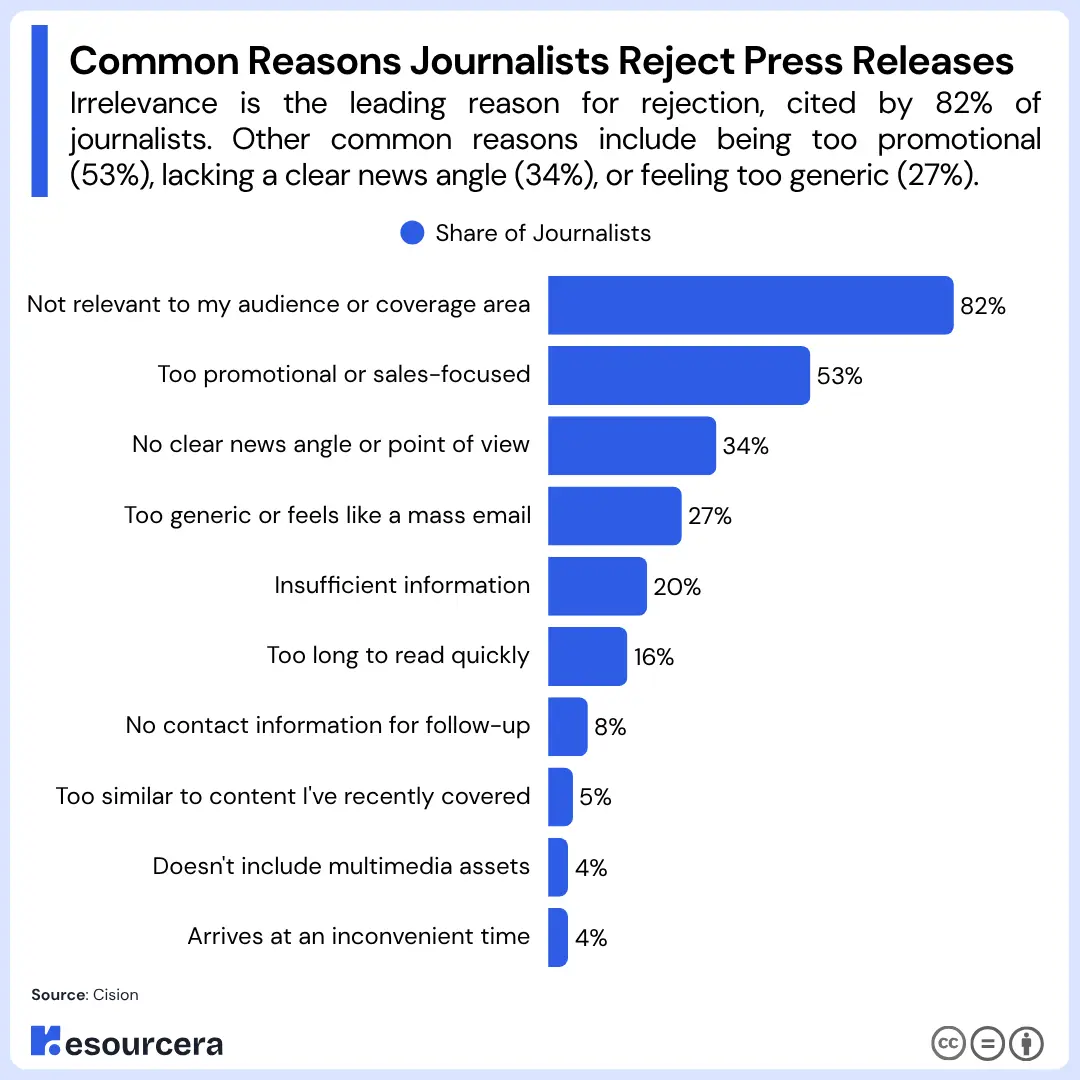
Journalists also expect a clear news angle instead of a generic marketing message. While details like multimedia assets and timing can affect engagement, they play a much smaller role than relevance, originality, and genuine news value.
| Reason for Rejecting a Press Release | Share of Journalists |
|---|---|
| Not relevant to my audience or coverage area | 82% |
| Too promotional or sales-focused | 53% |
| No clear news angle or point of view | 34% |
| Too generic or feels like a mass email | 27% |
| Insufficient information | 20% |
| Too long to read quickly | 16% |
| No contact information for follow-up | 8% |
| Too similar to content I’ve recently covered | 5% |
| Doesn’t include multimedia assets | 4% |
| Arrives at an inconvenient time | 4% |
Source: Cision
PR Distribution Platform Statistics
- Business Wire alone distributes for more than 26,000 companies through a network of 92,000-plus media outlets across 160-plus countries.
- Cision, which owns PR Newswire, counts 84% of the Fortune 500 among the organisations using its tools.
- Paid press release distribution typically ranges from about $29 for a basic release to roughly $1,999 for premium wire distribution.
- A national US release through PR Newswire starts near $1,000 plus membership, rising to about $1,820 once a logo and one image are added.
- Business Wire pricing sits in similar territory: around $760 for a standard 400-word national release, near $1,380 with extra words and a multimedia asset.
- Professional press release writing runs roughly $150 to $1,000 per release for freelance work, before any distribution cost.
- About 25% of press releases are picked up and published by media outlets without any follow-up from the sender.
- A high-performing press release typically earns 5 to 20 quality backlinks, with a median of about 13 per release.
- About 60% of major brands now maintain a dedicated newsroom or live press section on their website.
- 25% of brands publish more than 10 press releases per year.
- The global PR market is estimated at about $115 billion in 2026.
Sources: Company Data, Prowly, Cision, Business Wire.
Statistics on Crisis Communications
Crises spread faster than ever, especially on social media. How a brand responds in the first hours often decides whether it keeps or loses public trust. These statistics show what audiences expect and what a poor response can cost.
- 75% of consumers judge brands based on how they respond during a crisis.
- A poorly managed PR crisis can cost mid-sized businesses an average of $3.3 million in recovery, especially when it involves data breaches or serious reputational harm.
- 63% of PR professionals say an issue becomes a crisis when it needs to land on the CEO’s desk.
- Up to 50% of crisis coverage is now driven by social media virality rather than traditional news outlets.
- Companies with a strong crisis plan and fast, transparent response can cut their brand reputation recovery time by up to 50%.
Source: Syndigo, Avaans Media, Agility PR, FGS Global, PRSA.
AI Is Rewriting the Press Release
- More than half of PR professionals now use AI to write press releases and craft pitches.
- Generative AI adoption among PR pros has reached 76%, nearly triple the level when Muck Rack first measured it in 2023.
- 82% of PR pros use AI for brainstorming and 72% for drafting content, the two most common use cases.
- 93% of PR pros say AI speeds up their work and 78% say it improves the quality of their output.
- On the newsroom side, 71% of journalists say they are open to PR teams using AI to generate releases and pitches.
- That openness comes with a caveat: 72% of journalists worry AI-generated content may contain factual inaccuracies, so releases that read as machine-written risk rejection.
- Only 21% of PR pros use AI to find journalists, one of the least-automated parts of the workflow.
Sources: Muck Rack, Cision.
Digital PR and SEO Statistics
Press releases and media coverage are now a real part of SEO strategy. When a brand earns coverage, it often picks up high-quality backlinks, more organic traffic, and stronger domain authority. These numbers show how PR and search performance connect.
- Only 2.2% of published online content earns multiple backlinks through digital PR and earned media campaigns.
- The average backlink earned through digital PR has a Moz Domain Authority of 43, with 32% of those links coming from domains with a DA above 70.
- The top-ranking page on Google typically has 3.8 times more backlinks than pages ranked 2nd through 10th.
- Brands see a 6% to 12% average increase in branded search volume after significant media coverage.
- A high-performing PR placement can drive over 1,000 referral visits to a brand’s website. The median sits between 100 and 500 visits per placement.
- About 64% of brands now actively measure the SEO impact of their PR campaigns using analytics tools.
- 48.6% of businesses consider digital PR their most successful strategy for earning high-quality backlinks.
- Around 85% of SEO professionals believe strong link-building efforts play a major role in improving a brand’s online authority.
- For most businesses 85.1%, the number of quality backlinks is the leading metric used to evaluate digital PR success, while fewer than three in ten 28.4% prioritize leads or conversions.
- More than half (58.4%) of digital PR professionals regularly recover unlinked brand mentions by requesting publishers to add backlinks.
- Digital PR campaigns generate a variety of backlink types, with follow links making up 48% of all links earned, syndicated links accounting for 33%, and nofollow links representing the remaining 19%.
- AI visibility has become an emerging performance metric, with 78.4% of businesses now monitoring how digital PR influences their presence in AI-powered search and answer engines.
Source: Digitaloft, Spiralytics, Ahrefs, Digital Third Coast, 829 Studios.
Digital PR ROI and Performance Statistics
- 67% of PR professionals say producing measurable results is the most important way to prove PR’s value, well ahead of creative work or executive visibility.
- Confidence in the numbers remains fragile: only 7% of PR pros describe themselves as extremely confident in the metrics they report to leadership.
- 78% of PR pros say tracking AI-generated mentions matters to their work, and 61% are already doing it or planning to.
- Two-thirds of PR pros (67%) expect visibility inside large language models to become a standard measurement metric.
- Low journalist response rates, cited by 72%, and shrinking media lists, cited by 62%, are the top obstacles to earning coverage from a release.
- Six in ten business leaders expect measurable results from digital PR campaigns within the first six months.
Sources: Muck Rack

