


YouTube is one of the most widely used online platforms in the United States. Around 250.1 million Americans use YouTube, including 84% of US adults.
It is also the second most-used platform for online searches in the country, showing that people use it for much more than entertainment.
YouTube Shorts has become a major part of this growth, reaching more than 175 million US users. This number is expected to rise beyond 192 million by 2027.
Moreover, Americans spend nearly 35 minutes on YouTube each day watching videos, searching for information, following creators, and discovering products.
This article covers the latest YouTube user statistics in the US, including audience growth, demographics, Shorts usage, viewing time, and other key trends.
YouTube US Users: 2026 Key Highlights
- 250.1 million people in the United States use YouTube in 2026.
- The US user base doubled between 2017 and 2025, growing by 125.07 million people.
- US users are projected to reach 278.6 million by 2030.
- 84% of US adults use YouTube, the highest reach of any online platform in the country.
- 95% of US adults aged 18 to 29 use YouTube, and 64% of those aged 65 and over do too.
- 48% of US adults visit YouTube every day, including 33% who open it several times a day.
- 76% of US teens use YouTube daily, and 17% say they are on it almost constantly.
- US adults spend about 35 minutes a day on YouTube.
- YouTube has held the top spot in US streaming watch time for nearly three years.
- YouTube Shorts has more than 175 million US users and is expected to pass 192 million in 2027.
- 35% of US adults regularly get news on YouTube, up from 23% in 2020.
- The United States is home to roughly 108 million YouTube channels, the largest creator base of any country.
How Many YouTube Users Are There in the US?
The United States has 250.1 million YouTube users.
That is the second-largest national audience in the world, behind India, and it represents just over 73% of the total US population.
The US number is unusual because it is close to saturation. India has more than twice as many YouTube users, but a much smaller share of its population is online.
In the US, almost everyone with an internet connection already uses the platform, which changes what growth looks like from here.
YouTube Users in the US Over the Years
The US YouTube audience has doubled in eight years. It stood at just over 125 million in 2017 and reached 250.1 million in 2026, an increase of 125.07 million people.
That works out to a compound annual growth rate of about 9.1% across the period. For context, the US population grew by roughly 5% over the same eight years, so almost all of the gain came from deeper adoption rather than more people.
The US audience is projected to grow by 28.5 million users between 2025 and 2030, reaching 278.6 million. That is a compound annual growth rate of about 2.2%, a sharp slowdown from the 9.1% recorded between 2017 and 2025.
The table below shows the confirmed data points in the US user series.
| Year | US YouTube Users |
|---|---|
| 2017 | 125.03 million |
| 2026 | 250.10 million |
| 2027* | 259 million |
| 2030* | 278.60 million |
Source: Statista 1, Statista 2, World Population Review
YouTube Paid Subscribers in the US
The United States is YouTube’s largest paid market.
US YouTube Premium subscribers reached 27.9 million in 2024, and American users spend more than $50 million a month on in-app purchases, more than the next four countries combined.
Paid growth in the US is steady rather than explosive, running at roughly 4.5% a year. The bigger story is spending intensity, with about 11% of US YouTube users paying for Premium; that minority generates over half of all global in-app purchase revenue.
YouTube Premium Subscribers in the US
US YouTube Premium subscribers grew from 25.5 million in 2022 to around 27.9 million in 2024. That is an increase of 2.4 million people, or 9.4% across two years.
Annual growth held near 4.5% in both years, which is unusually consistent for a subscription product. It also means Premium adoption in the US is growing roughly twice as fast as the overall US user base.
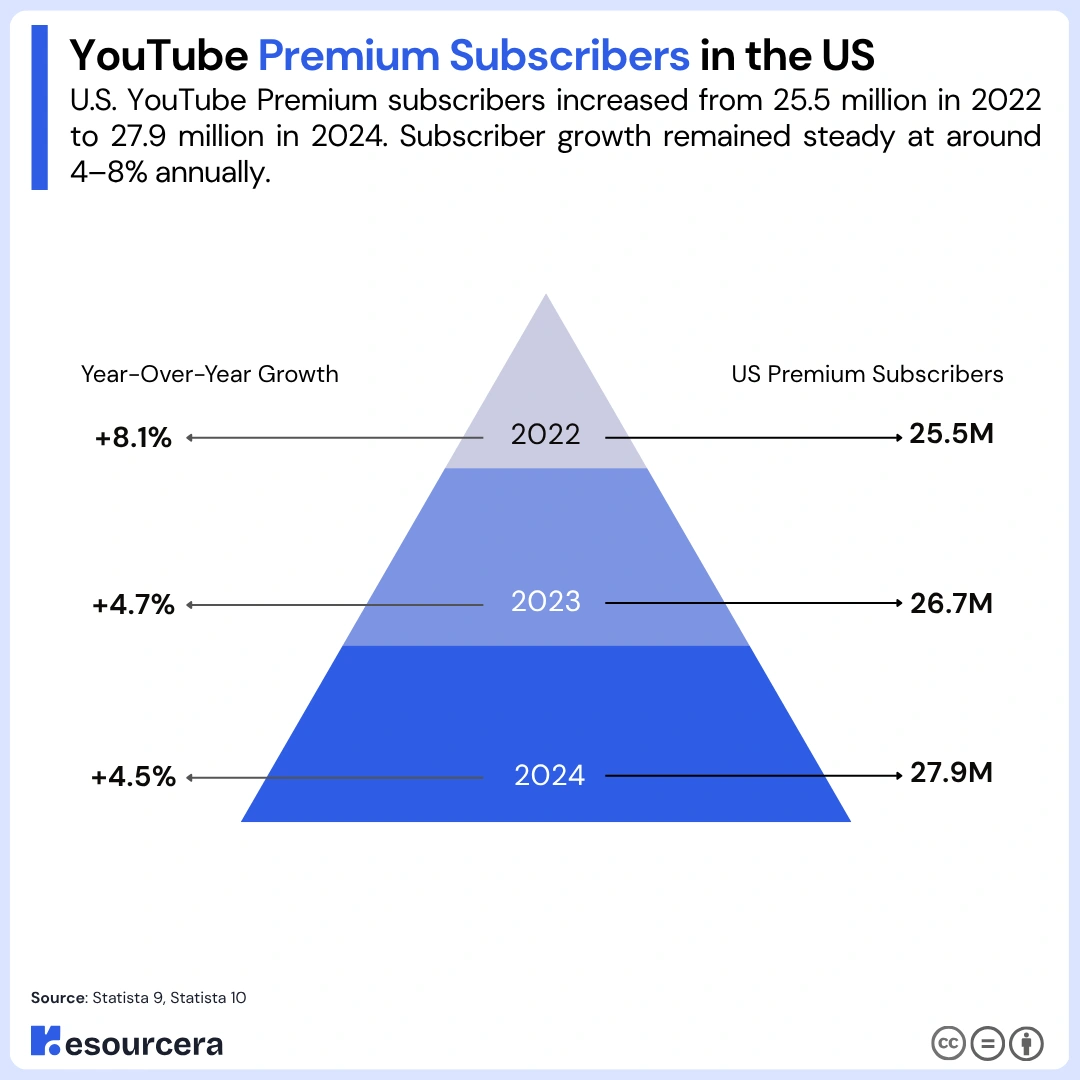
This table tracks US YouTube Premium subscribers year over year.
| Year | US Premium Subscribers | Year-Over-Year Growth |
|---|---|---|
| 2020 | 20 million | |
| 2021 | 23.6 million | +18.0% |
| 2022 | 25.5 million | +8.1% |
| 2023 | 26.7 million | +4.7% |
| 2024 | 27.9 million | +4.5% |
Source: Statista 8, Statista 9, Statista 10
YouTube Shorts Users in the US
YouTube Shorts has more than 175 million users in the United States as of June 2026. That is about 70% of the total US YouTube base, meaning roughly seven in ten American YouTube users watch Shorts.
Shorts is projected to cross 192 million US users in 2027, an increase of about 17 million or 9.7% from the current figure. Growth is still running well ahead of the platform’s overall US growth rate of 2.2% a year.
The number to hold onto is the 70% overlap. Shorts is not a separate audience the platform acquired; it is a format the existing US audience adopted, which is why the two user curves are converging rather than adding up.
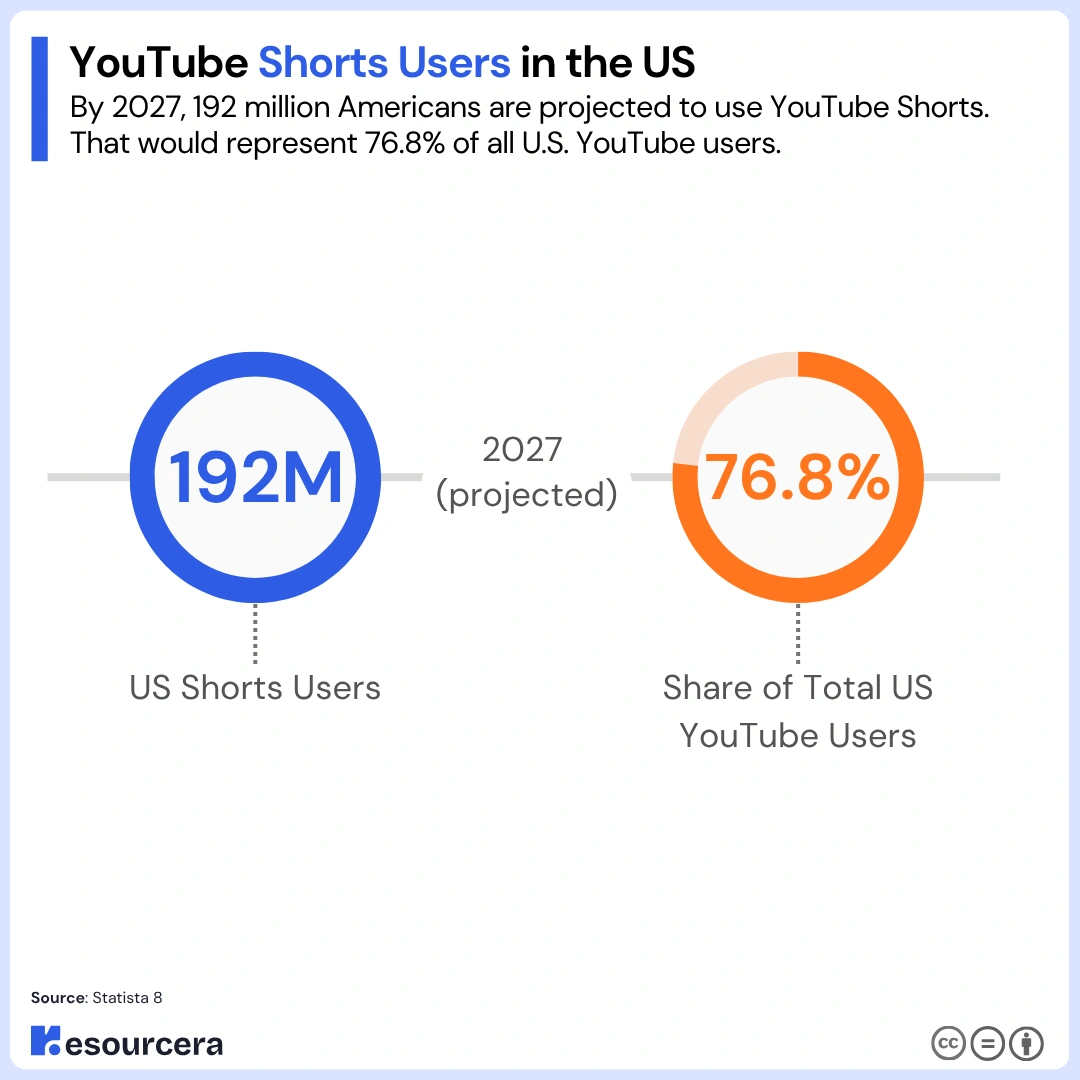
This table shows the US Shorts audience and its share of total US YouTube users.
| Period | US Shorts Users | Share of Total US YouTube Users |
|---|---|---|
| 2023 | 152.9 million | 61.1% |
| 2024 | 164.5 million | 65.8% |
| 2025 | 175.1 million | 70.0% |
| 2026 | 184.6 million | 73.8% |
| 2027 (projected) | 192 million | 76.8% |
YouTube Penetration in the US
84% of US adults use YouTube. No other online platform in the country comes close, and YouTube shares the top position with Facebook as the only two sites a majority of every adult age group uses.
Adult reach has climbed steadily. It sat at 72% in 2021 and 82% in 2022, meaning YouTube added 12 percentage points of US adult reach in four years while several rival platforms flattened out.
Share of US Adults Who Use YouTube Over Time
US adult reach has grown 12 points since 2021. The jump from 72% to 82% in a single year was the largest single-year gain in the series, and growth has been slower but positive since.
This table tracks the reported share of US adults using YouTube.
| Year | Share of US Adults Using YouTube |
|---|---|
| 2021 | 81% |
| 2023 | 83% |
| 2024 | 85% |
| 2025 | 84% |
YouTube vs Other Platforms in the US
YouTube is the only platform that holds majority reach across every US adult age group. Instagram, TikTok, X and LinkedIn all collapse among older adults, while YouTube still reaches 64% of Americans aged 65 and over.
The contrast is sharpest at the top of the age range. Among adults 65 and over, YouTube reaches 64%, Facebook reaches 57%, LinkedIn 21%, Instagram 19%, TikTok 12% and X 10%. YouTube’s lead over Instagram in that group is more than three to one.
Here is how the major platforms compare among US adults aged 65 and over.
| Platform | Share of US Adults 65+ Using It |
|---|---|
| YouTube | 64% |
| 57% | |
| 21% | |
| 19% | |
| TikTok | 12% |
| X | 10% |
By national penetration rate, the US sits at 77.4%, behind markets like Canada at 87.5%. The US ranks high but not at the very top, because several smaller and highly connected countries have almost universal coverage.
How the US Ranks Against Other YouTube Markets
The United States ranks second globally by YouTube audience size but first among large markets by penetration.
India has 518 million users against a population penetration of about 36%, while the US has 259 million on an advertising-reach basis at roughly 76%.
That gap matters for anyone comparing markets. India delivers scale, the US delivers depth, and the US audience is the one already saturated across every age group.
The table below lists the ten largest YouTube markets by audience size along with each country’s penetration rate.
| Rank | Country | YouTube Users | Penetration of Population |
|---|---|---|---|
| 1 | India | 518 million | 36% |
| 2 | United States | 259 million | 76% |
| 3 | Indonesia | 151 million | 54% |
| 4 | Brazil | 149 million | 68% |
| 5 | Mexico | 85 million | 64% |
| 6 | Japan | 78.7 million | 63% |
| 7 | Germany | 65.5 million | 78% |
| 8 | Vietnam | 62.3 million | 61% |
| 9 | Philippines | 57.7 million | 49% |
| 10 | Turkey | 57.5 million | 65% |
Note on figures: 250.1 million is the modeled monthly active user count for the US. The 253 million to 259 million range comes from advertising-reach estimates, which count reachable accounts rather than active users. Both are correct measures of different things.
Source: Pew Research Center 1, Pew Research Center 2, Statista 3
YouTube Users in the US by Demographics
YouTube has the flattest demographic profile of any major US platform. Usage varies by no more than 31 percentage points across age, 12 points across income, 11 points across education, and 10 points across race and ethnicity.
That flatness is the whole story. On most platforms, one group dominates and the rest trail badly. On YouTube, every group Pew measures clears 64%, which means a US campaign on YouTube reaches a cross-section of the country rather than a niche.
US YouTube Users by Age
95% of US adults aged 18 to 29 use YouTube, the highest of any age band. Reach declines with age but never falls below a majority, ending at 64% among adults 65 and over.
The 31-point gap between the youngest and oldest groups sounds wide until you compare it to Instagram, where the same gap runs past 60 points. YouTube loses older users more slowly than any competing platform.
This table shows YouTube reach across US adult age groups.
| Age Group | Share of US Users Using YouTube |
|---|---|
| 18 to 29 | 95% |
| 30 to 49 | 92% |
| 50 to 64 | 85% |
| 65 and over | 64% |
US YouTube Users by Income
89% of US adults earning $100,000 or more use YouTube, compared with 77% of those earning under $30,000. The 12-point spread is one of the smallest income gaps of any platform.
Adoption rises steadily with income but never drops off sharply at the bottom. More than three in four low-income US adults use YouTube, which is a higher share than most platforms manage among their best-performing income brackets.
The table below breaks down US YouTube usage by household income.
| Household Income | Share Using YouTube |
|---|---|
| Under $30,000 | 77% |
| $30,000 to $70,000 | 84% |
| $70,000 to $100,000 | 87% |
| $100,000 and above | 89% |
US YouTube Users by Education
89% of US college graduates use YouTube, against 78% of adults with a high school education or less. That is an 11-point gap, the narrowest education spread among widely used platforms.
The comparison with LinkedIn makes the point. LinkedIn reaches 37% of college graduates and 15% of adults with a high school education or less, a gap of more than two and a half times. YouTube’s ratio is 1.14 to 1.
Here is US YouTube usage by education level.
| Education Level | Share Using YouTube |
|---|---|
| High school or less | 78% |
| Some college | 87% |
| College graduate | 89% |
US YouTube Users by Race and Ethnicity
92% of English-speaking Asian adults in the US use YouTube, the highest of any racial or ethnic group measured. White adults report the lowest usage at 82%, a spread of just 10 points.
Every group clears 80%, which is rare. Most platforms show double-digit swings driven by one group over-indexing heavily, and YouTube does not.
This table shows US YouTube usage by race and ethnicity.
| Group | Share Using YouTube |
|---|---|
| Asian (English-speaking) | 92% |
| Hispanic | 88% |
| Black | 85% |
| White | 82% |
US YouTube Users by Generation
Millennials make up the largest share of US YouTube users at 25.5%, with Gen Z close behind at 25.1%. Together, the two younger generations account for just over half the US audience.
The other half is older. Gen X holds 19.9% and Baby Boomers 15%, meaning roughly 35% of US YouTube users were born before 1981. That is a far larger older-skewing base than short-form-first platforms carry.
The table below shows the generational split of US YouTube users.
| Generation | Share of US YouTube Users |
|---|---|
| Millennials | 25.5% |
| Gen Z | 25.1% |
| Gen X | 19.9% |
| Baby Boomers | 15.0% |
| Other | 14.5% |
Source: Pew Research Center 3, Global Media Insight
YouTube Usage Among US Users
Nearly half of US adults visit YouTube every day. 33% say they use it several times a day and another 15% open it about once a day, which puts total daily use at 48%.
Among people who already use YouTube, the daily rate is higher still.
About 62% of US YouTube users open the platform on any given day, so roughly three in five of the 250.1 million US users are on it daily.
Daily YouTube Use Among US Adults
48% of US adults use YouTube daily, split between 33% who visit multiple times a day and 15% who visit once. Heavy users outnumber light daily users by more than two to one.
That ratio is the number worth watching. It means most daily US usage is not a single scheduled session but repeated short visits spread through the day, which favors content built for quick entry rather than appointment viewing.
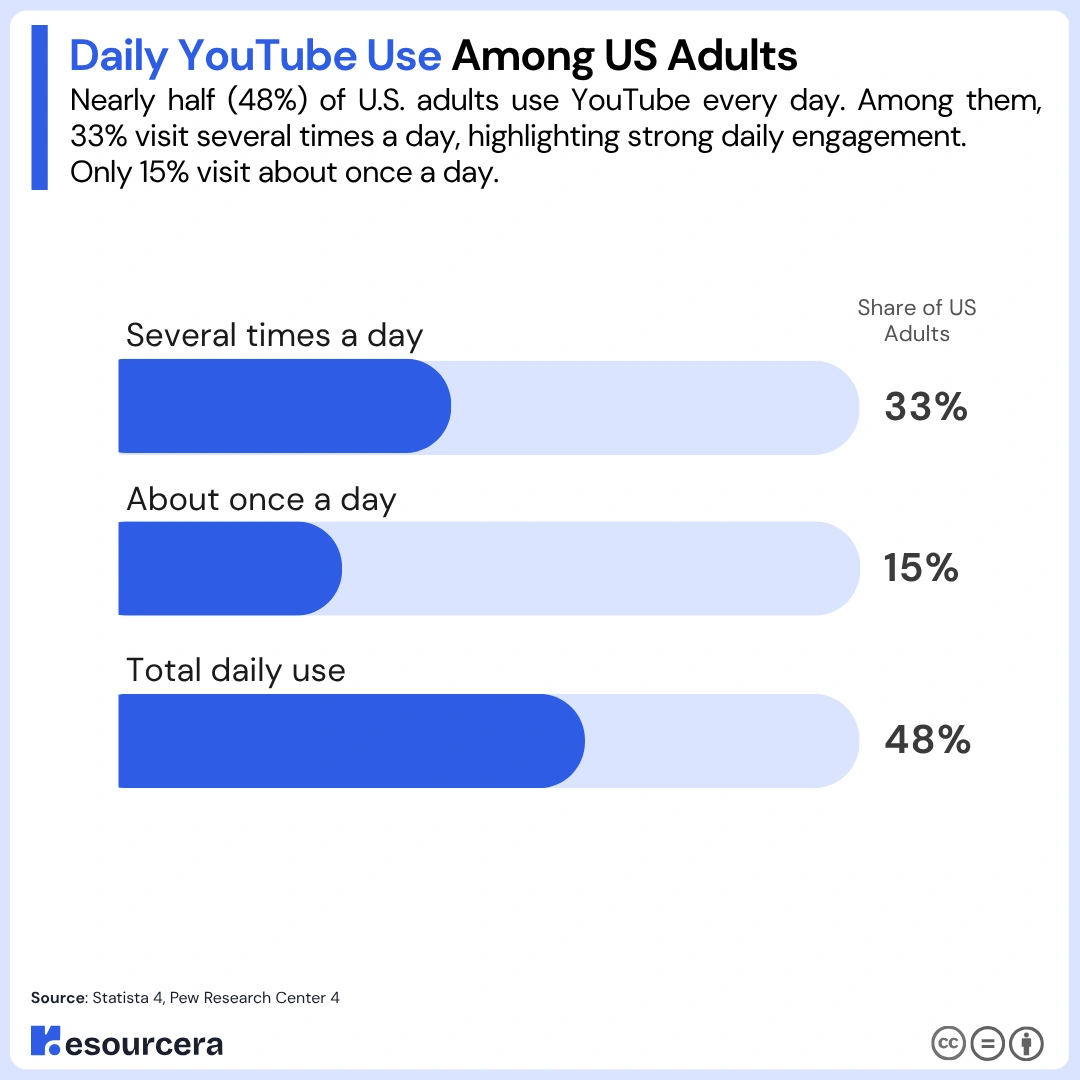
This table breaks down US adult YouTube visit frequency.
| Visit Frequency | Share of US Adults |
|---|---|
| Several times a day | 33% |
| About once a day | 15% |
| Total daily use | 48% |
YouTube Use Among US Teens
76% of US teens use YouTube every day, and 17% describe their use as almost constant. Teens are the most intensive US age group on the platform by a wide margin.
The almost-constant figure is the one that separates YouTube from most services. Roughly one in six US teens treats the platform as an always-on background layer rather than something opened for a specific video.
YouTube Use Among US Children
58% of children in the United States watch YouTube videos. In 2026, US kids are expected to spend more time watching YouTube than traditional television for the first time.
That crossover has been building for years as YouTube’s share of children’s viewing climbed and linear TV’s share fell. It is the clearest signal that the next generation of US viewers is arriving on the platform with no television habit to break.
Source: Statista 4, Pew Research Center 4, Statista 5, Statista 6
Time Spent on YouTube by US Users
US adults spend about 35 minutes a day on YouTube. That is roughly 15 minutes below the global average of about 50 minutes per user per day, or 30% less.
The gap is not a sign of weak US engagement. It reflects how much competition for video time exists in the US market, where streaming services, cable, and other social platforms all fight for the same hours. In markets with fewer alternatives, YouTube absorbs a bigger share of daily video time by default.
Across a year, 35 minutes a day works out to about 213 hours per US adult user, or just under nine full days. Multiplied across 250.1 million US users, that is a very large block of national attention concentrated on one platform.
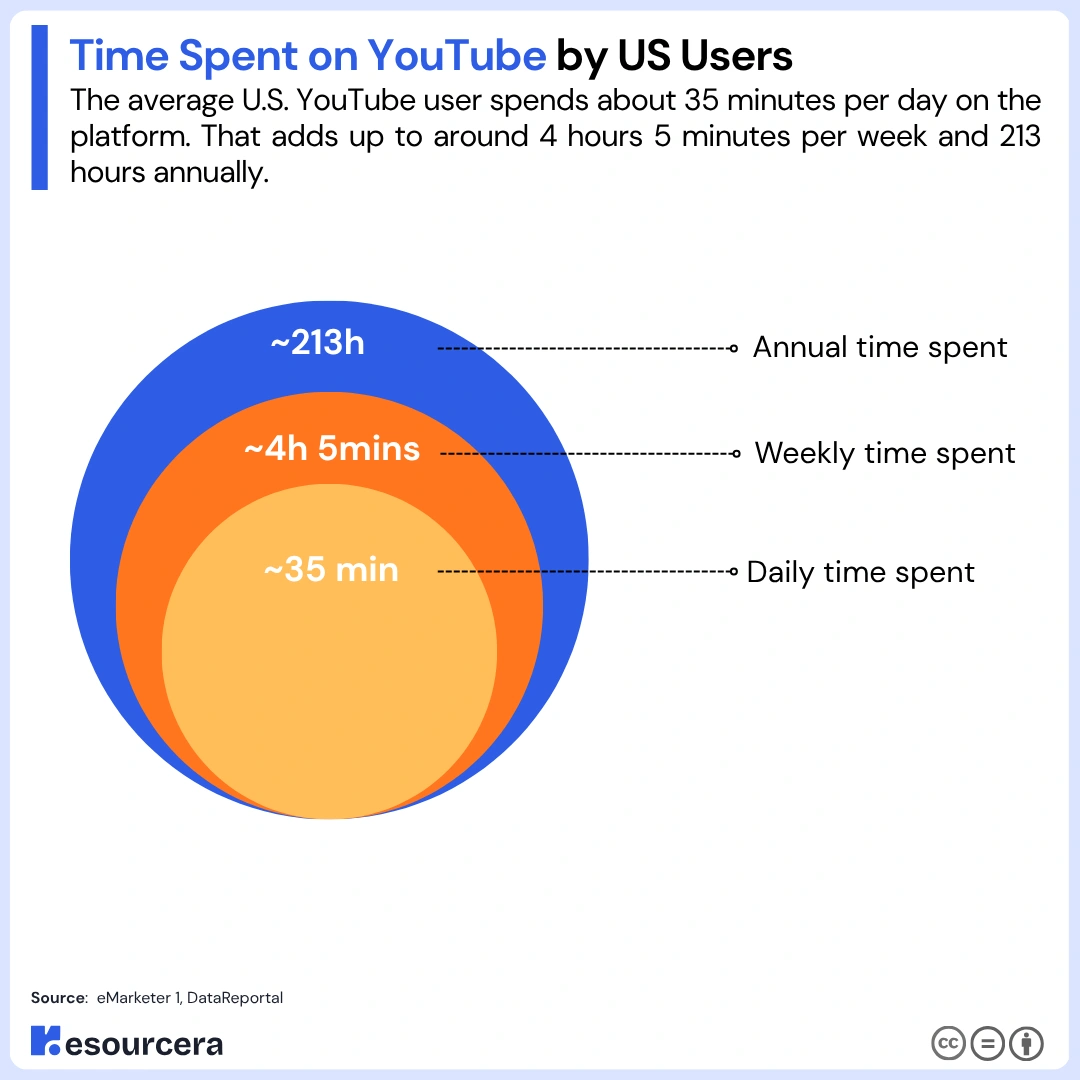
This table compares US daily time spent on YouTube.
| Measure | Time Spent by US Users on YouTube |
|---|---|
| Daily time spent | ~35 minutes |
| Weekly time spent | ~4 hours 5 minutes |
| Annual time spent | ~213 hours |
Source: eMarketer 1, DataReportal
How US Users Watch YouTube
Mobile dominates US YouTube viewing. Almost 70% of US YouTube users access the platform on a smartphone, and 84% of all YouTube views in the United States come from mobile devices.
The gap between those two numbers is worth noting. Fewer users are mobile-only than views are mobile-driven, which means the people who watch on phones watch far more often than people who stick to desktop.
Mobile Share of US YouTube Viewing
84% of YouTube views in the US come from mobile devices. That is high, but it is the lowest mobile share among YouTube’s major markets, with India at 96% and Brazil at 91%.
The US has the widest device mix of any big YouTube market. Higher desktop ownership, faster home broadband and heavy connected TV use all pull viewing away from the phone in ways they do not in mobile-first markets.
Globally, smartphones account for close to 90% of direct visits to YouTube and desktop for 10.5%, so the US sits meaningfully below the worldwide mobile norm.
Connected TV and the Living Room Shift
More than 40% of YouTube users see ads on connected TVs every month. The television screen has become a core YouTube surface rather than an occasional one.
Worldwide, people watch more than one billion hours of YouTube on television screens every day. In the US specifically, this shift is what turned YouTube from a phone app into a direct competitor to broadcast and cable.
Source: Statista 7, YouTube 1
YouTube Is the Most-Watched Streaming Platform in the US
YouTube has held the number one spot in US streaming watch time for nearly three years. It sits ahead of Netflix, Disney+, Hulu, and every other streaming service on the monthly US television measurement.
This is the single most underrated US YouTube statistic. A platform built on user-uploaded video now beats every studio-backed streaming service in the country on total time watched, and it has held that lead for three straight years.
YouTube TV Subscribers in the US
YouTube TV had about 10 to 11 million US subscribers at the end of 2025 and added 750,000 in the third quarter of that year alone. Forecasts put it at 12.4 million by the end of 2026.
At the midpoint of the current range, that is growth of roughly 18% in a single year, in a category that is shrinking overall. YouTube TV is on track to pass Comcast and Charter to become the largest pay-TV provider in the United States.
This table shows YouTube TV’s US subscriber trajectory.
| Period | US Subscribers |
|---|---|
| Q3 2025 additions | +750,000 in the quarter |
| Q4 2025 | 10 to 11 million |
| End of 2026 (forecast) | 12.4 million |
Source: Nielsen, Cord Cutters News
Shopping Behavior of US Users on YouTube
70% of US viewers say they purchased from a brand after seeing it on YouTube. 66% say they have found brands they love on the platform.
Satisfaction after purchase runs high. 79% of YouTube shoppers are satisfied with what they bought, 61% say they do not regret the purchase, and 57% tell other people about the brand.
The table below summarizes US shopper behavior tied to YouTube.
| Shopper Behavior | Share of US Respondents |
|---|---|
| Keep purchases more than Instagram or TikTok shoppers | 93% |
| Have made, plan to make, or will repeat a purchase | 85% |
| Satisfied with their purchase | 79% |
| Feel good about the purchase | 70% |
| Purchased after seeing a brand on YouTube | 70% |
| Found honest information | 69% |
| Found brands they love | 66% |
| Do not regret the purchase | 61% |
| Tell others about the brand | 57% |
Other than this, 68% of US users trust posts and videos from regular people on YouTube, and the same share trust consumer reviews on the platform. Trust drops to 61% for sponsored creators and 50% for YouTube ads.
The 18-point gap between everyday creators and paid advertising is the practical takeaway for US brands. Content that looks and sounds like a real user carries noticeably more weight than a polished ad unit.
This table shows what US users say they trust on YouTube.
| Content Type | Share of US Users Who Trust It |
|---|---|
| Posts and videos by regular people | 68% |
| Consumer reviews | 68% |
| Sponsored creators and influencers | 61% |
| YouTube ads | 50% |
US Advertising on YouTube
59% of US respondents say YouTube ads are more relevant than ads on linear TV or other streaming apps. More than half of US marketers plan to use YouTube for influencer marketing.
Apple was the largest US YouTube advertiser at $273.15 million in spending across a single measured period, out of a total US YouTube advertising pool of $19.77 billion.
Separately, 26% of social media users say they discover new brands and products through YouTube ads.
Source: HubSpot, Talk Shoppe, Google, Statista 11, eMarketer 2
Final Thoughts
The US YouTube story has changed. For eight years, the number that mattered was growth, with the audience doubling from 125 million to 250.1 million.
The next five years will add only 28.5 million more, so the platform’s US value is no longer about reaching new people.
What replaces growth is depth. YouTube reaches 84% of US adults, holds a majority in every age group including 64% of people over 65, and varies by only 10 to 12 points across income, education and race.
No other US platform is that evenly spread, and that flatness is now YouTube’s real advantage.
The pressure point is on the creator side. The US has 108 million channels against 250.1 million users, roughly one channel for every 2.3 people, and only 0.4% of those channels earn income.
Reaching Americans on YouTube has never been easier. Standing out among American creators has never been harder.

