

Google processes billions of searches every day, and a large share of them are questions.
People ask what time it is, where their tax refund is, and how to cook rice. Each one is a small request for help, and together they show what the world needs to know right now.
We ranked the 100 most asked questions on Google by monthly search volume. The top question is “What is my IP address?”, with around 3.4 million searches a month worldwide. The rest of the list moves between daily tasks, health, money, technology, and holidays.
This article covers the full ranked list, a breakdown by question type, the split between evergreen and trending queries, and how search behavior changes by country. It also covers what the data means if you plan content for a living.
Let’s quickly get into the details.
Most Asked Questions on Google: Key Highlights
- “What is my IP address?” is the most asked question on Google, with about 3.4 million monthly searches worldwide.
- “What” questions make up 34% of the top 100, the largest single group.
- “How” questions follow at 29%, which means nearly two-thirds of the list starts with one of those two words.
- “When” questions account for 14% of the list and spike around holidays and annual events.
- “Why”, “where”, and “who” questions together make up the remaining 23%.
- The top 10 questions alone carry more than 20 million monthly searches between them.
- Most of the highest-volume questions are simple lookups rather than deep research queries.
- AI questions now rank inside the top five, with “What is AI?” at about 2.2 million monthly searches.
How We Defined a Most Asked Question
Search volume alone is not enough to call a query a top question. A high number can come from a keyword that people rarely type as a real question. Three filters were applied to keep the list clean.
- The query has to be phrased as a question.
- It has to hold consistently high global or United States search volume.
- It has to appear in both autocomplete and People Also Ask, which confirms cross-platform relevance.
The final list mixes two types of queries. Some are evergreen, such as “What is my IP address?”, and hold steady month after month. Others are trending, and rose recently but show signs of lasting demand.
Top 10 Most Asked Questions on Google
The most asked question on Google in 2026 is “What is my IP address?”. It draws about 3.4 million searches a month worldwide, which puts it ahead of every other question-based query in the dataset.
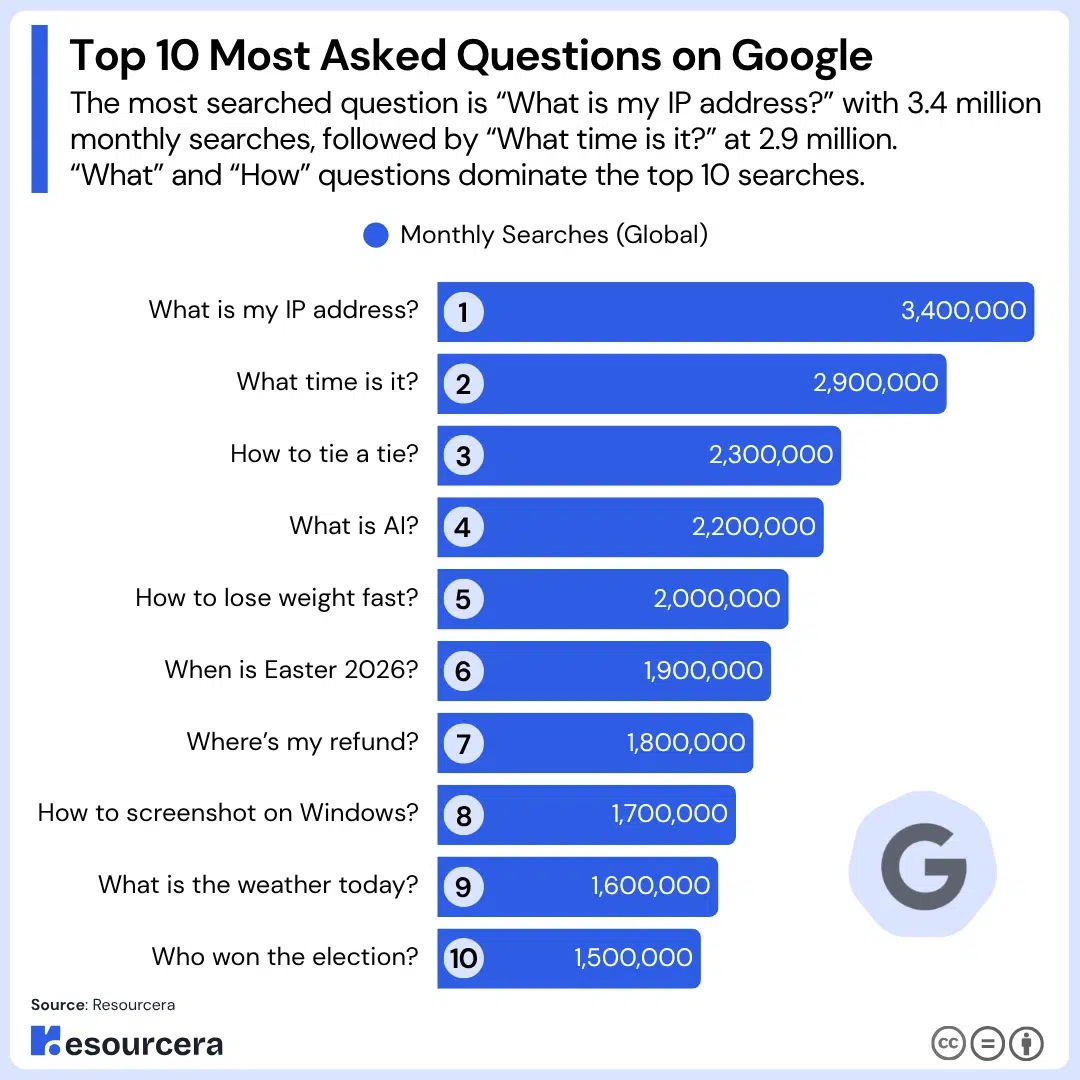
The table below shows the ten highest-volume questions.
| Rank | Question | Monthly Searches (Global) |
|---|---|---|
| 1 | What is my IP address? | 3,400,000 |
| 2 | What time is it? | 2,900,000 |
| 3 | How to tie a tie? | 2,300,000 |
| 4 | What is AI? | 2,200,000 |
| 5 | How to lose weight fast? | 2,000,000 |
| 6 | When is Easter 2026? | 1,900,000 |
| 7 | Where’s my refund? | 1,800,000 |
| 8 | How to screenshot on Windows? | 1,700,000 |
| 9 | What is the weather today? | 1,600,000 |
| 10 | Who won the election? | 1,500,000 |
These ten questions are not all the same kind of search. They fall into three groups.
- Evergreen interest, such as “What is my IP address?” and “How to tie a tie?”
- Utility-driven lookups, such as “Where’s my refund?” and “What time is it?”
- Timely and seasonal searches, such as “When is Easter 2026?” and “Who won the election?”
The pattern is clear. People use Google as a fast tool first and a research library second. Most of the top ten can be answered in a single sentence or with a small on-page widget.
Question Type Breakdown by Prefix
Grouping the top 100 by the first word shows what kind of help people want. A “what” question usually asks for a definition.
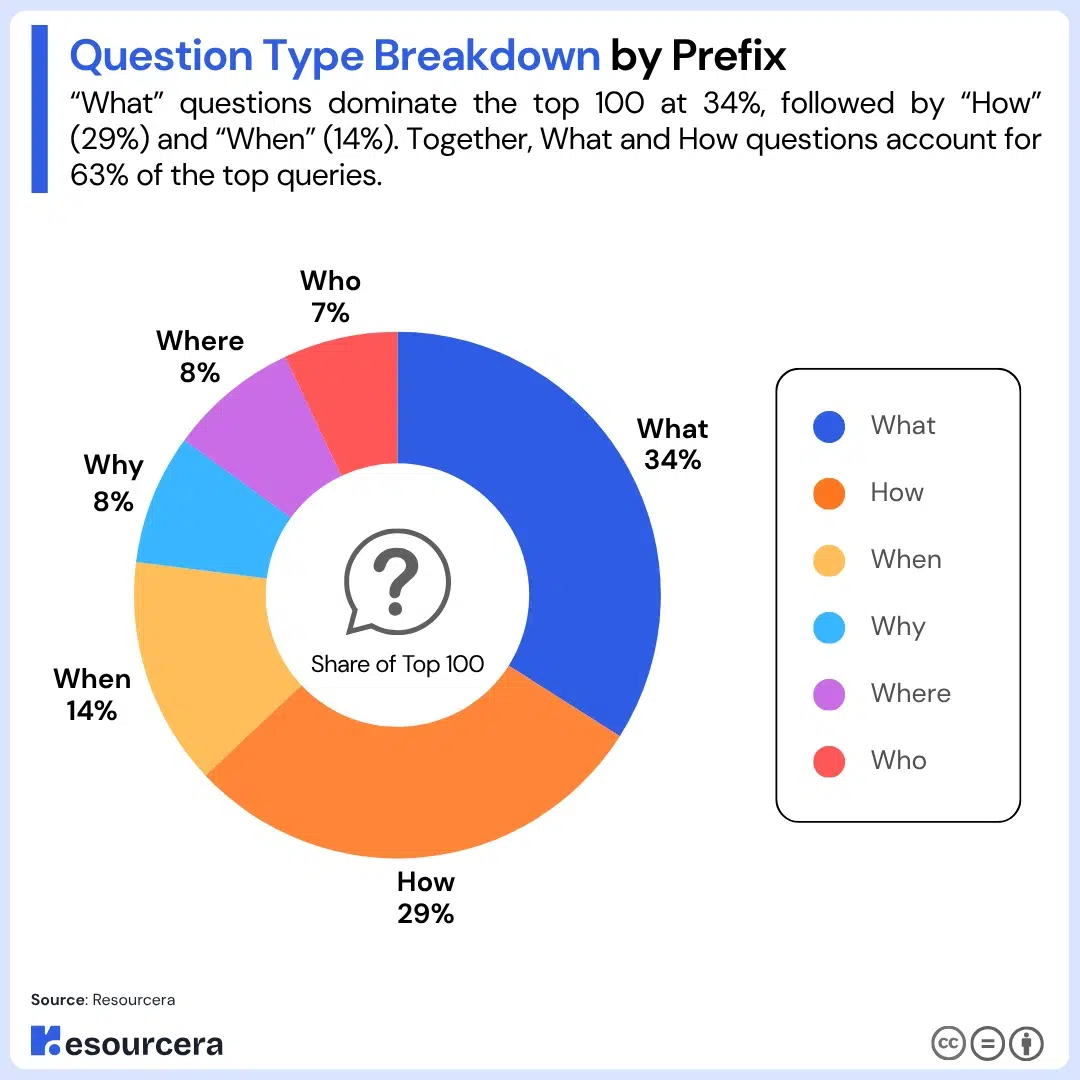
A “how” question asks for steps. The table below shows the share of each question type across the full list.
| Question Type | Share of Top 100 |
|---|---|
| What | 34% |
| How | 29% |
| When | 14% |
| Why | 8% |
| Where | 8% |
| Who | 7% |
“What” and “how” account for more than 60% of the entire list. That balance says a lot about how people treat Google. They want a definition or a set of steps, and they want it fast.
The remaining prefixes are smaller in volume but often carry sharper intent, since a “when” or “who” question usually points to a specific event or person.
The 100 Most Asked Questions on Google in 2026
The full list is below, ranked by estimated monthly global search volume. Each question is written the way people actually type it into Google.
The table also shows United States volume, the question type, and whether the query is evergreen or trending.
| Rank | Question | Monthly Searches (Global) | Monthly Searches (US) | Question Type | Evergreen or Trending |
|---|---|---|---|---|---|
| 1 | What is my IP address? | 3,400,000 | 2,900,000 | What | Evergreen |
| 2 | What time is it? | 2,900,000 | 2,400,000 | What | Evergreen |
| 3 | How to tie a tie? | 2,300,000 | 1,800,000 | How | Evergreen |
| 4 | What is AI? | 2,200,000 | 2,000,000 | What | Trending |
| 5 | How to lose weight fast? | 2,000,000 | 1,700,000 | How | Evergreen |
| 6 | When is Easter 2026? | 1,900,000 | 1,600,000 | When | Trending |
| 7 | Where’s my refund? | 1,800,000 | 1,700,000 | Where | Trending |
| 8 | How to screenshot on Windows? | 1,700,000 | 1,500,000 | How | Evergreen |
| 9 | What is the weather today? | 1,600,000 | 1,400,000 | What | Evergreen |
| 10 | Who won the election? | 1,500,000 | 1,500,000 | Who | Trending |
| 11 | How to delete Instagram account? | 1,400,000 | 1,200,000 | How | Evergreen |
| 12 | What is love? | 1,300,000 | 1,000,000 | What | Evergreen |
| 13 | What does my name mean? | 1,300,000 | 900,000 | What | Evergreen |
| 14 | How to take a screenshot on Mac? | 1,200,000 | 1,100,000 | How | Evergreen |
| 15 | What does AI stand for? | 1,200,000 | 1,050,000 | What | Trending |
| 16 | Why is the sky blue? | 1,100,000 | 900,000 | Why | Evergreen |
| 17 | What is inflation? | 1,100,000 | 950,000 | What | Trending |
| 18 | How to save money? | 1,000,000 | 900,000 | How | Evergreen |
| 19 | What is climate change? | 990,000 | 870,000 | What | Evergreen |
| 20 | How to cook rice? | 980,000 | 850,000 | How | Evergreen |
| 21 | What is a recession? | 970,000 | 820,000 | What | Trending |
| 22 | How many ounces in a cup? | 950,000 | 810,000 | How | Evergreen |
| 23 | When is the next full moon? | 940,000 | 800,000 | When | Trending |
| 24 | What is my location? | 920,000 | 890,000 | What | Evergreen |
| 25 | How to boil eggs? | 900,000 | 780,000 | How | Evergreen |
| 26 | When does daylight saving time end? | 880,000 | 850,000 | When | Trending |
| 27 | What is ChatGPT 5? | 860,000 | 830,000 | What | Trending |
| 28 | How to get Taylor Swift tickets? | 850,000 | 800,000 | How | Trending |
| 29 | Where is the next Apple event? | 840,000 | 790,000 | Where | Trending |
| 30 | What is the best laptop for students? | 830,000 | 750,000 | What | Trending |
| 31 | How to start a blog? | 820,000 | 700,000 | How | Evergreen |
| 32 | What is Bitcoin? | 810,000 | 740,000 | What | Trending |
| 33 | How to do a backflip? | 800,000 | 650,000 | How | Evergreen |
| 34 | What time zones are there? | 790,000 | 680,000 | What | Evergreen |
| 35 | When is Black Friday 2026? | 780,000 | 720,000 | When | Trending |
| 36 | Why do cats purr? | 770,000 | 650,000 | Why | Evergreen |
| 37 | How to jump higher? | 760,000 | 630,000 | How | Evergreen |
| 38 | What is love in Spanish? | 750,000 | 600,000 | What | Evergreen |
| 39 | How to make pancakes? | 740,000 | 680,000 | How | Evergreen |
| 40 | What is the stock market? | 730,000 | 650,000 | What | Evergreen |
| 41 | When is the next solar eclipse? | 720,000 | 700,000 | When | Trending |
| 42 | How to get rid of acne? | 710,000 | 650,000 | How | Evergreen |
| 43 | What is greenhouse effect? | 700,000 | 620,000 | What | Evergreen |
| 44 | How to change your password? | 690,000 | 600,000 | How | Evergreen |
| 45 | Why do we dream? | 680,000 | 590,000 | Why | Evergreen |
| 46 | What is the capital of France? | 670,000 | 580,000 | What | Evergreen |
| 47 | How to write a resume? | 660,000 | 580,000 | How | Evergreen |
| 48 | Who is Taylor Swift dating? | 650,000 | 620,000 | Who | Trending |
| 49 | What is quantum computing? | 640,000 | 600,000 | What | Trending |
| 50 | How to invest in stocks? | 630,000 | 560,000 | How | Evergreen |
| 51 | What is VPN? | 620,000 | 580,000 | What | Evergreen |
| 52 | When is Mother’s Day 2026? | 610,000 | 580,000 | When | Trending |
| 53 | How to increase Wi-Fi speed? | 600,000 | 550,000 | How | Evergreen |
| 54 | What is the Internet of Things? | 590,000 | 530,000 | What | Evergreen |
| 55 | How to play chess? | 580,000 | 500,000 | How | Evergreen |
| 56 | Why does the Moon change shape? | 570,000 | 520,000 | Why | Evergreen |
| 57 | What is blockchain? | 560,000 | 540,000 | What | Trending |
| 58 | How to clear browser cache? | 550,000 | 500,000 | How | Evergreen |
| 59 | Who invented the light bulb? | 540,000 | 500,000 | Who | Evergreen |
| 60 | When is Hanukkah 2026? | 530,000 | 500,000 | When | Trending |
| 61 | How to start a business? | 520,000 | 480,000 | How | Evergreen |
| 62 | What is cryptocurrency? | 510,000 | 480,000 | What | Trending |
| 63 | How to delete Facebook account? | 500,000 | 450,000 | How | Evergreen |
| 64 | What is the meaning of life? | 490,000 | 420,000 | What | Evergreen |
| 65 | Why do dogs bark? | 480,000 | 420,000 | Why | Evergreen |
| 66 | How to format USB drive? | 470,000 | 430,000 | How | Evergreen |
| 67 | What is a black hole? | 460,000 | 430,000 | What | Evergreen |
| 68 | When is Valentine’s Day 2026? | 450,000 | 420,000 | When | Trending |
| 69 | How to fix a flat tire? | 440,000 | 400,000 | How | Evergreen |
| 70 | Who is the President of the United States? | 430,000 | 430,000 | Who | Evergreen |
| 71 | What is 5G network? | 420,000 | 400,000 | What | Trending |
| 72 | How to use ChatGPT? | 410,000 | 380,000 | How | Trending |
| 73 | Why is my wifi slow? | 400,000 | 380,000 | Why | Evergreen |
| 74 | What is the fastest land animal? | 390,000 | 360,000 | What | Evergreen |
| 75 | How to bake a cake? | 380,000 | 350,000 | How | Evergreen |
| 76 | When is Diwali 2026? | 370,000 | 350,000 | When | Trending |
| 77 | What is net worth? | 360,000 | 340,000 | What | Evergreen |
| 78 | How to make money online? | 350,000 | 320,000 | How | Evergreen |
| 79 | Why is the ocean salty? | 340,000 | 300,000 | Why | Evergreen |
| 80 | What is data science? | 330,000 | 300,000 | What | Trending |
| 81 | How to reset iPhone? | 320,000 | 290,000 | How | Evergreen |
| 82 | Who is the CEO of Google? | 310,000 | 300,000 | Who | Evergreen |
| 83 | When is Earth Day 2026? | 300,000 | 290,000 | When | Trending |
| 84 | What is artificial intelligence? | 290,000 | 270,000 | What | Trending |
| 85 | How to delete TikTok account? | 280,000 | 260,000 | How | Evergreen |
| 86 | Why do we yawn? | 270,000 | 250,000 | Why | Evergreen |
| 87 | What is digital marketing? | 260,000 | 240,000 | What | Trending |
| 88 | How to find your IP address? | 250,000 | 230,000 | How | Evergreen |
| 89 | When is Mother’s Day in UK? | 240,000 | 230,000 | When | Trending |
| 90 | What is climate crisis? | 230,000 | 210,000 | What | Evergreen |
| 91 | How to download YouTube videos? | 220,000 | 200,000 | How | Evergreen |
| 92 | Why is my phone ringing? | 210,000 | 200,000 | Why | Evergreen |
| 93 | What is deep learning? | 200,000 | 180,000 | What | Trending |
| 94 | How to remove background from image? | 190,000 | 170,000 | How | Evergreen |
| 95 | When is Labour Day 2026? | 180,000 | 170,000 | When | Trending |
| 96 | What is microeconomics? | 170,000 | 150,000 | What | Evergreen |
| 97 | How to fix computer not turning on? | 160,000 | 140,000 | How | Evergreen |
| 98 | Who is the richest person in the world? | 150,000 | 150,000 | Who | Trending |
| 99 | What is pH scale? | 140,000 | 130,000 | What | Evergreen |
| 100 | How to create a website? | 130,000 | 120,000 | How | Evergreen |
The drop from rank 1 to rank 100 is steep. The top question pulls more than 25 times the volume of the hundredth. That gap is worth noting, because it means the first ten entries do most of the work in this data set. The sections below break the list down further.
Methodology and Sources
Ranking questions is harder than sorting a keyword list by volume. The same question can be typed in five different ways, and small changes in phrasing can split the volume across several entries. Intent matters as much as the raw number.
Where the Data Comes From
The rankings in this article come from a mix of keyword volume data and Google’s own suggestion systems. Using more than one source helps confirm that a question is genuinely popular and not just an artifact of one tool.
The dataset draws on the following sources.
- Large-scale keyword databases with monthly search volume estimates
- Google autocomplete suggestions
- Google’s People Also Ask boxes
- Google Trends data covering 2024 through the first quarter of 2026
- Clustering methods that separate true question queries from general keywords
Only queries written as questions were included. That means the query has to start with a question word such as “what”, “how”, “when”, “why”, “who”, or “where”. The figures reflect data pulled in January 2026.
What People Are Really Asking
Grouping the top 100 by question type shows the intent behind the volume. Each prefix points to a different need, and each one suits a different kind of content. The four sections below cover every prefix in the list.
“What” Questions
Roughly 34% of the top asked questions on Google begin with “what”. These queries ask for a definition or a quick fact. They are the largest single group in the data set.
Common examples include the following.
- What is my IP address?
- What is AI?
- What does my name mean?
- What is inflation?
- What is climate change?
Most of these are evergreen, which means demand stays steady over time. If you want long-term search traffic, answering “what is” questions clearly remains one of the safest bets. A short definition placed right under the heading, followed by detail, is the format that tends to win featured snippets.
“How” Questions
About 29% of the most Googled questions start with “how”. These signal strong informational intent, since the person wants steps, a tutorial, or advice rather than a definition.
Common examples include the following.
- How to tie a tie?
- How to lose weight fast?
- How to screenshot on Windows?
- How to save money?
- How to boil eggs?
“How” queries work best in formats that show a process. Step-by-step blog posts, video tutorials, and product setup guides all fit. They also perform well in featured snippets when paired with numbered steps or short bullet points.
“When” Questions
“When” questions make up 14% of the list. They carry time-based intent, since people want a date for a holiday, an event, or a recurring change such as daylight saving time.
Common examples include the following.
- When is Easter 2026?
- When is the next full moon?
- When does daylight saving time end?
- When is Black Friday 2026?
- When is Diwali 2026?
These queries spike hard and then fall away, which makes them ideal for calendar-based content. News publishers do well here because they can update the same page year after year and keep the ranking.
“Why”, “Where”, and “Who” Questions
The remaining 23% of the list is split across “why” at 8%, “where” at 8%, and “who” at 7%. These are smaller in share but often more specific, and they tend to be driven by curiosity or by a live event.
Common examples include the following.
- Why is the sky blue?
- Why do cats purr?
- Where’s my refund?
- Where is the next Apple event?
- Who won the election?
Three traits show up again and again in this group. The queries are often emotional or curiosity-led, they are frequently event-driven, and many are personal to the searcher. That makes them a good fit for FAQ pages, support content, and news analysis.
Evergreen Questions Compared With Trending Questions
Not every popular question holds its value. Some hold steady for years, while others rise fast around an event and then fade. Knowing which is which changes how you plan and how you measure success. The two sections below cover both types.
Evergreen Questions That Hold Steady
Evergreen questions keep their volume regardless of the season, the news cycle, or the latest product launch. They form the base layer of search behavior and take up much of the top half of this list.
Examples from the top 100 include the following.
- What is my IP address?
- How to tie a tie?
- What does my name mean?
- How many ounces in a cup?
- Why is the sky blue?
There are three practical reasons these matter. They deliver stable monthly traffic, they suit pillar pages and long-term SEO, and they work well as reference or FAQ content. The best structure is simple. Answer the core question first, then branch into variations, follow-up questions, and related terms.
Trending Questions That Spike Fast
Trending questions are driven by real events. Elections, holidays, product launches, and breaking news all push volume up quickly. The traffic may not last, but the peak can be very large.
Examples from the top 100 include the following.
- When is Easter 2026?
- Who won the election?
- What is ChatGPT 5?
- Where is the next Apple event?
- How to get Taylor Swift tickets?
These queries earn high click-through rates during the peak window. They suit news outlets, event blogs, and social-first publishers. To catch them early, set up alerts on your core topics and watch trend tools so you can publish before the curve tops out rather than after.
Global and Local Search Differences
The top 100 reflects worldwide behavior, but search intent shifts by country, language, and even device. A question that dominates in the United States may not appear at all in Germany’s top queries. The three sections below show how that plays out.
United States
In the United States, utility questions and government topics rank high. Americans turn to Google for day-to-day tasks and for seasonal responsibilities such as filing taxes.
Common examples include the following.
- Where’s my refund?
- How to file taxes?
- What is my IP address?
- When is Thanksgiving?
United States search behavior also shows strong seasonality around sports events, elections, and federal holidays. That creates a predictable annual pattern that publishers can plan against.
Germany
In Germany, many of the most searched questions cover time zones, holidays, and everyday digital tasks. The phrasing changes, but the underlying need is often the same as in English-speaking markets.
Common examples include the following.
- Wie spät ist es? (What time is it?)
- Wann ist Ostern 2026? (When is Easter 2026?)
- Was ist KI? (What is AI?)
- Wie mache ich einen Screenshot? (How do I take a screenshot?)
German search leans toward factual queries. Clear answers and practical solutions tend to perform better than long, discursive content.
Questions That Rank Everywhere
Some questions cross borders and appear near the top in almost every market. They are universal in nature, which makes them a strong base for international content plans.
Common examples include the following.
- What is AI?
- How to lose weight fast?
- What is the weather today?
- How to take a screenshot?
One thing to watch here. The intent behind these questions stays the same across languages, but the phrasing does not. Translating the article is not enough. You also have to translate the keyword structure, since a direct translation often misses the phrase people actually type.
What the Top Questions Reveal
Once you look past the rankings, patterns start to appear. They show how people use search and where the openings are. The five sections below cover the main ones.
Informational Intent Beats Transactional Intent
Most of the top queries are informational, especially the “what” and “how” entries. People want answers, not products. That matches Google’s continued focus on experience, expertise, authoritativeness, and trust, along with topical depth. Building content clusters around informational queries captures both traffic and authority over time.
Simple Questions Win
Many of the biggest questions are short and plain. “What time is it?”, “What is my IP address?”, and “How many ounces in a cup?” all sit near the top. These reflect immediate, utility-based needs that can be solved in one line or with a small tool. The takeaway is to avoid overcomplicating the answer. A short, accurate response near the top of the page is often what wins the snippet.
AI and Tech Questions Are Rising
Queries such as “What is AI?”, “What does AI stand for?”, and “What is ChatGPT 5?” now sit high in the list. Public interest in emerging technology has moved from niche to mainstream. If you work in technology, finance, or education, the opportunity is to anticipate the next wave of questions and answer them in plain English before the volume peaks.
Time-Sensitive Questions Are an Opportunity
Many “when” and “who” queries show sharp seasonal spikes. Holiday dates, election results, and eclipse timings all follow a predictable curve. Build a content calendar around these, publish or update several weeks before the peak, and refresh the same page every year rather than starting over.
Localization Still Matters
Global trends tell one story, but country-level behavior often follows different rules. In markets such as Germany and India, the top questions reflect local holidays, regulations, and language habits. Check country-level data before you publish, and adjust headlines, structured data, and phrasing to match how people search in that market.
Takeaways for Content and SEO Teams
This list works best as a planning input rather than a set of trivia. The value comes from matching your content to the way people actually phrase their needs. The three sections below break the takeaways down by role.
For Content Creators
Write about what people ask, not what you assume they care about. The top asked questions on Google are usually simple but carry high intent, so your headings should mirror natural search phrasing rather than clever wording.
Two things help most here.
- Use H2 and H3 headings that repeat the question the way it is typed.
- Turn one high-volume query into a cluster. “How to lose weight fast?” can support related pieces on diets, exercise routines, and common mistakes.
For SEO Professionals
Question keywords are the most direct route to featured snippets. The format of this list maps neatly onto snippet optimization, since each entry is already a complete query.
Two things help most here.
- Open with a short factual answer, then expand, and support the page with FAQPage structured data.
- Review trending questions every month. Queries tied to technology, health, and pop culture move fastest and reward early coverage.
For Publishers and Media Teams
Publishers have an advantage on calendar-driven queries because they can build once and update forever. Seasonal “when” and “who” questions deliver repeatable traffic if the page is prepared in advance.
Two things help most here.
- Own the calendar. Prepare holiday and event pages early, then refresh them annually to hold the ranking.
- Localize where possible. Top questions in Germany or the United Kingdom differ from those in the United States, so adapt headlines and keyword phrasing for each market.
Related Read:
Conclusion
The most asked question on Google in 2026 is “What is my IP address?”.
That single entry sums up the wider pattern. People use search as a fast utility, and the biggest questions are usually the simplest ones.
Everything else in the list follows from that. Definitions and instructions dominate, holidays and events create predictable spikes, and technology questions keep climbing as new tools reach the mainstream.
For anyone planning content, the value is not in the ranking itself. It is in seeing which questions people already ask, and choosing the ones you can answer better than anyone else.

