
Sample Size Calculator
Determine how many survey responses you need for statistical significance.
Required Sample Size
Find out how many respondents you need to collect statistically reliable survey results.
Use this sample size calculator to estimate the number of people you should survey based on your population size, confidence level, and margin of error. It is useful for market research, customer surveys, academic research, business studies, and opinion polls.
Sample Size Calculator
Find how many respondents you need for statistically reliable survey results.
Check out all the free tools and calculators for market research and surveys.
What Is a Sample Size Calculator?
A sample size calculator helps you find how many people you need to include in a survey or research study.
When you cannot ask every person in a group, you collect responses from a smaller group. This smaller group is called a sample. The calculator helps you decide how large that sample should be so your results are more reliable.
For example, if your target audience has 10,000 people, you do not always need to survey all 10,000. A sample size calculator can show how many responses are enough to represent that group with a selected confidence level and margin of error.
Why Sample Size Matters
Sample size is important because it affects the accuracy of your survey results.
If your sample size is too small, your results may not represent the full audience properly. This can lead to weak conclusions or misleading decisions.
If your sample size is too large, you may spend more time, money, and effort than needed.
The goal is to find the right balance. A good sample size gives you useful results without wasting resources.
How to Use This Sample Size Calculator
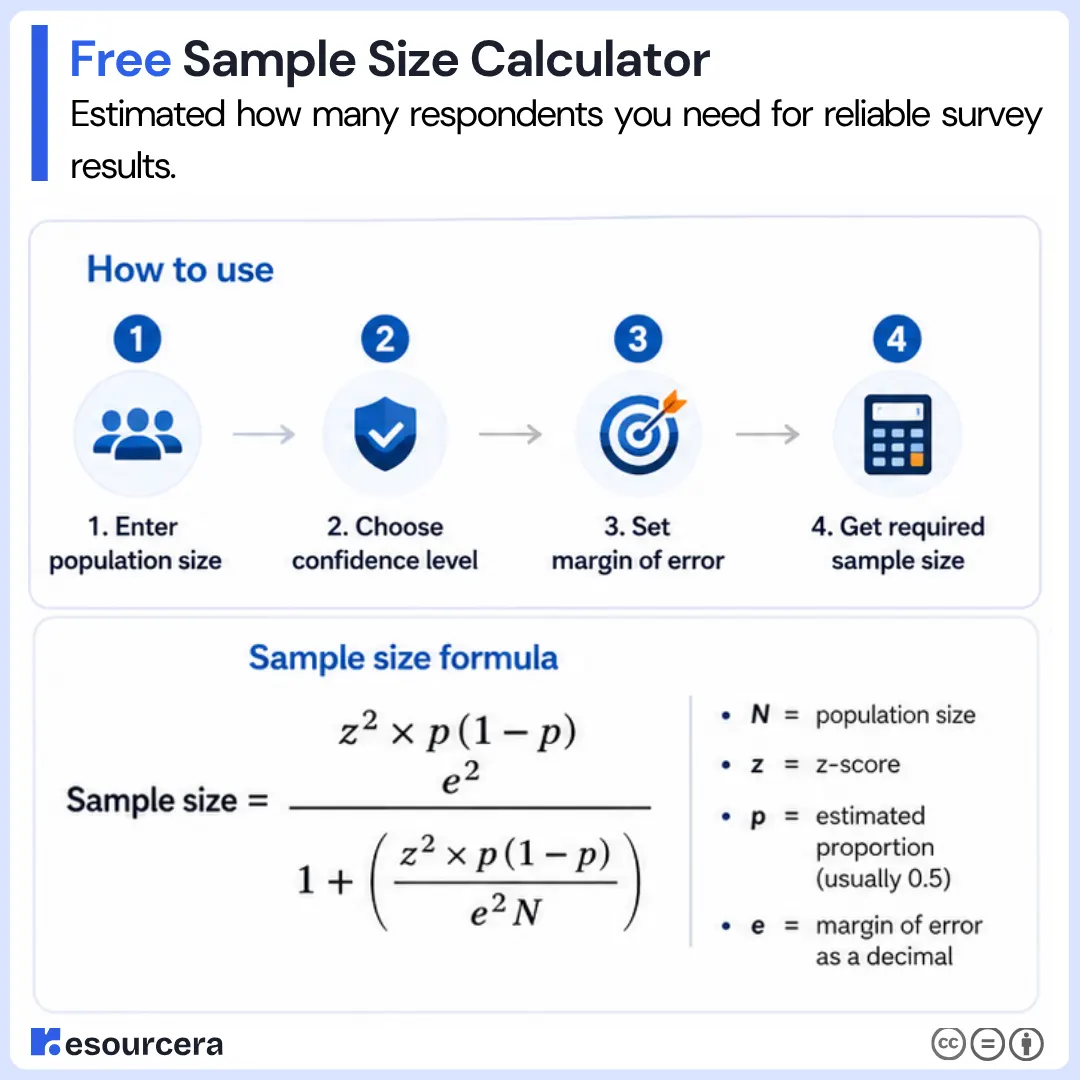
To use the calculator, enter three values:
Population Size
Population size means the total number of people in the group you want to study.
For example, this could be:
- Total customers
- Website visitors
- App users
- Employees
- Students
- Voters
- People in a target market
If you are not sure about the exact population size, use your best available number.
Confidence Level
Confidence level shows how sure you want to be that your survey results reflect the full population.
Common confidence levels are 90%, 95%, and 99%.
A 95% confidence level is commonly used in surveys and research. It means that if the same survey was repeated many times, the results would likely fall within the selected margin of error 95% of the time.
Higher confidence levels usually need a larger sample size.
Margin of Error
Margin of error shows how much your results may vary from the actual population value.
For example, if your margin of error is 5%, and 60% of respondents choose an answer, the actual result for the full population may be around 55% to 65%.
A smaller margin of error gives more precise results, but it also requires a larger sample size.
Sample Size Example
Suppose you want to survey a population of 10,000 people.
You choose:
- Population size: 10,000
- Confidence level: 95%
- Margin of error: 5%
The calculator will estimate how many respondents you need for reliable results.
This helps you plan your survey before collecting responses.
When Should You Use a Sample Size Calculator?
You can use this calculator before starting any survey, poll, or research project.
It is helpful for:
- Market research surveys
- Customer feedback surveys
- Product research
- Brand awareness studies
- Employee satisfaction surveys
- Student research projects
- Public opinion polls
- Website and app user research
Using the right sample size helps improve the quality of your research and makes your survey results easier to trust.
What Is a Good Sample Size?
A good sample size depends on your population size, confidence level, and margin of error.
There is no single number that works for every survey.
For many general surveys, researchers often use a 95% confidence level and a 5% margin of error. These settings give a practical balance between accuracy and effort.
If you need more precise results, you can reduce the margin of error. However, this will increase the number of responses required.
Sample Size Formula
This calculator uses the standard sample size formula with finite population correction.
Formula:
Sample size = [z² × p × (1 – p) / e²] ÷ [1 + {(z² × p × (1 – p)) / (e² × N)}]
Where:
- N = Population size
- z = Z-score based on the selected confidence level
- p = Estimated proportion of the population, usually 0.5
- e = Margin of error in decimal form
For example, if the margin of error is 5%, it is used as 0.05 in the formula.
The formula first calculates the ideal sample size and then adjusts it based on the total population size. This helps estimate how many respondents are needed without surveying the entire population.
