There are 597,737 ecommerce stores in Germany in 2026. That means Germany accounts for 2.43% of the world’s 24.56 million ecommerce stores, making it the third-largest market after the United States and the United Kingdom.
The German store count has grown 37.89% since 2020; back then, the country had 433,473 online stores.
This post covers the latest data on Germany’s ecommerce stores, including growth, platform share, sales, shopper spending, AI use, and cart abandonment.
Read on to get full insights.
Ecommerce Stores in Germany 2026: Top Picks
- There are 597,737 ecommerce stores in Germany in 2026.
- 2.43% of the world’s 24.56 million ecommerce stores are based in Germany.
- Germany added 39,237 new stores in 2026, a 7.0% rise on 2025.
- Shopify powers 29.22% of German ecommerce stores, the largest share of any platform.
- Germany has the third-most ecommerce stores in the world, behind the United States and the United Kingdom.
- German ecommerce stores generated €83.1 billion in goods sales in 2025.
- The average German ecommerce order was worth €146.19 in 2025.
- 47.3% of German retail companies use AI in at least part of their business.
How Many Ecommerce Stores Are There in Germany?
As of 2026, there are 597,737 ecommerce stores in Germany in 2026. That is 2.43% of the 24.56 million ecommerce stores in the world. The store count has grown 37.89% since 2020, when Germany had 433,473 stores.
Source: BuiltWith
Germany Ecommerce Store Growth By Year
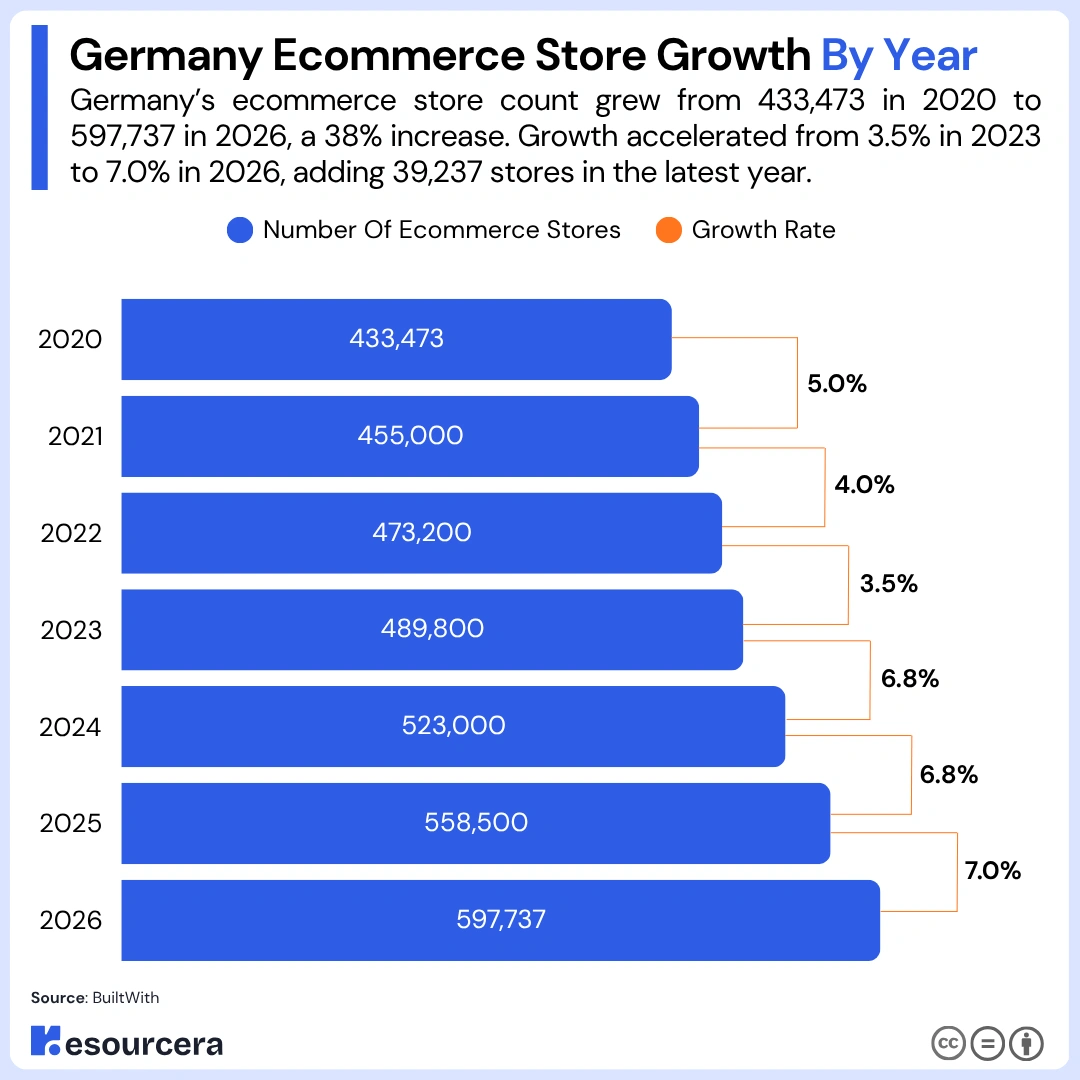
Germany added 39,237 ecommerce stores in 2026, a 7.0% rise on 2025. The store count has grown every year since 2020, and growth has accelerated again after slowing between 2021 and 2023.
| Year | Number Of Ecommerce Stores | Growth Rate |
|---|---|---|
| 2020 | 433,473 | – |
| 2021 | 455,000 | 5.0% |
| 2022 | 473,200 | 4.0% |
| 2023 | 489,800 | 3.5% |
| 2024 | 523,000 | 6.8% |
| 2025 | 558,500 | 6.8% |
| 2026 | 597,737 | 7.0% |
2026 is the fastest growth year in the series at 7.0%, while 2023 was the slowest at 3.5%.
Source: BuiltWith
Ecommerce Platform Market Share In Germany
Shopify is the most used ecommerce platform in Germany with a 29.22% market share in 2026. Wix Stores ranks second at 19.54%, and Cart Functionality ranks third at 12.50%.
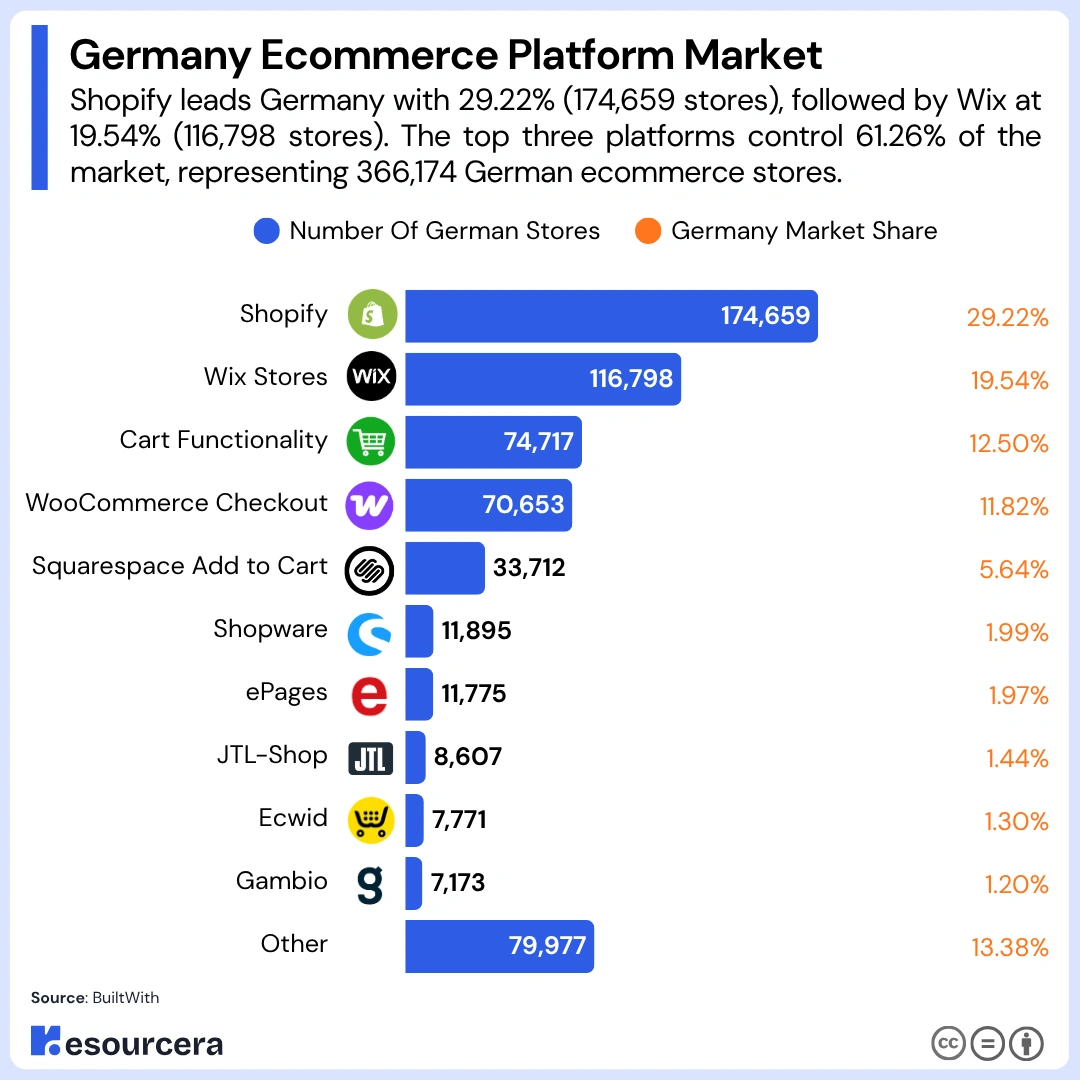
The top three platforms together power 61.26% of all German ecommerce stores.
| Ecommerce Platform | Germany Market Share |
|---|---|
| Shopify | 29.22% |
| Wix Stores | 19.54% |
| Cart Functionality | 12.50% |
| WooCommerce Checkout | 11.82% |
| Squarespace Add to Cart | 5.64% |
| Shopware | 1.99% |
| ePages | 1.97% |
| JTL-Shop | 1.44% |
| Ecwid | 1.30% |
| Gambio | 1.20% |
| Other | 13.38% |
| Total | 100.00% |
Shopify runs 174,659 stores in Germany, 57,861 more than second-placed Wix Stores.
| Ecommerce Platform | Number Of German Stores |
|---|---|
| Shopify | 174,659 |
| Wix Stores | 116,798 |
| Cart Functionality | 74,717 |
| WooCommerce Checkout | 70,653 |
| Squarespace Add to Cart | 33,712 |
| Shopware | 11,895 |
| ePages | 11,775 |
| JTL-Shop | 8,607 |
| Ecwid | 7,771 |
| Gambio | 7,173 |
| Other | 79,977 |
| Total | 597,737 |
Source: BuiltWith
Which Country Has The Most Ecommerce Stores?
The United States has the most ecommerce stores of any country, with 13.63 million stores in 2026. Germany ranks third with 0.60 million stores, behind the United Kingdom at 1.02 million.
Germany has 12,811 more ecommerce stores than Australia, which ranks fourth. The United States has 22.8 times more stores than Germany.
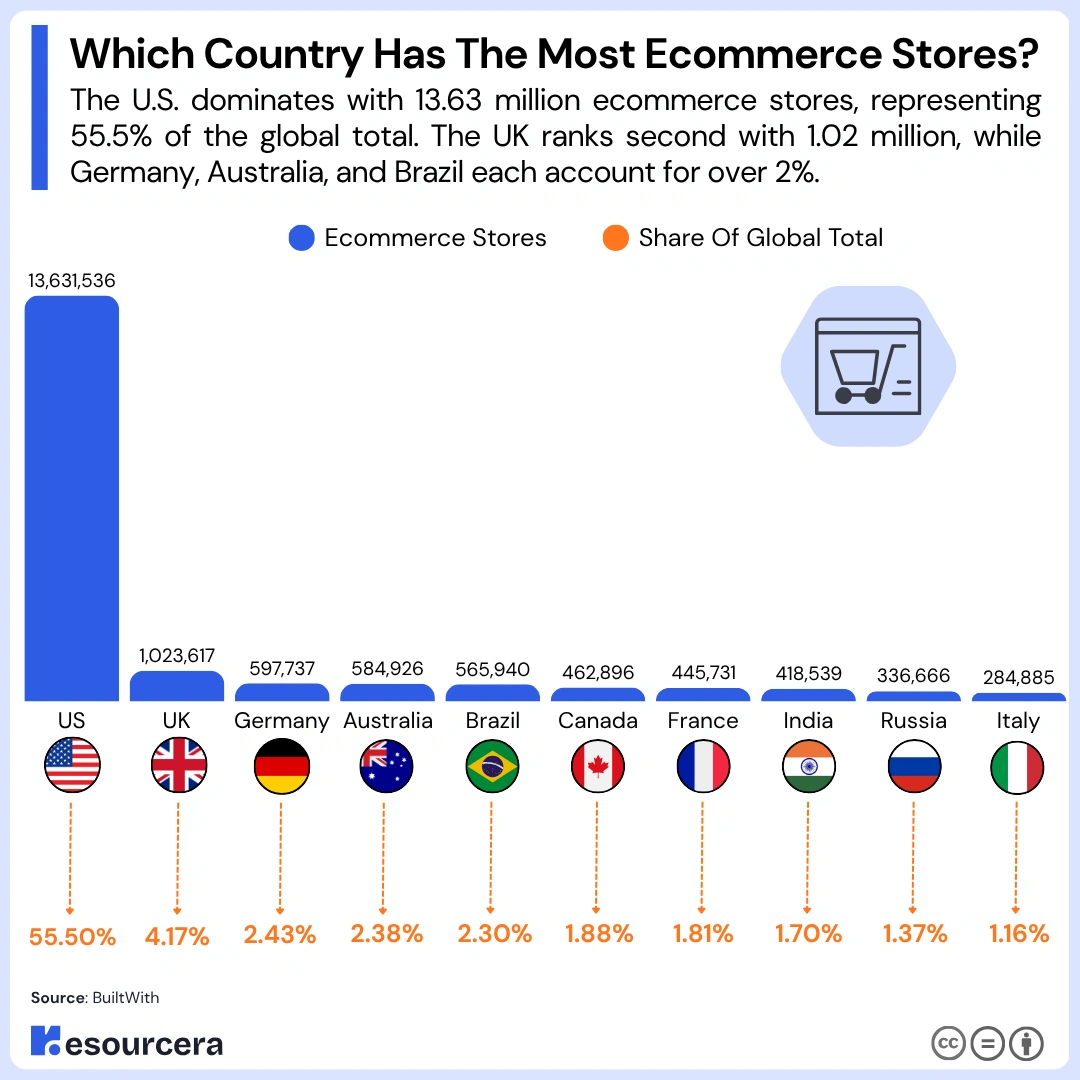
| Country | Ecommerce Stores | Share Of Global Total |
|---|---|---|
| United States | 13,631,536 | 55.50% |
| United Kingdom | 1,023,617 | 4.17% |
| Germany | 597,737 | 2.43% |
| Australia | 584,926 | 2.38% |
| Brazil | 565,940 | 2.30% |
| Canada | 462,896 | 1.88% |
| France | 445,731 | 1.81% |
| India | 418,539 | 1.70% |
| Russia | 336,666 | 1.37% |
| Italy | 284,885 | 1.16% |
For the full breakdown of the market leader, see our report on ecommerce sales in the USA.
Source: BuiltWith
How Much Revenue Do German Ecommerce Stores Generate?
German ecommerce stores generated €83.1 billion in goods sales in 2025, up 3.2% from €80.6 billion in 2024. Sales reached €41.6 billion in the first half of 2026, a 4.3% rise on the same period a year earlier.
The first quarter of 2026 generated about €20.4 billion in ecommerce goods sales and the second quarter generated €21.2 billion. bevh and the EHI Retail Institute expect full-year goods sales to grow 3.8% in 2026, which would put the market at about €86.3 billion if the forecast holds.
Based on the 558,500-store count for 2025, sales worked out to a simple average of about €148,800 per store.
Sources: bevh 2025 results, bevh H1 2026
How Much Do Shoppers Spend Per Order In Germany?
The average order value (AOV) for a German ecommerce order was €146.19 in 2025. That is up 1.4% from €144.12 in 2024.
German online shoppers are also frequent buyers. 34.2% of customers ordered goods online at least twice a week in 2025, almost unchanged from 34.1% a year earlier.
Customer satisfaction remained high at 96.2%, while the share of shoppers planning to spend less online fell to 24.6%, the lowest level in four years.
Source: bevh
How Much Of German Ecommerce Runs Through Marketplaces?
Online marketplaces generated €46.2 billion in German ecommerce goods sales in 2025. That is 56% of the country’s €83.1 billion ecommerce goods market.
Marketplace sales grew 4.9% in 2025, faster than the overall ecommerce market at 3.2%. This means more than half of German online spending now runs through platforms rather than only through retailers’ own online stores.
Chinese platforms are growing much faster. Shein, Temu and AliExpress generated €3.7 billion in German sales in 2025, up 27.2% from the year before. They accounted for 30% of the market’s total annual growth, and one in every 15 online orders went to one of these platforms.
Source: bevh
AI Adoption Among German Ecommerce Stores
47.3% of German retail companies now use AI in individual areas or across the business, up from 23.5% in 2023 and 7.5% in 2020. Another 16.8% are planning to use AI, while 35.9% say it is not in use and not planned.
The HDE figure covers German retail companies rather than ecommerce-only stores, but it is the strongest current store-side measure.
The gap by company size is wide. 73.2% of retailers with more than €1 billion in annual revenue use AI, compared with 51.7% of companies between €50 million and €1 billion and 25% of companies below €50 million.
Bitkom data shows where German retailers are already using AI:
| AI Use Case | Share Of German Retailers |
|---|---|
| Customer service and communication | 25% |
| Text generation | 22% |
| Personalized recommendations | 18% |
| Inventory management | 18% |
| Image generation | 17% |
| Price optimization | 13% |
| Fraud detection and security | 11% |
| Websites and apps | 7% |
61% of German retailers say using AI gives merchants a competitive advantage. The biggest gap is still between interest and day-to-day use.
Sources: HDE AI Study 2025, Bitkom
How Do Germans Shop Online?
96% of German internet users bought something online in the previous 12 months. More than one-third shop online at least once a week, including 36% who buy weekly or more often.
The smartphone is the most used device for online shopping. 73% of German online shoppers use a smartphone, compared with 52% who use a notebook, 31% a desktop computer and 27% a tablet.
This makes mobile presentation important even though shoppers still use several devices across the buying process.
Source: Bitkom
Cross-Border Ecommerce In Germany
65% of Germans have ordered from an online retailer outside the country. Among these cross-border shoppers, 49% have ordered from China.
Foreign online providers now generate close to €11 billion of ecommerce sales in Germany. Temu and Shein alone account for about €4.7 billion of that total.
Cross-border competition is therefore a material part of the German ecommerce market, not a small niche. It also helps explain why marketplaces and low-price international platforms are gaining share faster than the wider market.
Source: HDE Online Monitor 2026
Which Ecommerce Categories Generate The Most Revenue In Germany?
Clothing is the largest ecommerce product category in Germany, generating €15.13 billion in 2025. Electronics and telecommunications rank second at €12.25 billion, followed by household goods and appliances at €7.20 billion.
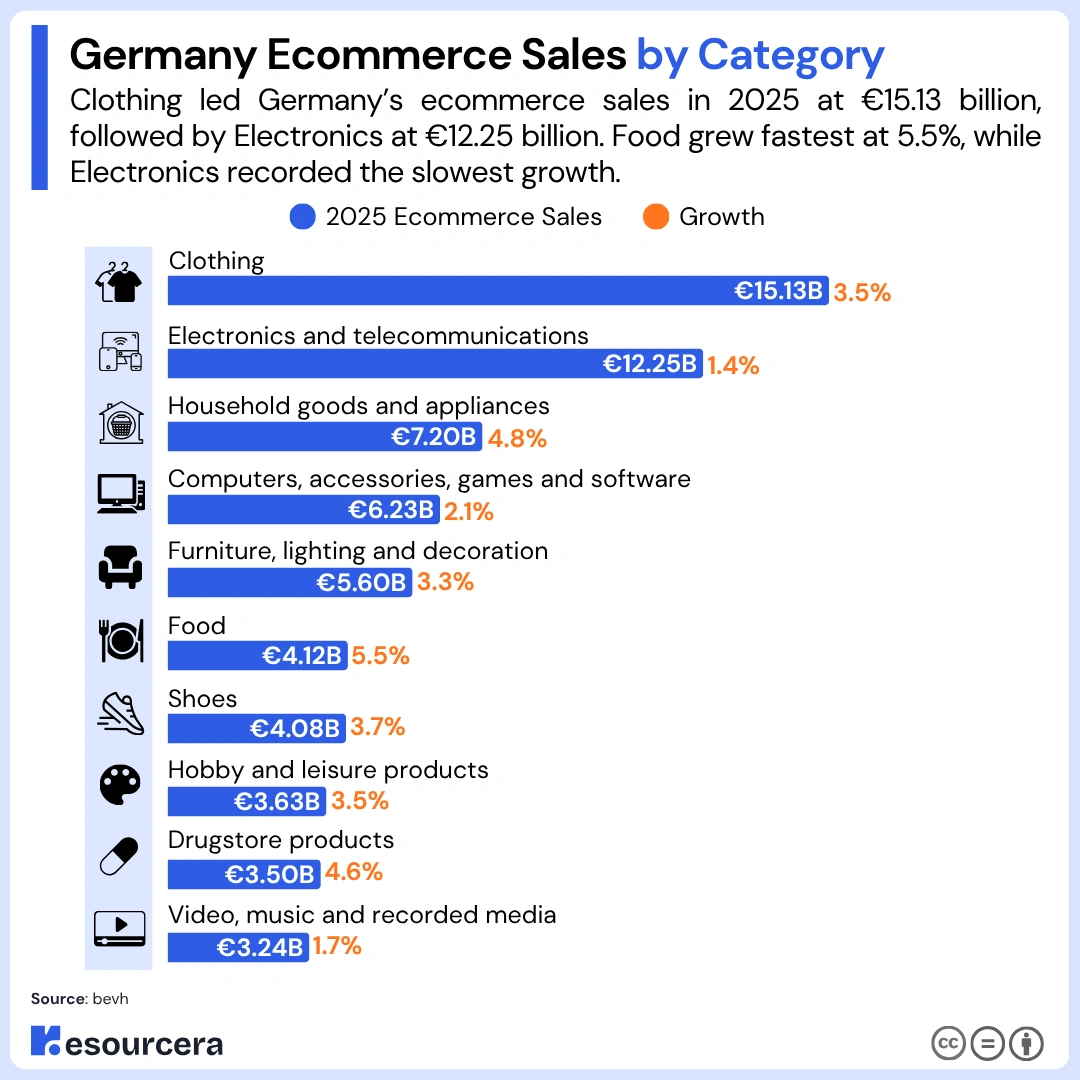
Here are the ten largest product categories by 2025 ecommerce goods sales:
| Product Category | 2025 Ecommerce Sales | Growth |
|---|---|---|
| Clothing | €15.13 billion | 3.5% |
| Electronics and telecommunications | €12.25 billion | 1.4% |
| Household goods and appliances | €7.20 billion | 4.8% |
| Computers, accessories, games and software | €6.23 billion | 2.1% |
| Furniture, lighting and decoration | €5.60 billion | 3.3% |
| Food | €4.12 billion | 5.5% |
| Shoes | €4.08 billion | 3.7% |
| Hobby and leisure products | €3.63 billion | 3.5% |
| Drugstore products | €3.50 billion | 4.6% |
| Video, music and recorded media | €3.24 billion | 1.7% |
The fastest-growing categories were medicines at 6.0%, food at 5.5% and pet supplies at 5.0%.
Source: bevh
Cart Abandonment Rate For Ecommerce Stores In Germany
Ecommerce stores in Germany have a cart abandonment rate of 80% in 2026. That means 80 out of every 100 online shoppers who add an item to their cart leave without completing the purchase.
Germany’s rate is three percentage points below the global average of 83%. It is also lower than the United States, Canada, France, Italy, Australia, Ireland, Spain and South Korea.
The UK, Japan, Belgium, the Netherlands and Switzerland all have lower cart abandonment rates than Germany.
Here is a table showing the cart abandonment rate across countries:
| Country / Region | Cart Abandonment Rate |
|---|---|
| Mexico | 93% |
| South Korea | 88% |
| Spain | 88% |
| Australia | 87% |
| Ireland | 87% |
| Canada | 85% |
| France | 85% |
| Italy | 85% |
| Global | 83% |
| Poland | 83% |
| Portugal | 83% |
| UAE | 83% |
| USA | 83% |
| New Zealand | 81% |
| Germany | 80% |
| Nordics | 79% |
| Japan | 78% |
| UK | 77% |
| Belgium | 76% |
| Netherlands | 66% |
| Switzerland | 60% |
Source: Statista
Future Outlook for German Ecommerce Stores
Germany’s ecommerce store count has grown every year since 2020 and reached 597,737 in 2026. Growth accelerated to 7.0% in the latest year, putting Germany third globally and first among European Union countries by store count.
Store sales are growing too, with €83.1 billion in goods sales in 2025 and €41.6 billion in the first half of 2026. Two shifts are worth watching from here.
First, marketplaces already handle 56% of German ecommerce goods sales and continue to grow faster than the overall market. Second, AI use among German retailers has doubled since 2023, from 23.5% to 47.3%.
We will update this page as new store count data is released.