
How Many Gamers Are There in the World? (2010 to 2030)
Definition of Gamer: Anyone who has played a video game on a PC, console, or mobile device at least once in the past six months.
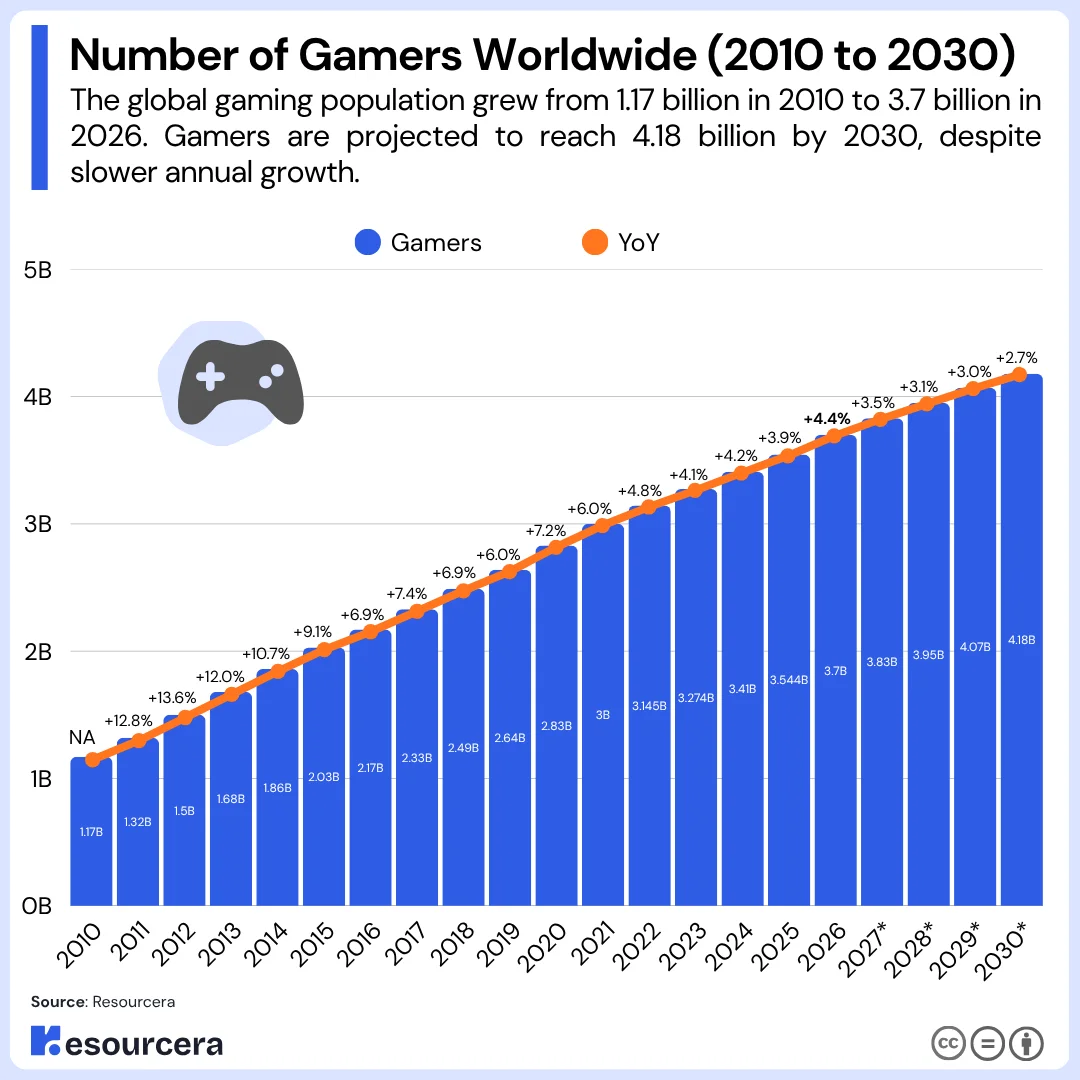
Number of Gamers Worldwide From 2010 to 2030
| Year | Gamers | YoY |
|---|---|---|
| 2010 | 1.17 billion | NA |
| 2011 | 1.32 billion | +12.8% |
| 2012 | 1.50 billion | +13.6% |
| 2013 | 1.68 billion | +12.0% |
| 2014 | 1.86 billion | +10.7% |
| 2015 | 2.03 billion | +9.1% |
| 2016 | 2.17 billion | +6.9% |
| 2017 | 2.33 billion | +7.4% |
| 2018 | 2.49 billion | +6.9% |
| 2019 | 2.64 billion | +6.0% |
| 2020 | 2.83 billion | +7.2% |
| 2021 | 3 billion | +6.0% |
| 2022 | 3.145 billion | +4.8% |
| 2023 | 3.274 billion | +4.1% |
| 2024 | 3.41 billion | +4.2% |
| 2025 | 3.544 billion | +3.9% |
| 2026 | 3.70 billion | +4.4% |
| 2027* | 3.83 billion | +3.5% |
| 2028* | 3.95 billion | +3.1% |
| 2029* | 4.07 billion | +3.0% |
| 2030* | 4.18 billion | +2.7% |
*Forecasted values.
Detailed Insights on the Number of Gamers Worldwide
There are 3.70 billion gamers worldwide in 2026. That is a 4.4% growth from 2025 when there were 3.54 billion gamers. Growth picked up this year after slowing to 3.9% in 2025, which was the lowest yearly rate since 2010.
2.53 billion individuals joined the global population of gamers between 2010 and 2026, more than tripling the global gamer base. Yearly growth has slowed over time, from double-digit rates between 2011 and 2014 to between 3.9% and 4.8% since 2022.
The number of gamers is expected to keep growing, but at a slower pace. Projections put the count at 3.83 billion in 2027 and 4.18 billion by 2030. That would be 480 million more gamers than in 2026, even as yearly growth slows to 2.7% by 2030.
Notable Data Points on Global Gamer Growth
- The number of gamers worldwide more than doubled during the 2010s, rising from 1.17 billion in 2010 to 2.64 billion in 2019, an increase of 1.47 billion.
- The global gamer base touched the 3 billion mark in 2021, that’s six years after it first crossed 2 billion in 2015.
- The number of gamers is projected to cross the 4 billion mark in 2029, when it is expected to reach 4.07 billion, eight years after the 3 billion milestone.
- 2020 recorded the largest single-year increase in the data, as the number of gamers grew by 190 million, from 2.64 billion in 2019 to 2.83 billion.
- 2012 had the fastest growth rate in the period, when the number of gamers rose 13.6% from 1.32 billion in 2011 to 1.50 billion.
Want to know what caused all these changes? Read on to know more!
Growth Factors For The Gaming Industry Over The Years
Understand what happened across the globe around the gaming sector from the early 1970s to date. This will help you grasp the change in gamer count over the years better.
1970 to 2005: A hobby that kept getting bigger
In the early days, nobody counted how many people played video games around the world. But there is another way to see how fast the hobby grew, and that is to look at how many consoles people bought.
Gaming began in arcades and living rooms in the late 1970s. The Atari 2600 came out in 1977 and went on to sell about 30 million units. That early boom did not last long enough, and the market crashed in 1983. Things recovered a couple of years later, when Nintendo released the NES and brought people back to gaming.
Once gaming was back on its feet, the next big step was taking it out of the house. Nintendo’s Game Boy arrived in 1989, and together with the Game Boy Color, it sold 118.69 million units. For the first time, kids could play in the car, at school, or anywhere else they went.
While Nintendo was winning over kids, Sony set out to win over older players. Its first PlayStation sold 102.49 million units and became the first home console to cross 100 million. The PlayStation 2 followed in 2000 and sold 160 million units. No console has outsold it since.
Consoles were not the whole story, though. At the same time, two quieter changes were bringing in people who had never owned a console. In South Korea and China, internet cafés turned PC games like StarCraft into something friends did together, even if they had no gaming hardware at home. And in 1997, Nokia put the game Snake on its 6110 phone. By 2005, Snake was on 350 million Nokia phones, and for many people it was the very first video game they ever played.
So by 2005, the base was ready. Consoles were part of everyday life, online play was growing, and the phone had already shown it could be a gaming device too.
2005 to 2008: Gaming left the bedroom
By the mid-2000s, plenty of people were playing. The Xbox 360 had just come out, and the PS2 and Nintendo DS were already in homes everywhere. But even though the audience was large, it was mostly made up of the same kind of people who had always played games.
The Nintendo Wii changed that when it launched in 2006. Instead of learning a controller full of buttons, you simply swung a remote. That made it easy for parents and grandparents to join in, and the Wii even became popular in retirement homes. It went on to sell more than 101 million units.
While the Wii was bringing new people into the living room, two launches in 2007 were quietly setting up the next big change. Apple released the iPhone, and Facebook opened its platform so outside developers could build apps for it. Neither one added many gamers right away, but both would soon matter a lot.
2008 to 2012: Phones and Facebook become game machines
That change began in 2008, when Apple’s App Store and Google’s Android Market opened. Now a game could be a free download on a phone people already owned, with no need to buy a console.
Facebook did the same thing on computers, since games ran right inside a site people already visited every day. FarmVille was the biggest example. In March 2010 it had 83.7 million players a month, at a time when Facebook itself had 400 million users. Many of these players had never thought of themselves as gamers.
Touchscreens made gaming even easier to pick up. Angry Birds and the iPad were simple enough for both young kids and older adults. On PC, League of Legends showed that a game could be completely free and still build a huge audience. Then Minecraft and Twitch arrived in 2011, and watching other people play started turning viewers into players themselves.
All of this showed up in the numbers. There were about 1.17 billion gamers worldwide in 2010. The count grew 12.8% in 2011 to reach 1.32 billion, and another 13.6% in 2012 to reach 1.50 billion. No period since has seen faster growth.
This period ended with two games that changed how mobile gaming made money: Candy Crush Saga and Clash of Clans. Candy Crush came to phones only in November 2012, yet by December 2013 it had 93 million people playing every day. Its model of free to download and pay only if you want soon became the standard for the whole industry.
2012 to 2015: Cheap phones shift gaming towards Asia
Growth stayed strong in the years that followed, though it began to slow a little. The count of gamers reached 1.68 billion in 2013, up 12.0%, and 1.86 billion in 2014, up 10.7%. In 2015, it crossed 2 billion for the first time, reaching 2.03 billion.
Some of this came from new consoles, as the PS4 and Xbox One launched in 2013. But most new players were coming from somewhere else. In 2014, Android phones costing under $100 spread across Asia, and for millions of people, that cheap phone was their first gaming device.
Where the players went, the money followed. China was expected to earn $22.2 billion from games in 2015, just ahead of the US at $22 billion. China was growing 23% a year, while the US grew only 3%. Asia-Pacific as a whole now made up 47% of the market.
2015 to 2019: India comes online, and battle royale takes over
Asia’s rise kept going, and 2016 brought two big moments. The first was Pokémon GO, which launched in July and crossed 500 million downloads in about two months.
The second happened in India. That year, Reliance Jio launched with free data at first and very cheap plans after that. It crossed 100 million customers in 170 days. Other telecom companies had to cut their prices to keep up, and the cost of mobile data fell from about Rs 250 per GB to about Rs 15. Almost overnight, playing games online became affordable for a whole country.
A new style of game arrived just in time for all these new players. In 2017, the Nintendo Switch launched, and PUBG and Fortnite made battle royale the most popular kind of game in the world. Fortnite reached 125 million players in less than a year. Because it was free, teenagers joined in huge numbers.
Battle royale soon moved to phones. Free Fire and PUBG Mobile were the two most downloaded games of 2019. Free Fire ran smoothly even on cheap, low-end phones, which made a big difference in India, Brazil and Southeast Asia.
All of this added up. The world gained about 150 million new players every year in this period, and the count reached 2.64 billion in 2019. That was 30% more than in 2015, or close to 7% growth every year.
2020 to 2021: Lockdowns push the gamer count to three billion
Then the pandemic hit. When the world stayed home in 2020, games became the easiest way to pass the time and stay in touch with friends. Among Us became a place where groups of friends hung out together. People who had stopped playing came back, first-time players joined in, and in November the PS5 and Xbox Series consoles launched into this busy market.
For the first time in years, growth sped up instead of slowing down. The count of gamers rose 7.2% in 2020 to reach 2.83 billion.
In 2021, the number grew another 6.0% and reached 3 billion, with 55% of all players in Asia-Pacific.
But 2021 also brought the first real slowdown. China limited under-18s to just one hour of online gaming, from 8 pm to 9 pm, and only on Fridays, weekends and holidays.
2022 to 2024: Gamers globally grew slower, steadier and were led by new regions
Once lockdowns ended, people went back to their normal lives, and they played less and spent less. The industry earned an estimated $184.4 billion in 2022, 4.3% less than the year before. It was the first yearly drop in revenue since these numbers started being tracked. Even so, the number of players kept rising, by 4.8%, to reach 3.145 billion.
2023 was a hard year for the people who make games, with an estimated 10,500 industry workers losing their jobs. Players, however, kept coming, and the count grew 4.1% to 3.274 billion. More of these new players now came from newer markets. The Middle East and Africa grew 12.3%, and Latin America grew 6.1%.
By 2024, the total gamer clout reached 3.41 billion, up 4.2%. Of these, 2.85 billion played on mobile, 908 million on PC and 630 million on consoles. Meanwhile, North America grew only 2.9% and Europe only 2.4%. The reason is simple. Most people in these rich markets who want to play already do, so new players now mostly come from places where people are still getting their first smartphone.
2025 to 2026: Growth slows down, but the count keeps climbing
That pattern carried on into 2025. The player count grew 3.9% to reach 3.544 billion, including 3 billion mobile players, 936 million on PC, and 645 million on consoles.
The biggest hardware news of the year was the Nintendo Switch 2. It launched in June 2025 and sold more than 3.5 million units in its first four days, the fastest start for any Nintendo device. Within 13 months, it had crossed 23 million units.
For 2026, the count is expected to reach 3.7 billion players, up 4.4%. Mobile makes up 3.1 billion of them, or 84%.
But behind these numbers, something has changed. About 62% of people who are online already play games, and that share is hardly moving. So the number of players now grows mainly because more people are getting online in the first place, with internet users rising 3.5% to 5.97 billion.
This is why growth looks so different from one region to another. Latin America is growing 4.7%, while North America is growing just 1.5%. More and more, future growth in players is expected to come from emerging markets.
Gaming platforms contribute significantly to the global gaming audience. For example, Roblox daily active users reached 123 million, highlighting the growing popularity of online gaming worldwide.
With fewer new players entering the market, gaming companies are focusing on generating more revenue from their existing user base. Global gaming revenue is expected to grow 6.1% in 2026, outpacing player growth. Roblox reflects this trend, generating $1.46 billion in revenue in Q2 2026, up 35.2% year over year and 1.4% from the previous quarter.
2027 to 2030: The gamer count is headed for the 4 billion mark
Looking ahead, the same story is expected to continue, just at a slower pace. The count of gamers is forecast to reach 3.83 billion in 2027 and 3.95 billion in 2028.
The big milestone is expected in 2029, when the number is estimated to cross 4 billion for the first time and reach 4.07 billion. By 2030, it is forecast to reach 4.18 billion, with growth slowing to 2.7%.
The reason for the slowdown is the one we saw in 2026. Most people who are online already play, so new gamers will mainly come as more people in emerging markets get internet access for the first time. Each year will still add over 100 million players, but the industry’s focus will keep moving from finding new players to earning more from the ones it already has.
Sources
Research team at Resourcera analyzed these sources to curate the above content and deliver up-to-date and transparent content for the nerds and researchers alike: Newzoo, Wikipedia, PocketGamer.biz, V&A Museum, Tech.eu, MCV, Voice&Data, The Next Web, Game Developer, The Jakarta Post, ARY News, GamesBeat, Al Jazeera, Premortem Games, VGC, WN Hub, GamesMarkt, Anime News Network, GameDev Reports, MediaNews4U
Related topics

Resourcera delivers market intelligence, industry research and data-driven insights that help teams make confident decisions.
California 91324, USA
India (422003)