

Your CFO asks a simple question at renewal. Where did this AI visibility number come from?
Many marketing teams cannot answer it. The tool they bought shows a score, but not the AI answers behind it. That gap is getting costly, because buyers now research vendors inside ChatGPT, Gemini, and Google’s AI results long before they talk to sales. Finance wants proof that the money spent tracking this channel is worth it, and a number nobody can trace back to a real answer rarely survives that review.
I compared eight AI visibility tools on the things that matter at budget time. That means verified pricing, the engines each plan really covers, how the data can be checked and exported, and the limits that show up after you sign.
In this guide, you will see how the eight tools compare side by side. You will also learn which one fits your team and how to run a short pilot before you commit.
Key Highlights
These are the numbers that shaped my picks. Prices and limits were checked on each vendor’s own pricing page in October 2026.
- 45% of B2B buyers used GenAI during a recent purchase, mostly to research vendors and products.
- 51% of B2B buyers say they are more likely to run into misleading information from GenAI, slightly more than the 49% who say the same about sales reps.
- Only 3.8% of cited sources are shared by ChatGPT, Gemini, Perplexity, and Google AI Overviews for the same prompt, so one engine cannot stand in for the rest.
(Source: Gartner, Writesonic)
What Is AI Visibility and Why Does It Matter for SaaS?
AI visibility is how often your brand shows up in AI-generated answers, where it appears in those answers, and how the AI describes you. For a SaaS company, it now matters as much as search rankings because buyers ask AI tools to shortlist vendors before they visit your site.
The buying data backs this up. In a survey of 645 B2B buyers, 45% said they used GenAI during a recent purchase, mainly to gather information on vendors and products. The same survey found buyers use an average of seven information sources per purchase, and 69% still prefer to check AI-generated insights with a sales rep. In other words, AI often creates the first shortlist, and your sales team gets to confirm it.
There is a second reason to track this carefully. AI engines do not agree with each other. Google AI Overviews and ChatGPT shared only 21.26% of cited domains in SE Ranking’s comparison of four AI engines, and a study of 161,286 prompts found that only 3.8% of cited sources were shared by all four major engines. A strong position in one engine tells you very little about the others.
That is why a single visibility score is not enough. You need to see which engines were checked, how often, and what the actual answers said.
How to Judge an AI Visibility Tool Before You Buy
The best way to judge an AI visibility tool is to ask whether you can check its numbers yourself. If you can open the real AI answer behind every score, with the engine, location, and date attached, the metric will hold up in a budget review.
AI answers change between engines and even between two runs of the same prompt. So a strong score in a sales demo means little until you know how it was built. I ask every vendor these five questions before a trial.
- Can I see the AI answer behind each number? The tool should store the full response, not just a mention count, so anyone on your team can verify a result.
- How often is each prompt checked, and how many times? Daily checks are now common on paid plans. A few tools also run the same prompt many times to smooth out random variation.
- Which engines are on my plan, not the top plan? Several vendors advertise nine or more engines but include only three or four on entry tiers.
- How is usage counted? Some tools count prompts, some count credits per AI response, and some count each location as a separate prompt. This changes your real cost more than the list price does.
- What do API access, exports, seats, and SSO cost? These are often add-ons or locked to Enterprise, and they decide whether the data can reach your BI dashboards.
If a vendor answers all five clearly, you are buying a metric you can defend. If not, you are buying a trend indicator, which is still useful but should be priced like one.
A free AI visibility checker is a good way to get a first baseline before any of these conversations. It will show you roughly where you stand, but it should not be the basis for choosing a platform.
AI Visibility Tools Compared Side by Side
The eight tools differ most on engine coverage at entry level, how they count usage, and whether API access is included. The table below shows what each one gives you on its published plans as of October 2026.
| Tool | Starting price | AI engines on entry paid plan | User seats | API access | Free trial or plan |
|---|---|---|---|---|---|
| SE Visible | $89/month($71 billed yearly) | 5 | Unlimited | All plans | 10-day trial |
| Conductor | Quote only | Not listed per plan | Usage-based, not per seat | Not listed per plan | Free trial |
| AthenaHQ | $295/month Starter | 11 (5 on free plan) | Unlimited | Paid add-on on Starter | Free plan |
| Scrunch AI | $250/month Core | 4 (9 on Enterprise) | 5 on Core | Enterprise | 7-day trial |
| Evertune | $60/month Starter | 5 (11 on Pro) | Not listed | Enterprise | No |
| Writesonic GEO | $79/month | 3 (9 on Enterprise) | 1 to 3 included | Not listed on plans | Free trial |
| Rankscale | $99/month | 17+ | Unlimited from Pro | From Pro+ ($229/mo) | Free Pro trial |
| LLMrefs | $79/month | 9 | Unlimited | Included | 7-day trial |
List prices hide the real difference, which is how much tracking each plan buys. I divided each entry plan’s monthly price by the number of AI answers the vendor says it covers.
| Plan | Monthly price | AI answers per month | Cost per AI answer |
|---|---|---|---|
| SE Visible Basic | $89 | About 11,250 | About $0.008 |
| Rankscale Pro | $99 | Up to 4,800 | About $0.021 |
| Writesonic Growth | $399 (yearly billing) | About 18,000 | About $0.022 |
| Writesonic Starter | $79 (yearly billing) | About 1,500 | About $0.053 |
| AthenaHQ Starter | $295 | 3,600 | About $0.082 |
Treat this as a rough guide, not an exact ranking. Vendors define an “answer” a little differently, and Rankscale’s figure assumes the cheaper engines that cost 0.25 credits per run. Conductor, Scrunch, Evertune, and LLMrefs do not publish answer volumes in a way that allows the same math.
The 8 Best AI Visibility Tools, Reviewed
Each review below covers who the tool suits, what I like, what to watch for, and verified pricing. I ranked them for a SaaS marketing team that has to justify the spend at renewal, so traceable data and clear plan limits count for more than feature count.
1. SE Visible
SE Visible is the tool I would test first if your main job is defending the AI visibility number to finance. It is SE Ranking’s standalone AI visibility platform, and every visibility, share of voice, and average position figure opens into the full AI answers behind it.
Answers from ChatGPT, Google AI Overviews, AI Mode, Gemini, and Copilot are collected the way a real user sees them, in the chat app or on Google Search, including the links each AI cites. On top of that, it classifies every prompt by search intent and funnel stage, separates branded from unbranded prompts, and shows which domains and pages AI cites instead of yours. Agencies can also give each client a login that shows only their own brand.
Suitable for: Mid-market and enterprise SaaS marketing teams and agencies that need a traceable, exportable AI visibility metric without signing an enterprise contract.
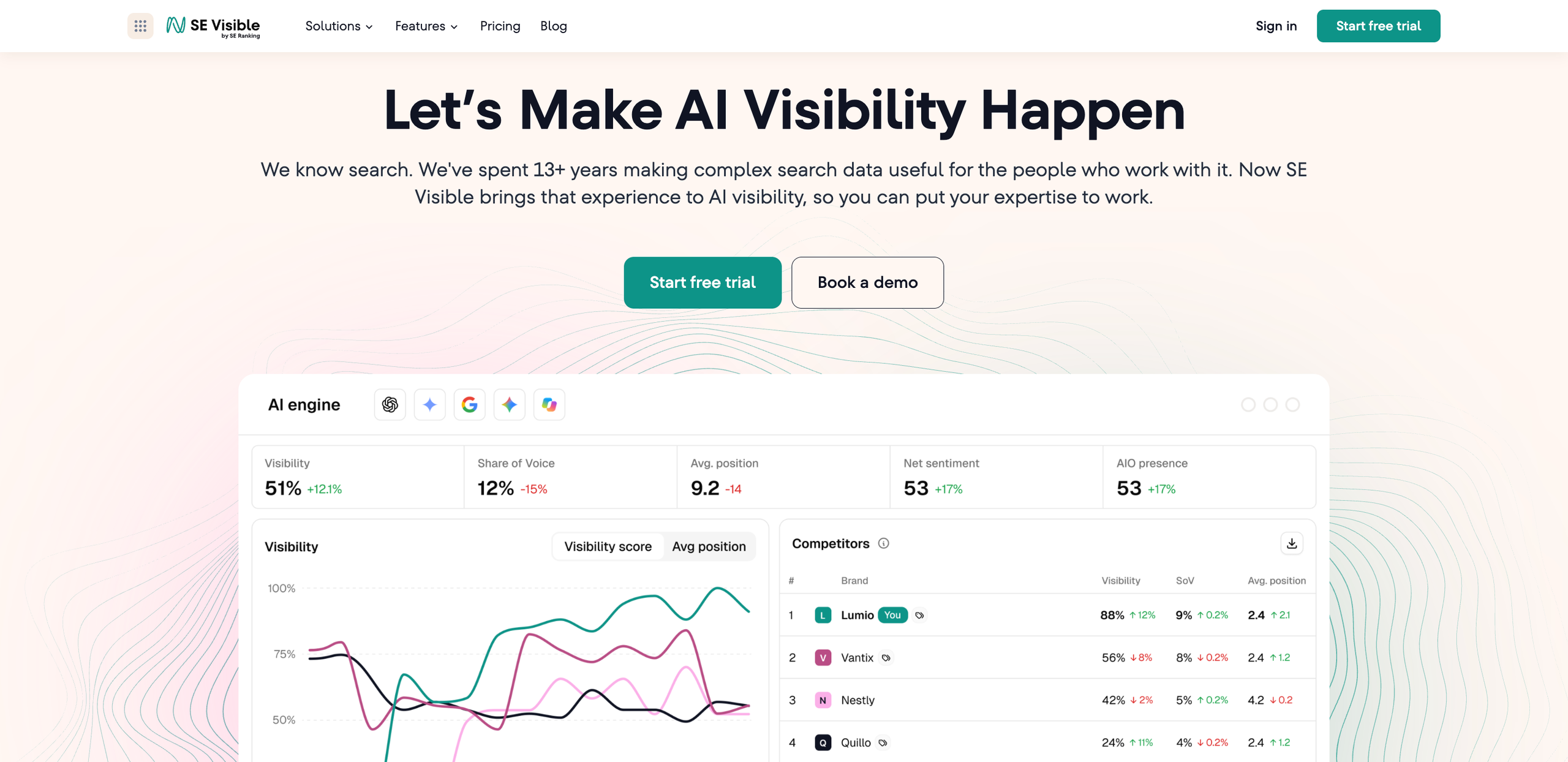
Here is what stood out in my review.
- All tracked engines (ChatGPT, Google AI Overviews, AI Mode, Gemini, and Copilot) are included on every plan.
- Every plan includes unlimited user seats, unlimited competitors, API access, MCP access, and a Data Studio connector.
- One tracked prompt is checked in every engine at no extra cost, and tracking runs daily.
- Share of voice, average position, net sentiment, and citation data sit side by side with your named competitors.
There are a few limits to plan around.
- Each location counts as a separate prompt, and Basic allows only one location per project.
- Claude tracking through the API is listed as coming soon, and Perplexity is not on the current plan table.
- Query fan-out, prompt volume, and content gap features are still marked as coming soon.
- Rank tracking, keyword research, and site audits live in SE Ranking, not SE Visible. SE Ranking plans from $103 a month include SE Visible.
Pricing. Basic costs $89/month for 75 prompts and 5 projects. Core costs $189/month for 200 prompts with unlimited locations. Agency costs $399/monthfor 1,000 prompts, and Enterprise starts at 2,000 prompts with custom pricing. A 10-day free trial is available.
Renewal tip. Multiply your prompts by your markets before picking a tier. Tracking 50 prompts in three countries uses 150 prompts, which already rules out Basic.
(Source: SE Visible pricing)
2. Conductor
Conductor is the strongest pick when your renewal case has to connect AI visibility to traffic and revenue inside one enterprise platform. It is a long-established enterprise SEO platform that now treats answer engine optimization (AEO) as a core part of the product rather than an add-on.
The platform has four parts. Intelligence reports on visibility in both AI and traditional search, Creator writes and scores content with an AI writing assistant, Monitoring checks your website around the clock, and AgentStack feeds Conductor’s data into LLMs, apps, and AI agents. Its customers include brands such as Microsoft, PayPal, and American Express, and it offers a free AI visibility analysis if you want a quick look before booking a demo.
Suitable for: Large SaaS companies that already run enterprise SEO and want AI search reporting, content creation, and technical monitoring under one contract and one data source.
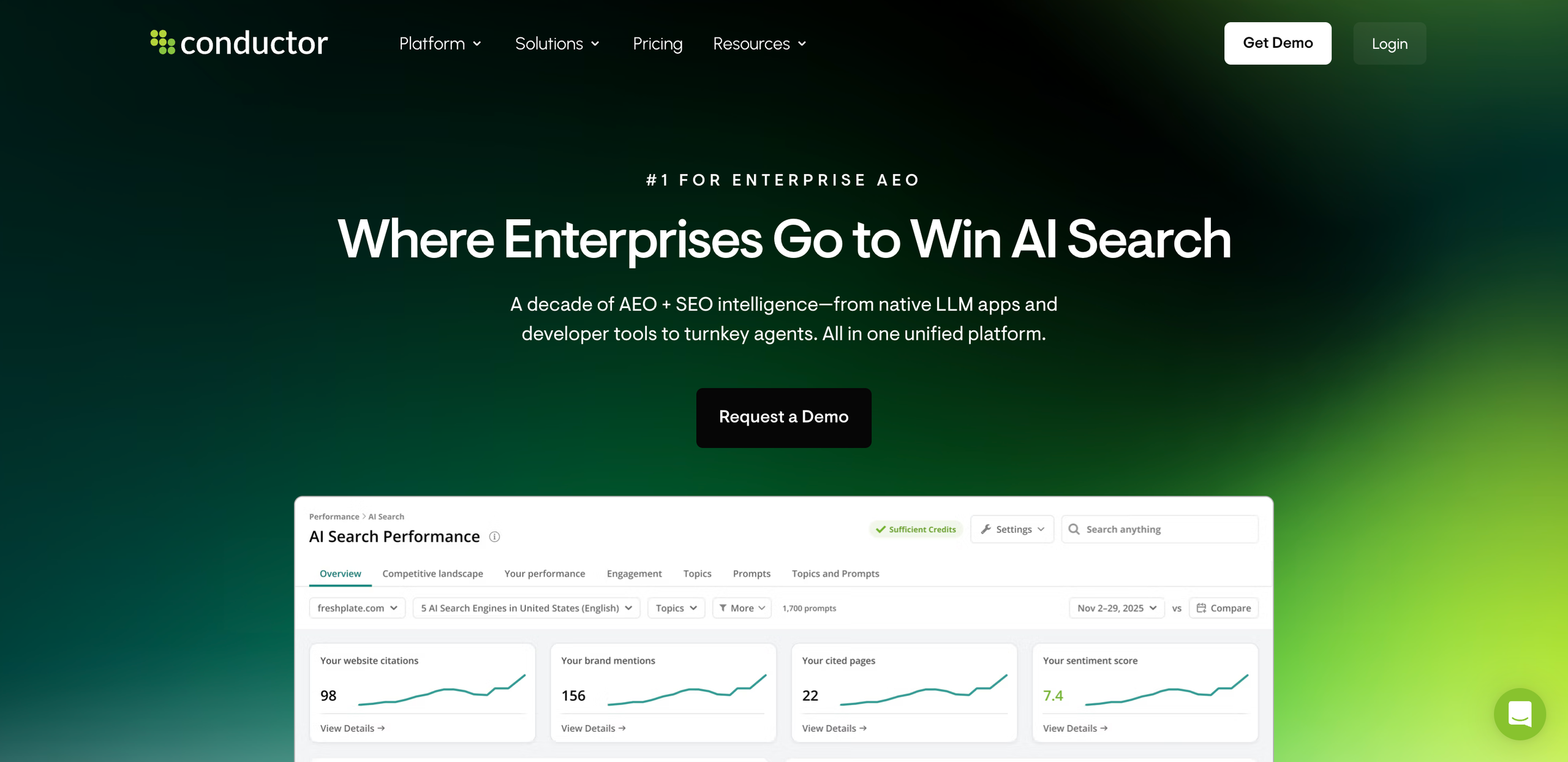
These are its main strengths.
- Pricing is usage-based, so you are not paying per seat.
- AI search reporting sits next to SEO reporting, content creation, and site monitoring.
- A free trial is available on the Essentials tier.
The limits are mostly about price clarity and AI tracking volume.
- No tier has a published price, so every plan goes through sales.
- Essentials includes no AI Search Credits. AI tracking starts on Growth with 2,500 credits a year.
- 2,500 credits a year works out to roughly 7 a day, which is thin for a large prompt set.
Pricing. Essentials, Growth, and Enterprise are priced on request.
Renewal tip. Ask how many prompts and engines one AI Search Credit covers before you sign. Without that number, you cannot compare Conductor’s AI tracking volume with any other tool.
(Source: Conductor pricing)
3. AthenaHQ
AthenaHQ gives you the longest model list of any self-serve plan in this group. Starter covers 11 models, including ChatGPT, Perplexity, AI Overviews, AI Mode, Gemini, Claude, Copilot, Grok, DeepSeek, Meta AI, and Mistral.
It also goes further than tracking. Starter includes a content optimization agent, on-page and off-page action suggestions, brand sentiment, and prompt volume estimates that show how often a topic is asked on AI platforms. It can manage AI crawler access through robots.txt and llms.txt files, and its SOC 2 certification and GDPR compliance make security review easier.
Suitable for: Growth-stage SaaS teams that want to benchmark many competitors across many AI models and act on the gaps, with the whole marketing team working in one account.
These features make it worth a look.
- A free Essential plan includes 300 credits and 5 engines, so you can test before paying.
- Starter includes unlimited seats with role-based access, unlimited prompts, and unlimited competitors.
- It connects to GA4 and Google Search Console and exports data to CSV.
- One credit equals one AI response, which makes usage easy to understand.
Watch these points before you commit.
- API access and extra credits are paid add-ons on Starter, with no published add-on price.
- Starter tracks a single country and language.
- SAML SSO, audit logs, multi-region tracking, and BI dashboards are Enterprise only.
Pricing. Essential is free. Starter costs $295 a month for 3,600 credits, with 17% off on yearly billing. Enterprise is custom.
Renewal tip. Do the credit math first. Checking 100 prompts across all 11 models uses 1,100 credits per run, so Starter covers only about three full runs a month.
(Source: AthenaHQ plans)
4. Scrunch AI
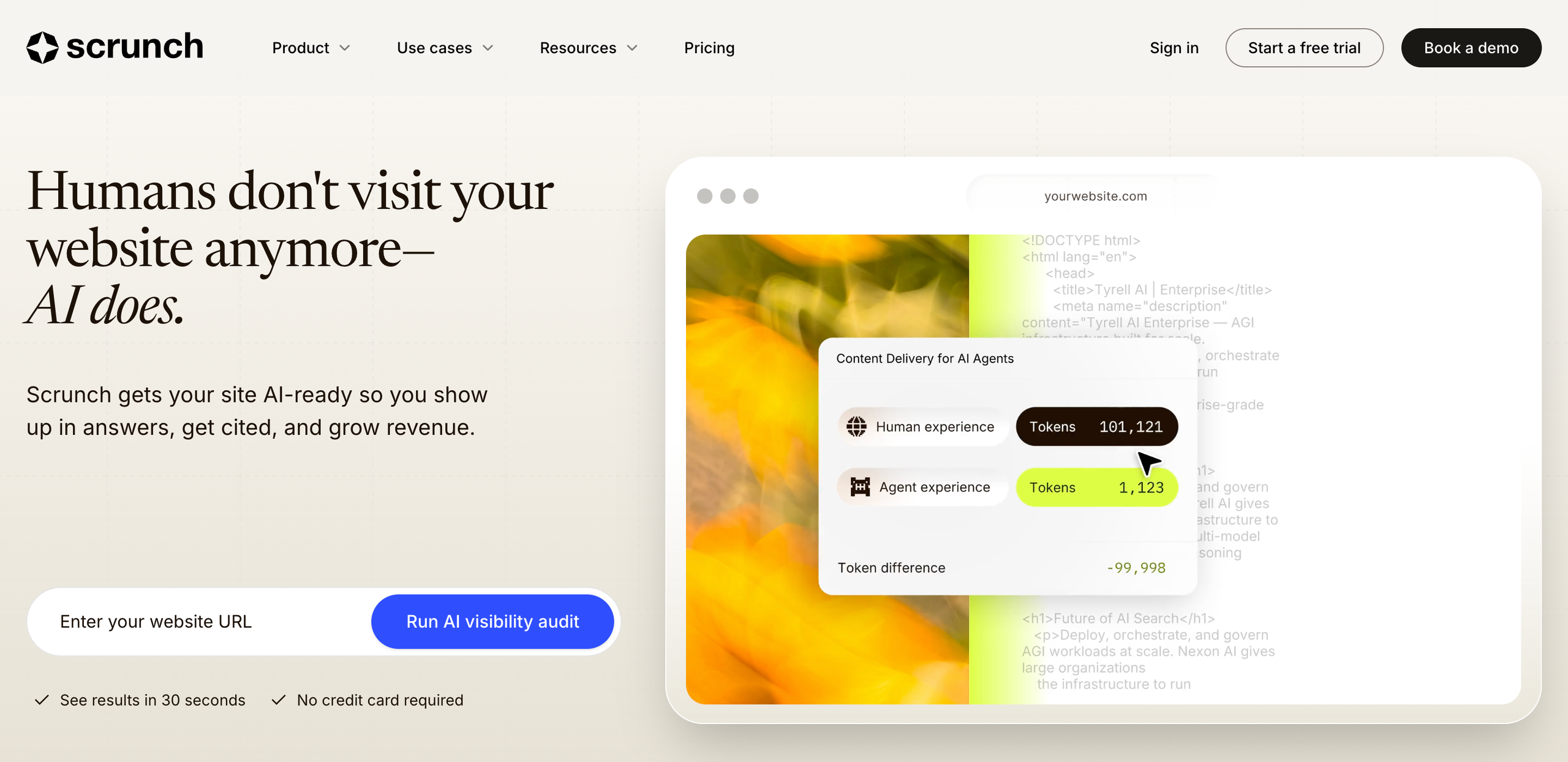
Scrunch AI offers one of the cleanest scoped pilots in this list. Its Core plan has fixed, published limits and is designed for setting AI visibility benchmarks and proving impact before you scale.
Day to day, you manage prompts in one place, review insights on content gaps, track when and how AI engines cite your brand, and audit pages for AI readiness. Prompts can be grouped by persona, so you can see how visibility changes for different buyer types. Its Agent Experience Platform (AXP), which serves AI-optimized versions of your pages to AI agents visiting your site, sits on the Enterprise plan.
Suitable for: Mid-market SaaS teams that want a time-boxed, fixed-scope pilot on the main engines and expect to move to an enterprise contract once results are proven.
Here is what I like about it.
- Core limits are clear, with 125 prompts, 5 site audits a month, 5 user licenses, and 1 brand workspace.
- Prompt management, insights, citation tracking, and page audits are included on every plan.
- A 7-day free trial lets you test before paying.
These are the trade-offs.
- Core tracks only 4 engines (ChatGPT, Perplexity, AI Overviews, and Copilot). Gemini, Claude, AI Mode, Meta AI, and Grok need Enterprise.
- API access and SAML or OIDC SSO are Enterprise only.
Pricing. Core costs $250 a month. Enterprise is custom, and agencies have a separate Agency Core plan at $500 a month.
Renewal tip. At $250 for 125 prompts, Core costs about $2 per tracked prompt a month. Ask for the Enterprise price in writing during the pilot so the upgrade is not negotiated under time pressure.
(Source: Scrunch pricing FAQ)
5. Evertune
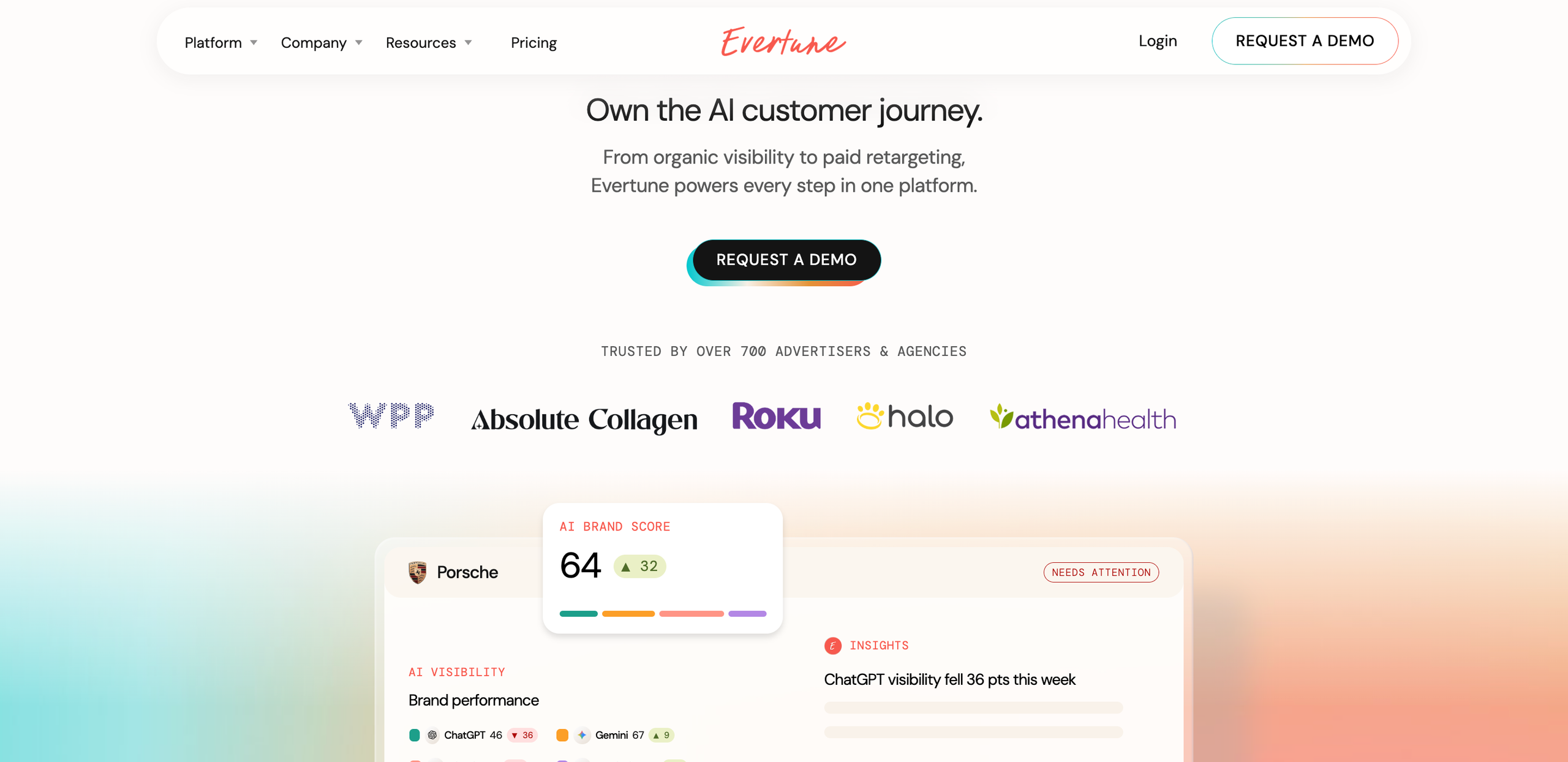
Evertune is the pick for teams that want statistical confidence in every movement. On Pro and Enterprise, each prompt runs 100 times across 11 models, which smooths out the randomness you get from a single AI answer.
The platform covers four jobs. It helps you explore how AI talks about your category, measure your visibility against competitors, act through a content agent and prompt research tools, and advertise through a ChatGPT ads agent and AI retargeting. Its prompt research draws on EverPanel, a consumer panel that shows real AI usage and prompt volumes, and its customers include brands such as Roku and Virgin Voyages.
Suitable for: Brand and marketing leaders at larger companies who will not act on a change until it is clearly more than random variation, and who may also want to run AI ads from the same platform.
These are its standout points.
- 100 samples per prompt on Pro gives you statistically sound data from the first day.
- A new $60 Starter plan with 5,000 prompt credits and up to 5 models lowers the entry point.
- Pro includes data downloads, a data MCP for Claude or ChatGPT, and a content agent that produces 25 articles a month.
- AI ads and AI retargeting tools sit on the same platform as visibility tracking.
Keep these limits in mind.
- The 100-sample method is not included on Starter.
- Pro is billed yearly, so the real commitment is $9,600 a year.
- Cloud data exports, APIs, and SSO are Enterprise only.
Pricing. Starter costs $60 a month. Pro costs $800 a month billed yearly for 100,000 prompt credits. Enterprise is custom.
Renewal tip. Get the sampling depth and model count written into the contract for your plan. That method is the main reason to pay for Evertune, so it should not change quietly at renewal.
Source: Evertune pricing
6. Writesonic GEO
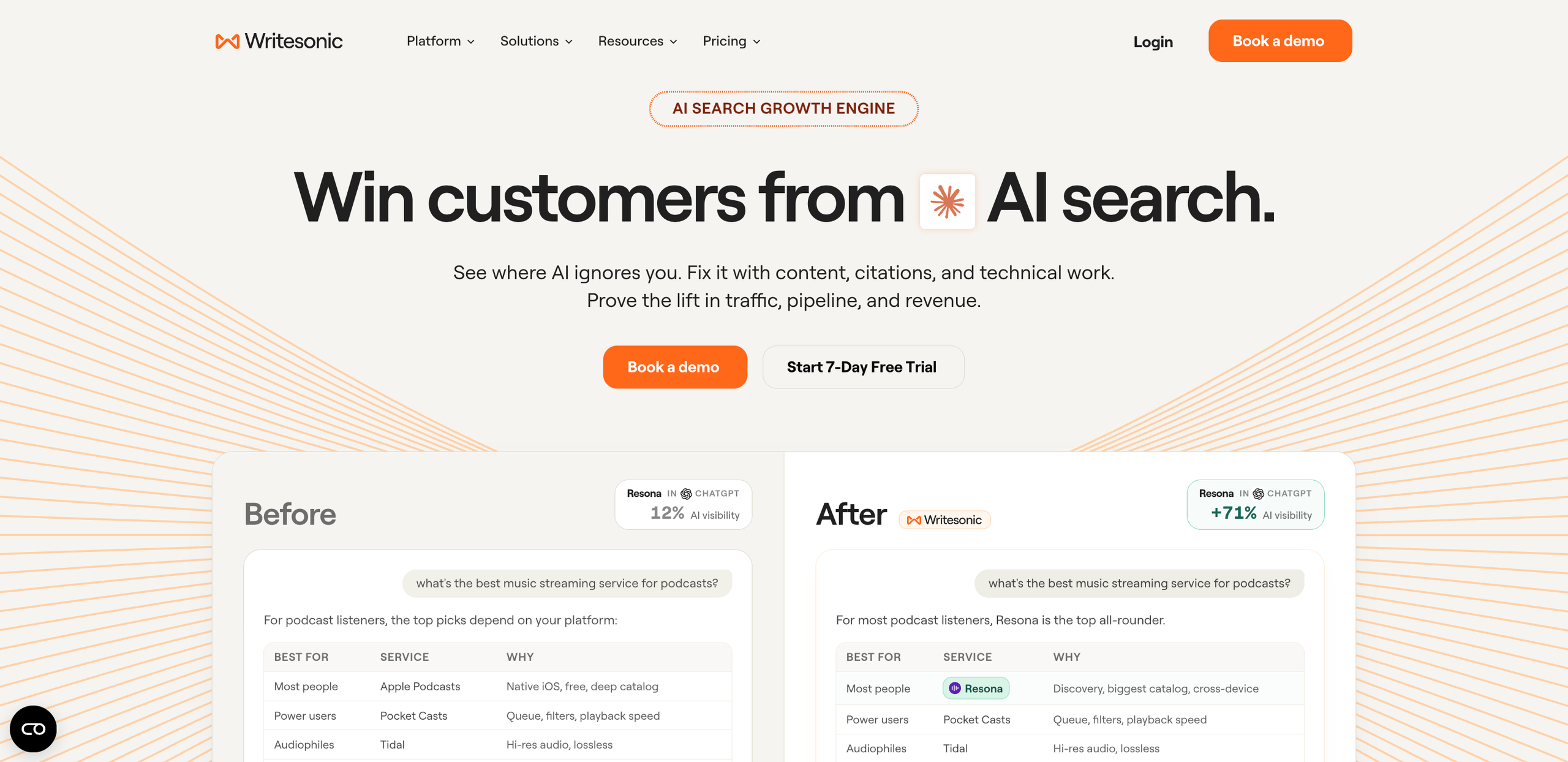
Writesonic GEO is the best fit when you want to find the prompts where AI recommends a competitor and then fix them in the same tool. Writesonic began as an AI writing tool and has rebuilt itself around AI search visibility, so tracking and content creation share one dashboard.
Every plan includes AI bot analytics, an AI article writer, site audits with automatic fixes, and ads monitoring for ChatGPT and Google AI. On Growth and Enterprise, its Action Center turns visibility gaps into specific on-page, off-page, and technical tasks. It pulls supporting data from Google Keyword Planner, Google search results, and Reddit, and it connects to Google Search Console and WordPress on all plans.
Suitable for: Content-led SaaS teams of one to five marketers who want visibility tracking and content production under a single subscription.
Here is what works well.
- All plans track daily and include ads monitoring for ChatGPT and Google AI.
- Site audits include automatic AI fixes on every plan.
- Growth adds sentiment analysis and a limited Action Center with 5 on-page and 5 off-page actions a month.
These limits matter for larger teams.
- Self-serve plans track only 3 engines (ChatGPT, Gemini, and AI Overviews). Perplexity, Claude, Copilot, AI Mode, and Grok need Enterprise.
- Self-serve plans include 1 to 3 users, with extra seats at $50 per user and a cap of 5 users in total.
- Self-serve plans cover one market, and SSO, GA4, and Looker Studio are Enterprise-only.
Pricing. Starter costs $79/month for 50 prompts. Basic costs $199 and Growth costs $399 a month, both billed yearly. Enterprise is custom, and a free trial is available.
Renewal tip. If your security team needs SAML SSO, budget for Enterprise from day one. Moving up later means a new negotiation.
(Source: Writesonic pricing)
7. Rankscale
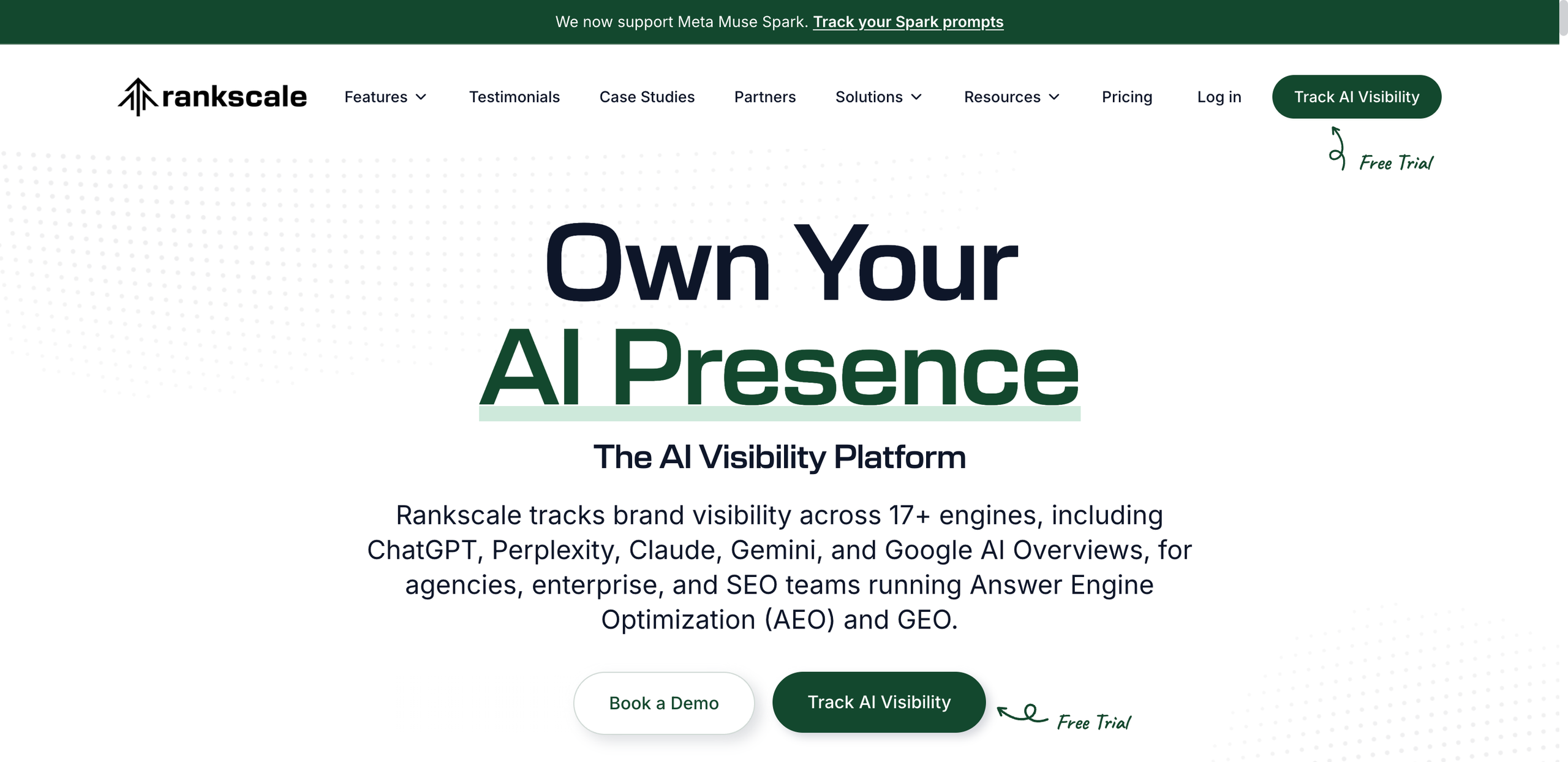
Rankscale gives you the widest engine choice on every plan and full control over how often each prompt runs. Each search term can be scheduled anywhere from hourly to monthly, and you pay in credits for each engine query.
Built by a Vienna-based team, it works like a classic rank tracker adapted for AI search. Beyond visibility and competitor benchmarking, it covers citation analysis, query fan-out, local results, shopping analysis, ad analytics, and page audits. It can query engines both through their visible interfaces and through their APIs, and the Growth plan adds white-label dashboards for agencies.
Suitable for: Technical SEO teams and agencies that want to tune tracking depth themselves, cover many engines, and pay only for the checks they run.
These are the reasons to shortlist it.
- 17+ AI engines are available on every plan.
- Pro and above include unlimited seats, CSV and Sheets exports, and a Data Studio connector.
- REST API access starts at Pro+, and unused credits roll over up to 2x or 3x your monthly allowance.
Watch the credit costs closely.
- Engines cost different amounts. Most use 0.25 credits per run, DeepSeek uses 1, and Claude uses 2, so one Claude check costs 8 times a ChatGPT check.
- Essentials has no exports, team seats, or API.
- SSO and SLA guarantees are only on a custom plan.
Pricing. Essentials costs $20 a month (yearly only), Pro $99, Pro+ $229, Growth $385, and Enterprise $780 a month. Yearly billing saves 15%, and Pro has a free trial.
Renewal tip. Model your credit use at your real schedule. Checking 100 prompts daily across ChatGPT, Gemini, AI Mode, and Perplexity uses about 3,000 credits a month, which is the full Pro+ allowance. Add Claude and you need about 9,000, which pushes you to Enterprise.
(Source: Rankscale pricing)
8. LLMrefs
LLMrefs is the most affordable way to set a first AI visibility baseline from the keywords your SEO team already tracks. Instead of writing prompts one by one, you import keywords and it generates related fan-out prompts based on real AI conversations.
Results are combined across every prompt for a keyword, so you see share of voice and average position for your brand and competitors rather than a single score. It also lists the source URLs AI engines cite, estimates monthly prompt volume for your topics, and includes free extras such as an AI crawlability checker and an llms.txt generator.
Suitable for: Lean SEO teams, startups, and agencies that want a low-cost baseline across many brands before committing to a larger contract.
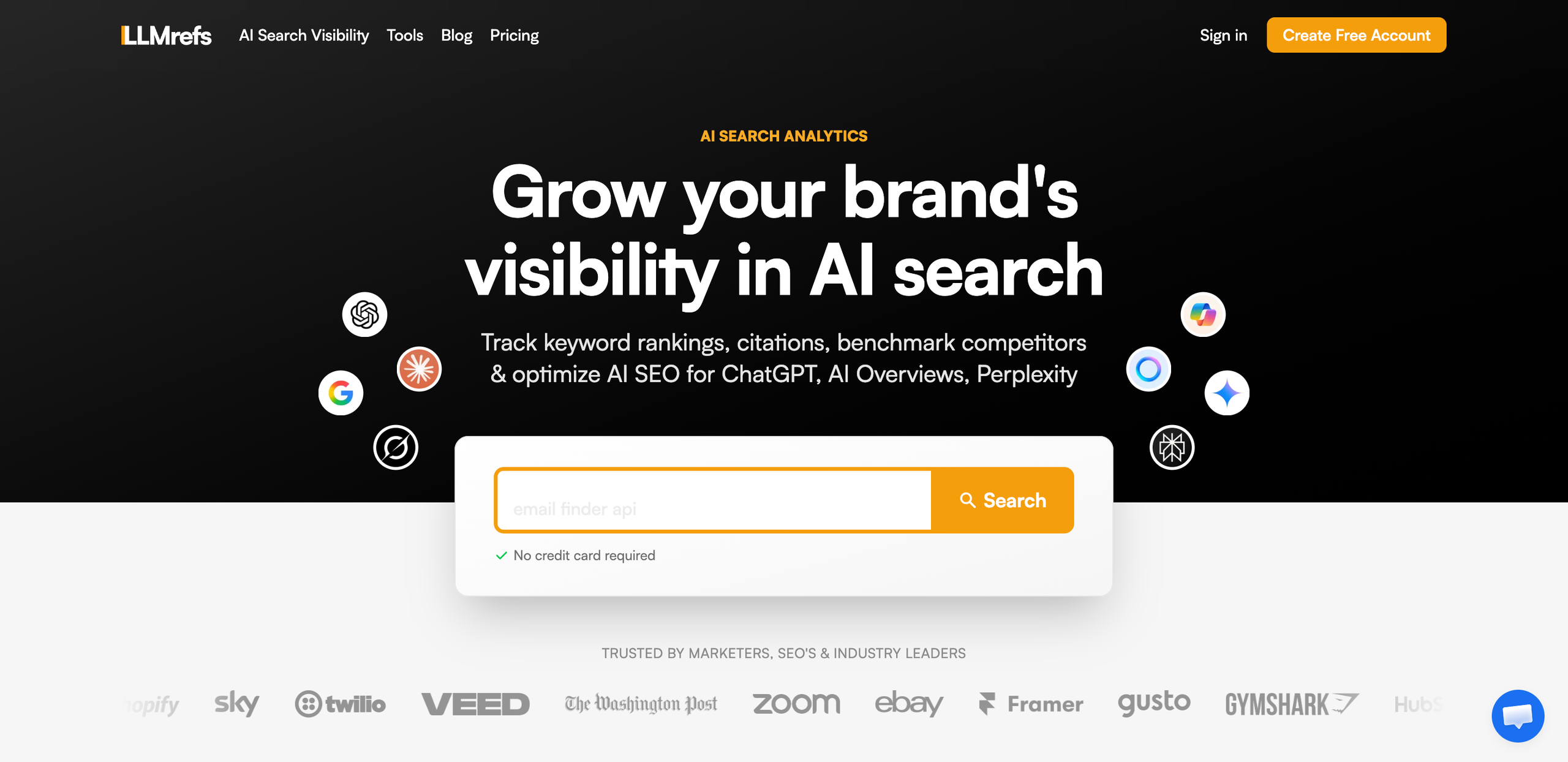
Here is what you get.
- One $79 plan tracks 500 prompts across 9 engines listed on the plan, with no extra engine fees.
- Unlimited team members and unlimited projects are included.
- CSV export and API access are included, along with citation tracking.
- Geo-targeting covers 50+ countries and 20+ languages.
The trade-offs are about freshness and price stability.
- Reports refresh weekly, not daily.
- The $79 price is marked as limited-time only.
- No SSO or role controls are listed on the plan.
Pricing. $79 a month, which works out to about $0.16 per tracked prompt, with a 7-day free trial.
Renewal tip. Because the price is flagged as temporary, lock the renewal rate in your order form before you build reporting on top of it.
(Source: LLMrefs)
Which AI Visibility Tool Should You Choose?
The right tool depends on the problem you need to solve at renewal, not on which one has the longest feature list. Start from your main constraint, whether that is proof for finance, engine coverage, budget, or security review.
Use this table to find your starting point.
| If your main need is… | Start with | Why |
|---|---|---|
| A number finance can trace and export | SE Visible | Full AI answers behind each metric, API on every plan, from $71 a month billed yearly |
| AI visibility tied to SEO, content, and revenue in one suite | Conductor | Combines AI search, SEO reporting, content, and monitoring with usage-based pricing |
| The most engines on a self-serve plan | Rankscale or AthenaHQ | 17+ engines on every Rankscale plan, 11 models on AthenaHQ Starter |
| Statistically sampled data | Evertune Pro | Runs each prompt 100 times across 11 models |
| Tracking plus content fixes in one tool | Writesonic GEO | Visibility tracking, AI articles, and site audits under one plan |
| A fixed-scope pilot before an enterprise deal | Scrunch AI | Published Core limits and a 7-day trial |
| The cheapest first baseline | LLMrefs | 500 prompts across 9 engines for $79 a month |
If two tools look equally good on paper, run both on the same prompts for the length of their trials. The tool whose answers you can check line by line is usually the one that survives the CFO review.
How to Run a 90-Day AI Visibility Pilot
A 90-day pilot with a fixed prompt set is the safest way to test a tool before a yearly contract. It gives you enough data to see real movement and a clean baseline to show finance at the end.
This is the process I would follow.
- Build a fixed set of about 40 buying questions. Mix your core use cases, buyer roles, and buying stages. For example, 4 use cases across 2 buyer roles and 3 stages gives you 24 prompts. Add 16 pricing, comparison, and “best tool for” questions to reach 40.
- Pick three direct competitors. Choose the brands that appear most often in your sales calls, not the biggest names in your category.
- Set up in week one and record a baseline. Use the first full collection cycle as your starting point, and do not change prompts after this.
- Collect at least four weeks of data before judging trends. AI answers move around from day to day, so early swings are often noise.
- Spot-check 10 answers a week by hand. Open the stored answers and confirm the tool counted mentions and positions correctly.
- Work out your real cost. Divide the monthly price by the prompts and answers you actually used, including extra locations and credit top-ups.
- Write your renewal terms before you sign. Put engine coverage, prompt limits, sampling depth, and the renewal price in the order form.
Keep the prompt set fixed for the full pilot, but review your competitor list each month. New rivals often show up in AI answers before they show up in your pipeline.
Final Thoughts
The data points to one clear rule. Buy the tool whose numbers you can check, not the one with the highest score in the demo.
With 45% of B2B buyers already using GenAI during purchases and only 3.8% of cited sources shared across the four main engines, you need multi-engine tracking with the answers stored behind every metric.
On that test, SE Visible stands out for a SaaS team that has to defend the budget. It includes five engines, API access, and unlimited seats on every plan, and at about $0.008 per AI answer, it is roughly 10 times cheaper per answer than AthenaHQ Starter.
The other tools win in narrower cases. Conductor suits enterprises that want AI search inside a full SEO suite, Evertune suits teams that need sampled data, and Rankscale and AthenaHQ suit teams that want the broadest engine list. LLMrefs is the cheapest baseline, but its weekly refresh and temporary price make it a starting point rather than a long-term reporting tool.
Whichever you pick, run a fixed 90-day pilot first. Three months of traceable data is what turns AI visibility from a nice dashboard into a line item finance will renew.
Explore our guide to the best SEO tools to find platforms that simplify keyword research, website audits, backlink analysis, and SEO performance tracking.
FAQs
Is AI visibility the same as GEO or AEO?
No. AI visibility is the measurement, while GEO and AEO are the work you do to improve it.
Do I need a separate tool if I already pay for an SEO suite?
Not always. SE Ranking plans include SE Visible, and Conductor adds AI tracking from its Growth tier, so check your current contract first.
How many prompts should a SaaS company track?
Start with 40 to 100 core buying questions per market. Expand once you know which questions actually lead to pipeline.
How often should AI visibility data refresh?
Daily data is best for decisions and reporting. Weekly data is enough for a first baseline.
Can I check AI visibility for free?
Yes, for a rough baseline. Free checkers and AthenaHQ’s free Essential plan show where you stand today, but they do not give enough history to choose a platform.
Why do two tools show different scores for the same brand?
They check different engines, locations, and numbers of runs, and they detect brand mentions in different ways. Compare tools on the same prompts before trusting either score.
Will tracking alone improve my AI visibility?
No. Tracking shows you the gaps, but content, citations, and digital PR are what close them.
